hard-panning

For Audiophile Quality Sound on “Jaws,” You Might Want to Look Elsewhere

Hot Stamper Pressings of Top Quality Jazz Albums Available Now

For good music? We will leave that judgment to you. Music is personal. What moves me in music and what moves you in music may be related but they are surely not identical.

In 1959 Eddie Lockjaw Davis & Shirley Scott recorded an album for Prestige and they called it “Jaws.”

The sound of the vintage pressing we played was not very good, with hard panning to the left and right. It was also dry and had too much reverb.

We were playing an early stereo copy, mastered by Van Gelder, but I honestly cannot remember the label.

Maybe the mono is better? It would not surprise me. If we see a mono pressing for cheap we will probably pick it up and give it a spin.

If you’re a fan of either of these two fine players, you might want to do the same. I believe we played the OJC pressing years ago and were not impressed, so best to skip that one too.

What we can say is that any album with sound as weak as the pressing we played leads us to believe that finding top quality sound is too unlikely for us to pursue the album further. Maybe at a bargain price, but vintage jazz records are rarely found for cheap these days. Best to move on.

(more…)

On Please Please Me, Which Is More 3-Dimensional, Mono or Twin Track?

Hot Stamper Pressings of the Music of The Beatles Available Now

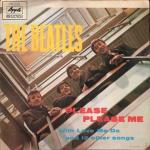
With all due respect to George Martin, we’ve played a number of mono pressings of Please Please Me in the past twenty or so years and have never been particularly impressed with any of them. The monos jam all the voices and instruments together in the middle, stacking them one in front of the other, and lots of musical information gets mashed together and simply disappears in the congestion. 

But is twin track stereo any better?

Yes, when you do it the way Norman Smith did on Please Please Me.

Twin Track stereo (which is actually not very much like two-track stereo, I’m sure Wikipedia must have a listing for it if you’re interested) is like two mono tracks running simultaneously. It allows the completely separate voices to occupy one channel and the completely separate instruments to occupy another, with no leakage between them.

On some stereos it may seem as though the musicians and the singers are not playing together the way they would if one were hearing them in mono. They are in fact recorded on two separate mono tracks, the instruments appearing in the left channel and the singers in the right, separated as much as is physically possible.

Stuck in their individual stereo speakers, so far apart from one another, the members of the band don’t even seem to be playing together in the same room.

That’s on some stereos, and by some stereos I mean stereos that need improvement. Here’s why.

Three-Dimensional Mono?

In the final mixing stage, Norman Smith added separate reverb to each of the two channels, sending the reverb for the sound recorded in each channel to the opposite channel. This has the effect of making the studio, the physical space that The Beatles appear to be in, seem to stretch all the way from the right channel, where the Beatles’ voices are heard, to the back left corner of the studio, where the reverb eventually trails off.

(more…)

Jazz Impressions of Black Orpheus Is a Bloated Mess at 45 RPM from Hoffman, Gray and Kassem

Hot Stamper Pressings of Jazz Piano Recordings Available Now

We played an amazing Hot stamper copy that got the bottom end on this album as right as we’ve ever heard. The contribution of the bass player was clear and correctly balanced in the mix, which we soon learned to appreciate was fundamentally important to the rhythmic drive of the music.

The bass was so tight and note-like you could see right into the soundstage and practically picture Monte Budwig plucking and bowing away.

This is precisely where the 45 RPM pressing goes off the rails.

The bloated, much-too-heavy and poorly-defined bass of the Heavy Vinyl remaster makes a mess of the Brazilian and African rhythms inherent in the music. If you own that $50 waste of money, believe me, you will not be tapping your foot to Cast Your Fate to the Wind or Manha de Carnival.

Our rule of thumb: he better the system, the more second-rate Hoffman’s remastered records will sound when they aren’t just terrible.

Is this the worst version of the album ever made? That’s hard to say.

But it is the worst sounding version of the album we’ve ever played, and that should be good enough for any audiophile contemplating spending money on this kind of trash. Take our advice and don’t do it.

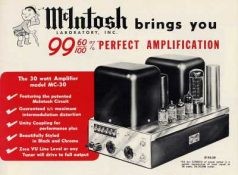
If you like the sound of old McIntosh tube equipment like the Mac 30s shown here, a sound Steve Hoffman apparently cannot get enough of, these remastered records have your name all over them.

We don’t sell junk like this, but every other audiophile record dealer does, because most of the current group of mastering engineers making records for audiophiles have somehow gotten into their heads that this is the way records should sound.

We’ve been telling them they are wrong about that for years now, that good records have never sounded this way, but the collectors and audiophiles of the world keep buying their wares, so why should they listen to us?

If you want to know what a properly-mastered, properly-pressed copy sounds like, we put the last one up in 2023.

(more…)

Shelly Manne and His Friends – My Fair Lady on the Yellow Label

  • My Fair Lady returns to the site for only the second time in two years, here with solid Double Plus (A++) sound from first note to last
  • The piano sounds lifelike right from the start – a beautiful instrument in a natural space, tonally correct from top to bottom
  • Here is the proof that this is a Demo Disc quality recording for Contemporary, which is saying a lot, considering how many great recordings this label can claim
  • Recorded entirely in one session, this album was the first jazz recording using only songs from a Broadway musical
  • 5 stars: “This trio set by Shelly Manne & His Friends… was a surprise best-seller and is now considered a classic…The result is a very appealing set that is easily recommended.”

This vintage Contemporary stereo LP has Demo Disc quality sound.

How can you beat a Roy DuNann piano trio recording? The timbre of the instruments is so spot-on it makes all the hard work and money you’ve put into your stereo more than pay off.

(more…)

The Three / Self-Titled (45 RPM)

More Jazz Recordings Featuring the Piano

  • Amazing sound throughout this Japanese import pressing, with both sides earning KILLER Shootout Winning Triple Plus (A+++) grades or close to them
  • The transients are uncannily lifelike – listen for the powerful kinetic energy produced when Shelly whacks the hell out of his cymbals
  • My favorite piano trio jazz album of all time — every one of the tracks is brilliantly arranged and performed
  • 4 stars: “One of Joe Sample’s finest sessions as a leader” – with Shelly Manne and Ray Brown, we would say it’s clearly his finest session, as a leader or simply as the piano player in a killer trio
  • Some of the other records we’ve discovered with top jazz piano sound can be found here
  • More amazing sounding piano recordings, of every kind of music, can be found here

If you want to hear the full six tunes recorded by The Three at that famous Hollywood session (which ran all day and long into the night, 4 AM to be exact), our 33 RPM pressings are your best bet.

If you want absolutely amazing, mind-blowing, you-are-there sound, a Hot Stamper 45 is the only way to go.

The music is so good that I personally would not want to live without the complete album. The Three is, in fact, my favorite piano trio jazz album of all time. Very one of those six tracks is brilliantly arranged and performed (if you have the right takes of course; more about that later).

This album checks off a number of important boxes for us here at Better Records:

(more…)

Time Further Out – “It’s amazing how well-recorded the group was back then.”

Hot Stamper Pressings of the Music of Dave Brubeck Available Now

Fred Plaut is one of our favorite recording and mixing engineers.

His work on Time Further Out speaks for itself — we think it’s the best sounding Brubeck recording of them all. 

We could find no information about the venue for this recording. It might be the Columbia Studios known as “The Church” — that would explain the amazing sound quality of the album — but it may just be Plaut’s engineering prowess in another location that makes this some of the best sound to be found on any Brubeck record.

Frederick “Fred” Plaut was a recording engineer and amateur photographer. He was employed by Columbia Records during the 1940s, 1950s, and 1960s, eventually becoming the label’s chief engineer.

Plaut engineered sessions for what would result in many of Columbia’s famous albums, including the original cast recordings of South Pacific, My Fair Lady, and West Side Story, jazz LPs Kind of Blue and Sketches of Spain by Miles Davis, Time Out by Dave Brubeck, Mingus Ah Um and Mingus Dynasty by Charles Mingus.

Wikipedia

Mark Wilder was interviewed about the recording of these Fred Plaut sessions and noted [bold added by me]:

Fred Plaut and Frank Laico were two of Brubeck’s recording engineers. Plaut is a true balance engineer; he’s my idol. I don’t know how he could pull off what he did in three hours.

He continued:

It’s amazing how well-recorded the group was back then. The sound is so three-dimensional, bigger than life.

Yet it’s amazing how little the engineers did to get that sound. They just put one mic a few feet from each instrument, and mixed live to 3-track—for left, center, and right. Then they edited the tape and mixed down to 2-track.

The old stuff sounds better than what we’re doing now. We’ve been going in the wrong direction sound-wise for many years. The layout of the stereo stage was more realistic then, too. Drums were on the left, piano on the right, sax and bass in the middle.

It’s easy to hear what each musician was playing because they were separated spatially. These days, you hear each instrument in stereo, on top of each other. The drums spread all the way between the speakers, and so does the piano.

In one Brubeck recording (Castilian Drums, not on this set), the stereo perspective changes radically within the recording. It starts with drums hard left and piano hard right. But when the drum solo starts, there’s an edit and suddenly you hear the drum set spread out in stereo.

At the end of the solo, you’re back to drums left and piano right. These effects are on Brubeck’s albums Countdown (Columbia CS 8575) and Time Further Out (Columbia CS 8490).

(more…)
Art Pepper / Meets The Rhythm Section

More Art Pepper

More Contemporary Label Jazz Recordings

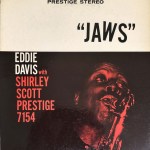
  • A vintage Contemporary pressing that was doing just about everything right, with both sides earning seriously good Double Plus (A++) grades – exceptionally quiet vinyl too
  • Many consider this to be the best record Art Pepper ever made, along with Art Pepper + Eleven, and I agree completely
  • The Contemporary stereo sound here is completely natural in all respects – rich, warm, and smooth, in short, the sound we love
  • Recorded in 1957 (the same year as Way Out West) by the legendary Roy DuNann, the sound of the better pressings is absolutely superb
  • 5 stars: “… this recording convinced [Pepper] that emotion was the paramount impulse of jazz performance… a diamond of recorded jazz history.”
  • This is a Must Own jazz album from 1957 that belongs in every jazz-loving audiophile’s collection

Many consider this to be the best record Art Pepper ever made, along with Art Pepper + Eleven, and I agree completely.

This one has many of the qualities of the better black label originals, without their bad vinyl and bloated bass. We get black label original Contemporary pressings in from time to time, but few of them are mastered right and most never make it to the site.

Some are pure muck. Some have bloated bass that is hard to believe. Don’t buy into that record collecting slash audiophile canard that Original Equals Better. That’s pure BS. It just doesn’t work that way, and anyone with two good ears, two good speakers and a decent-sized record collection should know better.

(more…)

Keeping the Players Together on Jazz Impressions of Black Orpheus

guarajazzi_wtlf_1406113104

Hot Stamper Pressings of Jazz Recordings Featuring the Piano

Another in our series of listening exercises here discussing the importance of transparency, ambience and resolution.

The arrangement of the players is straightforward, with the bass hard left, drums hard right (with leakage well to the left on the cymbals, but that’s another story), and Guaraldi on piano in the center. (The first track of side two reverses this arrangement; why, I have no idea.)

Here’s the crazy thing about this recording: The best copies really connect up — tie together — the space each of the players is in. I heard it during the shootout, and I can’t recall if it actually happened more than once or twice, but I know I heard it. They are all live, they are all on the same soundstage, but on most copies you would hardly know it.

They sound like they are playing in booths, the ambience never extending very far in any direction. The best copies have so much ambience that one player’s space extends all the way to the edge of the other player’s space. The effect, though rare, is nothing less than magical.

The piano is solid, mostly clear and not hard. Not many copies present the piano this way — correctly in other words. The amazing snare of Colin Bailey in the right channel is LIVELY and fun like you’ve never heard before.

There is no sacrifice in fullness, richness or Tubey Magic in the presentation, and that is the right sound for this music.

No Breakup on the Piano

I would be willing to bet that 90% or more of all the early pressings still in playable condition have some breakup on the piano. The old arms and carts of the day simply could not track the groove the way modern arms and carts can, and ended up damaging the record.

We are happy to report that this copy has no breakup on the piano at all.

The best copies bring out the contribution of the bass player better, the bass being essential to the rhythm of the music. On some, the bass is so tight and note-like you can see right into the soundstage and practically watch Monte Budwig play.


Further Reading

What I Couldn’t Hear on My 90s Tube System

Hot Stamper Pressings of Contemporary Jazz Albums Available Now

I have a very long history with Bells Are Ringing, dating back to the 90s. My friend Robert Pincus first turned me on to the CD, which, happily for all concerned, was mastered beautifully and comes highly recommended if you want to work on your digital playback or other non-analog aspects of your system such as your room, electricity, speaker placement and such like. (More recommended CDs here.)

Back in the day we often used it to test and tweak some of the stereos in my friends’ systems.

Playing the original stereo pressing, all I could hear on my 90s tube system was

  • blurred mids,
  • lack of transient attack,
  • sloppy bass,
  • lack of space and transparency,
  • and plenty of other shortcomings too numerous to mention.

All of which I simply attributed at the time to the limitations of the vintage jazz pressing I owned.

A classic case of me rather foolishly blaming the recording.

I know better now. The record was fine. I just couldn’t reproduce it.

Well, things have certainly changed. I have virtually none of the equipment I had back then, and I hear none of the problems with this copy that I heard back then. This is clearly a different LP, I sold the old one off years ago, but I have to think that much of the change in the sound was a change in cleaning, equipment, setup, tweaks and room treatments, all the stuff we prattle on about endlessly on this blog.

(more…)

Rubber Soul – Twin Track for Me But Not for Thee

Hot Stamper Pressings of the Music of The Beatles Available Now

How is it that none of the critics of “twin track stereo” — the two-track recording approach used on the first two albums, with the elements hard-panned left and right — has ever come clean about the obvious twin track stereo sound of Rubber Soul?

We used tracks four, five and six to test side two with, and in all three the vocals are hard-panned right with most of the instruments hard-panned left. Why is it wrong for Please Please Me to sound that way — the mono mix being the critic’s choice — but fine for Rubber Soul to be heard that way? 

Tons of energy on the drums in the left channel are a key test.

In the right channel the shakers and tambourines are way up in the mix.

The bass is a bit lean compared to the other tracks and tends to get a bit lost. If you can follow the bass throughout the song, that’s a good sign.

Balancing the bass and drums in the left channel with the vocals and percussion in the right channel is not easy to do, which of course is what makes it a great test.

(more…)