*Arcana – Mastering Info

Helpful title-specific information on mastering houses and engineers to help you find better pressings and avoid the worst ones.

We Don’t Offer Domestic Pressings of Pour Down Like Silver for One Very Simple Reason

Hot Stamper Pressings of the Music of Richard Thompson Available Now

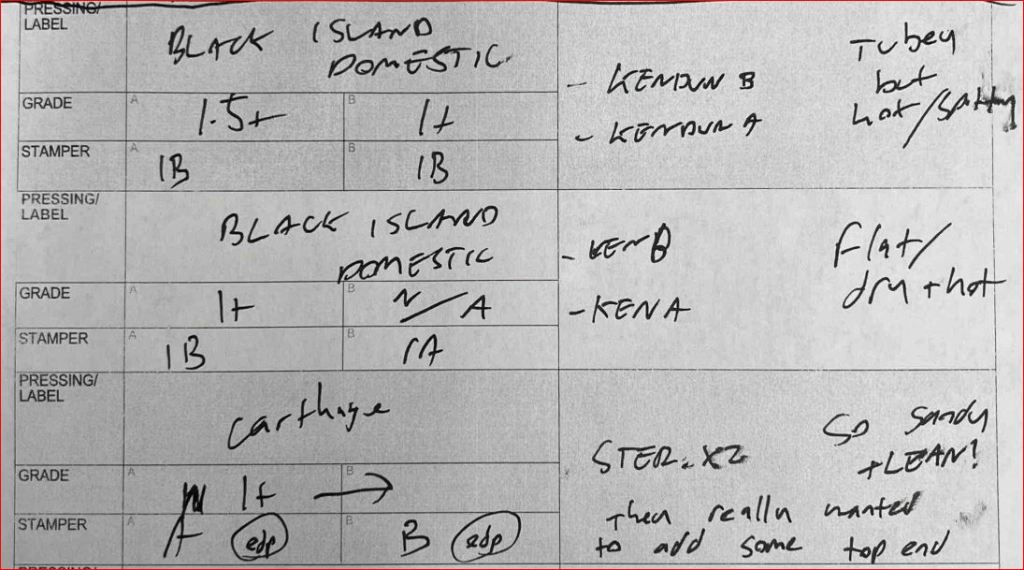
In spite of the fact that the domestic pressings of this Richard and Linda Thompson classic from 1974 were mastered by the likes of Kendun and Sterling — two of the greatest mastering houses of all time, — they have never impressed us with their sound quality.

The biggest problems with this record would be obvious to even the casual listener: gritty, spitty vocals; lack of richness; bright tonality; lack of bass; no real space or transparency, etc.

The domestic Island pressings did not do nearly as well in our shootout as the best Island imports, no surprise there as the early UK records were mastered by one of our favorite engineers.

Avoid the Carthage pressings mastered by Sterling. They came in last in our shootout.

The domestic breakdown follows:

Black Island Domestic #1

  • Tubey but hot and spitty.

Black Island Domestic #2

  • Flat, dry and hot (glary or bright)

Carthage Domestic recut from 1983, Sterling on both sides

  • So sandy and lean! They really wanted to add some top end (!)

Defending the Indefensible

(more…)

Stick with Porky on East Side Story

More Hot Stamper Pressings We Only Offer on Import Vinyl Available Now

Porky cut the original British pressings of this Squeeze album, one of countless personal favorites of yours truly. They are records (and cassettes and CDs) I have played hundreds of times and still listen to regularly to this very day, in this case more than forty years after I purchased my first copy. (Good albums age well.)

I would have picked the record out of the bin at my local Tower Records, probably based on the radio play Tempted was getting.

That copy undoubtedly would have been domestic and made from a sub-generation tape, although I’m quite sure I could not have recognized what constituted dubby sound back then. In 1981, what I understood about the importance of different record pressings would have fit comfortably in a thimble.

I had my MoFi’s, and although I hate to admit it, that’s about as far as I had gotten in my quest for superior sounding pressings. You could add Nautilus and a few other Half-Speeds to the list of what pressing I thought were impressive, leaving plenty of room in that thimble unfilled.

Thankfully those bad old days are gone, and the music can now, finally, live and breath on the best of these imports from the UK. Of course they are the only ones we buy these days for our shootouts. The others are what are known around these parts as “mistakes.”

Sometimes the imported pressings are mastered by Porky and sometimes they are not. The ones that are not tend to have a lot of problems, as you can see from our stamper sheet below.

When Porky is not on side one, that side will tend to be hard, lean and bright. Side two of that copy had decent sound, earning a minimal Hot Stamper grade of 1.5+.

(more…)

Wild Things Run Fast – A Personal Favorite

Hot Stamper Pressing of the Music of Joni Mitchell Available Now

One of our favorite Joni Mitchell albums.

A Desert Island disc for me and one of the few good reasons to listen to new music in the 80s. 

My personal Must Own Joni Mitchell list includes:

  1. 1968 Song to a Seagull
  2. 1971 Blue
  3. 1974 Court and Spark
  4. 1982 Wild Things Run Fast

WTRF is a TAS list Super Disc with many good qualities, but you’d never know it from the typically lean, bass-shy pressing you might find on your turntable.

Also, since this record can be a little cold sounding — it’s a modern recording after all, and 1982 is sadly nothing like 1972  — filling it out and warming it up is just what the doctor ordered.

John Golden (JG) mastered the originals. The best of them prove that he did a great job at least some of the time. (To find “the best of them,” aka Hot Stampers, read on.)

You can count on the fact that our Hot Stamper pressings will be unusually rich and full-bodied, with lovely warmth and presence.

(more…)

Shootout Winning Stampers for Rhythms of the South Revealed

Hot Stamper Pressings of Exotica and Bachelor Pad Recordings Available Now

There are some records that, no matter how amazing the sound, and how good the music is, simply will not find favor with our customers. This is one of them. I happen to like the music, and the sound is shockingly good, a true Demo Disc for those of you with big speakers pulled well out from the back wall in a spacious, heavily treated room like the one you see below.

We are most likely not going to be doing shootouts for this title in the future, so we thought we would share with everyone what we know about the record, which boils down to which stampers have the potential to do well and which do not.

As you can see, Stan Goodall did a much better job mastering the early Blueback London pressings for Decca than Jack Law.

What information can you rely on when trying to find the best sounding pressings?

The originals all have the same Blueback cover.

In this case, the stamper numbers are the only way to separate the potential winners from the sure losers.

11/2023 Ros, Edmundo Rhythms of the South (PS 114 London) early Blueback 3 3 1E 1E other copies: 2.5/2, 2/2.5
11/2023 Ros, Edmundo Rhythms of the South (PS 114 London) early Blueback 1.5 1 2D 2D s1 dry, flat, trashy. s2 smeary, messy, boring
RE ABOVE: I FOUND THIS IN A BOX. THOUGHT IT SOUNDED REALLY GREAT, ESP. T1, S1

Jack Law’s cutting for side one was

(more…)

Hey, Maybe Rudy Van Gelder IS as Bad a Mastering Engineer as They Say

Hot Stamper Pressings of Recordings by Rudy Van Gelder Available Now
It’s certainly a proposition worth considering, mostly because so many audiophiles seem to believe it. Or maybe in spite of their believing it, skeptics such as myself being the troublemakers they always are.

So let’s dig down into the dirt of a record that Rudy both recorded and mastered.

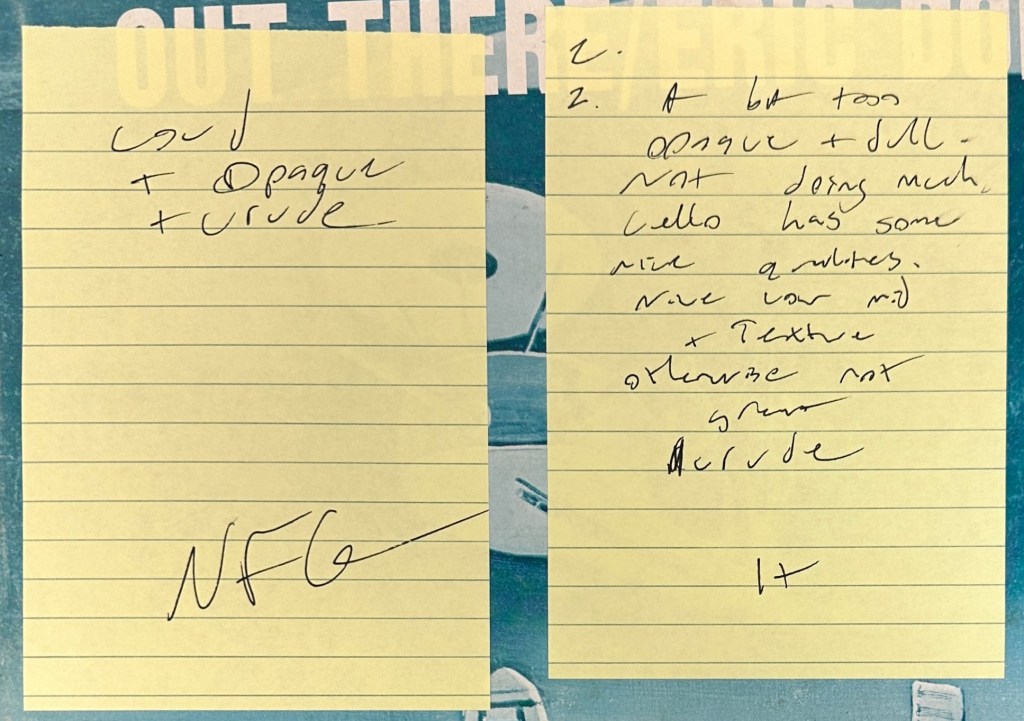
None of the Rudy Van Gelder cuttings we played of Eric Dolphy’s 1961 release of Out There were better than passable, and some had sides that were downright awful sounding, as you can plainly see from our notes.

The copies that won our most recent shootout were mastered by George Horn, and the best of them sound amazing. Here are some comments we made for the album years back as well as the Allmusic review:

Insanely good sound throughout with both sides earning Shootout Winning Triple Plus (A+++) grades. This copy was doing it all right: rich, full-bodied and Tubey Magical yet still super open and spacious.

“A somber and unusual album by the standards of any style of music, Out There explores Dolphy’s vision in approaching the concept of tonality in a way few others — before, concurrent, or after — have ever envisioned.” – 5 stars

As you will see from our notes, we played some very disappointing early pressings. All the early pressings we had on hand were expensive to acquire, the vintage jazz pressing market being what it is: expensive and full of optimistic record graders of questionable skill. (For these kinds of vintage pressings we probably return 70-80% of what comes our way.)

We have to pay top dollar to get copies that are clean, even on the 60s and 70s reissue labels. Noisy old jazz records are simply not saleable to audiophiles no matter how good they sound.

None of the early copies we played earned grades good enough to bother pursuing, not when there are wonderful sounding vintage reissues from the 80s available. On a more positive note, this being our first shootout for the album in many years, we certainly learned a lot, so let’s just chalk up the losses to the cost of doing business. Our newfound knowledge of the best pressings will continue to pay dividends for years to come now that we know what the right stampers tend to be.

The original recording of Out There was released in 1961 and was not available in stereo until 1969. (Prestige was famous for being an anti-stereo holdout long after everyone else in the jazz world had come to terms with the superiority of two channels over one. Apparently the age-old controversy over mono versus stereo is ongoing, which is why we write about it so often.)

The first record you see pictured below is the mono reissue from 1965, released with a different cover and pressed on the lovely dark blue Prestige label. It, like the stereo reissue below it, was mastered by RVG.

A word to the audiophile types who like to do their own hunting: we rarely buy vintage jazz reissue records from the 60s and 70s that were not mastered by RVG. Their track record is poor, with maybe one winner out of ten, if that.

Back to this mono reissue from 1965. It’s a mess on side one, NFG, with side two being passable at best, earning one plus.

The second record you see, the one with a different cover, is the stereo reissue from 1969, also on the dark blue label and mastered by RVG.

It too is a mess, with side one being good, not great, but side two earning a less-than-Hot Stamper grade of 1+.

Side One

  • Loud and opaque and crude
  • NFG

Side Two

  • A bit too opaque and dull
  • Not doing much
  • Cello (played by Ron Carter no less!) has some qualities
  • Nice lower mids and texture
  • Otherwise not great
  • Crude
  • 1+

(more…)

Does Year of the Cat on Mobile Fidelity Have Audiophile Sound?

Hot Stamper Pressings of the Music of Al Stewart Available Now

Our answer, judging by the copy we played not long ago, would be solidly in the negative. The final grade we awarded both sides was No, our way of saying the record is Not Good.

Below is a description for what a top copy of the album sounds like, based on our most recent shootout:

Incredible sound throughout this vintage Janus pressing of Stewart’s 1976 Masterpiece. With engineering by Alan Parsons, the top pressings are every bit the audiophile Demo Discs you remember. The best sides have sweet vocals, huge amounts of space, breathtaking transparency, and so much more.

Tubey Magical acoustic guitar reproduction is superb on the better copies of this recording. Simply phenomenal amounts of Tubey Magic can be heard on every strum, along with richness, body and harmonic coherency that have all but disappeared from modern recordings (and especially from modern remasterings).

But if you own the wrong Mobile Fidelity pressing — this one was reissued in 1981, the original came out in 1978, so there may be some other pressings that sound better than this one — you would never know how good sounding the album can be. We put a copy we had laying around in a shootout recently and the results were, not to put too fine a point on it, pretty painful.

As the notes make clear, the Mobile Fidelity pressing, with the stampers you see on the sheet above, is:

(more…)

How Paul and Judy Finally Turned Me Against DCC

Hot Stamper Pressings of the Music of Paul Simon Available Now

When I finally got around to comparing the two, I remember being taken aback by how much better my original Artisan pressing sounded than the supposedly superior DCC, the one pressed at high quality Heavy Vinyl at RTI to the most exacting standards possible, yada, yada, yada.

What finally turned me completely against DCC were the awful Paul Simon solo albums they remastered.  Two were released, two I had as unreleased test pressings, and all of them were clearly and markedly inferior to the good original pressings I had owned.

So much for believing in DCC.

Since that time we have learned that placing your faith in any record label or cutting operation is a mistake.

You have to play the records to know how they sound.

Nothing else works, and nothing else can work.

(more…)

FM Radio Sound on Blue Vinyl, Courtesy of a Mr. Gene Thompson

Hot Stamper Pressings of the Music of The Beatles Available Now

Here is how we described a recent Shootout Winning copy of 1967-1970:

This vintage import 2-LP compilation set boasts STUNNING Shootout Winning Triple Plus (A+++) sound or close to it on all FOUR sides. These pressings are rich, smooth and sweet, with plenty of Tubey Magic and little of the grain and grunge of most Brits (and don’t get us started on the domestics).

You get clean, clear, full-bodied, lively and musical ANALOG sound from first note to last. Like most compilations, some songs sound better than others, but “Don’t Let Me Down” and “Come Together” are two that really stand out here. For those of you out there who have never tried one of our Hot Stamper Beatles records, this may be the best sound you’ve ever heard from them. The CDs — even the new ones — sure don’t sound like this!

We are on record as finding the British pressings of 1967-1970 too bright; certainly most of them are anyway. The original domestic pressings, as anyone who has ever played one can attest, mastered at Sterling no less, are absolutely godawful.

Allow us to add one more to that group of pressings to avoid, the blue vinyl domestic pressings mastered by Gene Thompson. Based on how awful this pressings sounds, it would probably be wise to avoid his work in general.

The only artists who have earned the honor (ahem) of having their very own page on this blog are The Beatles. For those of you interested in learning more about their often amazing recordings, feel free to dig in to your heart’s delight.

(more…)

It’s Already So Good, How Could It Get Any Better?

Hot Stamper Pressings of the Music of Berlioz Available Now

You may have noticed that most of the time when we give out the stampers for the top copies of an album, we do not identify the title of the record that has those Shootout Winning stampers.

As you can imagine, our huge investments in research and development make up a big part of our costs, costs that accrue over the course of years, decades even, and that must eventually be passed on to our customers.

But this title is an exception, because we are telling you straight out that the 1K pressings of CS 6101, Music of Berlioz, are the way to go.

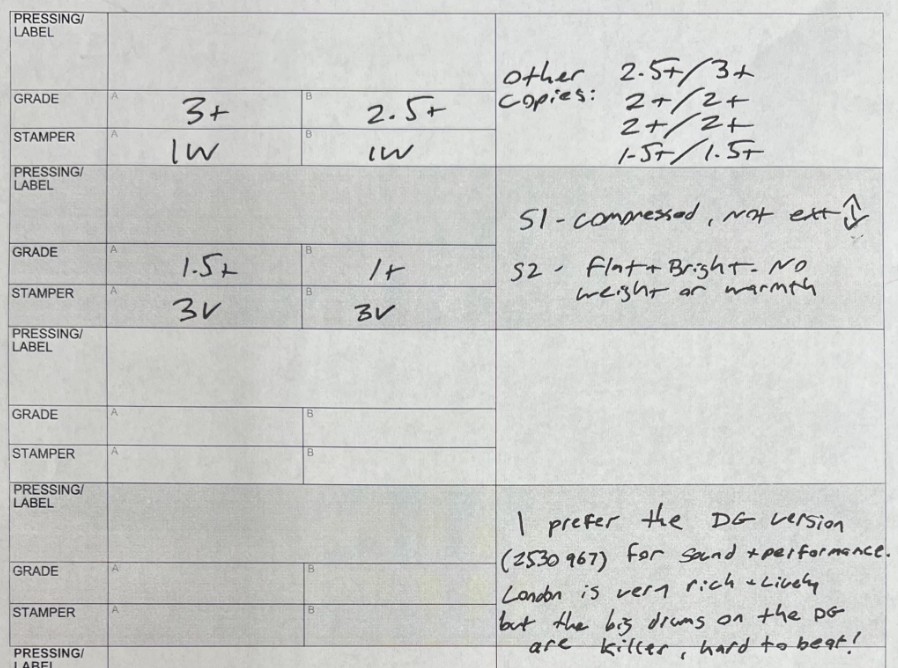
It turns out that both the early Decca pressings (SXL 2134) and the London Bluebacks were cut by Tony Hawkins.

It’s unfortunate that this record did not sell well when it came out in 1959, which explains why we could find no evidence of copies with any stampers other than 1K.

Not that the work of any other mastering engineers was in any way needed. Mr. Hawkins did a wonderful job on the copies we played than managed to reproduce the glorious, Golden Age All Tube analog sound of the master tape, which may sound  tautological as all get out but I assure you is not.

No, sadly for us, that glorious sound could be found on one and only one pressing, the one we graded 3+/3+.

No other pressing earned a top grade on either side. Whatever caused the amazing pressings to come out differently from the very good ones happened in the plating and pressing stages of manufacturing, an area that did not involve the work of any of the Decca mastering engineers.

(more…)

“KEV” Didn’t Have a Clue How to Master Teaser and the Firecat

Hot Stamper Pressings of the Music of Cat Stevens Available Now

In 2025, in preparation for a new shootout, we ordered a copy of Teaser from overseas that supposedly had the right stampers — we know what they are and we are only interested in copies with the right ones — and were sent this “KEV” pressing by accident.

Accident is right — whoever KEV is, he sure has no business mastering records if the one we played is anything to go by.

Discogs has an entry for it, current price around $10. (Apparently the word got out about the sound of this miserable pressing.)

  • This release is the pink ring Island Label. No Sterling etchings. (KEV) in matrix.
  • Side 1 has 9514 hashed out and 9154 etched above
  • Matrix / Runout (A-side runout. etched): ILPS 9154A-1K 1 KEV B
  • Matrix / Runout (B-side runout. etched): ILPS 9154B-1K 1 KEV B

Our notes read:

  • Loud, congested and hot.
  • Big, wonky bass.
  • Opaque and so compressed that it pumps.

And the best line of all:

  • Not too different sounding from the 2021 remaster that’s on Spotify. (!)

I looked up that 2021 release, mastered at Abbey Road Studios, and it appears they remixed it for some reason, as those who work at Abbey Road are wont to do, the result of which seems to be one disaster after another.

(more…)