Pressings with Good, Not Great Sound

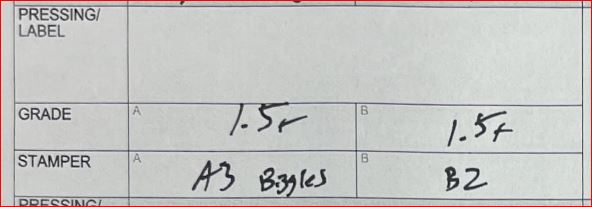
These are records that we auditioned and found to have good, not great, sound quality. If a record earns a Hot Stamper grade of 1.5+ on both sides, it is a very good sounding record, but it is a far cry from the best pressings that we’ve played in shootouts.

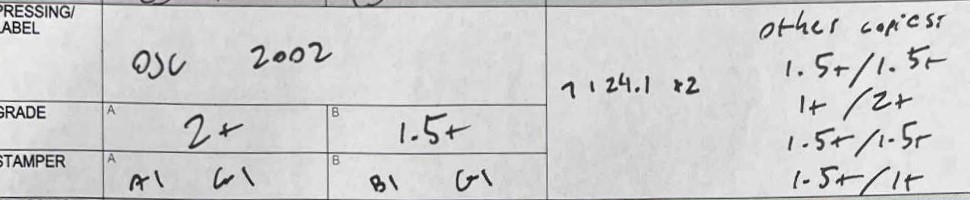
The 2002 OJC Pressings Can Be Very Good but They Don’t Win Shootouts

Hot Stamper Pressings of the Music of Bill Evans Available Now

For a Hot Stamper pressing we put up recently, we wrote:

Moon Beams is one of the best sounding Bill Evans records we’ve ever played. You can see why we chose it to be the first OJC Hot Stamper of his work to hit the site back in 2015. Play “It Might As Well Be Spring” for the kind of sublime musical experience you only find on 20th century analog recordings.

All of that is true for the best of the 20th century pressings we played. (Which, by the way, does not include any originals as those are consistently inferior to the later pressings we’ve auditioned.)

As for the 21st century, the sound of the best 2002 pressings on OJC are somewhat opaque and dry compared to the best that came before. This is something we rarely point out in the listings we have on sale on the site. You generally have to come to the blog to get a fuller picture of the specific shortcomings we might have of some of our Hot Stamper pressings.

We know both dry sound and opaque sound well, having played hundreds of pressings that suffer from such conditions.

The sound may be decent on most of these 2002 pressings, and fairly good on the best of them, but that’s not really what we were hoping to find. We spent a lot of money and we spent a lot of time, to quote a famous line by a famous rock band, but the six 2002 pressings we cleaned and played nevertheless came up a bit short. That’s just how it goes sometimes. (And sometimes it goes completely off the tracks.)

The way we approach a shootout such as this typically involves playing a copy or two some pressing, the 2002 OJC in this case, and hearing sound good enough to make us think it might have the potential for greatness. As you can see by the marks we gave out, the average copy earned a grade of 1.5+, which is a good, not great Hot Stamper grade.  Greatness was just not in the cards.

What Exactly Does Van Gelder Stamped in the Deadwax Tell You?

Hot Stamper Pressings of CTI Titles Available Now
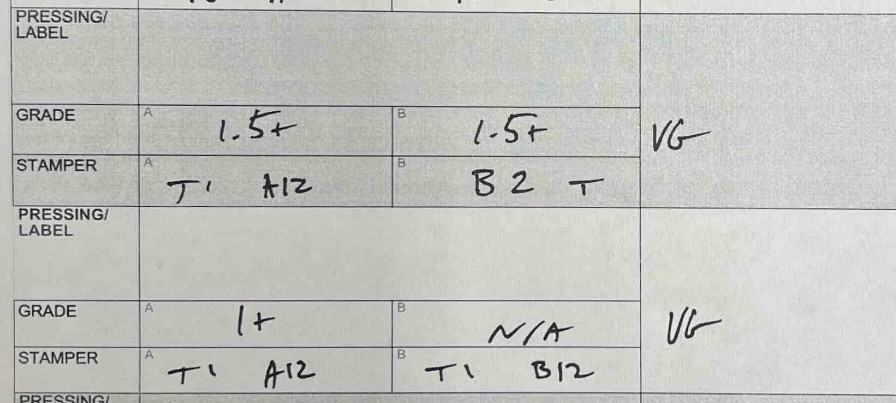
The section of the stamper sheet we wrote up after our most recent shootout belongs to George Benson’s White Rabbit album, the one released by CTI in 1972.

We think these stampers illustrate an important reality regarding the variability of record pressings, and it’s one that we run into on regularly during shootouts.

Keep in mind that the notes you see were made without the listener knowing what the stamper numbers were for the copy being evaluated. Some relevant facts:

  • Rudy Van Gelder cut all the original domestic pressings for the album that we played in our shootout since those are the only ones we know of to have the potential for Hot Stamper sound. (Hint: forget the reissues, imports, etc.)
  • The stampers for the two copies you see below were the two worst performers out of the six we had to work with. (We started out with more than six copies to audition. Unfortunately, some of the copies we clean and play get tossed out during the shootout for having noise issues — scratches that play, bad vinyl, inner groove distortion, etc. Noisy copies of  fairly common jazz records are not saleable no matter how good they sound.)
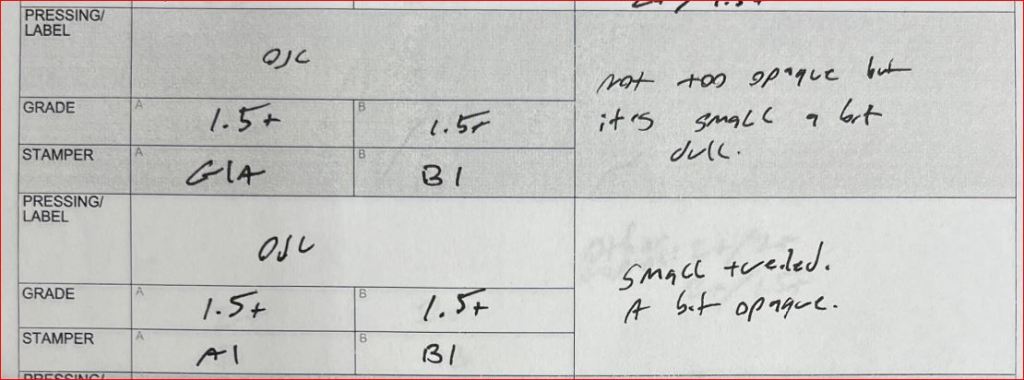
  • The top pressing shown below earned good, not great Hot Stamper grades of 1.5+ on both sides. This is the minimal rating any Hot Stamper pressing must earn to be offered to our customers. As you can see, A12/B2 are the stampers for this pressing.
  • There was another A12 side one in our shootout that did slightly better, earning a 2+ grade. The pressing you see at the bottom also had an A12 side one, but it did not make the grade. (The N/A means we didn’t play side two of that copy because the 1+ side one makes the record not worth the bother.)

We know that White Rabbit is an outstanding George Benson album, recorded by the immensely talented Rudy Van Gelder himself. All the original pressings were mastered by him as well. We’ve been doing shootouts for the album for more than a decade and in that time have heard some amazing sounding copies. I don’t recall one ever being returned, for any reason.

(more…)

Sibelius / Violin Concerto / Ricci

Hot Stamper Pressings of the Music of Jean Sibelius Available Now

This is a wonderful sounding London Stereo Treasury pressing featuring one of our favorite violinists, Ruggiero Ricci, performing the Sibelius Violin Concerto in D Minor.

The tone of the violin on side one is just right — every nuance of Ricci’s bowing can clearly be heard.

While the violin sounds amazing on side one, the orchestra lacks a bit of weight.

This side is also not quite as Tubey Magical as it could be. In our opinion, however, the violin tone and the incredible dynamics are more than enough to make us want to award this record a fairly high grade.

Side two actually has a bit more fullness, but this also seems to rob the violin of some of its presence. 

(more…)

Pros and Cons of this Copy of Swings in High Stereo

Hot Stamper Pressings of Large Group Jazz Recordings Available Now

Side One

Big and spacious, yet clear, dynamic and energetic. The brass is never “blary” the way it can be on so many Big Band or Dance Band records from the 50s and 60s. (Basie’s Roulette records tend to have a bad case of blary brass as a rule.)

Sharp transients and mostly correct tonality and timbres, powerful brass — practically everything you want in a Hot Stamper is here!

The stage is exceptionally wide on this copy.

Listen to the top end on track two — man, that is some natural sound!

This side could use a bit more weight so we feel a grade of Super Hot (A++) gets it right.

(more…)

The Gayne Ballet on Mercury Can Be a Little Bright

Hot Stamper Pressings of Classical Masterpieces Available Now

UPDATE 2025

The review you see below was written more than ten years ago.

Having just done another shootout for SR 90209, Dorati’s recording of the two works, The Gayne Ballet and Romeo and Juliet, I can now confirm that there are some stampers that are indeed way too bright.

Side one of a recent copy had a sour midrange. Side two of the same copy was brash and metallic.

As for side two not sounding as good as side one in the older review before, seems we clearly got that wrong, the result, to some degree, of having an inadequate sample size.

Also,  we didn’t have as good a stereo as we do now, and we weren’t as good at doing shootouts back then either.


Our Old Review

This side one is truly DEMONSTRATION QUALITY, thanks to its superb low-distortion mastering. It’s yet another exciting Mercury recording. The quiet passages have unusually sweet sound.

This kind of sound is not easy to cut. This copy gets rid of the cutter head distortion and coloration and allows you to hear what the Mercury engineers accomplished.

(more…)

We Were Wrong about the Reissues of Christmas with Chet Atkins

Hot Stamper Pressings of the Music of Chet Atkins Available Now

In 2006 we wrote our review for an orange label RCA reissue of the album.

Recently we did a shootout for the album and only one side of one of the later orange label pressings earned a Super Hot (2+) grade.

Our system was noticeably darker and clearly far less revealing than the one we have now, and those two qualities did most of the heavy lifting needed to compensate for the shortcomings of the reissue reviewed below.

What I couldn’t hear on my system back in those days (and even as late as 2006) no doubt explains most of these kinds of errors. That’s why we are constantly harping on the idea that audiophiles would do well to get good sound before they spend a fortune on vinyl.

Higher quality playback is what makes it possible to recognize and acquire better sounding records.

(more…)

Always wanted to have a Plum and Orange pressing? Here’s your chance!

Hot Stamper Pressings of the Music of Led Zeppelin Available Now

We should have titled this one “here was your chance,” since this pressing sold very quickly.

Over the years most Plum and Orange pressings were disposed by us of on ebay for the benefit of collectors and those audiophiles who might be ill-informed enough to think that early British pressings would have the best sound for Led Zeppelin III.

They do not. They can, however, sound reasonably good in some cases with the proper cleaning.

However, they are not even Double Plus (A++) good, which sounds like something from the novel 1984 but is in fact a Very Good grade and guaranteed to trounce any and all copies of the album you have ever heard.

No, the best Zeppelin album we have played to date with the early label in this case earned a grade of Single Plus to Double Plus, which we describe as “[a] wonderful sounding side with many impressive qualities, notably better than a Single Plus copy. A big step up from the typical pressing.”


UPDATE:

We do not even offer Single Plus copies on the site anymore. Although their faults would be less obvious to anyone who went through the shootout process with the album, such faults are much too bothersome to us precisely because we did go through that process.

Once you know what is right, it’s very easy to spot what is wrong.

This is the foundational principle of Hot Stampers.

(more…)

How Do the The Mastering Lab Pressings of Sticky Fingers Sound?

Hot Stamper Pressing of the Music of The Rolling Stones Available Now

A listing for an early domestic Hot Stamper pressing for Sticky Fingers will typically be introduced like this:

If you have never heard one of our Hot Stamper pressings of the album, you (probably) cannot begin to appreciate just how amazing the sound is.

A landmark Glyn Johns / Andy Johns recording, our favorite by the Stones, a Top 100 Title (of course) and 5 stars on Allmusic (ditto).

After hearing so much buzz about it, we finally broke down and ordered a German TML pressing about a year ago. Having played scores of phenomenally good sounding copies of the album over the past fifteen or so years, we were very skeptical that anyone could cut the record better than the mastering engineers who inscribed Rolling Stones Records into the dead wax on the early pressings. (I could find no mastering engineers credited.)

Well, the results were not good. As we suspected would be the case, we were not impressed in the least with what The Mastering Lab — one of the greatest independent cutting houses of all time, mind you — had wrought.

Their version is not really even good enough to charge money for. It might have earned a grade of One Plus, just under the threshold for a Hot Stamper that we would put on the site these days. Decent, but not much more than that.

Wait, There’s More

We subsequently learned that it is the British TML pressings that are supposed to be the best.

So we got one of those in, an A3/B4 copy.

Better, but good enough? Barely.

Here are the notes for the copy we played. For those who have trouble reading our writing, I have transcribed the notes as follows:

Side One

Track one:

Weighty, a bit veiled or smeary. Backing vox kinda lost.

Track three:

Very full, rockin’ but not the sparkle/space.

Kinda compressed.

Not as huge.

Side Two

Track two:

Not as rich, clear.

A bit pushy/dry vox.

No real space.

Thick drums

Track one:

This works better.

A bit hard, but full and lively.

This Sound?

Is this the sound audiophiles are raving about?

(more…)

The Yellow Label Reissues Can Sound Very Good, But Great? Not a Chance

Hot Stamper Pressings of Contemporary Jazz Albums Available Now

The earlier pressing on the site as of this writing is an amazingly well recorded album with many fine qualities:

Boasting seriously good grades from top to bottom, this vintage Contemporary pressing is doing just about everything right.

These sides are bigger and more open, with more bass and energy, than most others we played – the saxes and trumpets are immediate and lively.

Mr. Earl Hines himself showed up, a man who knows this music like nobody’s business – Leroy Vinnegar and Shelly Manne round out the quartet.

“Great musicians produce great results, and most of the LP’s tracks were done in one or two takes. The result is ‘a spontaneous, swinging record of what happened’ when Carter met Hines ‘for the first time. . . .'”

Our notes for the Yellow Label reissues point out that they are always more compressed, with some added upper midrange. The intro benefits from this but the peaks can get congested.

The earlier pressings, especially the originals on the Black Label, are the most likely to sound right, but they are tough to find in audiophile playing condition.

If you see a copy on the site with these grades — less than 2+ on both sides — it will proabably have a Yellow Label and some of the shortcomings we mention above.

Correct, In This Case

Some people like to search for relationships between the sound of the pressing and the label it has, but in our experience that is more often than not a fool’s errand once confirmation biases and other kinds of mistaken audiophile thinking are taken into account.

When the conventional wisdom turns out to be correct — in other words, when it comports with reality, at least for the six copies of this album that we played — we are happy to temporarily put aside our skepticism and learn the lessons playing a stack of copies of this title has taught us.

Why? Because the experimental evidence supports it.

(more…)

There’s a Very Good Chance We Were Wrong about Mulligan Meets Getz

More of the Music of Stan Getz /More of the Music of Gerry Mulligan

This is an album that we were probably wrong about in 2021 when the following Hot Stamper two-pak pressing went up for sale on the site. (The pressings we liked at the time are long gone by now.) Here is what we wrote back then:

Mulligan and Getz’s 1957 collaboration arrives on the site with this superb 2-pack offering Nearly Triple Plus (A++ to A+++) sound on both sides – just shy of our Shootout Winner

Full, rich, and spacious with tons of Tubey Magic and, better yet, not the least bit dry, hard or transistory

Practically impossible to find in stereo with audiophile playing surfaces – it took two different pressings to get two good sides, and they are very good indeed

The reissues we discovered in 2025 trounced the originals (in both stereo and mono) as well as the early reissues (on the Verve T Label) we played in our shootout, as you can see from the stamper sheet notes below:

Our mistaken judgment is simply the result of ignorance. In 2021 we simply had no idea just how good this recording could sound on vintage vinyl. We hadn’t done our homework properly, and because of that we came up with the wrong answer.

We only discovered the right pressings, with the right stampers, pressed in the right era, and mastered by the right guy, sometime in 2024 or so. We bought a bunch of those and in 2025 did the shootout with all kinds of copies, just to keep everybody honest.

That was the year much better sounding reissue copies that look like the one you see on the left came along. As we noted in the listing:

  • Leave it to Better Records to figure out a complicated title with a long history such as this one – originals, reissues, monos, stereos, we had to play them all to find a copy that sounds as good as this one does.
  • Full, rich, and spacious with an abundance of Tubey Magic and, better yet, not the least bit dry, hard or transistory.

Some quick notes:

Bowtie Label Stereo

  • Veiled and dry
  • Tons of reverb
  • 1.5+ at best (a good, not great Hot Stamper grade)

Our understanding is that Steve Hoffman chose to use the mono tapes as the source material for his DCC Gold CD because he felt there was too much reverb on the stereo tape. We heard too much reverb too.

What tapes our wonderful sounding reissues are made from we have no way of knowing. They do not suffer from too much reverb, that much we can tell you. The best pressings we offer sound great, and quite a bit better than any Gold CD will. However, if money is tight, the Gold CD is not a bad way to go for this music.

T Label Stereo

  • Dry, some squawk
  • 1+, what we would call passable sound

Mono Early Pressings

  • Rich but hot horns
  • 1.5+ at best

Lessons Learned

In this case, the conventional wisdom that the stereo originals would be the best sounding turned out to be incorrect.

Our lengthy commentary about conventional wisdom seeks to make the case that, although the most common record collecting approaches are more often right than wrong, there is simply no way to know what approach — original versus reissue, import versus domestic, mono versus stereo — will work the best for any given title.

(more…)