The Only Approach to Audio that Works

“Doing” Audio Is the Only Workable Approach to Better Sound

Author Nassim Taleb on why earned knowledge and being immersed in the details of any subject lead to success:

“The knowledge we get by tinkering, via trial and error, experience, and the workings of time, in other words, contact with the earth, is vastly superior to that obtained through reasoning…”

This idea ties in to a great many commentaries we’ve written on this blog, more about records than the pursuit of higher quality audio in the home. We are, after all, in the record business, not the audio business.

This commentary describing how big questions rarely have good answers gets to the heart of why predicting which record pressings should be the best is a fool’s errand. An excerpt:

We’re really not that interested in big questions, mostly because there aren’t any big answers for them.

When it comes to records, being able to reveal deep underlying truths about a wide range of vinyl pressings is simply not possible. To be honest, we don’t think it can be done.

It’s not that we don’t have plenty of working knowledge. It’s that we have so much of it that we needed a blog to hold it all so that we could share it with others.

No, our working knowledge is made up of lots of little bits of data that guide us in discovering the best sounding pressings for the individual titles we choose to play.

It would be nice to have general rules to help us in our search for better sound on vinyl, but our experience tells us that general rules are so unreliable that they fail to function as rules at all.

And the same thinking applies to audio equipment, room treatments, turntable setup and everything else having to do with reproducing music in the home. We made the point years ago that tuning and tweaking — in other words, getting your hands dirty — is one of the best ways to improve your listening skills, which can’t help but lead to improvements in your ability to reproduce your favorite recordings. An excerpt:

Since we play all kinds of records all day, practically every day, as part of our regular shootout regimen, tweaking and tuning are much easier for us to do than they would be for most audiophiles. As I have told many in this hobby over the years, if you don’t do the work, the only person who doesn’t get to hear better sound is you. I can come home to my good sounding stereo — I’ve put in the work — but you’re stuck listening to all the problems you haven’t solved, right?

There’s no problem with an untweaked stereo or an untreated room as long as you don’t mind mediocre sound. If you actually want good sound, you have to learn how to tweak your stereo and you have to learn how to treat your room. Neither one can be ignored. You have to learn how to do both.

And doing both is what teaches you how to listen, which is a skill that’s very hard to acquire any other way. This explains why so many audiophiles have such poor listening skills. They simply never developed them because they never needed them. Think about it: Listening to music for enjoyment requires the exercise of no skills whatsoever.

Such is obviously not the case with tweaking. Tweaking your system requires that you listen carefully and critically in order to make the fine judgments that are essential to making progress. Progress in audio from tweaking often occurs in small, almost imperceptible increments.

Being so subtle, these changes force you as a listener to concentrate, to focus your attention, to bring to bear all your critical listening skills.

Naturally, these skills, like any skills, having been exercised, start to improve, and continue to improve as you continue to exercise them.

I closed with this thought:

No amount of reading or advice was remotely as helpful as just getting down and messing around with anything and everything in my listening room.

It seems that Mr. Taleb and I have been seeing things the same way for quite a while now, he for investing, me for audio.


That guy you see pictured at the top left with a record under his arm is one who spent much of his time wandering around used record stores looking for great sounding records to play.

Before that he wandered around stores selling new records because he didn’t know how good old used records could sound. He admits he was pretty clueless at the start, a fact that I think we can all agree is beyond dispute.

In these posts he shares some of the things he’s learned since he started buying vinyl at the age of ten, roughly sixty years ago. (First purchase: She Loves You on 45. It’s still in the collection, although it cracked a long time ago and hasn’t seen a turntable in ages.)


Further Reading

Don’t Blame Bill Szymczyk If Your Copy of The Long Run Doesn’t Sound Good

Hot Stamper Pressings of the Music of The Eagles Available Now

Most copies have a smeary, veiled, stuck-in-the-speaker quality that makes for some painful listening on the tracks that are worth playing on The Long Run, which, depending on your taste and how much you like The Eagles, might work out to roughly half of them for most people who own the album, I’m guessing. We think the first two tracks on either side are hard to fault.

We should know; we’ve played them by the score. Some of their more notable faults in addition to those mentioned above:

  • Cardboard drums.
  • Non-existent ambience.
  • No energy.

Unless you get one of the hard, edgy, thin ones. Hard to say which would be more unpleasant to play.

The best copies are a whole different story, with the kind of big, punchy, full-bodied sound one hears on good copies of Hotel California.

What’s Bill Szymczyk’s problem anyway, you might ask. Can’t the guy record an album any better than this after being in the studio for all these years?

Yes he can. Don’t make the mistake of judging The Long Run by the typical bad pressing of it, the kind that Elektra was churning out by the millions back in the day.

Believe me, the master tape must be awesome if the sound of some of the records we played is any indication (which of course it is).

(more…)

Iggy Pop – The Idiot

More Rock and Pop

  • Iggy’s 1977 release is brought to life on this vintage RCA pressing with stunning Nearly Triple Plus (A++ to A+++) sound from start to finish – just shy of our Shootout Winner
  • These sides had the most energy, the punchiest bass, and the biggest, most immediate, most powerful presentation of practically any copy in our recent shootout
  • It’s the rare copy that’s this lively, solid and rich… drop the needle on any track and you’ll see what we mean
  • “[David] Bowie co-wrote a batch of new songs with Iggy, put together a band, and produced The Idiot, which took Iggy in a new direction decidedly different from the guitar-fueled proto-punk of the Stooges.”
  • 5 stars: “[The album] introduced the world to a very different Iggy Pop, and if the results surprised anyone expecting a replay of the assault of Raw Power, it also made it clear that Iggy was older, wiser, and still had plenty to say; it’s a flawed but powerful and emotionally absorbing work.”

(more…)

Elvis Costello – Trust

More of the Music of Elvis Costello

  • With two solid Double Plus (A++) sides or close to them, this original UK import pressing is guaranteed to handily beat any other Trust you’ve heard
  • This copy has Demo Disc sound guaranteed to knock you right out of your listening chair (particularly on side one)
  • The clarity and transparency on this side one allow you to appreciate subtleties in the high end even when the bass and drums are really pounding, and side two is not far behind in all those areas
  • 5 stars: “…their most ambitious and eclectic album to date… Costello & the Attractions demonstrate their musical skill and savvy by essentially sticking to the direct sound of their four-piece band. In the process, they recorded, arguably, their most impressive album, one that demonstrates all sides of Costello’s songwriting and performing personality without succumbing to pretentiousness.”
  • We’ve recently compiled a list of records we think every audiophile should get to know better, along the lines of “the 1001 records you need to hear before you die.”
  • Trust is a good example of a record many audiophiles would benefit from knowing better.

This copy has the big sound that lets this music really rock. There’s a ton of low-end on this record; regrettably, most copies suffer from either a lack of bass or a lack of bass definition. I can’t tell you how much you’re missing when the bass isn’t right on this album. It’s without a doubt the single most important aspect of the sound on this album.

When the bass is right, everything falls into place, and the music comes powerfully to life. When the bass is lacking or ill-defined, the music seems labored; the moment-to-moment rhythmic changes in the songs blur together, and the band just doesn’t swing the way it’s supposed to.

Rave Reviews

I pretty much agree with the AMG review below.

Trust, along with My Aim Is True and Armed Forces, is as good as it gets for Elvis on LP. All three are absolute Must Owns that belong in any serious rock collection.

This is that rare breed of music that never sounds dated (especially considering the era in which it was produced). Music with real depth such as this only gets better with the passage of time. The more you play it, the more you appreciate it, and the more you love it.

(more…)

Lincoln and Doug Produced The Audiophile Sgt. Pepper of Its Day

Hot Stamper Pressings of the Music of Lincoln Mayorga Available Now

When I was selling audio equipment back in the 70s (Audio Research, Fulton speakers), The Missing Linc this was a favorite Demo Disc in our store.

With a big speaker like the Fulton J, the bass drum at the end of track two would shake the walls. At the time I had never heard a record with bass that went remotely that deep. (The album came out in 1972. I’m guessing I probably first heard a copy in ’75 or ’76 when I bought my Fultons, which would have been sometime in my early twenties.)

Every bit as amazing to me was the string quartet on side 2. You could actually hear the musicians breathing and turning the pages on their music stands, just as if you were actually in their “living presence.” No recording I had ever owned allowed me to hear that level of natural detail.

This is one of the albums that made me realize how good audio in the home could be.

In a way this was the Audiophile “Sgt. Pepper” of its day, a record that was so much better than anything else you’d ever heard it made you rethink the possibilities.

Our best pressings are probably not very much like others you have heard. Some of those can be aggressive, many of them can be dull and lack the spark of live music, some of them can have wonky bass or be lacking in the lowest octave — they are prey to every fault that befalls other records.

Which shouldn’t be too surprising. Records are records. Pressing variations exist for every album ever made. If you haven’t noticed that yet, start playing multiple copies of the same album while listening carefully and critically.

If your stereo is any good at all, it should not take you long to notice how different one record sounds from another.

Just listen to the reedy texture on the saxophone on “Limehouse Blues” — on the best copies you can really hear the leading edge transients of the brass, so important to the sound of those instruments.

Doug Sax Is The Man

The Mastering Lab was one of the greatest cutting houses to ever master records.

Doug Sax knew how to keep his lathes and amplifiers working at state-of-the-art levels. The sound quality is unsurpassed.

And he did it all with tubes.

(more…)

Letter of the Week – “… even my 65 year old father, with no musical background at all, was amazed when I play your Beatles stampers.”

Hot Stamper Pressings of the Music of The Beatles Available Now

One of our good customers had this to say about some Hot Stampers he purchased recently:

Hey Tom, 

I have enjoyed your records since I got a “Sgt. Peppers” hot stamper in 2011, and you guys have never disappointed me!

Every time I play one of the hot stampers for my musician friends, I don’t tell them “it’s a special pressing” but just play the record – they always comment on the sound quality, almost always saying “that’s so clear, so clean, etc…” – even my 65 year old father, with no musical background at all, was amazed when I play your Beatles stampers. He said, “in my time, records sounded scratchy and noisy.” What a revelation the Hot Stamper is.

(more…)

Al Stewart – Time Passages

More of the Music of Al Stewart

  • Amazing sound throughout this vintage British import, with both sides earning INSANELY GOOD Shootout Winning Triple Plus (A+++) grades
  • The better sides have the kind of analog richness, warmth, and smoothness that make listening to records so involving
  • Standout tracks include “Song on the Radio” and “Time Passages” (an edited version of which made it all the way to #7 on the Pop charts)
  • 4 1/2 stars: “…this is exceptionally well-crafted, from Stewart’s songs, where even three-minute songs seem like epics, to Alan Parsons’ cinematic arrangements and productions. [O]ne of Al Stewart’s very best albums.”

Our Hot Stampers of Year Of The Cat are always a big hit, and this, the 1978 follow-up, shares many of the same qualities. Alan Parsons is a pretty good producer and engineer it turns out.

This copy is richer and sweeter than most, with a big, bold, three-dimensional sound that perfectly suits the kind of Big Productions that are his stock in trade. The bigger the better we say!

Standout tracks include “Song on the Radio” and “Time Passages” (an edited version of which made it all the way to #7 on the Pop charts.) Both of these songs are more than six minutes long on the album.

(more…)

Winds In Hi-Fi / Fennell – Another Top Mercury, formerly on the TAS List

Hot Stamper Mercury Pressings Available Now

  • An early Plum Label copy of this famous TAS list LP with STUNNING Shootout Winning Triple Plus (A+++) grades or close to them throughout
  • It’s also fairly quiet at Mint Minus Minus, a grade that even our most well-cared-for vintage classical titles have trouble playing at
  • This pressing boasts incredible sound from start to finish – Mercury knows how to capture the bite of the brass
  • Fennell is a master of this sort of sweet and lyrical Wind Music
  • Both sides of this spectacular Demo Disc recording are big, clear, rich, dynamic, transparent and energetic – here is the Mercury sound we love, and that is so hard to find
  • Marks and problems in the vinyl are sometimes the nature of the beast with these early pressings – there simply is no way around them if the superior sound of vintage analog is important to you

Harry Pearson put this record on his TAS list of Super Discs many years ago, but, like so many amazingly good recordings from the golden age, it no longer appears to qualify for inclusion.

Regardless of its current status with the writers at The Absolute Sound, a group whose taste and acumen must be considered questionable at best, the credit must go to Fennel along with the brilliant engineering team at Mercury. I’ve been told that he was a stickler for making sure everyone was perfectly in tune and playing correctly within the ensemble. That’s exactly what you hear when you play a record like this — it’s practically sonic perfection.

Fennell made a number of band music recordings for Mercury. My favorite is British Band Classics Vol. 2, which was the first Mercury recording I ever heard. I went out and bought a copy of it immediately from my local Tower Records on Golden Import.

Years later when I heard the real thing, and original pressing, I realized the Golden Import was a pretty second rate reissue, fine for the $3.99 I might have paid but a big step down from the early pressings.

Also, if you ever see a clean copy of Vol. 1, only available in Mono, pick it up. If it’s cut right it, too, is out of this world.

(more…)

On Our Top Copy, How Could We Tell that One Side Was Not as Full-Bodied?

Hot Stamper Pressings of the Music of Gordon Lightfoot Available Now

We described a recent Shootout Winning pressing of Summer Side of Life this way:

So transparent, open, and spacious that nuances and subtleties that escaped you before are now front and center.

Everything you want in the sound of a good Folk Rock album is here in abundance.

Tubey Magical acoustic guitar reproduction is superb on the better copies of this recording. Simply phenomenal amounts of Tubey Magic can be heard on every strum, along with richness, body and harmonic coherency that have all but disappeared from modern recordings (and especially from modern remasterings).

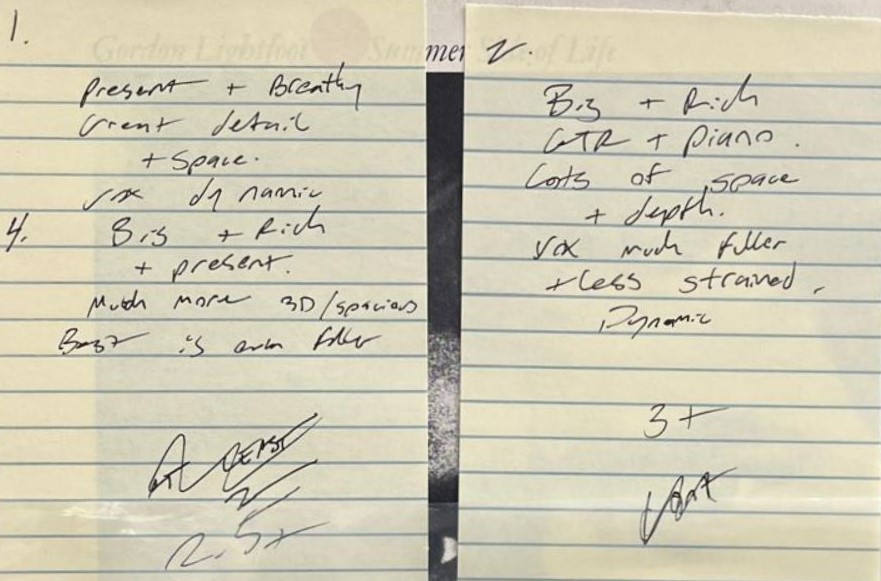
Here are the notes for the 2.5+/3+ copy we put up on the site and sold in 2025.

Side two was killer in every way, and the way we know that is we played a bunch of copies and nothing could beat it. This side two took top honors for having exactly the sound we described above.

(more…)

Nilsson’s Aerial Pandemonium Ballet Sounds Absolutely Awful

Hot Stamper Pressings of the Music of Harry Nilsson Available Now
Tracks from the first two Nilsson albums were turned into this monstrosity in 1971. Some were remixed, some parts rerecorded, but whatever they did, they really screwed up the sound of the finished LP.

I cannot even say that the remixing and rerecording and editing are not an improvement on the songs found on the first album — they may be, it’s not a record I know well. What I do know is that this compilation is so bad sounding it doesn’t matter what they did or how well they did it. The record is simply unplayable.

We’ve never done a shootout for the first album, but the second album we know can have wonderful sound on the right pressings. We described a recent Hot Stamper of the second album this way:

Both of these sides are big, clear and full-bodied throughout – if you are a Nilsson fan, this copy is guaranteed to beat anything you’ve heard before, and by a wide margin.

All of the elements are working here – you get silky vocals, punchy bass, breathy brass, silky highs, superb immediacy, remarkable clarity, and the list goes on.

AMG writes:

4 1/2 stars: “As ‘Good Old Desk’ opens Aerial Ballet with a cheerful saunter, it’s clear that Harry Nilsson decided to pick up where he left off with his debut, offering another round of effervescent, devilishly clever pop, equal parts lite psychedelia, pretty ballads, and music hall cabaret.”

All true! Nilsson is one of my favorite artists to this day, 56 years after I first heard the album “Harry,” which is still a personal favorite and one I listen to regularly, along with many others, including a compilation I think is excellent, Personal Best — The Harry Nilsson Anthology.

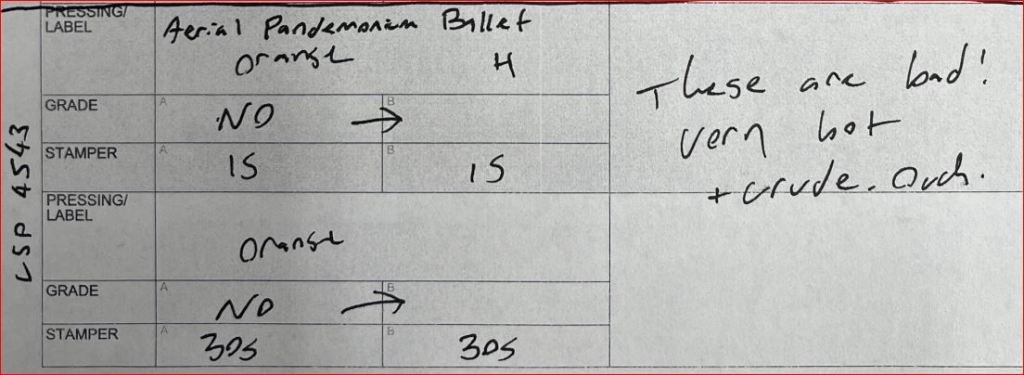
However, this compilation is shockingly bad — It’s cut loud, and it’s very hot and crude. Ouch is right.

(more…)