Advice-WTLF, Vocals

Records with advice on what to listen for in order to separate the best pressings from the also-rans.

Getting the Balance Right on Mean to Me

Hot Stamper Pressings of Pop and Jazz Vocals Available Now

Mean to Me is a favorite test track for side one, with real Demo Disc quality sound. We credit it with helping us dramatically improve our playback.

Roy DuNann at Contemporary was able to get all his brass players together in one room, sounding right as a group as well as individual voices.

The piano, bass, and drums that accompany them are perfectly woven into the fabric of the arrangement.

What makes this song so good is that when the brass really starts to let loose later in the song, with the right equipment and the right room, you can get the kind of sound that’s so powerful you could practically swear it’s live.

Helen was recorded in a booth for this album, and her voice is slightly veiled relative to the other musicians playing in the much larger room that of course would be required for so many players.

When you get the brass correct, the trick is to get her voice to become as transparent and palpable as possible without screwing up the tonality of the brass instruments.

The natural inclination is to brighten up the sound to make her voice more clear.

But you will quickly be made painfully aware that brighter is not better when the brass gets too “hot” and starts to tear your head off.

The balance between voice and brass is key to the proper reproduction of this album.

Once you have achieved that balance, tweak for transparency while guarding against too much upper midrange or top end. Which also means watch out for audiophile wires that may have fooled you into thinking they were more resolving when actually they were just peakier in some portion of the frequency range.

(more…)

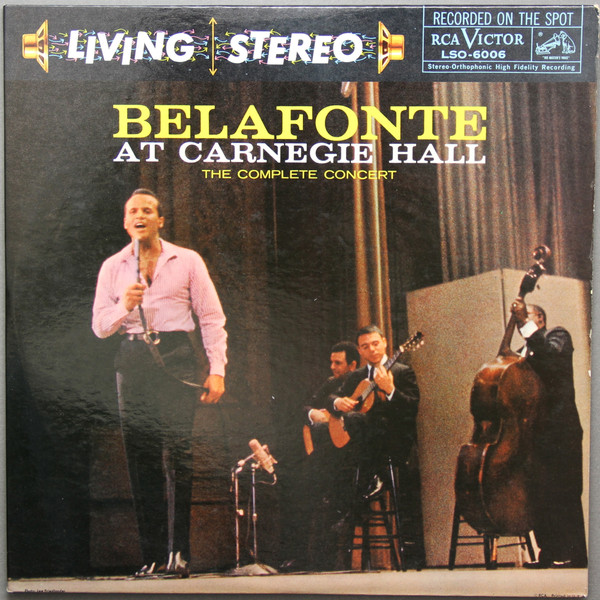
Belafonte at Carnegie Hall – I Have a Theory

Hot Stamper Pressings of the Music of Harry Belafonte Available Now

We’ve long known that some copies of the album are mastered with the polarity reversed. This is one of those copies.

But the crazy news we have today is that this copy of the album sound just fine without reversing the polarity of the system, better than any other copy we played.

True, it sounds a bit better with the polarity reversed, but it is still our Shootout Winner even with the wrong polarity.

I would never have believed that to be the case in the past, but my theory is that the new studio we built has reduced distortions and problems to such a degree that polarity issues are less of a problem now than they might have been in the past.

As I say, it’s just a theory, and as time goes on we will revisit this idea with other recordings that we know to have polarity issues, and we’ll be sure to let you know what we find.

The best sounding versions we played are cut super clean. The brass and strings have dead-on correct textures and timbres.

As good as some pressings are, the best pressings are clearly a step up in class. The differences are easy to hear:

  • The brass has more weight and body and richness.
  • Same with the strings.
  • The voice gets fuller and sweeter and less sibilant, while still maintaining every nuance of detail.
  • The presence is startling; Belafonte is absolutely in the room with you.

(more…)

1962 Tubes and The Sound That’s Been Lost for Fifty Years

Hot Stamper Pressings of Pop and Jazz Vocal Albums Available Now

UPDATE 2025

This review was written many years ago, circa 2010 I would guess, right about the time we first started doing shootouts for the album. (Here is what we have to say about I Left My Heart in San Francisco these days, suspiciously similar to what we had to say in 2010. As the song says, ‘”The fundamental things apply…”)


Everything that’s good about All Tube vocal recordings from the 50s and 60s is precisely what’s good about the sound of this record.

The huge studio the music was recorded in is captured faithfully on this pressing. The height, width and depth of the staging are extraordinary, a true Demo Disc in that regard.

We are not big soundstage guys here at Better Records, but we can’t deny the appeal of the space to be found on a record that sounds as good as this one does.

Transparency and Tubey Magic are key to the sound of the orchestra and you will find both in abundance on these two sides.

(Other records that are good for testing those two qualities can be found here and here.)

Albums such as this live and die by the quality of their vocal reproduction. On this record Mr. Tony Bennett himself will appear to be standing right in your listening room, along with the 38 other musicians from the session. (Actually, come to think of it, they’re probably sitting.)

On the best pressings, the space of your stereo room will seem to expand in all directions to accommodate them — an illusion of course, but nevertheless a remarkably convincing one.

(more…)

Belafonte at Carnegie Hall – Key Tracks for Side One

Hot Stamper Pressings of Pop and Jazz Vocal Albums Available Now

Harry Pearson brought this record to the attention of audiophiles with his TAS list a long time ago, and rightfully so: it’s an amazing recording.

We happen to love the music too, which makes it one of the most recommendable records we have ever offered. If you can find a better combination of demo disc sound, with music worth the hassle and expense of reproducing it properly, more power to you. We sure can’t.

Because this is a live recording, because it has lots of natural instruments as well as a vocal, because it was recorded in the Golden Age by one of the greatest labels of all time, RCA, by Bob Simpson no less — for this and many other reasons, it has to be considered one of the most amazing recordings in the history of the world.

That said, it is our contention (and the basis of our business model) that the brilliant quality of the recording can only be appreciated if you have the pressing that captured the sound that the engineers recorded. In other words, a Hot Stamper.

From an audiophile point of view, you get to hear live musicians and all the energy they bring to this music, all on the stage at the same time: strings, brass, percussionists, and Harry Belafonte front and center. Tube mics (and not too many of them), a tube tape recorder, RCA’s superb engineering and all-tube mastering chain ensure that the “breath of life” is captured intact.

I know of no better live popular vocal recording on the planet.

Side One

Introduction
Darlin’ Cora
Sylvie 

This is a wonderful song, sung by Belafonte with virtually no accompaniment. His voice should be rich and full-bodied with plenty of presence. In other words, he should sound like a living, breathing person.

Cotton Fields 

The liner notes say this song was introduced in the previous year in Las Vegas. Before I read that I noted that the uptempo arrangement had a jazzy feel to it. The walking bass is well up in the mix and the piano and a few of the other instruments in the song are well behind — it’s pretty much Belafonte and bass. The bass is deep and very note-like.

This is of course a big system record. Do not expect good results from small speakers.

But what makes this one of the best Demo Quality tracks on the album is Belafonte’s amazingly energetic performance. He really sells this song.

As I was listening to the dynamics on the best pressings, it made me think about all the compressed-to-death vocals that are so much a part of the recording style of the modern era. Nobody gets loud anymore.

Belafonte did back in 1959, and not too many followed him.

(more…)

Lady in Satin – What It Takes to Hear It Right

Robert Brook runs a blog called The Broken Record, with a subtitle explaining that the aim of his blog is to serve as:

A GUIDE FOR THE DEDICATED ANALOG AUDIOPHILE

Here is Robert’s latest posting.

LADY IN SATIN: What it Takes to HEAR it RIGHT

Robert writes:

A few years ago, Better Records founder Tom Port told me something that I’ve never forgotten. I had just demoed my system for an industry guy, and while relaying the experience to Tom, he asked me what records I had played for him. I mentioned a few, including Charles Mingus‘s Ah Um.

Tom said (paraphrasing here) “Not a good choice. You want to play records that can only sound good one way. Ah Um can sound good a lot of different ways.”

At the time I didn’t fully understand what Tom was getting at. Ah Um, or at least the copy of it I had, always sounded great. Wasn’t it therefore a great record to demo my system with?

Since then I’ve come to understand that this was exactly Tom’s point. If you really want to show someone what your system can do, by all means, play a great sounding record, but also one that requires your turntable and your system as a whole be at their best to reproduce it.

Lately I’ve come to understand something that I feel every audiophile, analog audiophiles in particular, would do well to recognize and come to terms with. When we play a record, each of us is listening for different things, and these things are very often not the things that we should be listening for if we want to determine if our system is sounding its best.

Robert continues:

But a pretty steady diet of Ah Um for a number of years now has taught me that the right copy will sound good, even with the most basic turntable setup, and even on a system that’s not performing its best.

Meanwhile, it would seem that Lady In Satin is a record that only sounds good, great even, one way and one way only. It needs us to attend to all the little details in our system before it will reveal its magic.

(more…)

Another 30th Street Studio Knockout – This One’s from Tony Bennett

Hot Stamper Pressings of the Music of Tony Bennett Available Now

UPDATE 2018

This review was written many years ago, circa 2010 I would guess, right about the time we first started doing shootouts for the album. (Here is what we have to say about I Left My Heart in San Francisco these days, suspiciously similar to what we had to say in 2010. As the song says, ‘”The fundamental things apply…”)


Everything that’s good about All Tube vocal recordings from the 50s and 60s is precisely what’s good about the sound of this record.

The huge studio the music was recorded in is captured faithfully on this pressing. The height, width and depth of the staging are extraordinary, a true Demo Disc in that regard.

We are not big soundstage guys here at Better Records, but we can’t deny the appeal of the space to be found on a record that sounds as good as this one does.

Transparency and Tubey Magic are key to the sound of the orchestra and you will find both in abundance on these two sides.

(Other records that are good for testing those two qualities can be found here and here.)

Albums such as this live and die by the quality of their vocal reproduction. On this record Mr. Tony Bennett himself will appear to be standing right in your listening room, along with the 38 other musicians from the session. (Actually, come to think of it, they’re probably sitting.)

On the best pressings, the space of your stereo room will seem to expand in all directions to accommodate them — an illusion of course, but nevertheless a remarkably convincing one.

(more…)

Thoughts on a Direct to Disc Recording, Its Strengths and Weaknesses

Hot Stamper Pressings of Direct-to-Disc Recordings Available Now

Reviews and Commentaries for Direct to Disc Recordings

In a shootout we conducted more than ten years ago, two White Hot Stamper pressings tied for the best side two we had ever heard.

In the final round it simply came down to the fact that the other copy was a little more clear, this one is a little richer.

They were both so amazing we couldn’t decide which we preferred so we gave them both White Hot Stamper grades.

In our experience this rarely happens.

Most of the time one side of one of the records in the shootout will show itself to be the clear winner, doing everything — or almost everything; there is no such thing as a perfect record — right.

When you play enough copies, eventually you run into the one that shows you how the music wants to be heard, what kind of sound seems to work for it the best. The two side twos we liked were variations, and fairly subtle ones at that, on a theme — a little richer here, a little clearer there, but both so good.

To be honest, most copies of this title were quite good. Few didn’t do most things at least well enough to earn a Hot Stamper grade. This has not been the case with many of the Sheffield pressings we’ve done shootouts for in the past. Often the weaker copies have little going for them. They don’t even sound like Direct Discs.

Some copies lack energy, some lack presence, most suffer from some amount of smear on the transients.

But wait a minute. This is a direct disc. How can it be compressed, or lack transients? Aren’t those tape recorder problems that are supposed to be eliminated by the direct to disc process?

(more…)

More June Christy Fifties Capitol Magic in Mono

Hot Stamper Pressings of Pop and Jazz Vocals Available Now

Side two of this White Hot Stamper June Christy record on the original Capitol Turquoise label is AMAZING, both musically and sonically. It has all the TUBEY MAGIC we know these old records are famous for, but this copy gives you something you may never have heard on a vintage pressing before: real frequency EXTENSION, both high and low. Who knew an old record could have extended highs like these and such deep bass?

I can honestly say I have never heard any June Christy record sound as good as this copy does.

(We had a fantastic Something Cool a while back but that was all pre-upgrades. The sound is far better now than it was then, making comparisons all but meaningless.)

Side Two

OFF THE CHARTS A Triple Plus Sound from start to finish. Rich and sweet and present like no copy we have ever heard. No copy out of the four originals we played earned more than a grade of A++, so this side two is a big step up over everything and the best sound we have ever heard for ANY June Christy record. 

Side One

Not as tubey magical as the best we heard but earning lots of points for being present and clear. It has some of the top end you will hear on side two, which is also rare in our experience. With more richness and fullness, the kind side two has in spades, this would have been a real contender for side one. No side one earned a higher grade than A++ so this copy was actually not that far off the best we played. It’s this side two that had us gobsmacked and forced us to set a higher standard for the other copies.

Musically

Musically this album is right up there with the best female vocal records we have ever played, the creme de la creme, albums on the level of Clap Hands and Something Cool and Billie’s Music for Torching. It really doesn’t get much better than this.

What to Listen For

There is what sounds to us like a contrabassoon on the second track on side one, When the Sun Comes Out. It’s so real sounding it will give you chills!

(more…)

Balancing the Vocal, Strings and Rhythm on Lady in Satin

Hot Stamper Pressings of the Music of Billie Holiday Available Now

The better copies reproduce clearly the three most important elements in the recording — strings, rhythm, and vocal — and, more importantly, they are properly balanced with one another. 

The monos, as you might expect, balance the three elements well enough, but the problem with mono is that the vocals and instruments are jammed together in the center of the soundfield, layered atop one another.

Real clarity, the kind that live music has in abundance, is difficult if not impossible under those circumstances.

Only the stereo pressings provide the space that each of the players needs in order to be heard.

Naturally the vocals have to be the main focus on a Billie Holiday record. They should be rich and tubey, yet clear, breathy and transparent.

To qualify as a Hot Stamper, the pressings we offer must be highly resolving. You will hear everything, all of it surrounded by the natural space of the legendary Columbia 30th Street Studio in which the recording was made.  (more…)

I Left My Heart In San Francisco – Notes from Our First Hot Stamper Circa 2010

More Vintage Hot Stamper Pressings on Columbia

Everything that’s good about All Tube Vocal Recordings from the ’50s and ’60s is precisely what’s good about the sound of this record.

The huge studio the music was recorded in is captured faithfully here. The height, width and depth of the staging are extraordinary. We are not big soundstage guys here at Better Records, but we can’t deny the appeal of the space to be found on a record as good as this.

Transparency and Tubey Magic are key to the sound of the orchestra and you will find both in abundance on these two sides.

Some quick notes:

Side One

Highly resolving; tonally balanced; rich bottom end; breathy vocals; instruments are jumping out of the speakers; dynamic; with a touch of grain and spit on even the best copies.

Killer. Can’t be beat.

Side Two

Might be slightly better, but let’s just leave the grade at Triple Plus.

The first track is not as well recorded as those that follow.

The violin is sweeter on the second track here than on any other side we played.

The whole production is so immediate, so right, and so real it may just take your breath away.

The third track is rich, solid and tonally correct, which pretty much sums up the sound we heard on the best copies of the album.

Albums such as this live and die by the quality of their vocal reproduction. On this record Mr. Tony Bennett himself will appear to be standing right in your listening room, along with the 38 other musicians from the session (actually they’re probably sitting).

The space of your stereo room will seem to expand in all directions in order to accommodate them, an illusion of course, but nevertheless a remarkably convincing one.