Prog Rock – Reviews and Commentaries

In the Court of the Crimson King – An Overview

Hot Stamper Pressings of Progressive Rock Albums Available Now

If you have the Atlantic pressing, from any era, you have not yet begun to hear this record at its best. The better sounding domestic originals we’ve played are clearly mastered from copy tapes, which results in dubby sound.

In the Court of the Crimson King is such a well recorded album that even the sound quality derived from second-generation tapes is still better than most of what came out in 1969.

(By the way, 1969 was a phenomenal year for audiophile quality recordings – as of 2026 we’ve auditioned and reviewed more than one hundred and twenty titles, and there are undoubtedly a great many more that we’ve yet to play. To make it easier for audiophiles to separate the wheat from the chaff, we’ve also identified more than 25 Rock and Pop albums essential to any audiophile record collection worthy of the name.)

Now on to brass tacks.

UK Polydor Label

Passable, not really worth the labor to put them in a shootout just to have them earn sub-Hot Stamper grades. A1/B5 is a common stamper for these pressings and with those stampes the Polydor is not worth the vinyl it’s pressed on.

Pink Label Island

The same can be said for some of the earliest UK Pink Label Island pressings. None of them has ever won a shootout and probably none of them ever will. (A number of Pink Label Island pressings that never win shootouts can be found here.)

The conventional wisdom which holds that original pressings are superior to reissues in this case turns out to be flat wrong.

The Pink Label pressings can be good, but we rarely buy them, our two best reasons being:

(more…)

Thick As a Brick on MoFi

Hot Stamper Pressings of the Music of Jethro Tull Available Now

Sonic Grade: D

Here you will find the same problems as the MoFi Meddle, released the previous year, 1984. Here is what we had to say about it back in the day when we were selling this kind of crap.

The MoFi is TRANSPARENT and OPEN, and the top end will be lush and extended. If you prize clarity, this is the one.

But if you prize clarity at the expense of everything else, you are seriously missing the boat on Meddle (and of course Thick As A Brick too).

The MoFi is all mids and highs with almost nothing going on below.

This is a rock record, but without bass and dynamics the MoFi pressing doesn’t rock, so why would anyone want to own it or play it?

The one thing these pressings have going for them is that they tend to be transparent in the midrange.

It sounds like someone messed with the sound, and of course someone did. That’s how they get those audiophile records to sound the way they do.

For some reason, some audiophiles like their records to sound pretty and lifeless with blurry bass.

The whomp factor on this pressing is Zero. Since whomp is critical to the sound of this album, it’s Game Over for us.

That is not our sound here at Better Records. We don’t offer records with shortcomings like these and we don’t think audiophiles should have to put up with records that sound the way this one does.

(more…)

Expanding Space Itself on The Dark Side of the Moon

Many years ago, right around 2015 I believe, we played a copy with all the presence, all the richness, all the size and all the energy we could have ever hoped to hear on a pressing of Dark Side of the Moon.

It did it all and then some.

The raging guitar solos (there are three of them) on Money seemed to somehow expand the system itself, making it bigger and more powerful than I had ever heard.

Even our best copies of Blood Sweat and Tears have never managed to create such a huge space with that kind of raw power. This copy broke through all the barriers, taking the stereo system to an entirely new level of sound.

Listen to the clocks on Time. There are whirring mechanisms that can be heard deep in the soundstage on this copy that I’ve never heard as clearly before. On most copies you can’t even tell they are there.

Talk about transparency — I bet you’ve never heard so many chimes so clearly and cleanly, with such little distortion on this track.

One thing that separates the best copies from the merely good ones is super-low-distortion, extended high frequencies. How some copies manage to correctly capture the overtones of all the clocks, while others, often with the same stamper numbers, do no more than hint at them, is something no one can explain. But the records do not lie. Believe your own two ears. If you hear it, it’s there. When you don’t — the reason we do shootouts in a nutshell — it’s not.

The best sounding parts of this record are nothing less than ASTONISHING. Money is the best example I can think of for side two. When you hear the sax player rip into his solo as Money gets rockin’, it’s almost SCARY! He’s blowin’ his brains out in a way that has never, in my experience anyway, been captured on a piece of plastic. After hearing this copy, I remembered exactly why we felt this album must rank as one of the five best Rock Demo Discs to demonstrate the superiority of analog. There is no CD, and there will never be a CD, that sounds like this.

In fact, when you play the other “good sounding” copies, you realize that the sound you hear is what would naturally be considered as good as this album could get. But now we know better. This pressing took Dark Side to places we never imagined it could go.

(more…)

Thick as a Brick Marked a Milestone in 2007

jethrthick_1410_3_1192056381

Hot Stamper Pressings of the Music of Jethro Tull Available Now

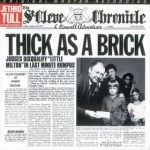
Until about 2007, Thick as a Brick was the undiscovered gem (by me anyway) in the Tull catalog. The pressings we’d heard up until then were nothing special, and of course the average pressing of this album is exactly that: no great shakes.

With the advent of better record cleaning fluids and much better tables, phono stages, room treatments and the like — taking full advantage of the remarkable number of revolutions in audio that have occurred over the last two or three decades –some copies of Thick As A Brick have shown themselves to be truly amazing sounding. Even the All Music Guide could hear how well-engineered the album was.

Marking Two Milestones from the Past

The 2007 commentary you see below discusses the pros and cons of both the British and Domestic original pressings. With continuing improvements to the system, room, etc., it would not be long before we realized that the British pressings were simply not competitive with the best domestic ones.

You might say this record helped us mark two important milestones in the developing history of Better Records.

The first, around 2007, was recognized by the fact that we had improved our playback to a very high level, one high enough to reproduce the album with all the clarity, size and energy we were shocked to hear at the time.

The second milestone would result from the audio changes we continued to make for the next couple of years, from 2007 to 2010, which allowed us to recognize that the best British pressings, as good as they might be, were not in the same league as the best domestic ones. We broke down in detail exactly what we were listening for and what were hearing in this commentary, and the Brits were clearly not cutting it at the highest levels by 2010.

If you find yourself with one of more British copies of the album that you think have superior sound — any copies of the album, really — we would love to send you one of our Hot Stampers so you can hear what you are missing.

(more…)

Folks, This Is Why We Love Vintage Analog

Hot Stamper Pressings of the Music of Emerson, Lake and Palmer Available Now

This is ANALOG at its Tubey Magical finest. You ain’t never gonna play a CD that sounds like this as long as you live. I don’t mean to rain on anyone’s parade, but digital media are evidently incapable of reproducing this kind of sound. There are nice sounding CDs in the world but there aren’t any that sound like this, not in my experience anyway.

If you are thinking that someday a better digital system is going to come along in order to save you the trouble and expense of having to find and acquire these expensive original pressings, think again.

This is the kind of record that shows you what’s wrong with your BEST sounding CDs. (Best not to talk about the average one in your collection, or mine. The less said the better.)

This is the kind of record that somebody might hear in a stereo store and realize that the digital road he’s been going down for so many years is nothing but a sonic dead end.

The organ captured here by Eddie Offord (of Yes engineering fame — we’re his biggest fans) and then transferred so well onto our Hot Stamper pressings (that’s partly what makes them Hot Stampers, right?) will rattle the foundation of your house. This music really needs that kind of megawatt reproduction to make sense.

It’s big bombastic Prog Rock that wants desperately to rock your world.

At moderate levels it just sounds overblown and silly.

At loud levels it actually will rock your world.

(more…)

Leftoverture – “…a certain ‘squawky, pinched’ sound to the guitars…”

Hot Stamper Pressings of Arty Rock Albums Available Now

This is one of the pressings we’ve discovered with reversed polarity.

This copy of Kansas’ most consistent album, their masterpiece I might venture to say, has an OFF THE CHARTS A+++ side two! This copy shows you the ROCK album they actually recorded. The average copy of Leftoverture only hints at the power of the band.

Side two just KILLED from start to finish, with the deepest, punchiest bass, moving up the frequency ladder to the clearest sweetest mids, and following it all the way to the top with the most extended grain-free, silky highs.

Most copies, like so many rock records from the era, are veiled and smeary. Often they lack extension at one or both ends of the frequency spectrum, more often than not up top, which results in harshness and shrillness, not the sound you want on a Kansas record.

But copies such as this one show you the kind of sound that is possible with Leftoverture. It is, in a word, SMEAR-FREE, with superb transients, textures and clarity that are the natural result of getting every last bit of musical information into the grooves.

(more…)

Emerson, Lake and Palmer’s Debut Is an Audiophile Must Own

Hot Stamper Pressings of the Music of Emerson, Lake and Palmer Available Now

Robert Brook has a blog which he calls

A GUIDE FOR THE DEDICATED ANALOG AUDIOPHILE

Below is a link to a review Robert Brook wrote for a pressing of the album I had loaned him so that he could hear just how good ELP’s debut can sound on one of our hottest Hot Stampers. Please to enjoy.

Emerson, Lake & Palmer and Why You NEED a Hot Stamper of THIS Record!


Robert’s Approach

Robert has methodically and carefully — one might even say scientifically — approached the various problems he’s encountered in this hobby by doing the following:


(more…)

Listening in Depth to Emerson, Lake & Palmer

Hot Stamper Pressings of the Music of Emerson, Lake and Palmer Available Now

If you’ve got the system to play this one loud enough, with the low end weight and energy it requires, you are in for a treat with Emerson, Lake and Palmer’s debut.

The organ that opens side two will rattle the foundation of your house if you’re not careful. This music really needs that kind of megawatt reproduction to make sense. This is bombastic prog that wants desperately to rock your world. At moderate levels it just sounds overblown and silly. At loud levels, it actually will rock your world.

To play this record right, you should have, at a minimum:

  • Big dynamic speakers, and they should be pulled out well into the room to create a three-dimensional presentation, in this case of a live rock concert. If the speakers are too big for the room, or stuck in the corners, you haven’t got a chance with a recording as powerful as this one.
  • A large room. (Our new studio has a 12 foot ceiling, a big help with a blockbuster recording such as this one.)
  • Strong walls with no windows, and, if possible, a concrete floor to keep the bass from leaving the room.
  • Seating for a single listener far from any boundary, especially the back wall (a common problem with small-ish rooms).
  • Extensive room treatments to deal with the loud levels this music requires.
  • Enough amplifier power driving speakers with big enough woofers to move all the air in the listening room with authority.
  • And, finally, high quality electricity, a heavily tweaked front end and all the rest of the audio stuff we discuss endlessly on this blog.

Without all of these things, it’s hard for us to imagine anyone could hear this record sound the way the artists and engineers wanted it to. Playing a record like this in a small room at moderate levels practically guarantees that the listener will not be able to hear what makes the best copies of this album so special.

(more…)

In the Court of the Crimson King – A Surprisingly Good Pressing from Mobile Fidelity

Hot Stamper Pressings of Progressive Rock Albums Available Now

The MoFi pressing shown here is surely one of their best.

Unfortunately, these days we have little tolerance for the dynamic compression, overall lifelessness and wonky bass heard on practically every record they ever mastered. Including this one.

One of the reasons your MoFi might not sound wrong to you is that it isn’t really “wrong.” It’s doing most things right, and it will probably beat most of what you can find to throw at it. A quick survey:

If you have the Atlantic pressing, from any era, you have never begun to hear this record at its best. It was cleary mastered from copy tapes, which is where its dubby sound comes from.

UK Polydor reissue? Passable, not really worth the labor to put them in a shootout just to have them earn mediocre grades.

The same can be said for some of the earliest UK Pink Label Island pressings.

None of them has ever won a shootout and probably none ever will. As a rule, we don’t buy them, for two related reasons:

  1. They are quite expensive in clean condition, and
  2. Their sound quality does not justify paying the premium price sellers typically ask.

We leave them to the record collectors who like to collect originals.

We and our customers are audiophiles. We like to collect records with good sound.

If we have our heads on straight, we don’t care what pressing we buy as long as it’s the one with the best sound. 

Back to the MoFi

It’s lacking some important qualities, and a listen to one of our Hot Stampers will allow you to hear exactly what you’re not getting when you play an audiophile pressing, any audiophile pressing, even one as good as MoFi’s.

Side by side the comparison will surely be striking. How much energy, size, power and passion is missing from the record you own?

There’s only one way to find out, and it’s by playing a better copy of the album.  (more…)

Thick as a Brick Is a Top Test Disc for System Accuracy

Hot Stamper Pressings of the Music of Jethro Tull Available Now

From 2009 to 2010 this was our single go-to record for testing and tweaking our system.

Although we now use an amazing copy of Bob and Ray (the big band version of The Song of the Volga Boatmen located therein has to be one of the toughest tests we know of), we could easily go back to using TAAB.

Artificiality is the single greatest problem that every serious audiophile must guard against with every change and tweak to his stereo. cleaning system, room, electricity and everything else.

Since TAAB is absolutely ruthless at exposing the slightest hint of artificiality in the sound of the system, it is clearly one of the best recordings one can use to test and tune with. Here are just some of the reasons this was one of our favorite test records back in the day:

Dynamics

The better copies are shockingly dynamic. At about the three minute mark the band joins in the fun and really starts rocking. Set your volume for as loud as your system can play that section. The rest of the music, including the very quietest parts, will then play correctly for all of side one. For side two the same volume setting should be fine.

Bass

The recording can have exceptionally solid, deep punchy bass (just check out Barrie “Barriemore” Barlow’s drumming, especially his kick and floor toms. The guy is on fire).

Midrange

The midrange is usually transparent and the top end sweet and extended on the better pressings.

Tubey Magic

The recording was made in 1972, so there’s still plenty of Tubey Magic to be heard on the acoustic guitars and flutes.

(more…)