beatles-test

On Please Please Me, Which Is More 3-Dimensional, Mono or Twin Track?

Hot Stamper Pressings of the Music of The Beatles Available Now

With all due respect to George Martin, we’ve played a number of mono pressings of Please Please Me in the past twenty or so years and have never been particularly impressed by any of them.

The monos jam all the voices and instruments together in the middle, stacking them one in front of the other, and lots of musical information gets mashed up and simply disappears in the congestion. 

But is twin track stereo any better?

Yes, when you do it the way Norman Smith did on Please Please Me.

Twin Track stereo (which is actually not very much like two-track stereo, I’m sure Wikipedia must have a listing for it if you’re interested) is like two mono tracks running simultaneously. It allows the completely separate voices to occupy one channel and the completely separate instruments to occupy another, with no leakage between them.

On some stereos it may seem as though the musicians and the singers are not playing together the way they would if one were hearing them in mono. They are in fact recorded on two separate mono tracks, the instruments appearing in the left channel and the singers in the right, separated as much as is physically possible.

Stuck in their individual stereo speakers, so far apart from one another, the members of the band don’t even seem to be playing together in the same room.

That’s on some stereos, and by some stereos I mean stereos that need improvement. Here’s why.

Three-Dimensional Mono?

In the final mixing stage, Norman Smith added separate reverb to each of the two channels, sending the reverb for the sound recorded in each channel to the opposite channel. This has the effect of making the studio, the physical space that The Beatles appear to be in, seem to stretch all the way from the right channel, where the Beatles’ voices are heard, to the back left corner of the studio, where the reverb eventually trails off.

(more…)

What the Shootout Winning Copies of A Hard Day’s Night Really Get Right

Hot Stamper Pressings of the Music of The Beatles Available Now

I wrote this bit of commentary about twenty years ago:

When comparing pressings of this record, the copies that get their voices to sound both present and warm, smooth, and sweet, especially during the harmonies, are always the best.  All the other instruments seem to fall in line when the vocals are correct. This is an old truism — it’s all about the midrange — but in the case of A Hard Day’s Night, it really is true.

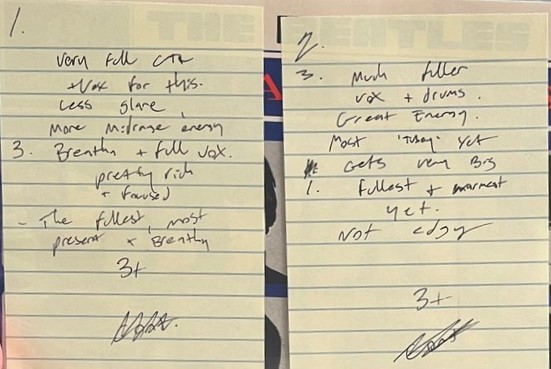
Now that we are putting our unredacted (!) shootout notes on the blog for everyone to see, here are the actual notes for the shootout winning pressing we just played (6/2025), notes that back up what we said so many years ago 100%.

What’s does this amazing side one sound like?

  • Very full guitars and vocals for this
  • Less glare
  • More midrange energy
  • Breathy and full vocals
  • Pretty rich and focussed
  • The fullest, most present and breathy vocals

And this amazing side two?

  • Much fuller vocals and drums
  • Great energy
  • Most “tubey” yet
  • Gets very big
  • Fullest and warmest yet
  • Not edgy

Both sides had qualities that did much to set them apart, coupled with fewer of the shortcomings we found in practically all the other pressings we played.

Less glary and less edgy are critical to the better pressings, simply because few copies are not glary and edgy in the midrange to some degree.

But the real keys to the shootout winners are vocals that are full, present, warm and breathy.

For The Beatles in 1964, nothing else about the sound of their recordings could possibly compete with those four qualities.

We could add two more. Energy would probably be the next most important one, followed by Tubey Magic.

That brings the total of most important qualities to a grand total six.

(more…)

Two Key Tracks for Testing Rubber Soul

Hot Stamper Pressings of Rubber Soul Available Now

Rubber Soul is one of the most difficult Beatles records to get to sound right. The individual tracks seem to vary drastically in terms of their tonality. Some (What Goes On) sound sweet, rich and near perfect. Others (You Won’t See Me) can be thin and midrangy. What’s a mother to do?

I think what we’re dealing with here are completely different approaches to the final mix. The Beatles were experimenting with different kinds of sounds, and their experiments produced very different results from track to track on this album more than practically any other I can think of besides The White Album (which was recorded in multiple studios by multiple producers and engineers).

Is Your Rig Up To It?

One final note: this is the kind of record that really rewards a good cartridge/ arm/ table combination. You do not want to play this record with a lean or bright sounding cartridge, or a front end that does not track sibilances well. (I could name some equipment that I would not want to play this record on, but rather than insult the owners of such equipment, let’s just say they will have a tough time with this record.)

The Toughest Test on Side One

Nowhere Man.” Unless you have an especially good copy this song will sound VERY compressed, much too thick and congealed to be as enjoyable as we know it can be. The best copies manage to find the richness in the sound as well as the breathiness in the vocals that others barely hint at.

Play this track on whatever copies you own (more than one I hope) and see if it doesn’t sound as compressed, thick and congested as we describe.

The Toughest Test on Side Two

(more…)

Are Your Cellists Digging In on I Am the Walrus?

This commentary was written many years ago.

Over the last decade I Am The Walrus has evolved into a good test for side one, a fact that came as a complete surprise to me. As I was listening to the various copies in a shootout years ago I noted that the opening cellos and basses in the right channel were often tonally identical from copy to copy, but sounded quite a bit more lively and energetic on some pressings relative to others. Was it EQ? Level? Compression?  

Why so much more passion from the players on some copies and not others?

As I tried to puzzle it out, playing first one copy and then another, it became clear to me what was happening. The cellists and the bassists were just plain digging HARDER into the strings on the best copies. When you see live classical music, the cellists at the front of the orchestra are usually sawing away with abandon when the music is really going. They dig their bows hard into the strings to make them vibrate as loud as possible. To make their instruments heard in the back row it becomes a matter of muscle, of pure physical exertion.

So armed with the copies where the string players are working the hardest, I checked the other tracks. Sure enough, the opening cut, MMT, jumped out of the speakers with the most energy I had heard on any copy. As I went through the tracks one by one, they had the most life of any of the copies I had been listening to. To use a word that was popular at the time, the music was HAPPENING.

This was the final piece to the puzzle. Tonality always comes first. Frequency extension; lack of distortion; rich, powerful bass — these are important qualities as well. But the life of the music is in the micro and macro dynamics, and that is what I had not been paying sufficient attention to during the shootout.

That was until I listened to Walrus and heard the players working up a good healthy sweat. Then I knew I had a Hot Stamper. And when I played the not-so-Hot Stampers, the string guys sounded like session musicians picking up a paycheck.

Where was their passion? Didn’t they realize they were making a classic?

If you get the right pressing they sure were!

(more…)

A Fun and Easy Test for Abbey Road: MoFi Versus Apple

More of the Music of The Beatles

There is a relatively simple test you can use to find out if you have a good Mobile Fidelity pressing of Abbey Road. Yes, as shocking as it may seem, they actually do exist, we’ve played them, but they are few and far between (and never as good as the best Brits).

The test involves doing a little shootout of the song Golden Slumbers between whatever MoFi pressing you have and whatever British Parlophone pressing you have. If you don’t have both LPs, this shootout will be difficult to do.

The idea is to compare aspects of the sound of both pressings head to head, which should shed light on which one of them is more natural and which is more hi-fi-ish sounding.

The Golden Slumbers Test

I’ve come to realize that this is a Key Track for side two, because what it shows you is whether the midrange of your pressing — or your system — is correct.

At the beginning Paul’s voice is naked, front and center, before the strings come in.

Most Mobile Fidelity pressings, as good as they may be in other areas, are not tonally correct in the middle of the midrange.

The middle of the voice is a little sucked out and the top of the voice is a little boosted.

It’s really hard to notice this fact unless one plays a good British pressing side by side with the MoFi.

Then the typical MoFi EQ anomaly become obvious. It may add some texture to the strings, but the song is not about the strings.

Having heard a number of audiophile systems (especially recently) that have trouble getting this part of the spectrum right, it would not be surprising that many of you do not find the typical MoFi objectionable, and may even prefer it to the good British copies. The point I’m belaboring here is that when it’s right, it’s RIGHT and everything else becomes more obviously wrong, even if only slightly wrong.

The Heart of the Midrange

For a while in my record reviewing system many years ago I had a relatively cheap Grado moving magnet cartridge. The midrange of that cartridge is still some of the best midrange reproduction I have ever heard. It was completely free of any “audiophile” sound. It was real in a way that took me by surprise. I played Abbey Road with that cartridge in the system and heard The Beatles sound EXACTLY the way I wanted them to sound.

(more…)

Listening For the Spirit and Enthusiasm of the Musicians

Hot Stamper Pressings of Revolver Available Now

The discussion below, brought about by a Hot Stamper shootout we conducted for Revolver quite a number of years ago (2007!), touches on many issues near and dear to us here at Better Records.

Some of the things we learned about Revolver all those years ago are important to our Hot Stamper shootouts to this very day, including, but not limited to:

  • Pressing variations,
  • System upgrades,
  • Dead wax secrets,

and the quality we prize most in a recording:

  • LIFE, or, if you prefer, energy.

At the end of the commentary we of course take the opportunity to bash the MoFi pressing of the album, a regular feature of our Beatles Hot Stamper shootouts. We’re not saying the MoFi Beatles records are bad; in the overall scheme of things they are mostly pretty decent. What we are saying is that, with our help, you can do a helluva lot better.

Our help doesn’t come cheap, as anyone on our mailing list will tell you. You may have to pay a lot, but with us you get what you pay for, and we gladly back up that claim with a 100% money back guarantee for every Hot Stamper pressing we sell.


The Story of Revolver, Dateline October 2007

(Incidentally, 2007 turns out to have been a milestone year for us here at Better Records.)

White Hot Stampers for Revolver are finally HERE! Let the celebrations begin! Seriously, this is a very special day for us here at Better Records. The Toughest Nut to Crack in the Beatles’ catalog has officially been cracked. Yowza!
(more…)

On A Hard Day’s Night, It’s (Almost) All About the Midrange

Hot Stamper Pressings of the Music of The Beatles Available Now

This music has a HUGE amount of upper midrange and high frequency information. (Just note how present the tambourines are in the mixes.) If the record isn’t cut properly, or pressed properly for that matter, the sound can REALLY be unpleasant. 

One of our good customers made an astute comment in an email to us — the typical copy of this album makes you want to turn DOWN the volume. Sad but true.

It’s (Almost) All About The Midrange

There are two important traits that all the best copies have in common.

Tonally they aren’t bright and aggressive (which eliminates 80 percent of the AHDN pressings you find) and they have a wonderful warmth and sweetness in the midrange that really brings out the quality of the Beatles’ individual voices.

(more…)

Rubber Soul – Twin Track for Me But Not for Thee

Hot Stamper Pressings of the Music of The Beatles Available Now

How is it that none of the critics of “twin track stereo” — the two-track recording approach used on the first two albums, with the elements hard-panned left and right — has ever come clean about the obvious twin track stereo sound of Rubber Soul?

We used tracks four, five and six to test side two with, and in all three the vocals are hard-panned right with most of the instruments hard-panned left. Why is it wrong for Please Please Me to sound that way — the mono mix being the critic’s choice — but fine for Rubber Soul to be heard that way? 

Tons of energy on the drums in the left channel are a key test.

In the right channel the shakers and tambourines are way up in the mix.

The bass is a bit lean compared to the other tracks and tends to get a bit lost. If you can follow the bass throughout the song, that’s a good sign.

Balancing the bass and drums in the left channel with the vocals and percussion in the right channel is not easy to do, which of course is what makes it a great test.

(more…)

John’s Really Digging a Pony. Are You?

Hot Stamper Pressings of the Music of The Beatles Available Now

The best copies of Let It Be are Demo Discs for energy, and here are some others that we’ve discovered are good for testing that quality on vinyl.

What blew our minds about the Shootout Winning side one we played recently was how outrageously big, open and transparent it was on the song Dig a Pony. As the song started up the studio space seemed to expand in every direction, creating more height, width and depth than we’d ever experienced with this song before. 

But there is no studio space; the song was recorded on Apple’s rooftop. The “space” has to be some combination of “air” from the live event and artificial reverb added live or later during mixing. Whatever it is, the copies with more resolution and transparency show you a lot more of “it” than run-of-the-mill pressings do (including the new Heavy Vinyl, which is so airless and compressed we gave it a grade of F and banished it to our Shame Hall).  (more…)