bloated-bottom

The records on this list tend to be boosted in the middle and the top of the bass range, causing their low end to be bloated and unnatural.

Note that it is the rare Half-Speed mastered record that does not suffer from bass bloat.

Sonny Rollins Plus 4 – Defending the Indefensible

Hot Stamper Pressings of the Music of Sonny Rollins Available Now

UPDATE 2026

We reviewed this album in 2014 or thereabouts. It came out in 2007, proving that Chad had learned nothing about the sound of jazz during the previous 13 years after having made his first foray into bad Heavy Vinyl.

Almost twenty years later has anything changed? Not to our ears it hasn’t.

In point of fact, the releases of his records and plenty of others’ we’ve auditioned over the last few years are every bit as bad or worse.

When you’re making a lot of money doing it the way you’ve always done it, why would you ever want to change?

To make a better sounding product? Yeah, that’s a good one. How do you improve on perfection?


I cannot recall hearing a more ridiculously thick, opaque and unnatural sounding pair of audiophile records than this 45 RPM Analogue Productions Heavy Vinyl release, and I’ve heard a ton of them. 

Surely someone must have noticed how awful these records sound.

So, being an enterprising sort, with a few idle moments to spare, I did a google search. To my surprise it came up pretty much empty. Sure, dealers are selling it, every last one of the bigger mail-order types.

But how is it that no reviewer has taken it to task for its oh-so-obvious shortcomings?

And no one on any forum seems to have anything bad to say about it either. How could that be?

We don’t feel it’s incumbent upon us to defend the sound of these pressings. We think that for the most part they are awful and want nothing to do with them.

But don’t those who DO think these remastered pressings sound good — the audiophile reviewers and the forum posters specifically — have at least some obligation to point out to the rest of the audiophile community that at least one of them is spectacularly bad, as is surely the case here.

Is it herd mentality? Is it that they don’t want to rock the boat? They can’t say something bad about even one of these Heavy Vinyl pressings because that might reflect badly on all of them?

(more…)

So at 45 RPM – One Side Bad, Another Awful, What’s a Mother to Do?

Hot Stamper Pressings of the Music of Peter Gabriel Available Now

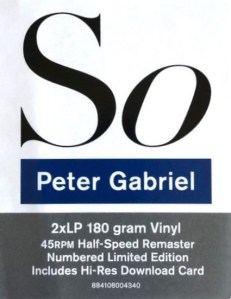
In 2016 a version of So came out using this currently popular vinyl format:

2 180g discs / 45 RPM / Deluxe, Numbered, Limited Edition /Half Speed mastered

As of this writing, there are 15 copies on Discogs, the cheapest of them starting at $139.77.

Sounds like it must be pretty good for that kind of money!

This So release was mastered by a fellow named Matt Colton, who has been doing this kind of work for a very long time, judging by the fact that he has 3,775 technical credits under his name on Discogs.

That did not stop this particular 2 LP set from being one of the worst sounding albums we have played in quite a while.

Let’s take a closer look at the specifics. We played sides one and four of the two-disc, four-sided album. That was more than enough to evaluate the sound quality.

(more…)

Can You Hear the Bloated Bass on This DCC Pressing?

Hot Stamper Pressings of the Music of Linda Ronstadt Available Now

UPDATE 2026

This review was written many years ago, around 2004 I think. This was one of the first DCC records I did an early pseudo-shootout for up against run-of-the-mill Mastering Lab domestic pressings.

I found, somewhat surprisingly, at least at that time, that the DCC came up short, as you will see in the review below. Down the road, Paul and Judy showed me once again what a fool I had been. In 2007, Joni was the last straw.


As much as I admire Steve Hoffman’s work for DCC, on this title the DCC is not as good as the best domestic copies.

The best domestic pressings are just plain more fun.

The DCC sounds thick in the midrange and fat in the bass, although some of that boost in the bass could have been used to the advantage of some of the domestic pressings we played. 1 DB or so at 50-60 cycles would help, but the DCC has a boost in the middle and upper bass that causes the bass to sound bloated next to a properly-mastered, properly-pressed LP. 

I like rich sounding records just like Steve does, but his version of this title is too rich for my blood. If your system is lean sounding you may prefer the DCC, but we found it less than agreeable over here.

(more…)

The Bloated Cello Sound Some Find Appealing

Hot Stamper Pressings of the Music of Claude Debussy Available Now

UPDATE 2026

We made a crack about the Starker Mercury recordings below which we gernerally no longer agree with, although I am sure there are some pressings which have bloated sound. Those are the ones that don’t win shootouts.


On this pressing we were a bit surprised at how natural the cello sounded — more like the real instrument and less like the typical recording of it. 

Normally when recording the cello, the microphones are placed fairly close to the instrument. This often results in what’s known as the “proximity effect,” which simply describes a boost in the lower frequencies relative to the more linear response of the microphone when placed at a distance.

The famous Starker cello recordings on Mercury — you know the ones, the originals and even the reissues sell for hundreds and hundreds of dollars — suffer from this effect, which audiophiles seem to prefer. (The Mercury heavy vinyl reissues, at least the ones I’ve played, were ridiculously fat and bloated in the bottom.)

Audiophiles did not seem to mind much, judging by the apparently strong sales and the rave reviews I read. Bass shy systems, and that means most of the systems owned by audiophiles, probably benefited from the bass boost.

Systems with lots of large woofers — at least in our case — would of course make the sound of these pressings positively unbearable. That indeed was our experience.

(more…)

Good Digital Beats Bad Analog Any Day

Hot Stamper Pressings of the Music of Sonny Rollins Available Now

And this is some very bad analog indeed!

We here present our 2010 review of the Sonny Rollins Plus 4 album, the one remastered on two slabs of 45 RPM Analogue Productions Heavy Vinyl.

It has everything going for it, right?

Steve Hoffman, Kevin Gray, 45 RPMs, Heavy Virgin Vinyl, fancy packaging — clearly no expense was spared!

The ingredients may have been there, but the cake they baked was not only not delicious, it was positively unlistenable — I mean, inedible.

I cannot recall hearing a more ridiculously thick, opaque and unnatural sounding “audiophile” pressing than this Rollins record, and believe me, I’ve heard plenty. (And it seems the bad news will never stop.)

As I noted in another commentary “Today’s audiophile seems to be making the same mistakes I was making as a budding enthusiast more than thirty forty years ago. Heavy Vinyl, the 45 RPM 2 LP pressing, the Half-Speed limited edition — aren’t these all just the latest audiophile fads, each with a track record more dismal than the last one?”

It reminds me of the turgid muck that Doug Sax was cutting for Analogue Productions back in the 90s. The CD has to sound better than this. There’s no way could it sound worse.


CD Update:

I managed to track down a copy of the CD and it DOES sound better than this awful record, and by a long shot. It’s not a great sounding CD, but it sure isn’t the disaster this record is.

Buy the CD, and whatever you do, don’t waste money on this kind of crap vinyl.


This is a very bad sounding record, so bad that one minute’s play will have you up and out of your chair trying to figure out what the hell is wrong with your system. But don’t bother. It’s not your stereo, it’s this record.

It has the power to make your perfectly enjoyable speakers sound like someone wrapped them in four inches of cotton bunting while you weren’t looking.

(more…)

Analogue Productions Fails Spectacularly Right Out of the Gate

Hot Stamper Pressings of Contemporary Albums Available Now

You may remember what a disaster the Analogue Productions version of Jazz Giant from the 90s was.

Or maybe you agree with a certain writer that they were god’s gift to the record lovers of the world in need of higher quality pressings. We thought they were crap right from the get-go and were not the least bit shy about saying so,

I haven’t heard the new 45 RPM version and don’t intend to play one, but I seriously doubt that it sounds like our good Hot Stamper pressings. We have yet to hear a single Heavy Vinyl 45 that sounds any good to us, judged by the standards we set in our shootouts.

Actually, to run the risk of sounding even more pedantic than usual, the records themselves set the standards.

We simply grade them on the curve they establish for themselves.

We guarantee that none of their LPs can hold a candle to our vintage records or your money back. If you have one of the new pressings and don’t know what’s wrong with it, or don’t think that anything is wrong with it, try one of ours.

It will show you just how much better a real record can sound, with more space, more transparency, more energy, more presence, more drive, more ambience — more of everything that’s good about the sound of music on vinyl.

It is our contention that no one alive today makes records that sound as good as the vintage LPs we sell. Once you hear one of our Hot Stamper pressings, those Heavy Vinyl records you bought might not ever sound right to you again.

(more…)

Acoustic Sounds Hired Doug Sax to Ruin a Classic Chet Baker Album

Hot Stamper Pressings of Jazz Recordings Featuring the Trumpet

The less said about this awful mid-90s Doug Sax remastering for Analogue Productions the better. What a murky piece of crap it was.

Audiophile reviewers may have been impressed, but even way back then we knew a bad sounding record when we played one, and that pressing was very bad indeed.

One further note: the Heavy Vinyl pressings being made today, twenty-five thirty-one years later, have a similar suite of shortcomings, sounding every bit as bad if not worse, and fooling the same audiophile reviewers and their followers to this very day.

Nothing has changed, other than we have come along to offer the discriminating audiophile an alternative to the muddy messes these labels have been churning out for decades.

(more…)

The Nautilus Half-Speed of Harvest Is Not Bad!

Hot Stamper Pressings of the Music of Neil Young Available Now

Sonic Grade: B

We haven’t played a copy of this record in more than a decade [make that two], but back in the day we liked it, so let’s call it a “B” with the caveat that the older the review, the more likely we are to see things differently now. 

In the early 2000s we wrote the following (please excuse the all-caps, I could barely type back then):

This is a SURPRISINGLY good sounding Nautilus Half-Speed mastered LP with AMAZING transparency.

The sound here is DRAMATICALLY more natural than your average audiophile pressing. Just listen to the phony top end found on most MoFis to see what we mean.

On this record you’ll hear none of the hyped-up highs that are MoFi’s claim to fame.

This Nautilus is sure to destroy the typical domestic pressing, which (before cleaning) will tend to sound opaque, thick and dull.

This Half-Speed wouldn’t really match up to our Hottest Stampers, but you could sure do a lot worse.

Although it’s a tad fat at the bottom, it still retains much of the warmth and richness found on the best copies.

(more…)

The Dreadful Sound of the Heavy Vinyl Reissues Doug Sax Mastered in the 90s

Hot Stamper Pressings of the Music of Sonny Rollins Available Now

Longstanding customers know that we have been relentlessly critical of so-called “audiophile” LPs for years, especially in the case of these Analogue Productions releases from back in the early-90s. A well-known reviewer loved them, I hated them, and he and I haven’t seen eye to eye on much since.


(Old) Newflash!

Just dug up part of my old commentary discussing the faults with the original series that Doug Sax cut for Acoustic Sounds. Check it out.

In the listing for the OJC pressing of Way Out West we wrote:

Guaranteed better than any 33 rpm 180 gram version ever made, or your money back! (Of course I’m referring to a certain pressing from the early 90s mastered by Doug Sax, which is a textbook example of murky, tubby, flabby sound. Too many bad tubes in the chain? Who knows?

This OJC version also has its problems, but at least the shortcomings of the OJC are tolerable. Who can sit through a pressing that’s so thick and lifeless it communicates none of the player’s love for the music they’re making?

If you have midrangy transistor equipment, go with the 180 gram version (at twice the price).

If you have good equipment, go with this one.


UPDATE 2015

We are no longer fans of the OJC of Way Out West, and would never sell a record that sounds the way even the best copies do as a Hot Stamper. It’s not hopeless the way the Heavy Vinyl pressing is, but it’s not very good either. It’s yet another example of a record we was wrong about.

Live and learn, right?


(more…)

The MHS Recording of Chopin’s First Piano Concerto Had the Most Natural Piano of Them All

Hot Stamper Pressings of the Music of Frederic Chopin Available Now

There are some wonderful Musical Heritage Society records sitting in the bins of your local record store or Goodwill, and this one is worth picking up just to hear how well recorded the piano is.

We described it this way:

Beautiful piano. The most natural and realistic mix with the piano not in the foreground.

But there is more to the recording than the sound of the piano.

Smeary, bloated and dry orchestra holds it back.

Well, at least we tried. (Note that side two was deemed not worth grading.)

Our favorite recording for performance and sound is the Living Stereo from 1961, LSC 2575, with Rubinstein at the piano and Skrowaczewski conducting the New Symphony Orchestra of London.

This is what we had to say about the sound of our Shootout Winner:

We love the huge, solid and powerful sound of the piano on this recording. This piano has weight and heft. As a result, it sounds like a real piano.

For some reason, a great many Rubinstein recordings are not capable of reproducing those seemingly all-important qualities in the sound of the piano.

Those are, as I hope everyone understands by now, the ones we don’t sell. If the piano in a piano concerto recording doesn’t sound solid and powerful, what is the point of playing such a record?

Or, to be more accurate, what is the point of an audiophile playing such a record? (Those of you who would like to avoid bad sounding vintage classical and orchestral records have come to the right place. We’ve compiled a very long list of them for precisely that purpose, and we add to it regularly.)

(more…)