Stan Goodall, Engineer – Rev/Com

Stan Goodall mastered records for Decca.

Every Last One of These Bartok Records with Ansermet Was No Good

Hot Stamper Pressings of the Music of Bela Bartok Available Now

Every last one of our London pressings of Concerto for Orchestra was a disaster: smeary strings, blary brass and painfully shrill throughout, with no top or bottom to speak of, the very definition of boxy sound.

The entire group of CS 6086 we had on hand — whether on Blueback or Whiteback, we had a good selection of both — were much too unpleasant to be played on high quality modern equipment.

Why had I been buying them for years?

I made the mistake of assuming that the phenomenally talented Decca engineering and producing team who worked on this project could be relied upon to produce a top quality recording of the Concerto for Orchestra.

As it turns out, my guess turned out to be wrong.

I had made the mistake of believing in the infallability of experts.

I talk about the team of producers and engineers seen below in listing after listing, raving about the amazing sound of the recordings produced by them in the 50s and 60s, many of which are right at the top of the best sounding recordings I have ever had the privilege to play.

(more…)

Our Top Copy of Iberia Lacked a Measure of Weight and Tubey Magic on Side Two

Hot Stamper Pressings of Recordings by Decca Available Now

Subtitled:

The Thrill of Hearing Massive Sound on an Orchestral Blockbuster of the First Order.

We described our most recent shootout winning pressing this way:

This superb classical release (the first copy to hit the site in close to two and a half years) boasts big, bold, dynamic Shootout Winning Triple Plus (A+++) sound or close to it throughout this early London pressing.

The notes rave about this copy: “huge and spacious, strong strings and brass, very rich, well-defined low end, sweet and rich and textured strings, gets massive and extends both up high and down low.”

Here you will find the huge hall, correct string tone, spacious, open sound that are hallmarks of all the best vintage orchestral pressings.

Listen to the plucked basses – clear, not smeary, with no sacrifice in richness. Take it from us, the guys that play classical recordings by the score, this is hard for a record to do.

Below you can find our actual shootout notes for that copy.

We discovered that side two was slightly lacking in some ways. We had a side two on another copy that was better than the 2.5+ side two you see here.

When we played the two best copies back to back, side one of this copy came out on top, earning a grade of 3+, but the side two of another copy showed us there was potentially even more weight and Tubey Magic to the recording than we had expected after hearing a number of copies by that point in the shootout.

As a consequence we felt it best to drop side two’s grade a half plus to 2.5+. Initially it was graded “at least 2+”, and the grade was then raised to 2.5+ after playing it head to head in the final round against the eventual shootout winner.

We marvelled at these specific qualities in the sound of side one.

Track Three

  • Huge and spacious
  • Strong strings and brass
  • Very rich
  • Well defined lows

Track Two

  • Sweet and rich and textured strings
  • Gets massive
  • Extends at both ends of the frequency spectrum

“Gets massive” is something we don’t say about too many records, but the best Hot Stamper pressings of Orchestral Spectaculars such as this one can certainly get massive if you have the speakers, the power to drive them, and the room big enough to unleash the kind of orchestral power found on these phenomenal sounding LPs.

In our experience, if you really want to hear this kind of “massive sound,” an early pressing of a Decca recording from 1960 is a good place to go looking for it.

You are very unlikely to hear it on any record made in the last fifty years, although we can’t say it isn’t possible.

Allow us to save you some trouble looking for love in all the wrong places. Take our word and skip the more than forty remastered classical and orchestral titles we’ve played over the years that badly missed the mark. (For other kinds of music there are hundreds more.)

Side two was nearly as good:

(more…)

When Fisher Took Over from Goodall, He Really Let the Side Down

Hot Stamper Pressings of Recordings by Decca Available Now

Please keep in mind that, as per our usual, the record you see pictured is not the record we are discussing in this posting.

The stamper numbers you see below belong to a different album.

The quick takeaway: Stan Goodall (“E”) cut the Shootout Winning early pressings.

Then, for reasons known only to the folks at Decca, Harry Fisher (“W”) took the reins and managed to cut some side twos that were very good. Not as good, but still very good: 2+ most of the time, some slightly worse. They were not as weighty or rich, and we take a lot of points off for records that are not as weighty or rich as they should be.

By the time Decca had changed its label to the Decca in a Box design, Mr. Fisher was cutting all the pressings, and, in our experience, not doing an especially good job. We do not even offer records with grades that low.

The sound might be passable, and would probably still be better than whatever Heavy Vinyl pressings might have been made from the tapes in the last twenty years, but that’s not good enough for us here at Better Records, not at the prices we charge anyway.

We described Fisher’s sound as dry and hot on side one, and thin and very small on side two of the 5W-stamped pressing we played. We only had the one, and the reason we had even one after having heard other Boxed Decca pressings do poorly, is that it’s a good way to stay honest and to have a better baseline to work with.

If we played nothing but 3E/1E originals, most of those 1E side twos would have earned a 2+ grade, but they would have sounded much better than the 2W-graded copies, and that seriously screws up the grading scale, especially when clean originals cost us a hundred bucks or more these days.

(more…)

This Blueback Was Somewhat Opaque and Crude – Does that Surprise You?

Hot Stamper Pressings of the Music of Felix Mendelssohn Available Now

Presenting our latest findings from 2023:

For our most recent shootout, the original we played earned grades of 1.5+ on both sides, a grade that is the absolute minimum for a Hot Stamper pressing to be listed on the site now.

Our best reissues killed it.

The 3D/3E stampers of our early Blueback copy can probably be beaten by others — assuming there are others — but this is just not a good bet for us when it comes to Mendelssohn’s famous Third Symphony, not when there are so many other pressings with superior sound.

Our favorite performance with top quality sound is made from the same recording you see here, but on a certain budget reissue that has much better sound.

It’s very possible that the Speakers Corner Heavy Vinyl pressing from 2003 pictured below would beat the original we describe. We make no claims that it doesn’t, or wouldn’t.

Our claim would be that a properly-mastered, properly-pressed version of the album is very unlikely to be bested by something from Speakers Corner, or any other label making records during the last thirty years.

What I would have played against the Speakers Corner pressing in 2003 would have been an original London Blueback, and maybe a Stereo Treasury or two. Both of them would have been obvious choices, and I was stuck making obvious choices because I simply did not understand enough about classical records at the time to do otherwise.

I confess I knew very little about the recording of the 3rd symphony back in those days, and I certainly didn’t know how good some of the right reissues could sound.

Obviously we needed to do a great deal more research and development, which we began to undertake over the course of the next twenty years in a much more serious way, making one discovery after another.

And that all happened out of the love for great sounding music on vinyl, and, every bit as importantly, because we get paid to do it.


(more…)

On this Wonderful Sounding London, Is Ted Burkett’s 2G Stamper the Way to Go?

Hot Stamper Pressings of Recordings by Decca Available Now

Before we go any further, let me say that the record you see pictured is not the record whose shootout and stampers we are about to discuss.

Yes, that’s right, the stamper numbers you see below belong to a different album.

We’ve lately been giving out much more stamper information than we used to, but for now we are keeping this title close to the vest.

What can we learn about the best sounding pressings of this vintage Decca recording, mastered by Mr. E and Mr. G, both outstanding mastering engineers?

It seems that Mr. G cut the better sounding pressing, our shootout winner as a matter of fact, but I can’t say whether the pressing that won was an original, since there were two differently-mastered Blueback pressings in the shootout, and one of them came in tied for last.

It was actually beaten by two copies of the Whiteback reissue. Those seem to be made from the same stampers as the winning pressing, but are those stampers the earliest or did they come later? Who knows?

Mr E. cut a version of the record that was quite a bit less impressive than most of the others, earning grades of 1.5 on side one and 2+ on side two.

Side one was dry and flat, side two rich but hard. We hear a lot of records with these shortcomings. If you play lots of classical music on vintage vinyl, you should be hearing them too.

And Your Point Is?

(more…)

The Early London Pressings Of Schubert’s 9th Are Awful

Hot Stamper Classical and Orchestral Imports on Decca & London

There are plenty of Deccas and Londons that we’ve cleaned and played over the years that were disappointing, and some of them can be found here.

What was most striking about this shootout was how poorly the original London Bluebacks (CS 6061) fared when going head to head with the best vintage reissues. In fact, they were so obviously inferior I doubt we would have even needed another pressing to know that they could not possibly be considered Hot Stampers.

The two we had were crude, flat, full of harmonic distortion, and both had clearly restricted frequency extremes.

In other words, it just sounded like an old record, and not a very good one at that. The world is full of them.

But I remember liking the Blueback pressings I played ten or twenty years ago.

Did I have better copies, or was my system not capable of showing me the shortcomings I so clearly heard this time around? Since this is a question that cannot be answered with any certainty, we’ll have to leave it there.

Our favorite performance of the work is this one with Krips and the LSO, but on a much later reissue pressing produced by Decca in the 70s. Imagine that!

(more…)

Decca’s Violin Concerto Recordings on the Early Label Are Hard to Beat

Hot Stamper Pressings Featuring the Violin Available Now

Lately we’ve been having exceptionally good luck with the early label pressings of many of the London violin concerto records we’ve done shootouts for.

The notes you see below are fairly typical. However, the notes you see below do not belong to the wonderful Sibelius record pictured here.
They belong to another London record. We give out lots of bad stampers on this blog, but almost never do we give out the good ones. (When we do give out the best stampers, we keep the title a mystery, as is the case of the record here.)

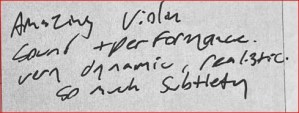
The amazingly good sounding pressing on the early label took the recording to another level. Our shootout notes read:

  • Amazing violin sound and performance.
  • Very dynamic and realistic.
  • So much subtlety.

Key Takeaways

  • The top four copies all had the same stampers, yet the sound varied noticeably from side to side, from Super Hot (A++) to White Hot (A+++), with one earning the grade between, Nearly White Hot (A++ to A+++).
  • We’ve done this shootout a few times before. Since we know that the best copies are going to be on the early label, those are mostly the copies we’ve been stocking up on whenever possible.
  • We also buy the second label copies if the price is right, and in this case we had a couple on hand to play, both of which earned a Super Hot stamper grade on one side and something slightly lower on the other.
  • They aren’t as big as the best, nor do they extend as much up high or down low.
  • Keep in mind that even worst of the second label copies are still very good sounding records, beating practicallly any orchestral recording that can be found on Heavy Vinyl (with only two exceptions we know of, one of which is this lovely title).
  • The second labels are fairly impressive, but it is unlikely you would find yourself calling them amazing.
  • Amazing is what you say when you play that one very special original pressing out of four and can hardly believe what your ears are telling you.
  • How many audiophiles will go to the trouble of finding, buying, cleaning and playing four original copies in order to find the one with sound that soars above the rest? Let’s just say we only know of one, and he writes a blog very much like this one.

What It Takes

If you have big speakers and you play them at loud levels in a large enough room, on the highest quality equipment, tweaked and tuned to within an inch of its life, you can get a lot closer to the sound of live music in the home than most audiophiles will ever be able to experience for themselves.

(more…)

Neither of These Tchaikovsky 5ths Made the Grade

More of the music of Peter Ilyich Tchaikovsky (1840-1893)

We’ve been playing quite a number of different pressings of Tchaikovsky’s Symphony No. 5 lately, hoping to find a 5th that would really knock us out.

Most have left us unimpressed with the quality of the sound, and in the case of this Solti on London, the performance.

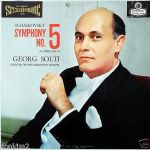
London CS 6117. Solti conducts the Paris Conservatory Orchestra.

The sound is OK. It’s fairly tubey and there’s a decent amount of energy to the recording.

The problem is not the sound, the problem is that the performance is terrible. Our main listening guy said he could hardly recognize the music!

DG SLPM 138 658. Mravinsky conducting the Leningrad Phil on an early pressing from 1961.

Big energy and a great performance but the string tone is shrill and smeary.

We are very used to hearing this kind of sound on Deutsche Grammophon records. This is why you see so few of that label’s pressings on our site.

How Did We Figure All of This Out?

There are more than 2000 Hot Stamper reviews on this blog. Do you know how we learned so much about so many records?

Simple. We ran thousands and thousands of record experiments under carefully controlled conditions, and we continue to run scores of them week in and week out to this very day.

(more…)

Forget the STS Labels with Black Print on Images Pour Orchestra

More of the music of Claude Debussy (1862-1918)

None of the pressings on this later Stereo Treasury label that we played in our most recent shootouts were very good, unlike the Silver Print labels, which can sound quite respectable.

At this stage of the game, we’ve learned our lesson and will not be giving any more of the Black Label pressings a chance. This goes for practically all the records we’ve played on the later Stereo Treasury label. They rarely sound any good and just aren’t worth the trouble now that we know what the best pressings are.

Both the Ansermet on London and the Munch on RCA are better recordings, but both sell for quite a bit more money than the Stereo Treasury pressings we offer, so if you can’t see spending the kind of bread they command, there is a much more affordable alternative that is guaranteed to satisfy.

(more…)

This Blueback of Le Cid Was Just Awful

Hot Stamper Classical and Orchestral Imports on Decca & London

Don’t buy into that record collector/audiophile canard that the originals are always the best sounding pressings.

This original Blueback pressing — true, we only had the one, so take it for what it’s worth — was a complete disaster: shrill, with no top or bottom to speak of, the very definition of boxy sound.

Our current favorite for sound and performance is the one Fremaux conducted for EMI in 1971.

It had been on the TAS List for some time, but we confess we didn’t bother finding out how good it was until about five years ago when it became clear to us what a wonderful conductor Louis Fremaux could be.

Here are some other Hot Stamper pressings of TAS list titles that we like.

Back to London

The sound of the London original you see above was much too unpleasant to be played on high quality modern equipment. There are quite a number of others that we’ve run into over the years with similar shortcomings.

(more…)