Soundtracks – Reviews and Commentaries

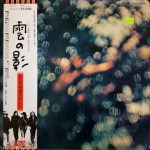
Obscured By Cloudy Japanese Vinyl

Hot Stamper Pressings of the Music of Pink Floyd Available Now

When I was just getting up to speed in audio and exploring the world of music available on vinyl in the 70s, many of the stereo stores I frequented carried Japanese pressings. They were widely believed to have superior sound relative to their domestic counterparts — in this case, the mass-produced pressings I would see at the Tower Records right across from the Sports Arena in my hometown of San Diego. I went there at least once a week, probably more like two or three times.

Tower was far and away the best place to go record shopping in those days. The store was huge and they had dramatically more stock than Licorice Pizza or The Wherehouse.

They also had a separate section for Half-Speed mastered pressings from a number of labels, which of course was the first place in the store I would visit, digging through the bins to see what new remastered titles may have been produced for audiophiles searching for the ultimate in sound quality.

Of course, I identified as just such a person. In terms of sound quality, and with the extremely limited knowledge I had acquired at the time, I believed I set a high standard for the sound of the records I bought. I was willing — eager even, you could even say excited — to pay whatever premium price I had to for a record that was sure to deliver superior sound quality. To me, in the late 70s, that meant two things: direct to disc recordings, and Half-Speed mastered pressings.

(There was a another category of records that did not fall into the above two, best exemplified by American Grammaphone and the Fresh Aire series, but the less said about those schlocky releases the better, other than to point out that some of their titles are TAS list carryovers from HP’s time running the Super Disc list, specifically Fresh Aire 2 and 3, both best avoided.)

And, like any other open-minded individual, when it came to Japanese vinyl I was willing to give a few a spin.

However, the more of them I bought, the more clear it became to me that even the best of them sounded mediocre (veiled, smeary and dubby from second generation tapes) and more often than not they were just plain awful. (Second generation tape issues being the main problem, of course, with the additional insult of poor tonality, the result of being mastered using wacky equalization, typically with added brightness where none was needed.)

Pink Floyd

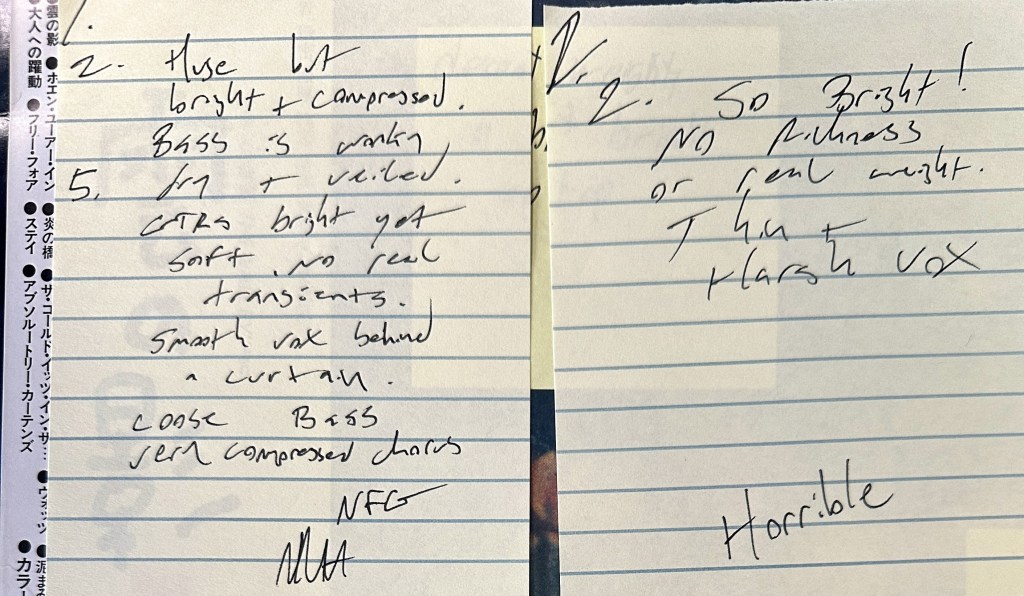
The notes for the Pink Floyd album you see below, Obscured by Clouds, were written sometime in March of 2025 as part of the shootout we conducted for the album.

If we assume it would be an audiophile who would be attracted to this pressing, perhaps for its quieter playing surfaces, perhaps operating under the assumption that the Japanese engineers mastering the record would be more likely to do a better job as well, then what we have here is a textbook case of an audiophile bullshit pressing.

One that sounds nothing like the album is supposed to, based on having played a number of exceptionally good sounding copies, all British and all on the Green Harvest label, mastered from good tapes, sometimes by the legendary Harry T. Moss. We feel we are more than qualified to make these judgments. If we can’t make them, nobody can.
Discogs allows us to glean some information regarding the desirability of this Japanese reissue with the record buying public currently in the market for Pink Floyd vinyl who register on their site.

(more…)

This Is What We Refer to as “Blockbuster Sound”

Hot Stamper Pressings of the Music of Bernard Herrmann Available Now

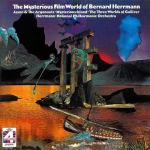
The Mysterious Film World of Bernard Herrmann is an outstanding recording, with a huge three-dimensional stage. It’s open and clear, with an extended top and plenty going on down low. The sound on the best pressings is nothing short of amazing.

This is Demo Disc quality sound by any measure, especially on big speakers at loud levels.

Side one boasts some wonderful material from Mysterious Island and Jason and the Argonauts. Who else but Herrmann could have orchestrated such phantasmagorical goings on?

The Three Worlds Of Gulliver Suite takes up all of side two. The complete score from which the suite is taken can be found on the original Herrmann album The Three Worlds of Gulliver, a long-time and extremely rare member of the TAS Super Disc List.

Borrowing from the Best

One reason this music is so wonderful is because it’s been more or less lifted from, and orchestrated exactly like, Rimsky-Korsakov’s The Tale of Tsar Saltan.

Herrmann was no doubt familiar with Rimsky-Korsakov’s work, and knew that his “sound” was exactly the one that would work for the film. He overlayed his own compositional style onto Rimsky-Korsakov’s, and the result is a soundtrack of breathtaking beauty, full of exotic instrumental colors and delicious audiophile-candy percussion.

(more…)

Phase IV and the TAS List – Three-Dimensional Depth, Transparency and Space

Hot Stamper Pressings of Phase 4 Recordings Available Now

The best Hot Stamper pressings of this TAS List album, one of the greatest and most famous orchestral blockbuster soundtracks ever recorded, more than live up to our expectations for Decca Phase 4. This is Phase 4 done right.

As with all the best Herrmann releases, the huge size and scope you hear is the sound of orchestral music recorded in glorious analog.

The sound is so clear, spacious and three-dimensional that you will feel as if your speakers have disappeared before your very eyes.

The layering of depth is really something to hear on the best copies, with choirs of brass instruments located precisely in space, some further back, some off to the side of the soundstage. And what a soundstage it is, so wide and deep.

Transparency is what allows this all to sound real.

Opacity Vs. Transparency

Note that we have been especially anti-Heavy Vinyl in our recent commentaries for their consistently opaque character, the opposite of what makes it possible to hear into the music, deep into the soundstage, to see and hear all the instruments, even the ones placed far back.

Try that with any Classic Records or Speakers Corner pressing. It’s records like this that show you precisely what you have been missing all these years if you have been collecting and playing releases from those two labels and the others like them.

Tubey Magic with Clarity

Yes, Decca in 1977 managed to keep its lovely Tubey Magical analog sound without getting mired in the muck of tube smear and thickness, the kind that bedevils so many pressings from the 50s.

Couple that with real bite to the brass and texture to the strings and you have the best of both worlds on one record.

(more…)

The Insufficiently Dedicated Will Struggle Mightily with the Music of Bernard Herrmann

A spectacular orchestral dreadnought such as this requires mastering and pressing of the highest quality.

Herrmann’s music taxes the limits of LP playback itself, with deep organ notes (listen for the famous Decca rumble accompanying the organ if you have the deep bass reproduction to hear it); incredible dynamics from every area of the stage; masses of strings playing at the top of their registers with abandon; huge drums; powerful brass effects everywhere — every sound an orchestra can produce is found on this record, and then some.

You will hear plenty of sounds that defy description, that’s for sure. Some of the time I can’t even imagine what instrument could possibly make such a sound!

Your Hard Work Pays Off

A recording of this size and scope will bring virtually any stereo system to its knees. This is the real Power Of The Orchestra! You had better have a top quality front end if you want to play this record properly, not to mention plenty of power and big speakers.

This is not the record for the weekend budget audiophile. If you haven’t put in the years of effort and invested the tens of thousands of dollars in equipment and room treatments it takes to play records of great difficulty such as this one, your system is probably not up to the challenge this album represents.

If, on the other hand, you’ve done the work and spent the money, this is the album that will show you what you have achieved.

Side One

Journey to the Center of the Earth

All those lovely harps! You can practically feel the cool air of the cave as you descend into the blackness.

The Seventh Voyage of Sinbad

Side one boasts some wonderful material from Jason and the Argonauts, including the fight with the skeletons that we all remember from our Saturday matinee movie days. Who else could have orchestrated such a film?

Side Two

The Day the Earth Stood Still

Astonishingly powerful deep bass and drum sounds!

Fahrenheit 451

One of our key tests for side two is the string tone on the Fire Engine sequence.

(more…)

Our Previous Shootout for Hatari Was 15 (!) Years Ago

Hot Stamper Pressings of Soundtrack Recordings Available Now

It’s 2024 and we’ve just finished a big shootout for the album, our first since 2009.

Here is what the best copy sounded like, amazing in every way.

Here is our listing for a very good sounding copy.


Our Review from 2009

This Super Hot Stamper pressing is one of the BEST COPIES we’ve ever played! Both sides earned very high A Double Plus honors, beating practically all the other copies we played it against. The sound is relaxed, natural, and musical, with an incredibly sweet top end. 

The overall sound is airy, open, spacious, and SUPER transparent. The brass on this copy also sounds just right: breathy with a nice bite, avoiding most of the blarey quality we heard on so many other pressings. (There is a touch of smear on even the best copies; this one is no different.)

The sound is super 3-D. You’re not going to believe all the ambience surrounding this room full of musicians, especially on the drums! We LOVE that sound.

Baby Elephant Walk is of course the track everyone knows, and just wait until you hear how breathy the calliope is here. When the piccolos come in watch out! There is more high frequency information on this album from the woodwinds alone than from all the instruments on 99 out of 100 other records. (A tough tracking test if ever there was one!)


Find this video and play it on hi-fideity speakers if you have any hooked up to your television. The brass are especially powerful here but my computer speakers clearly cannot do them justice.

The Fantasy Film World of… “Did MoFi bother to listen to this before they ruined it?”

Hot Stamper Pressings of the Music of Bernard Herrmann Available Now

Sonic Grade: F

Obviously our customers know by now that a Hot Stamper London or Decca pressing is going to be far better than the Anadisq that MoFi cut in the mid-90s.

How much better?

Words fail me.

Their record was a complete disaster. Perhaps some of the MoFi collectors didn’t notice because they had nothing to compare it to. 

God forbid they would ever lower themselves to buy as common a pressing as a London. Had they done so, what they would have heard is huge amounts of musical information that is simply nowhere to be found on the MoFi.

There is a place on this album, I failed to note exactly where, in which a group of tubas play a descending scale that is somewhat buried in the mix. On the London, they can clearly be heard and recognized as tubas. On the MoFi, I don’t think they can be heard except as some general group of low notes, and anyone thinking that they were tubas would be guessing, the sound is that murky, muddy, and ill-defined.

Robert Pincus once left a Post-It note stuck to the MoFi jacket of a copy he was playgrading for me that summed up our thoughts on the quality of their mastering to a “t”:

“Did MoFi bother to listen to this before they ruined it?”

It’s positively shameful. This music is so good. On top of that, it’s custom made for audiophiles. Audiophiles are the ones who can appreciate the new colors Herrmann created, using what a wise man once called the single greatest instrument ever invented: the symphony orchestra.

If this Mobile Fidelity LP isn’t the perfect example of a pass/not-yet record, I can’t imagine what would be. To find a more poorly remastered record, you would really have to work at it.

(more…)

Was It Even Possible for Harry Pearson to Create a Meaningful Super Disc List?

Hot Stamper Pressings of TAS Super Disc Recordings Available Now

A customer brought up Harry Pearson in a discussion we were having about the best sounding records, which went a little something like this:

“You’re as much a pioneer as Harry Pearson ever was, and your authenticity is unchallengeable…”

Even I wouldn’t go that far! We make plenty of mistakes, and we learn new things about records all the time, so calling us “unchallengable” is a bit off the mark. However, we are always up for the challenge, and are happy to put our records up against any and all comers.

As far as Harry Pearson, I had this to say about the man:

Very kind of you to say. I think Harry could have been much better at his job if he had had access to modern record cleaning technology, better playback, and a staff of people playing thousands of records every year to help him discover the best sounding pressings.

No one can succeed as a one man show in audio. Audio is too complicated. It takes a team of dedicated professionals with expertise in every area of audio and record collecting to do it right.

He never understood stampers and the like because he didn’t have the research staff to get the data he would have needed to test all the stamper variations and learn from them.

He was stuck at the level of labels, and also not nearly skeptical enough of the idea that “the original is better,” a myth audiophiles cling to to this very day. That, and the superiority of the Heavy Vinyl remaster, which we both know is a crock of sh*t.

TP

Our comments for The Fantasy Film World of Bernard Herrmann have something to say about these same issues.

Decca Versus London

There’s a reason this record is on the TAS List of Super Discs — if any LP should be called a Super Disc, this one should. (With Phase Four sound you might even call it a Super-Duper-Disc.)

But Harry is, not atypically, rather misinformed about the catalog number and country of manufacture. He exclusively admits the Decca pressing to his list, and that is clearly contrary to our experience in general as well as our findings for this shootout. The best Decca pressing we played rated no better than a B+ for either side. That’s five — count them, five — sonic grades lower than the A Triple Plus sides of our best London copy.

If you are one of those audiophiles who’s been following Harry down the rabbit hole for years, discovering a little site called Better Records may just turn out to be a life-changing event. Here you can find records that live up to the hype, ours and his.

Selling the Hype

Record dealers that sell records based on their reputation — and that means pretty much all of them — are selling the hype.

If they haven’t played the record, they can’t tell you what it sounds like, TAS List or no TAS List.

The catalog number may be right, but finding the sound that lives up to the description can only be done one way: by playing the record.

Most copies of The Fantasy Film World, whether they have a Decca label or a London one (all of the ones we are selling are mastered and pressed by Decca; some get one label and some get the other) leave much to be desired.

Casino Royale Is Really a Mess on Classic Records Vinyl

Hot Stamper Pressings of the Music of Burt Bacharach Available Now

Casino Royale under the sway of Bernie’s penchant for bright, gritty, sour, ambience-challenged sound? Not a good match. There is no reissue, and there will never be a reissue, that will sound as good as a properly-mastered, properly-pressed, properly-cleaned original.

And I hope it would go without saying that most copies cannot begin to do what a real Hot Stamper original can.

As is often the case, the Classic Heavy Vinyl Reissue is simply a disgrace.

Is it the worst version of the album ever made?

That’s hard to say. But it is the worst sounding version of the album we’ve ever played, and that should be good enough for any audiophile contemplating spending money on this Heavy Vinyl trash. Our advice: don’t do it.

Star Wars, Close Encounters and Other Multi-Miked Messes

Decca and London Hot Stamper Pressings Available Now

This Mobile Fidelity LP contains the music of Star Wars and Close Encounters, conducted by Zubin Mehta. The MoFi pressing is far more transparent than the London pressings we have auditioned of the album, even the ones half-speed mastered by Stan Ricker himself.

Yes, he cut the original Londons! At Half Speed! (We’ve also played some later pressings not mastered by Stan, of course. Who can predict which version would sound the best?)

It’s still one of the better MoFi remasters, all things considered. The music, to these ears, has always been hi-fi-ish schlock, and the recording itself is too multi-miked to be taken seriously. It sounds far too much like a bad Phase IV recording, and we know whereof we speak when it comes to Phase IV, good or bad. We’ve played them by the score.

This famous record from the Top Seven of the TAS Super Disc List has the same problem, but I never hear anybody mention it. Why that is I cannot imagine, other than our favorite explanation for just about everything that seems to fly under the audiophile radar, or perhaps a better description would be flying over the heads of the self-appointed audiophile cognoscenti, our old standby, reviewer malpractice.

Bottom line, a loser, but the original Londons in our experience are even worse!

For more on the subject of opacity on record, click here and here.

(more…)

Symphonic Dances and the Need for Full Brass and Clean Cymbals

Hot Stamper Pressings of Orchestral Spectaculars Available Now

This reissue had the sound we were looking for!

One of the biggest advantages this copy had over most of what we played is fuller brass. The shrill sounding horns on most Columbia albums is what gets them tossed in the trade pile.

Fortunately for us audiophiles who care about these sorts of things, the sound here is rich and clean, with solid, deep bass. The stage is huge, with the multi-miking kept to a minimum so that you can really hear the space this big group of musicians occupies.

This pressing is a reissue, not a Six Eye original. The reason this particular LP beat every other pressing we played comes down to one specific quality — the top is dramatically cleaner and more extended.

There is a HUGE amount of top end on this recording. Wildly splashing cymbals and other percussion instruments are everywhere, and they are a joy to hear. No original was as clean up top as this reissue, and without a clear, (mostly) distortion-free top end, the work will simply not sound the way Bernstein wanted it to.

All that percussion is in the score. The high-frequency energy – perhaps the most I have ever heard from any recording of his music — is there for a reason. He conducted his own score, and one can only assume he liked the way it came out. We sure did.