*Import or Domestic?

We attempt to answer that question for some of the records we’ve auditioned.

We Don’t Offer Domestic Pressings of Pour Down Like Silver for One Very Simple Reason

Hot Stamper Pressings of the Music of Richard Thompson Available Now

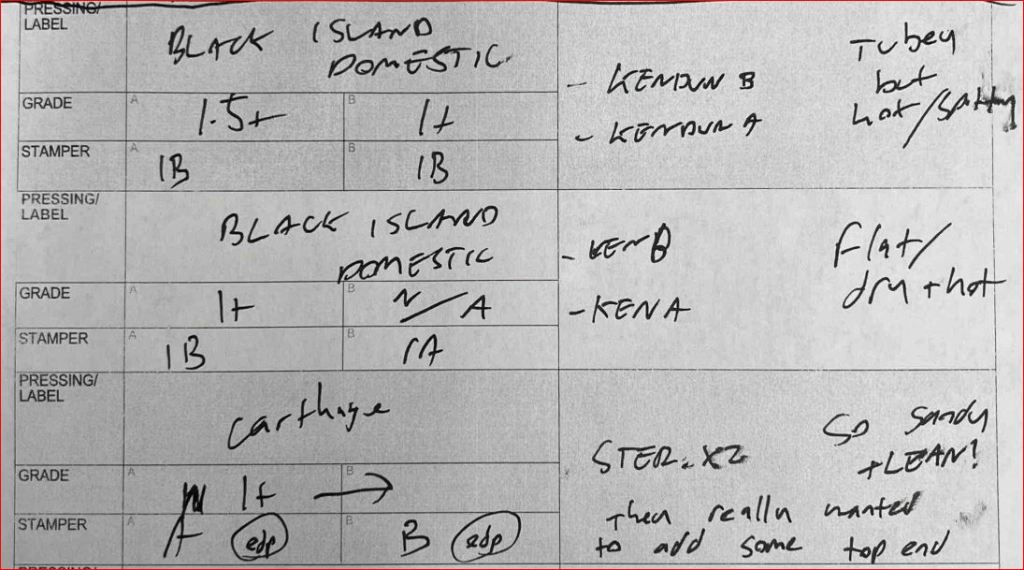
In spite of the fact that the domestic pressings of this Richard and Linda Thompson classic from 1974 were mastered by the likes of Kendun and Sterling — two of the greatest mastering houses of all time, — they have never impressed us with their sound quality.

The biggest problems with this record would be obvious to even the casual listener: gritty, spitty vocals; lack of richness; bright tonality; lack of bass; no real space or transparency, etc.

The domestic Island pressings did not do nearly as well in our shootout as the best Island imports, no surprise there as the early UK records were mastered by one of our favorite engineers.

Avoid the Carthage pressings mastered by Sterling. They came in last in our shootout.

The domestic breakdown follows:

Black Island Domestic #1

  • Tubey but hot and spitty.

Black Island Domestic #2

  • Flat, dry and hot (glary or bright)

Carthage Domestic recut from 1983, Sterling on both sides

  • So sandy and lean! They really wanted to add some top end (!)

Defending the Indefensible

(more…)

Thick as a Brick Marked a Milestone in 2007

jethrthick_1410_3_1192056381

Hot Stamper Pressings of the Music of Jethro Tull Available Now

Until about 2007, Thick as a Brick was the undiscovered gem (by me anyway) in the Tull catalog. The pressings we’d heard up until then were nothing special, and of course the average pressing of this album is exactly that: no great shakes.

With the advent of better record cleaning fluids and much better tables, phono stages, room treatments and the like — taking full advantage of the remarkable number of revolutions in audio that have occurred over the last two or three decades –some copies of Thick As A Brick have shown themselves to be truly amazing sounding. Even the All Music Guide could hear how well-engineered the album was.

Marking Two Milestones from the Past

The 2007 commentary you see below discusses the pros and cons of both the British and Domestic original pressings. With continuing improvements to the system, room, etc., it would not be long before we realized that the British pressings were simply not competitive with the best domestic ones.

You might say this record helped us mark two important milestones in the developing history of Better Records.

The first, around 2007, was recognized by the fact that we had improved our playback to a very high level, one high enough to reproduce the album with all the clarity, size and energy we were shocked to hear at the time.

The second milestone would result from the audio changes we continued to make for the next couple of years, from 2007 to 2010, which allowed us to recognize that the best British pressings, as good as they might be, were not in the same league as the best domestic ones. We broke down in detail exactly what we were listening for and what were hearing in this commentary, and the Brits were clearly not cutting it at the highest levels by 2010.

If you find yourself with one of more British copies of the album that you think have superior sound — any copies of the album, really — we would love to send you one of our Hot Stampers so you can hear what you are missing.

(more…)

Do The Original Domestic KC Pressings Always Beat the Later PC LPs?

Hot Stamper Pressings of Psychedelic Rock Recordings Available Now

Here is our description for the Super Hot (2+) copy that is currently on the site:

One of the most important records in my growth as an audiophile from 1971 to the present – my stereo was forced to evolve in order to play this kind of big production rock at the loud levels that the album needs in order to work its magic.

No matter how many times you play it, you will most likely hear – or at least gain more of an appreciation for – something new in the exceptionally dense, sophisticated soundfield Chris Kimsey creates for these songs.

And each time you make an improvement in the quality of your playback, this is the album that will show you exactly what you have just accomplished.


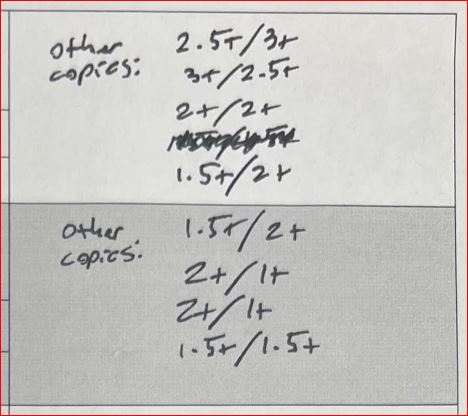
Overall, the best performers in our most recent shootout were UK pressings. They ranged in sound from the 3/3 Shootout Winning pressing (not shown) to the lowest graded British copy which earned grades of 1.5+/2+ (at the bottom of the top box).

On the left is a portion of the breakdown, minus the actual stamper numbers that earned the highest grades (for obvious reasons.)

We had six UK pressings, all with the same stampers — the five you see graded and the one hidden to the left that actually won the shootout. (Three sides earned White Hot Stamper grades, an unusual outcome and a good one for the bottom line.)

Note that with the “right stampers” you could have ended up with an incredible Demo Disc (copy #1) or just a very good sounding copy on side two mated to a passable side one (copy #6).

Finding six clean UK pressings is, as you can well imagine, neither cheap nor easy. We probably bought close to twice that many to end up with six that we’re in something close to audiophile playing condition.

As you can see from the grades, two of them were clearly inferior to the other four. In the case of this title, a small sample size could have been very misleading. Fortunately for us, we spent the money and the time it takes to track down a good-sized batch of UK pressings in order to avoid that possibility.

Next come the better domestic pressings. There was a 2+/2+ that outscored all the other domestic pressings, and four others that came in behind it, all with the same stampers.

Of the five copies that had those stampers, two had side two’s that scored sub-Hot Stamper grades, which marked them as unsaleable. (Perhaps we will offer them as one-sided records since their side one’s are so good.)

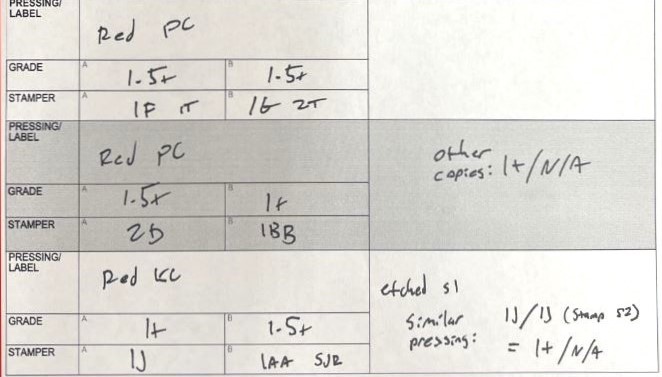
KC VS PC

We rarely have good luck with PC reissue copies when the originals come with the KC prefix, rarely meaning we find a PC winner maybe once out of every ten titles we play.

(more…)

Letter of the Week – “These days I don’t believe sh*t until my ears hear it, which is quite different than in the past.”

Our good customer Michel wrote to tell us — again — just how much he likes his Peter Gabriel Hot Stamper pressing of So.

I remember when I bought a 2+ copy of So. I had always thought that the UK’s would be the way to go, but even though I had a first press, ear fatigue set in quickly.

My US copy was not very good, so I wound up with the Classic gatefold … kind of cool packaging … so when I first listened to the 2+ I was besides myself, goosebumps and all.

Fast forward and I purchased a 2.5/2.5 Nearly White Hot Stamper copy. What a pleasure to be able to hear the improvement in the sound to yet another level. Bliss!

You guys have totally revolutionized my ears and my listening capabilities, which is utterly fantastic. Many thanks for that.

These days I don’t believe sh*t until my ears hear it, which is quite different than in the past.

Question … when you guys do shootouts for a particular LP, do you just compare the copies you have just procured, or do you have a +3/+3 house copy to compare to during your shootout?

What I like about the write-ups you do is it always gets me to thinking and going back to my LPs and relistening to them with my ‘new’ ears.

This process has been quite revealing.

Michel

Michel,

Thanks for your letter. As for your thinking that the Brit copies would be the way to go on So — and finding out otherwise — that’s precisely what happened to us about fifteen years ago:

We did a shootout many years ago that taught us a few things. The most surprising finding? The Brit copy I had in my own collection sucked — how about that! As a rule, I like the Brit pressings best for PG, but that rule got broken after playing all these domestic copies, some of which really sound good, clearly better than the Brits we had on hand.

Are rules made to be broken?

Yes they are.

This is a digital recording, and most of the time it is BRIGHT, SPITTY and GRAINY the way digital recordings tend to be, which plays right into the prejudices of most audiophiles for the “100% analog” approach they favor.

After hearing a bad copy, what audiophile wouldn’t conclude that all copies will have these bad qualities?

After all, it’s digital. It can’t be fixed simply by putting it on vinyl.

Ah, but that’s where logic breaks down. Proper mastering can ameliorate many if not most of a recording’s shortcomings. When we say Hot Stampers, we are talking about high-quality mastering doing exactly that.

But of course the mastering is only one part of the puzzle. I have multiple copies with the same stampers. Some of them are terrible, some of them are wonderful — you just can’t rely on the numbers to guide you with a piece of mass-produced plastic like this. You have no choice but to play the record to know what it sounds like. (And that’s a good thing. Keeps you honest. There’s no “cheating” when you have nothing to go by but the sound.)

The Classic Records pressing is at best mediocre — like most of the mid-fi junk they put out, we never bothered to write a review of it. We did manage to write more than 90, which means that as far as we’re concerned, we went beyond the call of duty and then some.

We did however happen to review the 2 LP 45 RPM Numbered Limited Edition that came out in 2016. We found it to be one of the worst sounding pressings of the album ever made. Of course it went right into our audiophile hall of shame with others of its ilk where it belonged.

As for the question of having a 3+ reference copy on the shelf to keep around for the next shootout, we have some, but not that many, probably less than a hundred.

Since we do more than a thousand different titles over the course of a decade, it would be nice to have more, but they aren’t really needed. It’s easy to hear when a record is doing everything right. When a record has one side that is not quite up to snuff, it’s the shootout that shows us in what area it may be lacking.

(more…)

How Good Are the Robert Ludwig-Mastered Pressings of Alchemy?

Hot Stamper Pressings of the Music of Dire Straits Available Now

The best domestic pressings we played, the ones cut by Robert Ludwig at Masterdisk, were simply not competitive with any of the early British LPs.

The evidence is pretty clear that the master tapes stayed in England and that only the British pressings are made from them. If you’ve played as many records as we have, it’s not hard to recognize dubby sound when you hear it.

As a general rule, this domestic pressing will fall short in some or all of the following areas when played head to head against the imported pressings we offer. Much like the records linked here:

(more…)

Reposted in Honor of Ozzy’s Passing — Import or Domestic on Paranoid?

Hot Stamper Pressings of the Music of Black Sabbath Available Now

The domestic copies we’ve played over the years for all the Black Sabbath titles are clearly better sounding than any import we’ve ever auditioned. It may be counterintuitive, but these are exactly the kinds of things you find out when doing blinded shootouts.

We have little use for intuitions (UK recording, UK pressing) and rules of thumb (original = better sound). We call that way of approaching the search for better sounding pressings mistaken audiophile thinking. 

Hard data — the kind you get from actually playing the records — trumps them all.

(We recently posted a lengthy commentary about conventional wisdom, attempting to make the case that, although the most common record collecting approaches are more often right than wrong, there is simply no way to know when any given approach will work for any given title.)

Want to find your own killer copy?

Consider taking our moderately helpful advice for how to find your own shootout winners.

(more…)

Emerson, Lake & Palmer – Islands Vs Cotillions

Hot Stamper Pressings of the Music of Emerson, Lake and Palmer Available Now

UPDATE 2020

This commentary was written many years ago, around 2010 I would guess.

It was updated in 2020 when we realized we were wrong about the domestic pressings being superior on side two. At one time we thought they were, and now, with many more shootouts under our belts, we are pretty sure they are not. But you never know!

The findings from the latest shootouts have shown us the error of our ways, yet another example of live and learn.


This is what we used to think:

The Brit copies may take top honors for side one (“sweetness, openness, tubey magic, correct tonality, presence without aggressiveness, well-defined note-like bass, extended airy highs”) but the Hot Stamper Cotillion copies KILL on side two. They really ROCK, with greater dynamic contrasts and seriously prodigious bass, some of the best ever committed to vinyl.

The Brits tend to be a bit too “pretty” sounding. They’re too polite for this bombastic music. This music needs the whomp down below and lots of jump factor to work its magic.

The Brits are super-low distortion, with a more open, sweeter sound, especially up top, but the power of the music is just not as powerful as it can be on these very special Cotillions.

We prefer the British pressings on both sides now. After years of improvement to our playback, they have shown themselves to be a step up over even the best domestic pressings. The Cotillions don’t win shootouts now and would be very unlikely to win one in the future. At best they tend to earn Super Hot Stamper grades.

A top copy might be described this way:

  • This UK Island Pink Rim pressing makes the case that ELP’s debut is clearly one of the most powerful rock records ever made, here with incredible Nearly Triple Plus (A++ to A+++) grades from top to bottom – just shy of our Shootout Winner
  • Spacious, rich and dynamic, with big bass and tremendous energy – these are just some of the things we love about Eddie Offord‘s engineering work on this band’s albums
  • Analog at its Tubey Magical finest – you’ll never play a CD (or any other digitally sourced material) that sounds as good as this record as long as you live
  • “Lucky Man” and “Take A Pebble” on this copy have Demo Disc quality sound like you won’t believe
  • Our White Hot pressing had a one half plus better grade on one side and sold for $849, making this copy a “relative bargain,” if there could ever be such a thing on this site – but what an amazing sounding record!

Without a doubt this record belongs in our Top 100 Rock and Pop section.

I’d even say it belongs in the Top Ten (which of course is where you can find it, where it belongs).

The organ on this album is wall to wall and floor to ceiling. The quiet interlude during “Take A Pebble” is about as quiet as any popular recording can ever be — the guitar is right at the noise floor. It’s amazing! (Which explains why so many domestic copies have groove damage. The record is just too hard to play for the average turntable. Hell, it’s hard to play with an audiophile turntable.)

Credit engineer Eddie Offord, who would later go on to enormous and entirely justifiable fame with Yes.

(more…)

Siren on Import Vinyl? Not So Fast

Hot Stamper Pressings of the Music of Roxy Music Available Now

Siren is one of our favorite Roxy albums, right up there with the first album and well ahead of the commercially appealing Avalon.

After reading a rave review in Rolling Stone of the album back in 1975, I took the plunge, bought a copy at my local Tower Records and instantly fell in love with it.

As is my wont, I then proceeded to work my way through their earlier catalog, which was quite an adventure. It takes scores of plays to understand where the band is coming from on the early albums and what it is they’re trying to do. Now I listen to each of the first five releases on a regular basis.

Somehow they never seem to get old, even after more than forty years.

Of all the Roxy albums (with the exception of Avalon) this is probably the best way “in” to the band’s music. The earlier albums are more raucous, the later ones more rhythmically driven — Siren catches them at their peak, with, as other reviewers have noted, all good songs and no bad ones.

Imports? Not So Fast

The British and German copies of Siren are clearly made from dub tapes and sound smeary, small and lifeless.

To be fair, Siren has never impressed us as an exceptionally good sounding recording. Like other middle period Roxy, records such as Country Life and Manifesto (the albums just before and after), it simply does not have Demo Disc analog sound the way Avalon, Stranded or the Self-Titled albums do (the latter two clearly being the best sounding in their catalog).

One would be tempted to assume that the import pressings of Siren would be better sounding, the way the imports of the first four Roxy albums are clearly better sounding. (There has never been a domestic Hot Stamper pressing of any of those titles and, since we never buy them or play them, there probably never will be.)

But in the case of Siren it’s the imports that are made from dubs. It may be a British band, recorded in British studios with a British producer, but the British pressed LPs are clearly made from sub-generation tapes, whereas the domestic copies sound like they’re made from the real masters.

Go Figure. And another thing: when it comes to records, never assume anything.

The typical domestic pressing is flat, bass-shy and opaque, sounding more like compressed cardboard than analog vinyl.

Unsurprisingly, the CD, whether imported or produced domestically, is clean and clear and tonally correct but lacks the warmth and richness of the better vinyl pressings.

(more…)

Most Domestic Pressings of On The Border Suck, and We Know Why

Hot Stamper Pressings of the Music of The Eagles Available Now

This is one of the pressings we’ve discovered with reversed polarity on some songs.

The domestic copies of On The Border have many tracks in reversed absolute phase, including and especially Midnight Flyer, a lifelong favorite of mine. The front and center banjo will positively tear your head off; it’s bright, sour, shrill, aggressive and full of distortion. Don’t look at me — that’s what reverse polarity sounds like!

I’ve known for some time that domestic pressings of On The Border have their phase reversed — just hadn’t gotten around to discussing the issue because I wasn’t ready to list the record and describe the phenomenon.

A while back [January 2005, time flies] I happened to play a copy of One Of These Nights and was appalled by the dismal quality of the sound. Last night I put two and two together. I pulled out both Eagles records and listened to them with the phase reversed. Voila! (On The Border is a favorite record of mine, dismissed by everyone else, but loved by yours truly.)

[I don’t think One of These Nights has its polarity reversed anymore, although some copies may.]

I’m of the opinion that only a very small percentage of records have their absolute phase reversed. Once you’ve learned to recognize the kind of distortion reversed polarity causes, you will hear recordings that may make you suspicious, and the only way to know for sure is to switch the positive and negative, wherever you choose to do so. 

With the help of our EAR 324 Phono Stage, the phase is reversible with the mere touch of a button, a wonderful convenience that we have grown to love, along with the amazingly transparent sound of course. (Hard to imagine living without either at this point.)

(more…)

Striving for Orchestral Clarity on Finlandia with Decca and Failing with RCA

More of the Music of Jean Sibelius

More of the Music of Edvard Grieg

The original RCA Living Stereo pressings we played in our 2014 shootout were not competitive with the best Deccas and London reissues of Finlandia.

Is the original the best way to go? In our experience with Finlandia, it is not. And it’s not even close.

The Decca reissue you see here is yet another wonderful example of what the much-lauded Decca recording engineers were able to capture on analog tape all those years ago. The 1961 master tapes have been transferred brilliantly using “modern” cutting equipment (from 1970, not the low-rez junk they’re forced to make do with these days), giving you, the listener, sound that only the best of both worlds can offer. [Not true, see Two Things below.)

When you hear how good this record sounds, you may have a hard time believing that it’s a budget reissue from 1970, but that’s precisely what it is.

Even more extraordinary, the right copies are the ones that win shootouts

Side One

Correct from top to bottom, and there are not many records we can say that about. So natural in every way.

The brass is HUGE and POWERFUL on this side. Not many recordings capture the brass this well. Ansermet on London comes to mind of course but many of his performances leave much to be desired. Here Mackerras is on top of his game with performances that are definitive.

The brass is big and clear and weighty, just the way it should be, as that is precisely the sound you hear in the concert hall, especially that part about being clear: live music is more than anything else completely clear. We should all strive for that sound in our reproduction of orchestral music.

The opening track on side one, Wedding Day at Troldhaugen, is one of my favorite pieces of orchestral music. Mackerras and the London Proms make it magical.

Side Two

The richness on this side is awesome. So 3-D, with depth and transparency to rival any recording you may own.

Two Things

When you hear a record of this quality, you can be pretty sure of two things: one, the original is unlikely to sound as good, having been cut on cruder equipment.


UPDATE

Let me stop myself right there. I no longer subscribe to this view. There are many original pressings mastered in the 50s that are as hi-rez and undistorted as anything made after them. Here’s one example. It would be easy to name a great many more. Live and learn I say.


And two, no modern recutting of the tapes (by the likes of Speakers Corner for example, but you can substitute any company you care to choose) could begin to capture this kind of naturalistic orchestral sound. [Mostly still true.]

I have never heard a Heavy Vinyl pressing begin to do what this record is doing. The Decca we have here may be a budget reissue pressing, but it was mastered by real Decca engineers (a few different ones in fact), pressed in England on high quality vinyl, and from fairly fresh tapes (nine years old, not fifty years old!), then mastered about as well as a record can be mastered.

The sound is, above all, real and believable.

The brass has weight, the top extends beautifully for those glorious cymbal crashes, the hall is huge and the staging very three-dimensional — there is little to fault in the sound on either side.

(more…)