Bernie Grundman, Engineer (Modern) – Commentaries

Houses of the Holy on Classic Records and 156 Other Records No Audiophile Should Want Anything to Do With

Hot Stamper Pressings of the Music of Led Zeppelin Available Now

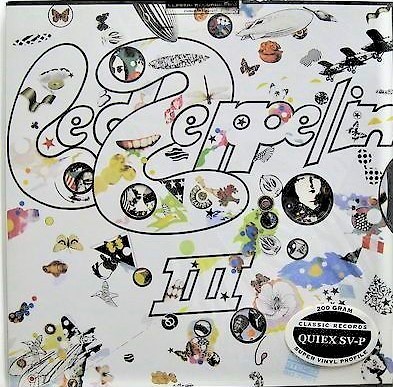
Houses of the Holy is another one of the very bad records Michael Fremer put on his 2009 Top LP list, while passing over one of Classic’s better titles, the first Led Zeppelin album.

(We don’t like it as much as we used to, but it is still a good record if you get a good pressing of it, something that can never be guaranteed of course. We link to our review of it below.)

Michael Fremer’s web site used to be called called musicangle (now defunct). On this site you would have been able to find a feature called157 In-Print LPs You Should Own!”

Surprisingly it seems that the link still works. If I had made a list this misguided, it surely would have turned into a “I’m sorry,  I didn’t know what I was talking about” commentary. I would have felt an obligation to correct the record, out of sheer embarrassment at the very least.

But this guy apparently never learns. As far as he’s concerned, what worked in 1982 ain’t broke and don’t need fixing.

The List

I can’t begin to count the bad records on this list.

There are scores of them — albums that are so bad that we actually created an audiophile hall of shame section to help you avoid them.  Obviously we never got around to making listings for them all and cataloging their flaws. Who has that kind of time? 

But Michael Fremer holds just the opposite view — he thinks these are records you should own. Now I suppose we can disagree over the merits (or lack of them) of a title such as Houses of the Holy on Classic (reviewed here). It’s a free country after all.

But the reason this list does such positive harm to the record-loving audiophile public, in my opinion, is that MF passes over one of the best records Classic ever cut, Led Zeppelin’s first album, in order to put the ridiculously bright and aggressive Houses of the Holy on the list in its place.

(more…)

Records Like This Make Audiophiles the Laughing Stocks of the Music World

More Reviews and Commentaries for Heavily Processed Recordings

This album has some of the worst sound I have ever heard in my life, worse than The Hunter even, and that’s saying something.

If this kind of crap is what audiophiles choose to play, then they deserve all the derision heaped upon them.

We’re glad we no longer offer embarrassments such as The Well, although we used to, many years ago. In our defense we would simply offer up this old maxim: de gustibus non est disputandum.

Our old slogan was Records for Audiophiles, Not Audiophile Records, but we also followed this business rule: Give the Customer What He Wants.

Now we give the customer what he wants, as long as he wants one of the best sounding pressings of the album ever made. (In this case obviously there is no good sounding pressing.)

How Bad Is It?

If this isn’t the perfect example of a pass/not-yet record, I don’t know what would be.

Some records are so wrong, or are so lacking in qualities that are critically important to their sound — qualities typically found in abundance on the right vintage pressings (although there is no acceptable pressing of this record, vintage or otherwise) — that the defenders of these records are fundamentally failing to judge them properly. We call these records pass/not-yet, implying that the admirers of these kinds of phony-sounding records are not where they need to be in audio yet, but that there is still hope, and if they devote enough time and money to the effort, they can get where they need to be, the same way we did.

(more…)

Waiting For Columbus Gets the Bernie Treatment Care of Rhino Records

Hot Stamper Pressings of the Music of Little Feat Available Now

A Hot Stamper pressing of this amazing sounding album, a title we regret to say we have in stock only rarely, might be described this way:

Some of the best sounding live rock and roll sound you will ever hear outside of a concert venue. If you want to understand the unique appeal of the band, there’s no better place to start than right here.

It’s one of our all-time favorite live recordings and their single best release – a true Masterpiece.

I have lately been listening to this album in its entirety at the gym (playing the standard cassette over headphones) and enjoying the hell out of it. As good as their best studio albums are, and I count myself as big a fan of the band as there is, Waiting for Columbus is surely the pinnacle of their recorded output. It is as close to perfect as any live album I know.

(The Last Record Album is my personal favorite of their studio albums, but since nobody seems to want to buy it at the prices we charge, I regret to say we had to stop doing shootouts for it years ago. We were losing too much money that way.)

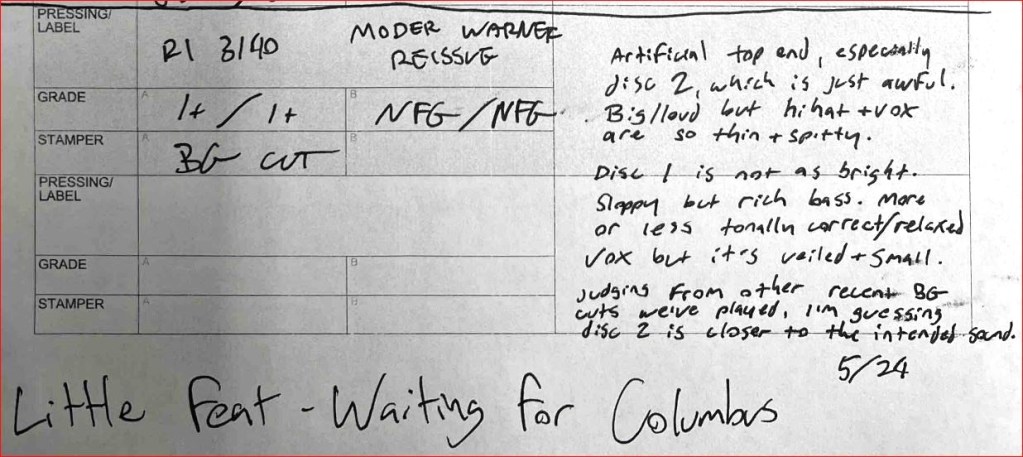
But Bernie Grundman’s version is just another one in a very long line of disastrous recuts, the kind of crap he has been churning out for the last thirty years. It’s all but unplayable on modern high quality equipment. (If it’s not on your system, you might consideer the idea that you still have plenty of work left to do, audio-wise.)

As you can see from the notes below, record one may be passable, but record two is NFG. How is it possible to turn such a wonderful recording into such a ridiculously bad sounding pressing? Even Mobile Fidelity did a better job with the album, and they’re one of the most incompetent remastering outfits that the audiophile world has even known.

We’re frankly at a loss to understand any of it.Bernie Grundman used to make good sounding records. We know that for a fact, having played them by the hundreds. Apparently those days are gone, and, based on this album and plenty of others, there is very little chance of them returning.

Notes on the Sound

(more…)

Axis: Bold As Love Is More of the Same Heavy Vinyl Trash from Classic Records

Hot Stamper Pressings of the Music of Jimi Hendrix Available Now

One of the worst things those dummies at Classic ever did. The mono mix sounds just plain awful.

Their reissue of the mono mix is flat and dry with practically no Tubey Magic whatsoever.

It positively screams “CHEAP REISSUE.” That two word description reminds me of this record, although to be fair the sound is quite a bit worse on the Hendrix.

Is it the worst version of the album ever pressed? It almost has to be, doesn’t it?


Further Reading

Even as recently as the early 2000s we were still impressed somewhat with the better Heavy Vinyl pressings. If we had never made the progress we’ve worked so hard to make over the course of the last twenty or more years, perhaps we would find more merit in the Heavy Vinyl reissues so many audiophiles are enamored with these days.

We’ll never know of course; that’s a bell that can be unrung. We did the work, we can’t undo it, and the system that resulted from it is merciless in revealing the truth — that these newer pressings are second-rate at best and much more often than not third-rate and even worse.

Some audiophile records have such bad sound that I was pissed off to the point of creating a special sh*t list for them. As of 2025, it contains close to 300 titles. That is a lot of bad sounding audiophile records! I should know, I played an awful lot of them.

Having now retired, I’m pleased to be able to leave that job in the more than capable hands of the listening crew at Better Records. They have been playing many of the newer releases and finding the sound is every bit as bad or worse these days.

Setting higher standards — no, being able to set higher standards — in our minds is a clear mark of progress. Judging by the hundreds of letters we’ve received, especially the ones comparing our records to their Heavy Vinyl and Half-Speed mastered counterparts, we know that our customers see things the same way.

(more…)

What Willie and Nat Can Teach Us about Heavy Vinyl

Hot Stamper Pressings of the Music of Willie Nelson Available Now

This letter came to us many years ago. Updates have been added as of 2024.

One of our good customers had this to say about some Hot Stampers he had purchased:

Hello team,

I’ve been a little distracted here, I got married over the weekend! So, haven’t done as much listening over the past couple of weeks. However, I did have a chance to listen to Stardust and Love Is The Thing. They were both different than their Classic Records and Analogue Productions counterparts. Willie sounded a little smoother, more organic, and more integrated.

The strings on Love Is The Thing were very different, more pronounced and emotional, but Nat’s voice, and the sound overall, sounded a little strident, maybe “too” hot.

I’d like to send them both back to you, and if you have a chance to send back the discs I sent to you I’d very much appreciate it. All told, the two big sets of Better Records are really incredible, and only serve to make my want list grow. Here’s to you and the next set!

Doug,

We now have the update for those two titles.

I, along with the two other guys in our listening panels, sat down to play the Heavy Vinyl you sent us, and the long and short of it is that we were astonished that records that sound as bad as those two actually were approved for release.

Nat is wrong six ways from Sunday, and Willie is not so much wrong as just not very good.

Nat: “F,” one of the worst heavy vinyl disasters of all time, and Willie: “D” sound, more like a CD than a record. There are many pressings of this album that are not good, but this version is probably worse than most of them, hence the D grade.

The old Classic pressing is probably better, and it would earn about a C grade. [I honestly do not remember exactly what pressing Douglas sent us. All I remember is that it was on Heavy Vinyl.]

I suspect the CDs of both these pressings are much better sounding than this vinyl.

The DCC gold is definitely better by a long shot, and the plain old Willie CD is probably a step up as well. 


A Further Update

(more…)

Witches’ Brew on Classic Records and How Crazy Wrong I Was, Part One

Hot Stamper Living Stereo Orchestral Titles Available Now

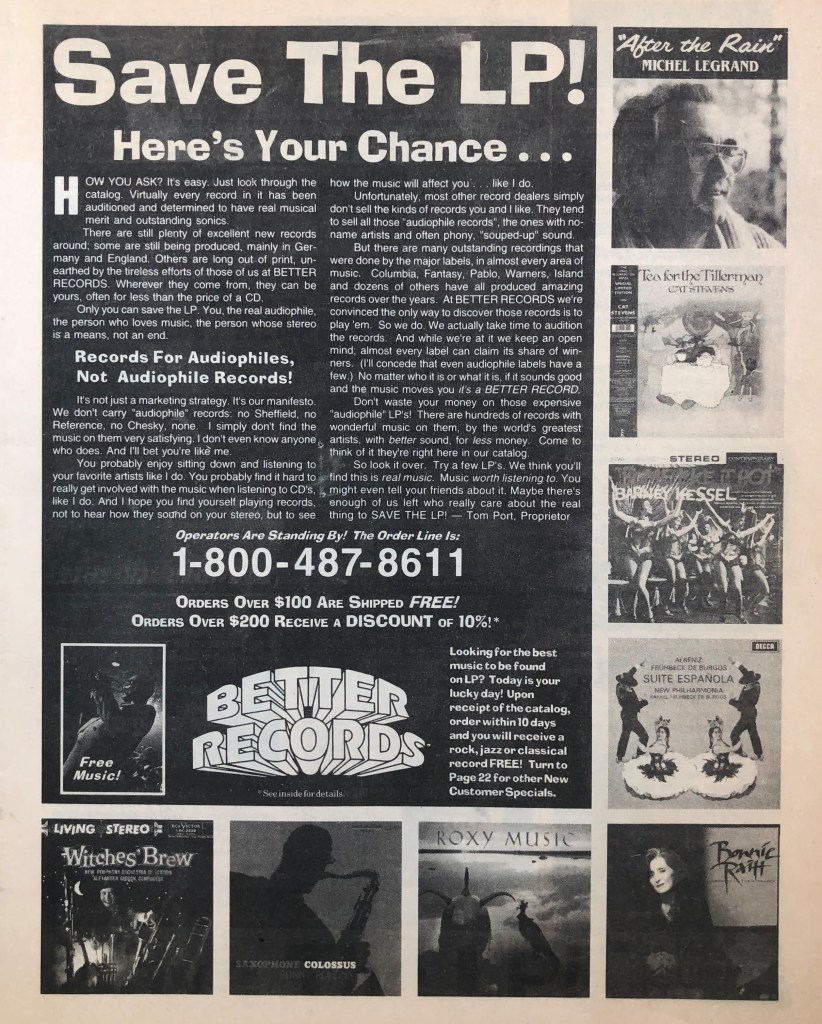
Well below the reproduction of the front page of our old catalog you will find the review I wrote in 2007 for the Classic Records’ Heavy Vinyl pressing of Witches’ Brew.

Clearly I did not care for it in the least. In fact, I thought it was one of the worst reissues I’d ever heard, so aggressive, boosted and unnatural it defied understanding that anyone could ever play such a record and not notice how wrong it sounded.

Now when I think about the Classic Records reissue of Witches’ Brew and its awful sound, it’s obviously a modern remastering I could not possibly have liked.

However, in preparing to move to Georgia in 2022, I found myself digging through some old catalogs from the early Nineties. Something I read in one of them chilled me to the bone.

There it was in black and white: my rave review for the Classic Records pressing of Witches’ Brew.

It’s actually on the front page of the catalog, along with at least one other record that I would be mortified to sell today: the OJC pressing of Saxophone Colossus.

(As soon as I find my review in the old catalog for Saxophone Colossus, I will post it. I can hardly believe I wrote it, but I did. I wrote all my catalogs back then. My lack of competence and the guilt associated with my lack of expertise at the time is undeniable. It obviously would be foolish and wrong of me to try to deny any of it, so I don’t.)

Below you will find a commentary from 2007 detailing the shortcomings of the Classic.

I sure had a lot of nice things to say about it in 1994.

I thought my stereo was awesome back then, but it was not nearly as awesome as I thought it was. It was better than any system I had heard in a stereo salon, audio show or friend’s house, but that has to be seen as a pretty low bar, and it may even be lower now than it was back then.

I’ve written a bit about the limitations of my 90s system here.

The Dunning-Kruger effect is real, and I clearly suffered from it.

In 1994 I had been a fairly dedicated audiophile for more than twenty years, and a strongly opiniated audiophile record dealer, one who took pride in curating his vinyl offerings right from the start of the business in 1987.

I thought I knew what I was talking about. Looking back it’s clear I had a lot to learn.

(more…)

Hearing Is All It Should Take, Right?

Hot Stamper Classical and Orchestral Pressings Available Now

Some person on some audiophile forum might feel obligated at some point to explain to you, benighted soul that you are, that the old classical records you — and other audiophiles like you — revere so highly have to be recognized these days for what they are: drastically compromised by the limits of their old technology.

Simply put, there’s just no way they can sound good.

It’s just a fact. It’s science. Technology marches on and those old records belong on the ash heap of history collecting dust, not sitting on the platter of a modern turntable.

That’s why the audio world was crying out for Bernie Grundman to recut those Living Stereo recordings from the 50s and 60s on his modern transistorized cutting equipment and have RTI press them on quiet, flat, high-resolution 180 gram vinyl, following the best practices of an industry that everybody knows has been constantly improving for decades.

Right?

For those of us who actually play these records, there is little evidence to support this narrative.

It’s a story made up mostly of assertions, along with an unhealthy amount of faith in so-called experts. [1]

Note that Bernie had no experience cutting classical music. He was a rock, pop and jazz guy. Robert Ludwig was the classical guy, cutting hundreds of albums for labels like Nonesuch in the 60s. What a different world it would be if he was the guy who cut for Classic Records! This review gets to the heart of the matter.

However, the contrarian view outlined above only really holds true for a very small minority of audiophiles of the analog persuasion: those given to empirical testing of such propositions. [2]

For an audiophile to compare the new pressings to the old ones, proper testing requires that the following four conditions can are met:

  1. He or she has a revealing, accurate stereo,
  2. A good record cleaning system, and
  3. Knows how to do shootouts using his or her
  4. Well-developed critical listening skills

If you’ve spent much time on this blog, you’ve probably read by now that the first three on this list are what allow you to achieve the fourth.

Compromises?

The best classical recordings of the 50s, 60s and 70s were compromised in every imaginable way, yet still they sound amazing.

(more…)

A Simple Listening Test Makes It Easy to Judge Pressings of Scheherazade

Hot Stamper Orchestral Pressings Available Now

The Classic reissue of LSC 2446, as well as the Analogue Productions version from 2013 (the original 33 is the only one I have played, mastered by Ryan Smith at Sterling), are both disasters for many reasons, but they do have one specific failing that is easy to recognize.

Both pressings are worth further discussion and analysis because they provide an easy test that can show you how wrong they are.

When reading the commentary below, keep in mind that what is bad about the Classic Records reissue from 1995 is what is bad about the Analogue Productions remaster put out many years later.

As I noted for some of the Classic Heifetz titles a while back, for all I know the CDs for his Living Stereo recordings may have better sound. That’s probably the first place to go, considering Classic’s rather poor track record regarding the remastering of his music.

Case in point: The Living Stereo CDs I own (both the CD and the SACD) of Scheherazade are dramatically better than the awful Classic Records pressing of it.

Audiophiles who don’t notice what is wrong with the Classic pressing need to get hold of a nice RCA White Dog pressing to see just how poorly the Classic stacks up. (They could even find one that’s not so nice and listen through the surface noise. The difference would still be obvious.)


UPDATE 2025

It has been many years since a White Dog pressing won a shootout. In our last listing for a Hot Stamper White Dog pressing in 2024, we noted:

Now that we know which stampers have the potential to win our shootouts, the right Shaded Dog originals have lately been coming out on top, although the White Dog pressings can still sound quite good, just not as good.

No White Dog earned a higher grade than 2+, and none of the three WD pressings we had on hand earned 2+ on both sides.

Our notes for the various sides of the WD pressings read: “a bit brash, sometimes squawky, dry and bright,” and the like.

Those of you looking for the best sound should stick to the Shaded Dog label originals. They are rich and lush in a way that the WD reissues in our experience never are. I used to swear by the WD reissues, but I see now how wrong I was. My judgments were colored by a darker, less revealing stereo than the one we use now, and that makes all the difference in the world.


Back to LSC 2446

The solo violin in the left channel at the opening of the first movement should be all it takes to hear what is wrong with the modern remastered pressings.

Anyone has ever attended a classical music concert will have no trouble recognizing that the violin on any of the Heavy Vinyl pressings, including the Analogue Productions pressing, is completely wrong and sounds nothing like a violin in a concert hall would ever sound.

And I mean ever.

No matter where you might be sitting.

No matter how good or bad the hall’s acoustics.

The violin on these Heavy Vinyl pressings is dark, it’s veiled, and it’s overly rich, as well as lacking in overtones.

Solo violins in live performance never sound like that.

They are clear, clean and present. You have no trouble at all “seeing” them, no matter where you sit.

(more…)

Witches’ Brew on Classic Records and How Crazy Wrong We Were, Part Two

Hot Stamper Living Stereo Classical and Orchestral Titles Available Now

As I noted in Part One of this commentary, I promised to find my old blurb for the Classic pressing of Witches’ Brew from the catalog I sent out for years in the mid-’90s.

Well, I found it.

The excerpt from the earlier commentary seen below gets to the heart of the problem with my (embarrassing) review.

“With an old school audio system you will continue to be fooled by bad records, just as I and all my audio buds were fooled thirty and forty years ago. Audio has improved immensely in that time. If you’re still playing Heavy Vinyl and Audiophile pressings, there’s a world of sound you’re missing. We would love to help you find it.”

Ouch.

I apparently had one of those systems in the ’90s, because my system sure wasn’t doing a very good job of showing me how awful the Classic pressing of Witches’ Brew was.

Also, my guess that the Classic pressing was 10db more dynamic is risible. That number was clearly plucked out of thin air by someone who didn’t know what he was talking about (10db is a lot).

I will take some solace from my comment that  “90% of the magic of the original is here,” which means that even in 1994 I could hear that Bernie’s cutting system had problems reproducing the Tubey Magical Living Stereo sound that was all the rage at the time, mostly owing to Harry Pearson’s listing so many RCAs on his Super Disc List.

And, although we still like Gibson’s reading of the work, these days our favorite performance of Danse Macabre is this one on EMI, one we only discovered about five years ago. It’s one advantage to being in the record business. You get to play lots and lots of records, and playing large numbers of records is practically the only way to find the ones that are even better than the ones you know.

(more…)

The First Classic Record We Ever Played – Thus Spake Zarathustra

Hot Stamper Pressings of Living Stereo Titles Available Now

Way back in 1994, long before we had anything like the system we do now, we were finding fault with the “Classic Records Sound.”

With each passing year — 28 and counting — we like that sound less.  Some Classic Records pressings may be on Harry’s TAS list — disgraceful but true — but that certainly has no bearing on whether or not they are very good records. 

I had a chance to play LSC 1806 (pictured above) not long ago and I was dumbfounded at how bright, shrill and aggressive it was.

I still remember playing my first Classic Records title, their first release, which would probably have been in 1994. The deep bass of the organ at the start of Also Sprach Zarathustra, the horns and the tympani blasting out from a dead silent background, put a lump in my throat. Had they actually managed to remaster these old recordings so well that the vintage pressings I was selling for such high prices would soon be worthless? I really do remember having that thought race through my mind.

But then the strings came in, shrieking and as bright as the worst Angel or DG pressing I’d ever heard. It was as if somebody had turned the treble control up on my preamp two or three clicks, into ear-bleeding territory. All my equipment at the time was vintage and tube, and even though my system erred on the dark side tonally, the first Classic release was clearly off the charts too bright and transistory, with none of the lovely texture and sheen that RCA was famous for in the early days of Living Stereo.

I knew right then that my vintage record business was safe.

Here is our review from the ’90s, written shortly after the release of Classic’s first three titles. (With minor additions and changes for clarity and context.)

Hall of Shame Pressings, Every One

I’m reminded of the nonsense I read in TAS and elsewhere in the mid-’90s regarding the reputed superiority of the Classic Records Living Stereo reissues. After playing their first three titles: 1806, 1817 and 2222 (if memory serves), I could find no resemblance between the reviews I read and the actual sound of the records I played. The sound was, in a word, awful.

To this day I consider them to be the single worst reissue series in history.


UPDATE 2025

Analogue Productions now holds that crown, surely. Still going strong, producing one crap pressing for the mid-fi collector market after another, there is simply no recording they won’t see fit to ruin.


When Harry Pearson (of all people! — this is the guy who started the Living Stereo craze by putting these forgotten old records on the TAS list in the first place) gave a rave review to LSC 1806, I had to stand up (in print anyway) and say that the emperor clearly had removed all his clothes, if he ever had any to begin with.

This got me kicked out of TAS by the way, as Harry does not take criticism well. I make a lot of enemies in this business with my commentary and reviews, but I see no way to avoid the fallout for calling a spade a spade.

Is anybody insane enough to stand up for LSC 1806 today? Considering that there is a die-hard contingent of people who still think Mobile Fidelity is the greatest label of all time, there may well be “audiophiles” with crude audio equipment or poorly developed critical listening skills, or both (probably both, as the two go hand in hand), that still find the sound of the shrill, screechy strings of the Classic pressing somehow pleasing to the ear. Hey, anything is possible.

As I’ve said again and again, the better a stereo gets, the more obvious the differences between good vintage pressings and most current reissues become. Modest front ends and mediocre playback systems can disguise these differences and mislead the amateur audiophile.

And the “professional” too. We’ve all had the experience of going back to play a record from years ago that we remember as being amazing, only to find it amazingly bad.

The Japanese Led Zeppelin series from the 90s comes immediately to mind. How could my system have been so dull that those bright pressings actually fooled me into thinking they sounded good all those years ago? I’ve done a few Mea Culpas over the years, and that’s one of the bigger ones.

Remember when Chesky Records were all the rage? Does anybody in his right mind play that shit anymore?

A short anecdote: A good customer called me up one night many years ago. He had just finished playing the Chesky pressing of Spain, and had pulled out his Shaded Dog original to compare. The sound of his Shaded Dog pressing was so much better that he took his Chesky and, with great satisfaction, ceremoniously dropped it in the trash can, noting, “Of course I could have sold it or traded it away, but nobody should have to listen to sound like that.”

Another anecdote: when Chesky first got started in the remastering business, a friend picked up their pressing of LSC 2150, Prokofiev’s Lt. Kije with Reiner. He played it for me when I came over to hear his system, and he and I were both shocked that his ’70s Red Seal pressing was better in every way.

We wanted to know: What kind of audiophile label can’t even go head to head with a cheap reissue put out twenty years after the initial release just to keep the bins stocked and satisfy the needs of the low-budget classical record buyer?

The answer: Plenty of them, and definitely Chesky. Playing most Classic Records classical titles is a painful experience these days. I do not recommend it to anyone with good equipment. If you love the Living Stereo sound and cannot afford vintage pressings, consider playing the CDs RCA remastered. The one I know well is clearly better than Classic’s and AP’s LPs.

(more…)