RCA Vintage – Reviews, Commentaries, Letters, etc.

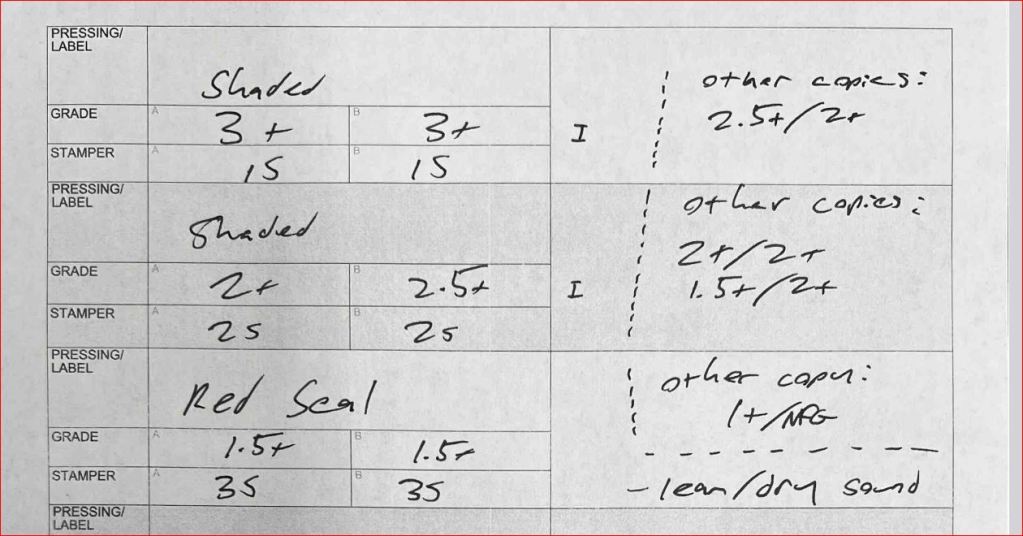
These Are the Shaded Dog Stampers to Avoid on LSC 2581

Hot Stamper Pressings of Living Stereo Titles Available Now

Even though they had the Shaded Dog label, some of the later stampers for this record were not very good sounding compared to the ones that won our shootouts.

15s on side one earned a grade that would prevent it from being sold as a Hot Stamper pressing. There was no reason to play side two (13s) since side one eliminated this copy from the competition.

The 1+ grade found on this side one means it’s simply not very good, Shaded Dog label or no Shaded Dog label.

Pressings with these stampers might be passable, even to some degree enjoyable, especially when played on an old school system, but they would not be worth bothering with on the high quality modern equipment we use.

In this case, the conventional wisdom that the original pressings will most likely have superior sound to the later-numbered copies turns out to be right.

(more…)

Looking for a Good Brahms 2nd Piano Concerto? Don’t Waste Your Money on LSC 2466

Hot Stamper Pressings of of the Music of Brahms Available Now

Never liked the performance or the sound.

LSC-2466 w/ Richter. Shaded dog, just ok sound, boring.
LSC-2466 w/ Richter. White dog reissue, smeary, NFG.

Some audiophiles may be impressed by the average Shaded Dog pressing, but I can assure you that we here at Better Records are decidedly not of that persuasion.

Something in the range of five to ten per cent of the major label Golden Age recordings we play will eventually make it to the site. The vast majority just don’t sound all that good to us. (Many have second- and third-rate performances and those get tossed without ever making it to a shootout.)

(more…)

On This Rachmaninoff Title, the Right Reissues Clearly Have the Best Sound

More of the music of Sergei Rachmaninoff (1873-1943)

Until we heard the right later pressings, we had always been disappointed with this TAS List recording, wondering what all the fuss was about. The original Shaded Dog pressings we had played left a lot to be desired. Like many of the old records we audition, it badly lacked both highs and lows, our definition of boxy sound.

Well, now we know.

The earliest Shaded Dog pressings have consistently worse sound than the reissues we offer.

We never offered the record in Hot Stamper form because we didn’t think the sound of the originals was all that impressive, TAS List or no TAS List.

Mystery solved, and truly Hot Stampers have now been made available to the discriminating audiophile.

Harry’s list, as was so often the case, did not provide the information needed to find the pressing that captured all the qualities of the recording the way this one does.

Did Harry have a good later pressing?

Did he have an original and simply liked it more than we did?

Who knows? Like so much in the world of records, it’s a mystery.

(more…)

Three Copies of Harold in Italy and Still No Luck

Hot Stamper Pressings of Living Stereo Titles Available Now

For a Living Stereo record from the Golden Age of All Tube recording, especially one from the late-50s, you might expect that the better Shaded Dog pressings would have exceptionally rich, natural sound.

After all, 1958 is clearly one of the great years for analog recordings, as evidenced by this amazing group of albums, all recorded or released in that year.

Unfortunately, the pressings we played of the Berlioz album you see pictured were quite a letdown. We dropped the needle on three different early copies of LSC 2228 with three different sets of stampers and found that none of them were all that impressive, as can be seen from our notes:

  • First: tubey but pretty hot, just okay. (6s/3s)
  • Second: smeary and congested, not great. (4s/4s)
  • Third: tubey but smeary (3s/1s)

We guessed that their final grades after a shootout would probably fall into the range of 1+ or so, just below the cutoff for a minimal Hot Stamper grade (1.5+).

If we’d half a dozen or more to play, some copies would probably be a bit better, some would be a bit worse, but the bulk of them would end up having sound that was merely passable, even after a good cleaning. (Without a good cleaning some might not even earn that single plus.)

For now we’re throwing in the towel and moving on to Golden Age records with better prospects.

(more…)

Making More Progress in Audio

Hot Stamper Pressings of Living Stereo Titles Available Now

The story of our recent shootout is what progress in audio in all about. As your stereo improves, some records should get better, some should get worse. It’s the nature of the beast for those of us who constantly make improvements to our playback and critically listen to records all day.

Courtesy of countless revolutions in audio. (In other words, this list is far from complete.)

In our previous listings we noted:

This is one of those odd records in which the variation in sound quality from track to track is dramatic. Take the first two tracks on side one — they suck. They sound like your average LSP Mancini album, the kind I have suffered through far too many times. And that means bad bad bad. 

But track three boasts DEMO DISC QUALITY SOUND and the next one is nearly as good. Listen to that wonderful glockenspiel. It sound every bit as magical as anything on Bang, Baa-room and Harp, and that’s some pretty magical sound in my book!

Same thing happens on side two. Bad sound for the first tracks, then track four sounds great, followed by a pretty good five and a lovely six with a chorus of voices to die for. Go figure.

Is there a copy that sounds good from start to finish? Doubtful.

We’ve made a dozen or more improvements to the system since we last did this shootout, and I’m happy to report that most of the tracks we had trouble with in the past are now sounding very good indeed. Of course the better tracks we noted from years ago are even better, making this a consistently good sounding Mancini record.

One obvious change from the old days is that we now spend a fair amount of time honing in the VTA for every title. That may account for the fact that the first track on side one, which used to be problematical, now sounds wonderful. The value of getting the correct VTA setting — by ear, for every record — cannot be overestimated in our opinion.

(more…)

Brahms / Sonata in D Minor / Laredo

Hot Stamper Pressings Featuring the Violin Available Now

DEMONSTRATION QUALITY SOUND for this incredibly rare Living Stereo violin record.

This is the first Shaded Dog pressomg of LSC 2414 I’ve ever seen. Side one, the Brahms Sonata, has very good sound and is played beautifully. When I dropped the needle on side two I went “Wow!”

The Bach partita for solo violin is incredible sounding. The violin is close-miked and every nuance of the instrument is right there before you. The immediacy of the recording is nothing short of stunning.

To quote from the liner notes, “Jaime calls the Sonatas and Partitas THE most demanding works in the literature. The works lightness and high spirits — the spirit of 17th century dance music — belie its complexity and the enormous technical and interpretive demands it makes of the performer.”

Having this intimate a window onto the piece, I completely agree. It’s a spell-binding work.

(more…)

Living Strings / Morton Gould and his Orchestra

Hot Stamper Pressings of Living Stereo Titles Available Now

UPDATE 2026

I typed so badly back in the early 2000s that it was actually easier to just dictate the short reviews we put up for our records. Rereading this just now made me recall that fact, because it is either poorly written or dictated, and I am going to go with the latter since I hate to think I ever wrote this badly.

As a rule, Moton Gould’s recordings for RCA are not especially good. If you see this title for cheap, pick it up. Otherwise I would give it a pass.


RCA Shaded Dog LP with good sound.

(more…)

Funny How You Rarely See Much Discussion of Records with Reversed Polarity

Hot Stamper Pressings of the Music of Harry Belafonte Available Now

UPDATE 2026

We mention below that we rarely have records with polarity issues on the site. To read more about any that may be active, please click here.


One of our good customers had this to say about some Hot Stampers he purchased recently (emphasis added):

Hey Tom, 

I bought the Harry Belafonte Carnegie Hall recently, a White Hot. I went to the On The Record site and came across the Offenbach Readers Digest discussion of reversed polarity. I had bought this record on your site a long time ago.

I listened to the record with the polarity reversed.

This is the first time I have heard this record sounding better.

Open, spacious and heard lots of macro and micro details, especially on side one, and the violin now is more natural as you described.

Btw, Do you have records with reversed polarity ready to hit the site? Please let me know.

Very interesting!

Hi,

Thanks for your letter. Glad I was able to help you get that Offenbach record to sound the way it should. It is a knockout performance with audio quality to match.

Funny how you rarely see much discussion of records with reversed polarity like Belafonte at Carnegie Hall.

Do most audiophiles have polarity switches on their preamps or phono stages?

Can they be bothered to go back and forth enough times to make sure they have the correct polarity setting for the records they play?

(more…)

For Concerto No. 1, This Is the Way the Piano Should Sound

Hot Stamper Living Stereo Classical and Orchestral Titles Available Now

We love the huge, solid and powerful sound of the piano on this recording. This piano has weight and heft. As a result, it sounds like a real piano.

For some reason, a great many Rubinstein recordings are not capable of reproducing those all-important qualities in the sound of the piano.

Those are, as I hope everyone understands by now, the ones we don’t sell. If the piano in a piano concerto recording doesn’t sound solid and powerful, what is the point of playing such a record?

Or, to be more accurate, what is the point of an audiophile playing such a record? (Those of you who would like to avoid bad sounding vintage classical and orchestra records have come to the right place. We’ve compiled a very long list of them precisely for that purpose, and we’ve been adding to it regularly.)

No doubt Kenneth Wilkinson made sure the recording captured the weight of the piano he was listening to as it played all those years ago in the wonderful acoustics of Kingsway Hall.

The strings have lovely Living Stereo (Decca-engineered) texture as well.

As befits a Wilkinson recording from 1961, there is no shortage of clarity to balance out the Tubey Magical warmth and richness.

When you add in the tremendous hall space, weight and energy, this becomes a Demo Disc orchestral recording by any standard.


Notes from a 2024 Shootout

Our notes above point out that:

(more…)

Shootout Winning Stampers for La Boutique Fantasque Revealed

Hot Stamper Pressings of the Music of Rossini Available Now

UPDATE 2026

Our current favorite recording of La Boutique Fantasque is the one Solti recorded for Decca in 1957.

It belongs to that very special group of roughly 150 orchestral recordings which have the potential to offer the discriminating (and well-heeled) audiophile the best performances of major works with by far the highest quality sound.

It has been our experience that modern remastered pressings simply cannot compete with the best pressings of these landmark recordings.

The Fiedler (LSC 2084) is still a very good record, but we no longer see much reason to carry it when the Solti is better in almost every way (and quieter as a rule to boot).

Below we have reproduced our full stamper sheet, including the Shootout Winning stampers, which happen to be 3S/4S for this album.

(more…)