Top Artists – Shelly Manne (leader)

This Early Stereo Black Label Pressing of My Fair Lady Sounded Great

The piano sounds lifelike right from the start, a beautiful instrument in a natural space, tonally correct from top to bottom.

This copy makes it clear that this is an exceptional Demo Disc quality recording for Contemporary, and that’s saying a lot.

It’s all tube, live-to-two-track direct from the Contemporary studio. It’s pretty much everything you want in a recording from this era.

How can you beat a Roy DuNann piano trio recording? We have a good supply of Hot Stamper pressings of great jazz piano recordings, but the ones we offer on Contemporary set a standard that few other labels have ever been able to meet.

(more…)

Shelly Manne & His Men – At The Black Hawk, Vol. 3

More of the Music of Shelly Manne

  • A vintage Contemporary stereo pressing with solid Double Plus (A++) sound or close to it from first note to last
  • This is West Coast Jazz at its best, and if anyone can capture the feeling of jazz in a small club, it’s the engineers and producers at Contemporary
  • The sound is superb – airy, open, and spacious with a solid bottom end – the depth and definition are out of this world (particularly on side one)
  • “Considering how much music was documented, it is fortunate that trumpeter Joe Gordon, tenorman Richie Kamuca, pianist Victor Feldman, bassist Monty Budwig and drummer Shelly Manne were in top form for this enjoyable gig. The music is high-quality straightforward and uncomplicated bebop.”

(more…)

Andre Previn & His Pals – Pal Joey

More Contemporary Label Jazz

  • Pal Joey returns to the site for only the second time in nearly five years, here with solid Double Plus (A++) sound throughout this vintage Contemporary label pressing – fairly quiet vinyl too
  • Our better Hot Stamper copies will show you just how good 50s All Tube Analog can sound
  • Yet another Demo Disc for Contemporary, more brilliant work by the engineering team of Dunann and Holzer
  • One of Andre Previn’s better jazz performances on record – his pals Manne and Mitchell are no slouches either
  • 1957 just happens to be a wonderful year for analog recordings, as evidenced by this amazing group of albums, all recorded or released in that year.

The piano sounds uncannily lifelike right from the start, a beautiful instrument in a natural space, tonally correct from top to bottom. I can’t think of many records off the top of my head that get a better piano sound than this one. Dunann and Holzer in 1957 are hard to beat. (more…)

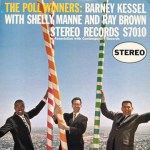
How Do the Early Pressings of The Poll Winners Sound?

Hot Stamper Pressings of Contemporary Jazz Albums Available Now

A recent Shootout Winning copy with the early stereo badge cover was described this way:

Stunning sound throughout this vintage Black Label Stereo Records pressing, with both sides earning Shootout Winning Triple Plus (A+++) grades or close to them

Roy DuNann always seems to get the real sound out of the sessions he recorded – amazingly realistic drums in a big room; Tubey Magical guitar tone; deep, note-like bass, and on and on

4 1/2 stars: “The choice of material, the interplay between the three players, and the lead work all meld together beautifully on The Poll Winners, making it a classic guitar album in a small-group setting.”

Musically, all true. Sonically, not so much. The early D1/D2 stampers on the early Black Label might be passable on side one (1+), but side two was just a mess (NFG).

Side One

Track Two

  • A bit bright and flat

Track One

  • Very clear but lacking richness, weight and depth
  • Thin, and bright up top
  • 1+

Side Two

Track One

  • Narrow stereo field
  • Weird tape hiss
  • Metallic top end
  • Very recessed and weird
  • Nope

A different Stereo Badge Cover copy sporting a Black Label won the shootout by the way. Go figure.

(more…)

The Three – Liner Notes and a Rave Review

Hot Stamper Pressings of The Three Available Now

Excerpts from the Liner Notes

On a windy and unusually cold night in Los Angeles, each of the three musicians arrived before the session start time of 10 PM on November 28, 1975. At exactly 10 PM, The Doobie Brothers session that was going on since morning ended. Two assistants immediately started setting up for the session. The Steinway concert grand piano, delivered the previous day, was wheeled in to the center of the room and got tuned. Shelly Manne’s drum kit was assembled in a makeshift “booth.” Microphones were set up, checked and positions adjusted.

Initially, Telefunken microphones were positioned on the piano, but later were replaced by two Neumann U87s. The piano lid was opened to the concert position and microphones were centered relative to the keys and placed a foot (30 centimeters) inward from the hammer and a foot (30 centimeters) away from the strings. One mic was pointed toward the bottom notes and the other pointed toward the top.

To record Ray Brown’s bass, a Shure SM56 and a Sony 38A were pointed at the bridge of the bass, two inches above it. The Shure was used to capture the attack and the Sony mic was used to capture the rich low tones.

Seven microphones were used to capture the sounds of the drum set. Two U87’s were placed overhead, roughly 16-inches above the cymbals facing down. The bottom quarter of the kick drum was dampened with a blanket on the outside and was mic’ed with a Shure SM56. SM56’s were also used for toms and bass toms. Sony 38A was used on the snare and Sennheiser’s Syncrhon on the high-hat.

Each mic was placed 2 inches away from the instruments in a close mic set up. Mr. Itoh got involved with fine tuning mic positioning for tone, stereo placement and balance. Meanwhile, final adjustments were being made on the cutting machine set up.

Within the hour, the set up was done and all preparations were completed. The musicians finished warming up and were ready for Take One. The usual banter subsided and everyone put on their “game face.” Even Ray Brown, who usually cracked jokes in a loud voice, looked serious as he turned his attention to Mr. Itoh, waiting for his cue. As soon as he was notified through the intercom that the cutting needle was put down, Mr. Itoh gave the signal with his hand, and the recording started. In 16 minutes, three tracks were recorded in rapid succession.

Relieved that the initial take was over, the musicians joined the producer and engineer in the control room to listen back from the 2-track tape that was used as back up. With the initial tension gone, all three excitedly made comments and evaluated their own performance and the sounds they got. The thumbs-up was given by the cutting engineer for take one and the musicians went back to the live room for the next take. This process was repeated until 4 AM the following morning, resulting in a total of three takes per track.

(more…)

Don’t Skip the OJC, Put It in a Shootout

Of the three early OJC pressings of West Coast Sound we played recently, only one met our standards. At 2+/1.5+, the sound was good, not great.

One copy earned grades of 1+/1+, which means the sound was passable. The last copy had an NFG side two, which means it was just awful.

(Many of the Heavy Vinyl disasters we’ve been cataloging lately have earned that notorious grade. The unacceptably lo- to mid-fi sound even the better ones offer doesn’t seem to bother the audiophiles who rave about them, however.)

So does side two of the OJC pressing have fairly good sound, merely passable sound, or is the sound hopelessly bad?

In the case of this Shelly Manne album, all three, and the only way we were able to discover that is by cleaning up three of them and playing them head to head with real Contemporary pressings in a blinded experiment.

Obviously we were hoping for better results from our OJCs — only one of the copies we played will turn out to be saleable.

Why did we bother? That old bugaboo the profit motive was all that was needed to make us give the OJC pressings a try. We thought we could make money on them but it turns out that the opposite will happen. Oh well, nothing ventured, noting gained.

More importantly, we are not the least bit shy about coming clean and sharing the results with our readers and customers, especially the part about three identical looking copies with the same stamper numbers all sounding very diffferent from each other.

An added bonus is that side two was worse than side one most of the time. That happens often enough, but nobody but us ever seems to want to talk about it.

If we had had ten OJC pressings to play, we probably would have be able to find at least one or two with a grade of 2+/2+, meaning that George Horn probably did a creditable job mastering the album back in 1984 when he cut it for Fantasy, to sell for the very affordable price of $5.98. It’s most likely the pressing plant that let listeners down.
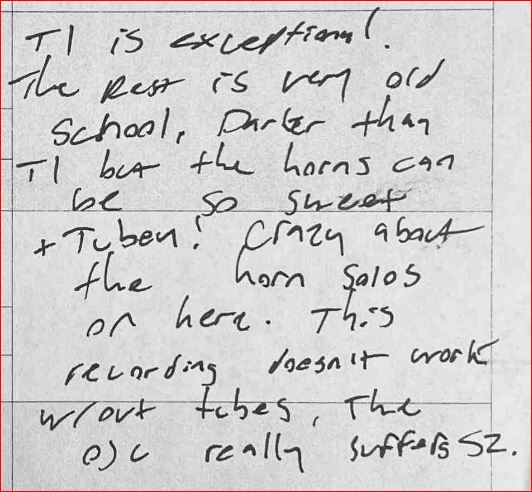
Needs Tubes

The problem here is that this title needs tubes, or, at the very least, the sound of tubes, and George apparently did not have them, or enough of them, in his mastering chain.

Our specific notes can be seen on the left. We mention that the first track has the best sound (1956 dates), the rest falling short for being darker and more crude (“old school,” some dating from 1953).

The West Coast horn players are the reason to buy this title, with horns that are “sweet and tubey,” but of course to hear that kind of sound you will need a real Contemporary pressing, not an OJC — or anything made in the modern era for that matter.

(more…)
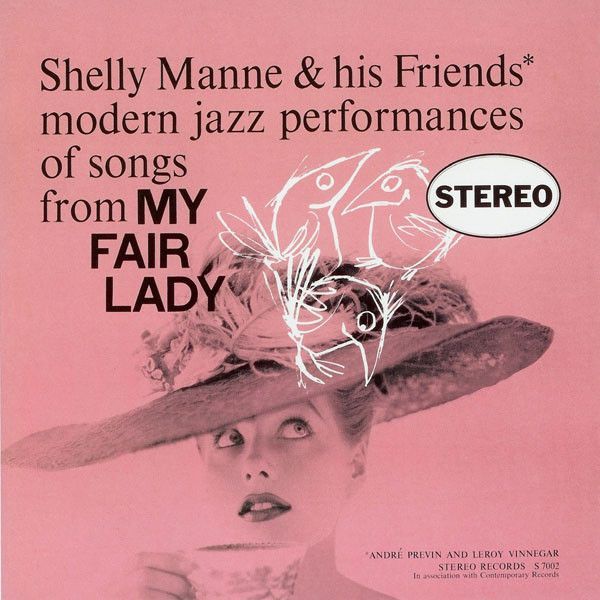
The Three on Inner City – By Far the Best Way to Get All Six Tracks

More of the Music of The Three

  • A Demo Disc quality Inner City pressing of this wonderful recording with INCREDIBLE Shootout Winning Triple Plus (A+++) sound or close to it from start to finish
  • The transients are uncannily lifelike – listen for the powerful kinetic energy produced when Shelly whacks the hell out of his cymbals
  • My favorite Piano Trio Jazz Album of All Time; every one of those six tracks is brilliantly arranged and performed
  • 4 stars: “One of Joe Sample’s finest sessions as a leader” – with Shelly Manne and Ray Brown, we would say it’s clearly his finest session, as a leader or simply as the piano player in a killer trio

If you want to hear the full six tunes recorded by The Three at that famous Hollywood session (which ran all day and long into the night, 4 AM to be exact), these 33 RPM pressings are the best way to go. The music is so good that I personally would not want to live without the complete album. The Three is, in fact, my favorite Piano Trio Jazz Album of All Time; every one of those six tracks is brilliantly arranged and performed (if you have the right takes of course; more about that later).

More On The Subject Of Energy

This is a quality no one seems to be writing about, other than us of course, but what could possibly be more important? On this record, the more energetic copies took the players’ performances to a level beyond all expectations. It is positively shocking how lively and dynamic the best copies of this record are. I know of no other recording with this combination of sonic and musical energy. It is sui generis, in a league of its own.

Both sides are so transparent you can hear Shelly Manne vocalizing as he’s playing the drums. The drum solo on side two is killer here. So full of energy and so dynamic. Why aren’t more drum kits recorded this well? Check out the pictures inside the fold-open cover to see all the mics that were used on the drums. That’s where that wall-to-wall, floor-to-ceiling sound comes from.

The transients are uncannily lifelike, conveying the huge amounts of kinetic energy produced when Shelly whacks the hell out of his cymbals.

Ne Plus Ultra Piano Trio

This record is made from the “backup” tape for the session. East Wind released two versions of the famous direct to disc version at 33 RPM, and for those of you who bother to read the commentary, you know that take one of that pressing presents a completely different performance of the music than the one found on the Inner City on offer here.

There was a time when the best copies of a recording like this would go directly into my collection. If I wanted to impress someone, audiophile or otherwise, with the You-Are-There illusion that only Big Speakers in a dedicated room playing a live recording can create, this would be up near the top of the list. There is practically nothing like it on vinyl in my experience.

This is without a doubt my favorite piano trio record of all time. Joe Sample, Shelly Manne, and Ray Brown only made one album together, this one, recorded direct to disc right here in Los Angeles for Eastwind in the Seventies. Joe Sample for once in his life found himself in a real Class A trio, and happily for jazz fans around the world, he rose to the occasion. Actually, it was more like an epiphany, as this is the one piano trio album I put in a class by itself. All three of The Three are giving us the best they’ve got on that November day in 1975.

When it comes to small combo piano jazz, there is none better.

(more…)

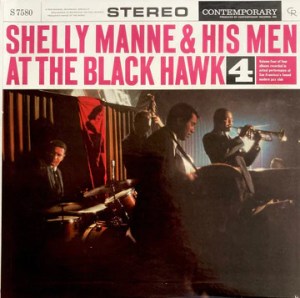
Shelly Manne & His Men – At The Black Hawk, Vol. 4

More of the Music of Shelly Manne

  • Here is an early Contemporary stereo pressing with solid Double Plus (A++) sound on both sides
  • This is West Coast Jazz at its best, and if anyone can capture the realism of a live jazz club, it’s the engineers and producers at Contemporary
  • For our shootout, we chose to play Volumes 2, 3 and 4 on the same day, which taught us something we might not have known otherwise — Volume 4 tends to have the best sound of those three albums
  • If you want to hear a healthy dose of the Tubey Magic, size and energy of this wonderful live session recorded at the Black Hawk in September 1959, this copy will let you do that
  • 4 stars: “Shelly Manne’s 1959 quintet (with trumpeter Joe Gordon, tenor saxophonist Richie Kamuca, pianist Victor Feldman, bassist Monty Budwig, and the drummer/leader) was … a hard-swinging unit well versed in bebop. The lengthy solos are consistently excellent, making this entire series recommended to straight-ahead jazz fans.

(more…)

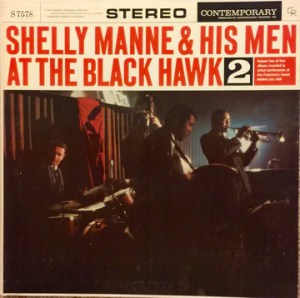
Shelly Manne & His Men / At The Blackhawk, Volume 2

More of the Music of Shelly Manne

  • With solid Double Plus (A++) sound or BETTER from first note to last, this early Contemporary stereo pressing will be very hard to beat
  • This is West Coast Jazz at its best, and if anyone can capture the realism of a live jazz club, it’s the engineers and producers at Contemporary
  • Each instrument here sounds right – the piano is weighty and percussive; the drums are punchy; and the brass has lovely leading edge transients
  • 4 stars: “These lengthy performances (“Vamp’s Blues” is over 19 minutes long) give trumpeter Joe Gordon, the cool-toned tenor-saxophonist Richie Kamuca, pianist Victor Feldman, bassist Monty Budwig and the leader/drummer a chance to really stretch out. Fine 1950s bebop.”

Wonderful sound and music! This is West Coast Jazz at its best. The sound is superb — airy, open, and spacious with a stunningly good bottom end. You won’t believe how alive the bass sounds — the depth and definition are out of this world! Each instrument here sounds just right — weighty, percussive piano; punchy drums; and lovely leading edge transients on the brass. Contemporary got live nightclub jazz sound down to a “T” here.

(more…)

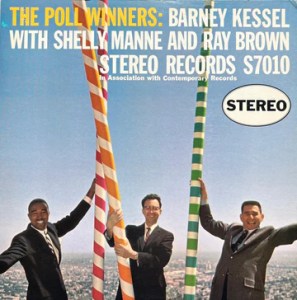
The Poll Winners – Self-Titled

More Contemporary Label Recordings

  • Stunning sound throughout this vintage Stereo Records pressing, with both sides earning Shootout Winning Triple Plus (A+++) grades or close to them
  • Roy DuNann always seems to get the real sound out of the sessions he recorded – amazingly realistic drums in a big room; Tubey Magical guitar tone; deep, note-like bass, and on and on
  • 4 1/2 stars: “The choice of material, the interplay between the three players, and the lead work all meld together beautifully on The Poll Winners, making it a classic guitar album in a small-group setting.”

(more…)