Contemporary – Reviews and Commentaries

Nobody Like Us Existed in the Record World of the 90s

Hot Stamper Pressings of Contemporary Jazz Albums Available Now

A newer customer wrote to me years ago about the amazing sounding Hot Stamper pressing of Way Out West that we’d sent him. He noted that his AP Heavy Vinyl pressing was “quite decent,” a characterization we found distressing.

Here is his original letter, along with some of what we wrote back. Newer comments and links have also been added.


As for your 1992 Analogue Productions Heavy Vinyl remaster, I honestly don’t know how anyone can listen to a record with sound like that and consider it acceptable, or, in your words, “quite decent.” I went into the long story of the album in this commentary.

Some things have changed since I wrote that screed many years ago. For example, we don’t find the sound of the OJC pressing of the album acceptable these days, a subject I plan to address before too long [and have yet to do].

The bottom line is this:

The Hot Stamper pressing of Way Out West you have now in your possession is the one that allows you to hear what that album is supposed to sound like.

Not the way Chad Kassem likes his records to sound: opaque, bloated, dull, smeary and compressed.

No, your White Hot Stamper has the brilliant sound that Roy DuNann recorded all those years ago, sounding, I believe, the way he wanted it to. This is of course only an opinion, but it is an opinion based on playing dozens of early Contemporary pressings and well as many vintage reissues that actually can beat them. Examples of both can be found here.

But Somebody Needed to Figure It Out, Right?

All that was needed was for some group to come along who could properly clean a batch of vintage pressings, original or otherwise, play them, figure out what the best copies do that the average copy doesn’t, identify that best copy, and send it your way.

(more…)

Hard Left, Hard Right Staging “Problems”

We hear complaints from time to time about hard-left/ hard-right staging, but the right pressing, properly cleaned, then played on the right equipment and all the rest, will allow you to hear the ROOM in the middle, the real space the musicians are in.

It’s the same with some of The Beatles twin track stereo stuff — there is a room there.

(And sometimes there was actually “no room” there but Norman Smith could make you think there was one.)

The sound may be stuck in the speakers at your house, but over here the music is floating in the real space of the studio, from left to right, and that includes the middle. (Records with stuck in the speakers sound can be found here — audiophiles with good systems would be wise to avoid them.)

Speaker placement is critically important in reproducing the size and space of recordings. No matter how expensive your speakers may be, if you stand them up against a wall (or stick them in the corners of your sound room) they will struggle to recreate the space that’s on your recordings.

This Kessel record really doesn’t have a problem with hard-right / hard-left sound, but some Contemporary titles do and I just thought I would get that off my chest.

Modest equipment (as well as not-so-modest equipment, especially if it’s modern) has one helluva time finding the ambient information on most recordings, just one more reason why we don’t recommend cheap tables and inexpensive phono stages.

(more…)

Skip the OJC on You Get More Bounce with Curtis Counce

Hot Stamper Pressings of Contemporary Jazz Albums Available Now
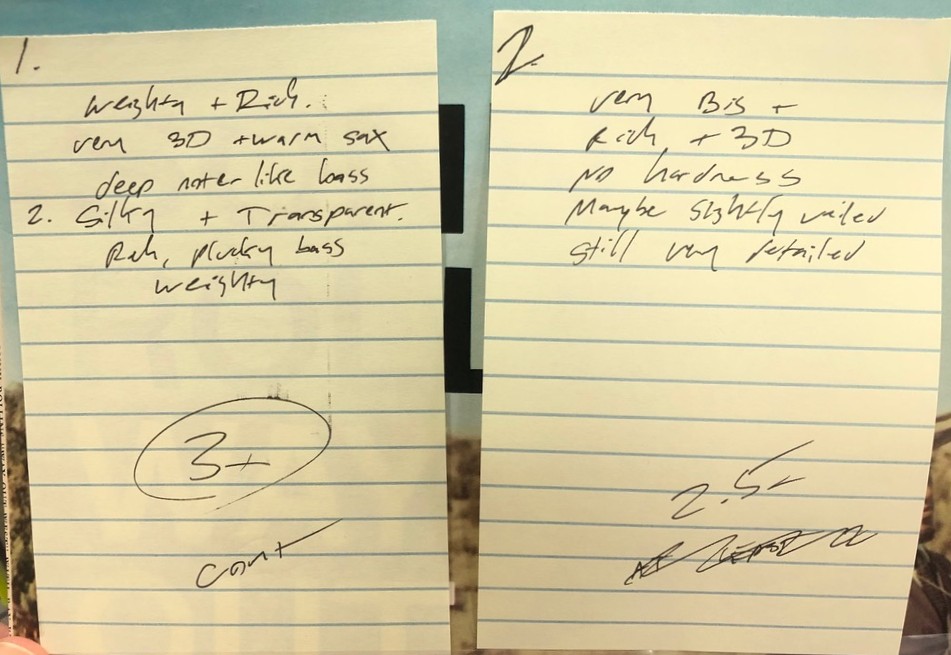

This album is findable on the OJC pressing from the 80s, but we found the sound of the oens we we played seriously wanting.

They were brighter and thinner than even the worst of the real Contemporary pressings.  Above all they badly lacked Tubey Magic, a sound the best pressings are swimming in. Consequently, none of them made the cut for our shootout.

Here are more than 400 other vintage albums that fell short, whether sonically or musically. Audiophiles should seriously consider avoiding them, and if any of you out there own copies of these titles, you might want to pull them off the shelf and see if the sound and/or music is as bad as we say.

Bright, thin and lacking in Tubey Magic is just not our sound.  It’s not the sound Roy DuNann was famous for, so why should we like it either?

(more…)

Black, Green, Yellow, Orange – Which Contemporary Label Has the Best Sound?

Hot Stamper Pressings of Contemporary Jazz Albums Available Now

UPDATE 2026

We’ve learned a lot about this amazing sounding record over the last twenty years. Check out the latest updates.


Our Hot Stamper commentary from a long-ago shootout we’d done for the wonderful Helen Humes album Songs I Like to Sing discusses the sonic characteristics we find most commonly associated with the various Contemporary labels.

This Contemporary Black Label Original LP has that classic tube-mastered sound — warmer, smoother, and sweeter than the later pressings, with more breath of life. Overall the sound is well-balanced and tonally correct from top to bottom, which is rare for a black label Contemporary, as they are usually dull and bass-heavy.

We won’t buy them locally anymore unless they can be returned. I’ve got a box full of Contemporarys with bloated bass and no top end that I don’t know what to do with.


UPDATE 2020

This commentary was written a long time ago. There are no boxes full of Contemporary records laying around in the back room. The ones that don’t sound good were sold off years ago.


Like most mediocre-to-bad sounding records we’ve auditioned, they just sit in a box taking up space. All of our time and effort goes into putting good pressings on the site and in the mailings. It’s hard to get motivated to do anything with the leftovers. We paid plenty for them, so we don’t want to give them away, but they don’t sound good, so most of our customers won’t buy them.

(more…)

Don’t Skip the OJC of Carl’s Blues

Hot Stamper Pressings of Contemporary Jazz Available Now

UPDATE 2025

The OJC pressings we played recently had much better sound than we described back in 2019 when our original highly-critical review was posted.

We told our customers to skip the OJC, but that turned out to bad advice as the right OJC pressings can be awesome sounding.

Seems we were dead wrong about this pressing. Live and learn is our motto, for this very reason.

And we don’t mind admitting to past mistakes, as that is a clear sign of progress.

(more…)

Listen for the Room Around this Drum Kit

Hot Stamper Pressings of the Music of Barney Kessel Available Now

We highly recommend you make every effort to find yourself a copy of this album and use it to test your system. The right pressing can be both a great Demo Disc and a great Test Disc.

The best Hot Stamper early pressings have the Tubey Magic we’ve come to expect from Contemporary circa 1958, with that warm, rich, full-bodied sound that RVG often struggles to get on tape. (But when he’s good he too is hard to beat.)

However, some pressings in our shootout managed to give us an extra level of transparency and ambience that most of the original pressings we played could not.

(more…)

This Early Stereo Black Label Pressing of My Fair Lady Sounded Great

The piano sounds lifelike right from the start, a beautiful instrument in a natural space, tonally correct from top to bottom.

This copy makes it clear that this is an exceptional Demo Disc quality recording for Contemporary, and that’s saying a lot.

It’s all tube, live-to-two-track direct from the Contemporary studio. It’s pretty much everything you want in a recording from this era.

How can you beat a Roy DuNann piano trio recording? We have a good supply of Hot Stamper pressings of great jazz piano recordings, but the ones we offer on Contemporary set a standard that few other labels have ever been able to meet.

(more…)

Looking Ahead! – Live and Learn

Hot Stamper Pressings of Contemporary Jazz Available Now

The Contemporary Yellow Label stereo reissue from the 70s we played way back when, probably fifteen or twenty years ago, was a good record, but not nearly as good as some of the other Contemporary pressings we’d come across since we began collecting them in the early 90s.

(Yes, we admit, we got a late start, but by the time 1995 rolled around we knew just how good this label’s records could sound, something that not everybody else did.)

Live and learn is our motto — and that approach turns out to be a feature, not a bug, of record collecting at the most advanced levels.

Experimenting with records is the only sure way to learn about them.

Our notes for the copy we put up years ago:

Another wonderful Contemporary LP. This Yellow Label Stereo pressing was a nice step up from most of what we heard, earning an A++ on side one and an A+ on side two. Side one was particularly good — the bottom end is superb, the vibra-harp sounds great and the piano has good weight. There’s lots of energy and the overall sound is big and open.

Side two was clean, clear and transparent but not quite as dynamic as side one.

Not an easy record to come by, and they usually don’t sound this good when you manage to track one down.

A top quality pressing of the album is a very different animal, a jazz Demo Disc of the highest order.

(more…)

Thoughts on One of the Most Dynamic Contemporary Recordings

Hot Stamper Pressings of the Music of Art Pepper Available Now

This commentary was written in 2008.


Intensity is right — this is some SERIOUSLY GOOD SOUNDING alto saxophone led quartet jazz. AMG was right to give this one 4 1/2 stars — the musicianship is top notch and Pepper’s playing is INSPIRED throughout. 

The real surprise was how well recorded this album from 1963 is. I can’t recall a more DYNAMIC Contemporary. Pepper’s sax gets seriously LOUD in some passages. This is very much a good thing. Not only is he totally committed to the music, but the engineers are getting that energy onto the record so that we at home can feel the moment to moment raw power of his playing.

(Pepper was famous for saying that his playing is best when he just plays whatever he feels in the moment, and this record is the best kind of evidence for the truth of that claim.)

Of course, since this is a Roy Dunann recording, all the tubey magical richness and sweetness are here as well, but what is surprising is how transparent, spacious and clear the sound is. Some of Roy’s recordings can sound a bit dead (recording in your stockroom is not always the best for spaciousness) and sometimes are a bit thick as well. Not so here. But it should be pointed out that we liked what we heard from a previous shootout too.

Last time around we wrote:

This record has superb sound: you can actually hear the keys clacking on the man’s alto. And that sort of detail does not come at the expense of phony brightness as it would with your typical audiophile recording. The tonality of the sax, drums, and bass are right on the money, exactly the way we expect Roy DuNann’s recording to be.

This time around we got more extension out of the cymbals. Either these copies are better, were cleaned better, or were helped quite a bit by our new Townshend SuperTweeters. (Probably the last two more than the first one.) (more…)

Audiophiles Should Skip Swingin’ the ’20s on OJC

Hot Stamper Pressings of Contemporary Jazz Records Available Now

This album is fairly common on the OJC pressing from 1988, but more recently we’ve found the sound of the OJC pressings we’ve played seriously wanting. They have the kind of bad reissue sound that plays right into the prejudices of record collectors and audiophiles alike, the kind for whom nothing but an original will do.

They were dramatically smaller, flatter, more recessed and more lifeless than even the worst of the ’70s LPs we played. (We tend to like those, by the way.)

The lesson? Not all reissues are created equal. Some OJC pressings are great — including even some of the new ones — some are awful, and the only way to judge them fairly is to judge them individually, which requires actually playing a large sample.

Since virtually no record collectors or audiophiles like doing that, they make faulty judgments – OJC’s are cheap reissues sourced from digital tapes, run for the hills! – based on their biases and reliance on inadequate sample sizes.

You can find those who subscribe to this approach on every audiophile forum there is. The methods they have adopted do not produce good results, but as long as they stick to them, they will never have to worry about discovering that inconvenient truth.

(more…)