Harry Fisher, Engineer – Rev/Com

Harry Fisher mastered records for Decca.

What’s More Important – The Right Label or the Right Stamper Numbers?

Hot Stamper Pressings Featuring the Violin Available Now

In this case, since the label is different but the stampers are the same, it’s the label that tells you how good your pressing may — heavy accent on the may — sound.

Lately we’ve been having exceptionally good luck with the early label pressings of many of the London violin concerto records we’ve done shootouts for.

However, the notes you see below do not belong to the wonderful Sibelius record pictured here.

They belong to another London record. We give out lots of bad stampers on this blog, but almost never do we give out the good ones. (When we do give out the best stampers, we usually keep the title a mystery, as is the case of the record here. To see the other titles whose Shootout Winning stampers have been revealed, please click here. The list to date is short but not to worry, more are on their way.)

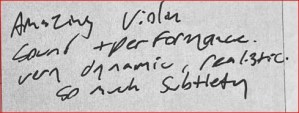
The amazingly good sounding pressing on the early label took the recording to another level. Our shootout notes read:

  • Amazing violin sound and performance.
  • Very dynamic and realistic.
  • So much subtlety.

Key Takeaways

  • The top four copies all had the same stampers, yet the sound varied noticeably from side to side, from Super Hot (A++) to White Hot (A+++), with one earning the grade between, Nearly White Hot (A++ to A+++).

(more…)

The Earliest Stampers Often Just Cannot Be Beat

Hot Stamper Pressings on Decca & London Available Now

We recently posted a lengthy commentary about conventional wisdom, attempting to make the case that, although the most common record collecting approaches are more often right than wrong, there is simply no way to know what approach will produce the best results for any given title.

Rather than post one exception after another — easily done, since we know literally hundreds of them — we are happy to admit that the generally accepted record collecting rules of thumb* work well for most records, with the definition of “most” being “more than half the time.”

In the case of this Mystery London, the received wisdom turns out to be right on the money. (As per our policy, please note that the Mahler album you see pictured is not the record we are discussing in this post.)

What conclusions can we draw from this information?

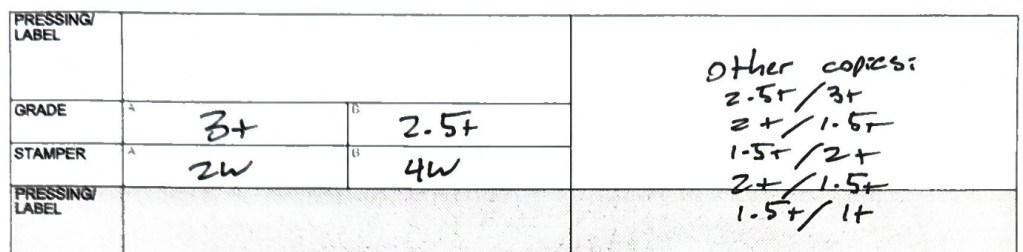
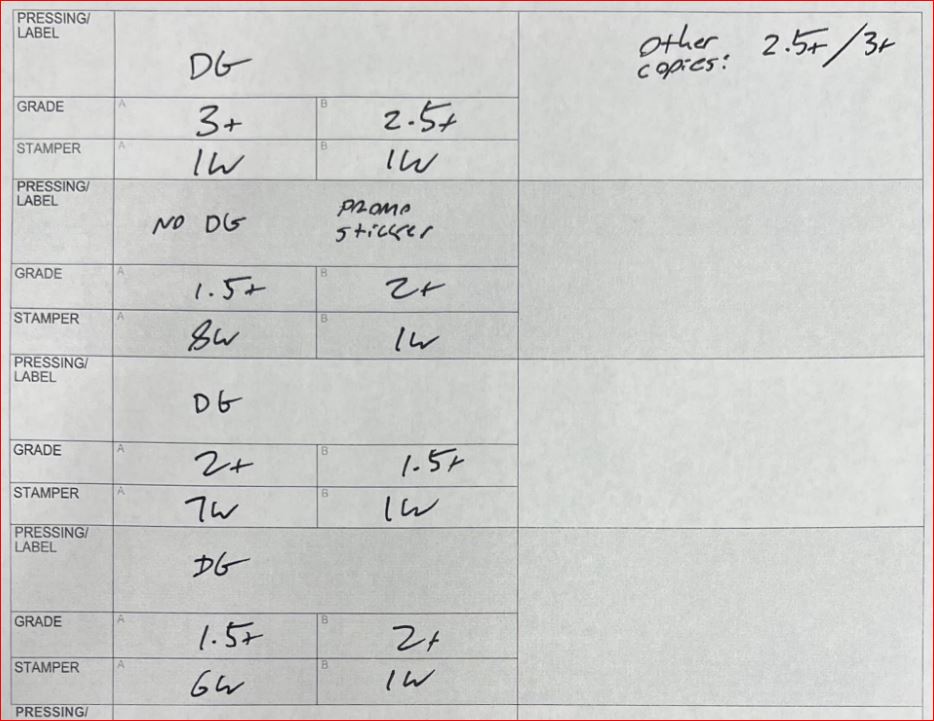
We would be very surprised if the earlierst pressings cut by Harry Fisher (1W/1W) can be beaten for sound. It’s possible, of course, and we will naturally continue to buy pressings with other stampers, if for no other reason than the fact that they are far more plentiful than the first pressings.

But if a 1W/1W gets offered to us at a high price, you can be sure we will jump at the opportunity to buy it and put it into a shootout.

The second one that comes to mind is that some vintage originals are not particularly well-mastered or pressed. (The 1W side twos should have sounded better than the 2+ grades they earned, but my guess is that the metal work by then was older and morn worn and just could not compete with the fresher, earlier copies, the ones with 1W side ones.)

All three of the early Deep Groove pressings with stampers other than 1W/1W did not earn Super Hot stamper grades (2+) on both sides. The only way to get top quality sound for this title is with the first pressing. And both of our 1W/1W pressings had Shootout Winning sides. (Here are some of the other albums we’ve discovered in which one set of stampers consistently win our shootouts.)

Now imagine that some company has come along and remastered the album on Heavy Vinyl for the benefit of audiophiles and music lovers alike.

If the vintage pressing you own just happens to have anything but 1W/1W stampers — you picked it up years ago because it’s an original on the Deep Groove early label and appears to be as vintage as vintage can be — you would be jumping for joy that finally the sound of the master tape has been transferred to vinyl properly after all these years.

Thank god for Kevin Gray / Bernie Grundman / Krieg Wunderlich / Chris Bellman or somebody else — pick any name you like — for the wonderful mastering work they do, bringing old records back to life.

What a service they do for the audiophile community!

Their critics must be idiots.

Sample Sizes and One Man Bands

Those of us who play a variety of pressings of the same album know where judgments of this kind come from.

They are mostly the result of sample sizes that are too small.

If you’re an audiophile reviewer operating as a one man band, which, as far as we know, is the only way any of them currently operate, your chances of getting it wrong are fairly high indeed. Here is one obvious example from a long time ago, but there are plenty more to be found under the heading of shootout malpractice here on the blog.

Just as an aside, please note that many of our customers do their own shootouts and seem to come to much more accurate assessments of the various pressings they play than any reviewers we’ve encountered. Perhaps we can take some small credit for showing them the way? I would like to think so.

How Did We Figure All of This Out?

(more…)

When Fisher Took Over from Goodall, He Really Let the Side Down

Hot Stamper Pressings of Recordings by Decca Available Now

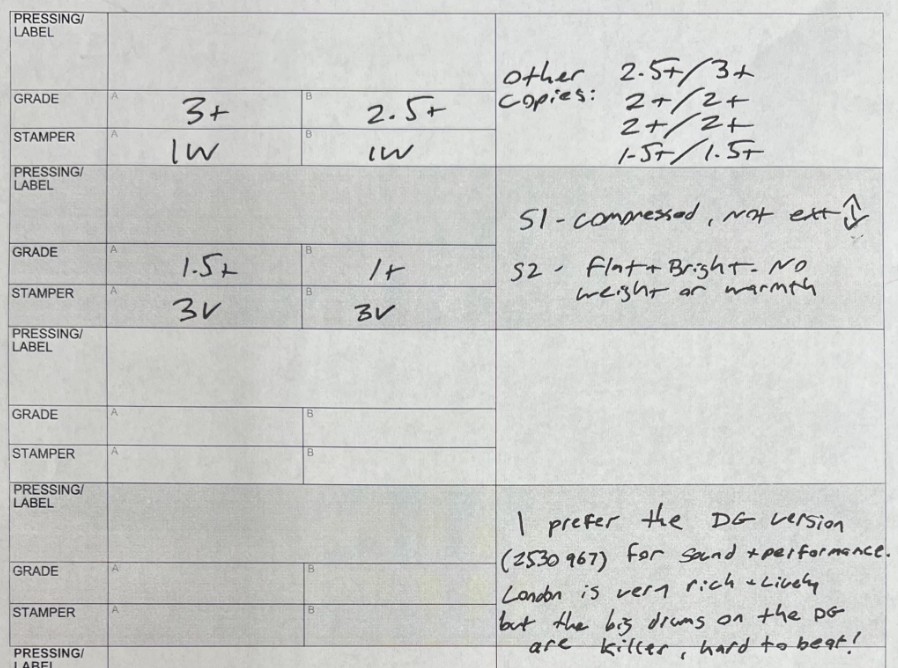
Please keep in mind that, as per our usual, the record you see pictured is not the record we are discussing in this posting.

The stamper numbers you see below belong to a different album.

The quick takeaway: Stan Goodall (“E”) cut the Shootout Winning early pressings.

Then, for reasons known only to the folks at Decca, Harry Fisher (“W”) took the reins and managed to cut some side twos that were very good. Not as good, but still very good: 2+ most of the time, some slightly worse. They were not as weighty or rich, and we take a lot of points off for records that are not as weighty or rich as they should be.

By the time Decca had changed its label to the Decca in a Box design, Mr. Fisher was cutting all the pressings, and, in our experience, not doing an especially good job. We do not even offer records with grades that low.

The sound might be passable, and would probably still be better than whatever Heavy Vinyl pressings might have been made from the tapes in the last twenty years, but that’s not good enough for us here at Better Records, not at the prices we charge anyway.

We described Fisher’s sound as dry and hot on side one, and thin and very small on side two of the 5W-stamped pressing we played. We only had the one, and the reason we had even one after having heard other Boxed Decca pressings do poorly, is that it’s a good way to stay honest and to have a better baseline to work with.

If we played nothing but 3E/1E originals, most of those 1E side twos would have earned a 2+ grade, but they would have sounded much better than the 2W-graded copies, and that seriously screws up the grading scale, especially when clean originals cost us a hundred bucks or more these days.

(more…)

On this Mystery London, The Reissues Have Lately Been Letting Us Down

Hot Stamper Pressings of Recordings by Decca Available Now

The record you see pictured is not the record we will be discussing in this post.

The stamper numbers and grades you see below belong to a different album.

We’ve lately been giving out much more stamper information than we used to, in some cases including the actual stamper sheets compiled from the shootout — winners, losers, and everything in between — but for now we are keeping this title close to the vest.

This pressing was not as bad as many of the golden age classical titles we play. (See links below.)

Although it has the potential to sound amazingly good on the early labels, the second label London pressings never seem to do much better than 1.5+, a barely passing Hot Stamper grade.

It’s small, stuck in the speakers, and had no real top end. We judge the best pressings on the second label with these stampers to have good, not great sound quality.

1.5+ is four grades down from the top copy.

That’s a steep dropoff as far as we’re concerned. 1.5+ only hints at how good a recording this London can be on the best early pressings.

To see more records that earned the 1.5+ grade, please click here. (Incidentally, some of them are even on Heavy Vinyl. The better modern pressings have sometimes, if rarely, been known to earn Hot Stamper grades, and one shocked the hell out of us by actually winning a shootout. Wouldn’t you like to know which one!)

For those who might be interested, there’s more on our grading scale here.


Here are reviews for some of the titles we’ve auditioned, broken down into the three major labels that account for most of the best classical and orchestral titles we’ve had the pleasure to play.

  • London/Decca records with weak sound or performances
  • Mercury records with weak sound or performances
  • RCA records with weak sound or performances

We’ve auditioned countless pressings in the 37 years we’ve been in business — buying, cleaning and playing them by the thousands.

(more…)

On Young Person’s Guide, Stick with the Unboxed Deccas

Hot Stamper Pressings of Classical and Orchestral Music Available Now

This is our favorite recording of the work. Those of you looking for a Young Person’s Guide can stop looking, this is the one.

For those who have never heard it, check out The Young Person’s Guide on YouTube – it is a tour de force of orchestral excitement, especially from the percussion section.

We’ve learned from shootouts past (and were reminded again during our most recent) that the London pressings can also be quite good, but none of them can hold a candle to the early Deccas.

However, the later Boxed Label Deccas leave a lot to be desired and should be avoided by those looking for top quality sound.

Side one of this copy was dry and hot. Side two thin and very small.

This is an amazing recording, but you’d never know it from playing the reissues.

There are about 150 orchestral recordings we think offer the best performances with the highest quality sound. This record is certainly deserving of a place on that list.

(more…)

Pictures at an Exhibition – Uncannily Natural Piano Reproduction

More of the music of Modest Mussorgsky (1839-1881)

In a recent listing for a shootout winning pressing, we noted:

This original London pressing of the solo piano version of Pictures at an Exhibition has uncannily natural piano reproduction, which is why we are awarding this side one our highest sonic grade, A Triple Plus.

The fact that the recording takes place in Kingsway Hall in 1967 no doubt plays a large part in the natural sound. The hall is bigger here than on other copies, the piano even more solidly weighted, yet none of this comes at the expense of the clarity of the playing.

The piano has no smear, allowing both the percussive aspects of the instrument and the extended harmonics of the notes to be heard clearly and appreciated fully.

Side two has Mehta’s performance of the orchestrated work squeezed onto side two, which is never a good idea if one is looking for high quality orchestral sound. The performance itself is mediocre as well.

We are not, and never haver been, big fans of Mehta’s work with the Los Angeles Philharmonic on London.

The exceptionally rare copy of Mehta’s Planets can sound good, but 90% of them do not — just don’t make the mistake of telling that to the average audiophile who owns one. Harry told him it was the best, he paid good money for it, and until someone tells him different it had better be “the one Planets to own.” (Our favorite performance of The Planets can be found here.)

We see one of our roles here at Better Records as being the guys who actually will “tell you different,” and, more importantly, can back up our opinions with the records that make our case for us. (more…)

Coppelia and Sylvia / London Vs. Decca – Updated 2025

Hot Stamper Pressings of Music Conducted by Ernest Ansermet Available Now

Once again, the right Decca reissue blows the doors off the original London we played. This has lately become a pattern, but keep in mind it’s a pattern that’s reliable less than half the time, if memory is any guide. Many of the Decca reissues we’ve played over the last few years have failed badly in a head to head with their earlier-mastered and -pressed counterparts.

But the ones that beat all comers are the ones that stick in our minds and show up on our site.


UPDATE 2025

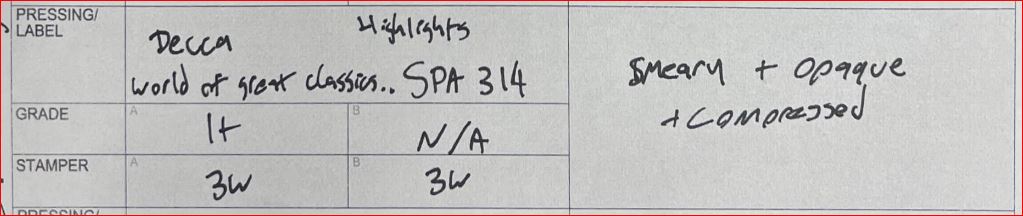
A copy of one of the SPA reissues we used to like shown above made it to our latest shootout and did not do nearly as well as a copy did years ago.

We don’t have those copies anymore and cannot say whether they actually did sound as good as we thought they did.

Our advice would be to assume that this is not the best way to buy this album. But neither is the original, as you will read below.

Clearly a case of confirmation bias, but at least we know something about our own biases, and that puts us well ahead of the audiophile pack.

Record collectors and record collecting audiophiles will tell you it shouldn’t happen, but fools like us, who refuse to accept the prognostications of those supposedly “in the know,” have done the work and come up with the experimental data that’s proven them wrong again and again.

Sort of. We had one, and only one, pressing of the original London (CS 6185), and boy was it a mess — crude as crude can be.

It sounded like an “old London record,” not the Decca engineered and mastered vintage collectible we know it to be.

We’ve played them by the hundreds, so we know that sound fairly well by now.

Are there copies that sound better? Surely there are, but how are you going to find them? Are you going to shell out the going rate of $25-50 on ebay for one (or more) clean copies, only to find that it/they sound every bit as bad as the one we auditioned? The question answers itself.

If, however, you are one of the lucky few who has a nice London or Decca original of this recording, please let us send you this copy so that you can do the shootout for yourself. You may be shocked at how good this music can sound on the right pressing. And if your copy sounds better than ours we will be very shocked indeed. [This offer was only good while we had the record, and it is long gone at this point. We still remember the sound though!]

Production and Engineering

James Walker was the producer, Roy Wallace the engineer for these sessions from April of 1959 in Geneva’s glorious Victoria Hall. It’s yet another remarkable disc from the Golden Age of Vacuum Tube Recording.

The hall the Suisse Romande recorded in was possibly the best recording venue of its day, possibly of all time. More amazing sounding recordings were made there than in any other hall we know of. There is a solidity and richness to the sound beyond all others, yet clarity and transparency are not sacrificed in the least.

It’s as wide, deep and three-dimensional as any, which is of course all to the good, but what makes the sound of these recordings so special is the weight and power of the brass, combined with unerring timbral accuracy of the instruments in every section of the orchestra.

(more…)