Decca SPA/SDD – Rev/Com

Striving for Orchestral Clarity on Finlandia with Decca and Failing with RCA

More of the Music of Jean Sibelius

More of the Music of Edvard Grieg

The original RCA Living Stereo pressings we played in our 2014 shootout were not competitive with the best Deccas and London reissues of Finlandia.

Is the original the best way to go? In our experience with Finlandia, it is not. And it’s not even close.

The Decca reissue you see here is yet another wonderful example of what the much-lauded Decca recording engineers were able to capture on analog tape all those years ago. The 1961 master tapes have been transferred brilliantly using “modern” cutting equipment (from 1970, not the low-rez junk they’re forced to make do with these days), giving you, the listener, sound that only the best of both worlds can offer. [Not true, see Two Things below.)

When you hear how good this record sounds, you may have a hard time believing that it’s a budget reissue from 1970, but that’s precisely what it is.

Even more extraordinary, the right copies are the ones that win shootouts

Side One

Correct from top to bottom, and there are not many records we can say that about. So natural in every way.

The brass is HUGE and POWERFUL on this side. Not many recordings capture the brass this well. Ansermet on London comes to mind of course but many of his performances leave much to be desired. Here Mackerras is on top of his game with performances that are definitive.

The brass is big and clear and weighty, just the way it should be, as that is precisely the sound you hear in the concert hall, especially that part about being clear: live music is more than anything else completely clear. We should all strive for that sound in our reproduction of orchestral music.

The opening track on side one, Wedding Day at Troldhaugen, is one of my favorite pieces of orchestral music. Mackerras and the London Proms make it magical.

Side Two

The richness on this side is awesome. So 3-D, with depth and transparency to rival any recording you may own.

Two Things

When you hear a record of this quality, you can be pretty sure of two things: one, the original is unlikely to sound as good, having been cut on cruder equipment.


UPDATE

Let me stop myself right there. I no longer subscribe to this view. There are many original pressings mastered in the 50s that are as hi-rez and undistorted as anything made after them. Here’s one example. It would be easy to name a great many more. Live and learn I say.


And two, no modern recutting of the tapes (by the likes of Speakers Corner for example, but you can substitute any company you care to choose) could begin to capture this kind of naturalistic orchestral sound. [Mostly still true.]

I have never heard a Heavy Vinyl pressing begin to do what this record is doing. The Decca we have here may be a budget reissue pressing, but it was mastered by real Decca engineers (a few different ones in fact), pressed in England on high quality vinyl, and from fairly fresh tapes (nine years old, not fifty years old!), then mastered about as well as a record can be mastered.

The sound is, above all, real and believable.

The brass has weight, the top extends beautifully for those glorious cymbal crashes, the hall is huge and the staging very three-dimensional — there is little to fault in the sound on either side.

(more…)

The World of the Zombies on Decca – How Accurate Is the Label?

Hot Stamper Pressings of the Music of The Zombies Available Now

For all intents and purposes, The World of the Zombies is a reissue of their 1965 debut album, Begin Here, with a few track changes, the most important of which is the addition of Tell Her No.

In 2008 and again around 2010 I had a chance to see the newly reformed Zombies play locally and they put on one helluva show. That rich keyboard sound Rod Argent pioneered influenced a ton of bands I love, especially pop groups like Jellyfish and Crowded House.

On our amazingly Tubey Magical Hot Stamper copies, the Hammond B-3 sound is GLORIOUS. Smooth, sweet vocals and dead on tonality complete the sonic picture here.

Just for fun sometime go to popsike.com and check out what the original first Zombies record on Decca sells for. Try $1500 and up! And people think our prices are high — we ain’t never charged that kind of bread.

[At the time of this writing that was true. Led Zeppelin II put an end to our old price ceiling.]

How Good Is the Stereo Reprocessing of the Mono Tracks?

Sticks and Stones on side one is in reprocessed stereo, but it has been done tastefully and is very close to mono.

(more…)

It’s Records Like This that Give Decca Reissues a Bad Reputation

Hot Stamper Pressings of of the Music of Johannes Brahms Available Now

Apparently mastered with no regard to sound quality, this Decca SPA reissue is a mess.

How do we know that? We go out of our way to play every pressing we can get our hands on, even cheap reissues such as this. That’s our job.  We play everything to find the best sounding records so you don’t have to.

And some of these cheap reissues win shootouts!

But you can’t guess which ones will. You have to play them to find out.

And that’s how we know that some of them are good, some of them are mediocre, and some, like this one, are just awful.

Want to be assured of getting good sounding pressings of the greatest classical recordings of all time?

Step right up and order anything classical or orchestral you see here, Every one of them is guaranteed to please.

(more…)

On Dvorak’s Ninth, Big Brass Is Key to the Sound of the Best Pressings

More of the music of Antonin Dvorak (1841-1904)

What do all the best pressings all have in common?

There the ones with brass that is both powerful and weighty. That’s the sound that has the drive and energy to move the listener. As a rule, the tympani too will sound right when the brass has the air-moving power it should. The same is true for the lower strings.

Without fullness, richness and clarity in the area below the midrange, neither the sound nor the music can succeed. Many of the pressings we auditioned early on in an elimination round could not reproduce the brass with much weight; consequently they did not make it to the shootout.

(Sibelius’ Finlandia is the same way; it needs real weight down low. The huge brass opening of the piece is breathtaking on the best copies.)

More  of our favorite orchestral recordings with especially weighty brass

(more…)

Shootout Winning Stampers for Schubert’s Ninth Revealed!

More of the Music of Franz Schubert

Looking to pick up a Hot Stamper on your own?

Easy — all the best Decca copies in our shootout were mastered by Ted Burkett and were incribed with the stampers 5G/7G.

I suppose it’s only fair to point out that all the worst copies had those same stampers.

There were a few others as well — it was quite a big shootout — but most of those ended up in the middle of the pack.

And here you thought I was actually being helpful.

But we are being helpful. We’re sharing with you an important truth.

Stamper numbers only tell part of the story, and they can be very misleading, in the same sense that a little knowledge is sometimes a dangerous thing.

To know what a record sounds like you have to play it.

This is a subject near and dear to us here at Better Records, and that has been the case for many decades.

We discuss it at length in a commentary you may have seen on the site called the book of Hot Stampers.

(more…)

Coppelia and Sylvia / London Vs. Decca – Updated 2025

Hot Stamper Pressings of Music Conducted by Ernest Ansermet Available Now

Once again, the right Decca reissue blows the doors off the original London we played. This has lately become a pattern, but keep in mind it’s a pattern that’s reliable less than half the time, if memory is any guide. Many of the Decca reissues we’ve played over the last few years have failed badly in a head to head with their earlier-mastered and -pressed counterparts.

But the ones that beat all comers are the ones that stick in our minds and show up on our site.


UPDATE 2025

A copy of one of the SPA reissues we used to like shown above made it to our latest shootout and did not do nearly as well as a copy did years ago.

We don’t have those copies anymore and cannot say whether they actually did sound as good as we thought they did.

Our advice would be to assume that this is not the best way to buy this album. But neither is the original, as you will read below.


Clearly a case of confirmation bias, but at least we know something about our own biases, and that puts us well ahead of the audiophile pack.

Record collectors and record collecting audiophiles will tell you it shouldn’t happen, but fools like us, who refuse to accept the prognostications of those supposedly “in the know,” have done the work and come up with the experimental data that’s proven them wrong again and again.

Sort of. We had one, and only one, pressing of the original London (CS 6185), and boy was it a mess — crude as crude can be.

It sounded like an “old London record,” not the Decca engineered and mastered vintage collectible we know it to be.

We’ve played them by the hundreds, so we know that sound fairly well by now.

Are there copies that sound better? Surely there are, but how are you going to find them? Are you going to shell out the going rate of $25-50 on ebay for one (or more) clean copies, only to find that it/they sound every bit as bad as the one we auditioned? The question answers itself.

If, however, you are one of the lucky few who has a nice London or Decca original of this recording, please let us send you this copy so that you can do the shootout for yourself. You may be shocked at how good this music can sound on the right pressing. And if your copy sounds better than ours we will be very shocked indeed. [This offer was only good while we had the record, and it is long gone at this point. We still remember the sound though!]

Production and Engineering

James Walker was the producer, Roy Wallace the engineer for these sessions from April of 1959 in Geneva’s glorious Victoria Hall. It’s yet another remarkable disc from the Golden Age of Vacuum Tube Recording.

The hall the Suisse Romande recorded in was possibly the best recording venue of its day, possibly of all time. More amazing sounding recordings were made there than in any other hall we know of. There is a solidity and richness to the sound beyond all others, yet clarity and transparency are not sacrificed in the least.

It’s as wide, deep and three-dimensional as any, which is of course all to the good, but what makes the sound of these recordings so special is the weight and power of the brass, combined with unerring timbral accuracy of the instruments in every section of the orchestra.

(more…)

Concierto De Aranjuez – Another London with Dry Strings (on Some Copies)

More of the music of Joaquín Rodrigo (1901-1999)

On some copies of this album the strings are dry, lacking the full measure of Tubey Magic we know the tape to have. This is decidedly not our sound, although we’ve heard if often enough, having played hundreds of vintage Decca and London pressings over the years.

If you have a rich sounding cartridge, perhaps with that little dip in the upper midrange that so many moving coils have these days, you will not notice this tonality issue nearly as much as we do.

Our 17D3 is ruler flat and quite unforgiving in this regard. While it certainly makes our shootouts much easier, it does bring out the flaws in all but the best pressings — exactly the job we require it to do.

Here are some other records that are good for testing string tone and texture.

With a sonic grade of A++, the sound is glorious, with practically all of the qualities that make listening to classical music in analog so involving. The presentation is shockingly three-dimensional, with an exceptionally wide and deep stage. The orchestral sound is rich and sweet, yet the guitar is clear and immediate. Managing to balance — so effortlessly — two dissimilar elements such as these, in 1959 no less, requires an enormous amount of skill and effort. Fifty-odd years later, those of us with good turntables are profoundly thankful for their achievement, in terms of both performance and sound.

If you were only to be allowed one Guitar Concerto recording, this would probably be the one to own. You will recognize the main theme instantly; it’s the one Miles Davis appropriated for the astonishingly innovative Sketches of Spain album he did with Gil Evans which came out the following year in 1960.

Side One – Guitar Concerto: “Concerto De Aranjuez” (1939)

A++, including all the qualities we discussed above, with an especially immediate and real solo guitar.

With a bit more top end extension this side would have been White Hot. It should be noted that no Decca or London copy in our shootout had as much top end as we would have liked on the Rodrigo, a fault perhaps in the recording?

Side Two – Fantasìa Para Un Gentilhombre (1954)

A++, equally good in its own way. Rich and lush strings, but slightly veiled compared to side one. So musical and analog, although, like many concerto recordings, the guitar is much larger in the soundfield of the recording than it would be in the concert hall.

The music is reminiscent of Respighi’s Ancient Airs and Dances, for those of you familiar with the work (a longtime resident of the TAS List. Wish we could find them!).

(more…)

Records Like This Give Decca’s Reissues a Bad Reputation

Hot Stamper Pressings of of the Music of Johannes Brahms Available Now

Apparently mastered with no regard to sound quality, this Decca SPA reissue is muddy, dull, congested and full of harmonic distortion in the louder passages.

How do we know that? We go out of our way to play every pressing we can get our hands on, even cheap reissues such as this. That’s our job.  We play everything to find the best sounding records so you don’t have to.

And some of these cheap reissues win shootouts!

But you can’t guess which ones will. You have to play them to find out.

And that’s how we know that some of them are good, some of them are mediocre, and some, like this one, are just awful.

Want to be assured of getting good sounding pressings of the greatest classical recordings of all time?

Step right up and order anything classical or orchestral you see here, Every one of them is guaranteed to please.

Our Pledge of Service to You, the Discriminating Audiophile 

We play mediocre-to-bad sounding pressings so that you don’t have to, a free service from your record-loving friends at Better Records.

(more…)

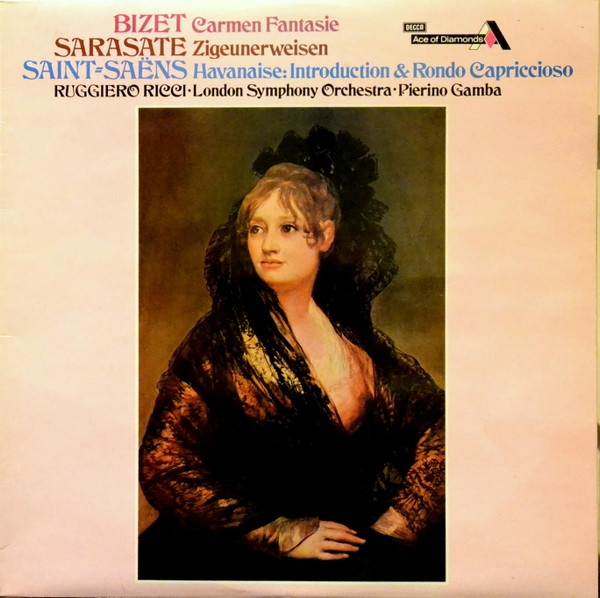
Bizet / Carmen Fantaisie – A No-Better-than-Decent Decca Reissue

More of the music of Georges Bizet

This Ace of Diamonds UK pressing (SDD 420) of the famous Ricci recording has fairly good sound, but it is a far cry from the real thing on either Decca or London disc.

The right originals are just too good. There is nothing like them. They are simply amazing recordings, unequaled in fifty or more years. If you want that sound, you’d better plan on going back to 1960 or thereabouts to find it.

The Speakers Corner Reissue was my first exposure to this music and I fell in love with it. I recommended it highly back in the days when I was selling Heavy Vinyl.

I admit I haven’t heard one in years, but my guess is that you are probably better off with this Decca Ace of Diamonds pressing that anything Speakers Corner might have put out.

(more…)

A Must Own Performance of the 1812 Overture by Alwyn on Decca

Hot Stamper Pressings of Orchestral Spectaculars Available Now

Years ago we found a very special copy of this album in a shootout and gave it a grade of A++++. We don’t give out that grade anymore, but we gave it out to this side one back in the day. We describe the sound of that side one below.

A BEYOND White Hot Quadruple Plus side one – hear Tchaikovsky’s 1812 in Demo Disc sound. This is the most exciting and beautifully played 1812 we know of, with the best sound ever to boot on this copy. This is an exceptional Decca remastering of a superb Golden Age recording on very good vinyl.

The WHOMP FACTOR on this side one has to be heard to be believed. If you’ve got the woofers for it this record is going to rock your world!

Side One (1812 Overture)

Off the charts, the best we have ever heard this work sound. Big, rich, clean and clear barely begins to do this side justice. The strings are wonderfully textured and not screechy in the slightest.

The brass is big and clear and weighty, just the way it should be, as that is precisely the sound you hear in the concert hall, especially that part about being clear: live music is more than anything else completely clear. We should all strive for that sound in our reproduction of orchestral music.

Not many recordings capture the brass this well. (Ansermet on London comes to mind of course but many of his performances leave much to be desired. Here Alwyn is on top of his game with performances that are definitive.)

Here’s what you get on this side one:

The most dynamic sound we have ever heard for any side of this album.

The most weight and power we have ever heard for the 1812, and as you can imagine, for this work to have the kind of power this pressing has was nothing less than a THRILL to hear. Who knew? Until we played this copy, not us!

The most depth and space we have ever heard on this album.

To earn our coveted Three Plus (OR BETTER) rating here at Better Records all you have to do is be the best copy we’ve ever played. Just be right in every way (or almost every way; no record can be perfect, but some, such as this one, seem to us to get pretty darn close). (more…)