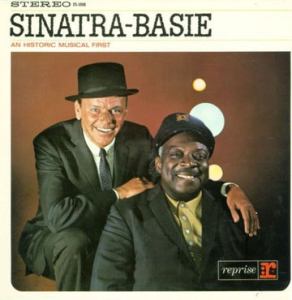
- Boasting two INCREDIBLE Shootout Winning Triple Plus (A+++) sides, we guarantee you’ve never heard beloved this Sinatra / Basie collaboration sound this good
- Tubey, warm and smooth, with an extended top and bottom, the louder you play this record the better it sounds
- Marks in the vinyl are sometimes the nature of the beast with these early pressings – there simply is no way around them if the superior sound of vintage analog is important to you
- 4 stars: “The long-awaited first collaboration between two icons did something unique for the reputations of both. For Basie, the Sinatra connection inaugurated a period in the 1960s where his band was more popular and better-known than it ever was, even in the big band era. For Sinatra, Basie meant liberation, producing perhaps the loosest, rhythmically free singing of his career.”
A historic musical first!
As the liner notes mention — “sizzling tenor-sax solos by Frank Foster and Eric Dixon,” and they aren’t kiddin’!
This 60s LP has the kind of Tubey Magical Midrange that modern pressings cannot BEGIN to reproduce. Folks, that sound is gone and it sure isn’t showing any sign of coming back.
Having done this for so long, we understand and appreciate that rich, full, solid, Tubey Magical sound is key to the presentation of this primarily vocal music. We rate these qualities higher than others we might be listening for (e.g., bass definition, soundstage, depth, etc.). The music is not so much about the details in the recording, but rather in trying to recreate a solid, palpable, real Sinatra singing live in your listening room. The best copies have an uncanny way of doing just that.
If you exclusively play modern repressings of older recordings (this one is now almost 65 years old), I can say without fear of contradiction that you have never heard this kind of sound on vinyl. Old records have it — not often, and certainly not always — but less than one out of 100 new records do, if our experience with the hundreds we’ve played can serve as a guide.
What The Best Sides Of Sinatra-Basie Have To Offer Is Not Hard To Hear
- The biggest, most immediate staging in the largest acoustic space
- The most Tubey Magic, without which you have almost nothing. CDs give you clean and clear. Only the best vintage vinyl pressings offer the kind of Tubey Magic that was on the tapes in 1962
- Tight, note-like, rich, full-bodied bass, with the correct amount of weight down low
- Natural tonality in the midrange — with all the instruments having the correct timbre
- Transparency and resolution, critical to hearing into the three-dimensional studio space
No doubt there’s more but we hope that should do for now. Playing the record is the only way to hear all of the qualities we discuss above, and playing the best pressings against a pile of other copies under rigorously controlled conditions is the only way to find a pressing that sounds as good as this one does.
Copies with rich lower mids and nice extension up top did the best in our shootout, assuming they weren’t veiled or smeary of course. So many things can go wrong on a record. We know, we’ve heard them all.
And we know a fair bit about the man’s recordings at this point. As of today, we’ve done commentaries for more than 28 different Sinatra shootouts, and that’s not counting at least another ten titles that either bombed or were sold off years ago.
A Big Group of Musicians Needs This Kind of Space
One of the qualities that we don’t talk about on the site nearly enough is the SIZE of the record’s presentation. Some copies of the album just sound small — they don’t extend all the way to the outside edges of the speakers, and they don’t seem to take up all the space from the floor to the ceiling. In addition, the sound can often be recessed, with a lack of presence and immediacy in the center.
Other copies — my notes for these copies often read “BIG and BOLD” — create a huge soundfield, with the music positively jumping out of the speakers. They’re not brighter, they’re not more aggressive, they’re not hyped-up in any way, they’re just bigger and clearer.
And most of the time those very special pressings are just plain more involving. When you hear a copy that does all that — a copy like this one — it’s an entirely different listening experience.
What We’re Listening For On Sinatra-Basie
- Energy for starters. What could be more important than the life of the music?
- The Big Sound comes next — wall to wall, lots of depth, huge space, three-dimensionality, all that sort of thing.
- Then transient information — fast, clear, sharp attacks, not the smear and thickness so common to these LPs.
- Tight note-like bass — which ties in with good transient information, also the issue of frequency extension further down.
- Next: transparency — the quality that allows you to hear deep into the soundfield, showing you the space and air around all the instruments.
- Extend the top and bottom and voila, you have The Real Thing — an honest to goodness Hot Stamper.
Side One
Pennies From Heaven
Please Be Kind
(Love Is) The Tender Trap
Looking at the World Through Rose Colored Glasses
My Kind of Girl
Side Two
I Only Have Eyes for You
Nice Work If You Can Get It
Learnin’ the Blues
I’m Gonna Sit Right Down (And Write Myself a Letter)
I Won’t Dance
AMG 4 Star Review
The long-awaited first collaboration between two icons, Count Basie and Frank Sinatra, did something unique for the reputations of both. For Basie, the Sinatra connection inaugurated a period in the 1960s where his band was more popular and better-known than it ever was, even in the big band era. For Sinatra, Basie meant liberation, producing perhaps the loosest, rhythmically free singing of his career.
Propelled by the irresistible drums of Sonny Payne, Sinatra careens up to and around the tunes, reacting jauntily to the beat and encouraging Payne to swing even harder, which was exactly the way to interact with the Basie rhythm machine — using his exquisite timing flawlessly.
Also the members of the Basie band play a more prominent role than usual on a Sinatra record, with soloists like Frank Wess — in some of the finest flute work of his life — and tenors Frank Foster and Eric Dixon getting prominent solo opportunities on several of the tracks.
The record was criticized by some as a letdown when it came out, probably because Neal Hefti’s charts rarely permit the band to roar, concentrating on use of subtlety and space. Yet the record’s restraint has worn very well over the long haul — it doesn’t beat you into submission — and it concludes with its best shot, a wonderfully playful treatment of “I Won’t Dance.”