Robin Geoffrey Cable, Engineer – Reviews, Commentaries and Letters

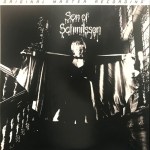
Son of Schmilsson at 45 RPM – How Can It Possibly Sound This Bad?

Hot Stamper Pressings of the Music of Harry Nilsson Available Now

Alternately titled: Forty Five, Schmorty Five.

Recently someone loaned us a copy of the Mobile Fidelity pressing of this album, the one they put out in 2021 on two discs cut at 45 RPM, remastered by that notorious hack, Krieg Wunderlich.

Our last shootout took place all the way back in 2021. Although I listen to this title regularly,  unfortunately it does not sell all that well, so we haven’t been making the effort we should to find copies in order to offer the best of them to our customers.

Why the album is not more popular is a question we ask about a number of titles on our site. We love the music and we love the sound, as can be seen from what we (with the help of Allmusic) had to say about a very good sounding pressing back then:

  • This is one of Nilsson’s best albums, sonically and musically. (With Ken Scott at the board at Trident Studios the sound just has to be good, doesn’t it?)
  • Son of Schmilsson has more than half a dozen of the best songs Nilsson ever wrote, and should make it a Must Own for every right thinking audiophile with sophisticated tastes in popular music (we hope this means you)
  • 4 1/2 stars: “… this is all married to a fantastic set of songs that illustrate what a skilled, versatile songsmith Nilsson was. No, it may not be the easiest album to warm to — and it’s just about the weirdest record to reach number 12 and go gold — but if you appreciate Nilsson’s musicality and weirdo humor, he never got any better.”

So true!

The MoFi, however, is a joke next to a properly-mastered and properly-pressed RCA vintage release. Our notes for it read:

  • Big but flat
  • Voice is recessed and lacks richness
  • Rock songs, track one in particular work OK but
  • Ballads lose all the magic

(more…)

Living and Learning Is How the Game Is Played

Hot Stamper Pressings of the Music of Elton John Available Now

A classic case of live and learn.

Scroll down to read more about what we learned from a big shootout we did many years ago for the Self-Titled album.

To illustrate how the game is played, we’ve copied some of the previous commentary into this listing to clarify how our understanding had changed from 2004 to roughly 2010, which is when all the comments you see below were written.

Live and Learn, Part One

These domestic original pressings have the very same stamper numbers as the British pressings. It appears that the metalwork was produced in England and shipped to America for pressing on domestic vinyl. What’s strange is that the American pressings are consistently brighter than the British pressings. Why this should be is a mystery, but I have a theory to explain it. The British stampers are used to make British LPs on that lovely see-through purple vinyl, and I’m guessing that that compound is a little smoother sounding than the vinyl that Uni uses. Either that or there is some other way that Uni produces their records so that they end up being brighter, even using the exact same stampers as the British ones.”

Partly true.

We have five British copies in stock, and the reason they don’t sound as good probably has less to do with British vinyl and more to do with the fact that the British ones we have are not the stampers we like the best. The domestic pressings with our favorite stampers have more highs and better highs and just plain sound better to us now.

Notice how I completely contradict myself below, yet both listings were up on the site all this time and nobody, especially me, seems to have noticed.

Live and Learn, Part Two

These original British pressings, with the lovely see-through purple vinyl, are the only good sounding versions of this album that I have ever heard. As you can imagine they are extremely difficult to come by in clean condition.

What is there to say about such a bald-faced turnabout?

Simple. We make our judgments based on the records we have on hand to play. When better pressings come along, or our equipment has improved to the point where we can appreciate other pressings, we will happily and unhesitatingly report what we hear.

The Best Version?

(more…)

Letter of the Week – “It realized what I was imagining when I read your description on the website.”

Hot Stamper Pressings of the Music of Elton John Available Now

One of our good customers had this to say about some Hot Stampers he purchased a while back:

Hey Tom, 

You got me again. After hearing the Elton John record I was thoroughly pleased.

It realized what I was imagining when I read your description on the website. I can only imagine what the Super Hot Stamper LP would sound like as a White Hot Stamper.

Andrew S.

Andrew,

Glad you are enjoying that amazing pressing of Madman. We thought it sounded great too, and naturally that’s why we had so many nice things to say about it in our review. We discussed what separates the White Hot winners from the Super Hot second place finishers here:

(more…)

The Strings on Elton John’s Second Album Are a Tough Test

Hot Stamper Pressings of the Music of Elton John Available Now

What’s especially remarkable about this album is the quality of Paul Buckmaster‘s string arrangements. I don’t know of another pop record that uses strings better or has better string tone and texture. Strings are all over this record, not only adding uniquely interesting qualities to the backgrounds of the arrangements but actually taking the foreground on some of the songs, most notably Sixty Years On.

When the strings give in to a lovely Spanish guitar in the left channel (which sounds like a harp!) just before Elton starts singing, the effect is positively glorious. It’s the nexus where amazing Tubey Magical sound meets the best in popular music suffused with brilliant orchestral instrumentation. Who did it better than The Beatles and Elton John? They stand alone.

Correct string tone and texture are key to the best-sounding copies. The arrangements are often subtle, so only the most transparent copies can provide a window into the backgrounds of the songs that reproduce the texture of the strings.

Without extension on the top, the strings can sound shrill and hard, a common problem with many pressings.

Without a good solid bottom end, the rockers (“Take Me to the Pilot”) don’t work either of course, but you can even hear problems in the lower strings when the bass is lightweight.

String tone on a pop record is a tough nut to crack, even more so on a record like this where the strings play such a prominent role. It’s the rare copy that allows you to forget the recording and let you just enjoy the music.

For that you really need a Hot Stamper.

These Are Some of the Qualities We’re Listening For on Elton’s Albums

There are probably closer to a dozen, but some of the more important ones would be these:

(more…)

Our Tumbleweed Connection to the Tubey Magical Top Ten

Hot Stamper Pressings of the Music of Elton John Available Now

You don’t need tube equipment to hear the prodigious amounts of Tubey Magic that exist on Tumbleweed Connection. For those of you who’ve experienced top quality analog pressings of Meddle or Dark Side of the Moon, or practically any jazz album on Contemporary, whether played through tubes or transistors, that’s the luscious sound of Tubey Magic, and it is all over Elton John’s Masterpiece, Tumbleweed Connection

Ranked strictly in terms of Tubey Magic, I would have to put Tumbleweed Connection on our list of Most Tubey Magical Rock Recordings of All Time, right up there with, in alphabetical order (limited to one album per artist or band):

This has to be one of the best sounding rock records of all time — certainly worthy of a Top Ten spot on our Top 100 list. Engineered by Robin Geoffrey Cable at Trident, there is no other Elton John recording that is as rich, big, powerful and dynamic as Tumbleweed Connection. (Honky Chateau, the Self-Titled album and Madman Across the Water would not be far behind. All are amazingly good sounding Rock Demo Discs that — on the right pressings of course — will more than likely put to shame 99% of the records you own.)

Many of the albums you see here played an important role in helping me improve my stereo [1], some of them starting as far back as the mid-70s.

By the 2000s, we had a heavily-treated, dedicated room, and later still a custom built studio. The challenges posed by these recordings were instrumental in helping us make improvements to the quality of the playback in both.

The better the stereo got, the more these records showed us just how amazing the right pressings — we call them Hot Stampers — could sound.

I have been playing some of these albums for more than fifty years. They, more than anything else, helped me learn much of what I think I know about records and equipment.

[1]  Here are some links to other records that were instrumental in helping make me a more critical listener and motivated me to improve the quality of my stereo, room, setup, electricity and all the rest.

Were it not for my desire (obsession may be the better word) to get the wonderful music on these albums to sound better on my stereo with each passing year, there would be no Hot Stampers. Hot Stampers are hard to find. No one would go to all that trouble for music that was not overwhelmingly powerful and all but irresistible.

(more…)

Letter of the Week – “Big, warm, mushy and limp”

Hot Stamper Pressing of the Music of Joni Mitchell Available Now

One of our good customers had this to say about some records he played recently:

Hey Tom, 

I just had to drop you a brief note, to say THANK YOU, for your writings regarding DCC pressings many years back.

I was just going back through them on your site, after I unearthed my DCC pressings this afternoon and gave a couple of them (i.e., Elton’s Madman; Joni’s Court and Spark) a spin – as I recall y’all being the first to speak truth in the face of overwhelming adoration regarding these (when they first were released).

OMG. They are COMPLETELY lifeless, with ZERO energy!

Big, warm, mushy and limp, yes.

Probably sound comforting (at some level) on a low-budget lean solid state system. [High-budget ones too I would venture to guess.]

But on a system with any level of transparency and truth-to-pressing, YIKES. It just made me sad.

THEN, I went online, and checked the current PRICES for these pressings (of which I own several sealed), and I got SUPER HAPPY! People are paying some serious coin for these turkeys – so I can be well rid of them, and take that cash and buy some more of YOUR awesome pressings! Win-win! 👍😊

Warmest regards,

Steve

Steve,

I should say right off the bat that I think the DCC of Court and Spark is not a bad sounding record, at least the copy I had wasn’t bad sounding last time I played it. Your mileage apparently varied.

Madman I hope to write about before too long. I found my DCC copy to be lean in the lower midrange, and missing much of the Tubey Magic that makes that recording so special (along with many others by Elton from that era).

A few more thoughts:

The sound I think you are hearing that you refer to as lifeless and lacking in energy is really the result of Kevin Gray’s lousy cutting chain. The sound you hear on your DCC albums is precisely the sound I had heard on this DCC album many years ago. Played back-to-back with the properly-mastered, properly-pressed originals, the DCC was shockingly lacking in many of the most important qualities a record should have. Eventually Paul and Judy that showed me what a fool I had been.

Low resolution cutters like the ones used to cut the DCC discs sound dead and boring, even when the mastering choices are good ones and no obvious compression is being used.

Kevin Gray famously does not have a way to put compressors into his chain, as my friend Robert Pincus at Cisco found out when he cut 52nd Street and could not get some aspects of it to sound right, unable as he was to add compression in the mastering the way Sterling had.

That’s what it needed and that’s what it didn’t get. Kevin don’t play dat.

I have been beating this long-dead horse for about fifteen twenty years now. Any time I actually do play one of the DCC records these days, it usually sounds worse than I remember it.

(more…)

Listening in Depth to No Secrets

Hot Stamper Pressings of the Music of Carly Simon Available Now

Presenting another entry in our extensive listening in depth series with advice on what to listen for as you critically evaluate your copy of No Secrets.

Here are some albums currently on our site with similar Track by Track breakdowns.

Balance is key to getting all the tracks to sound their best. Many copies we played were too dull or too bright.

One more note: having your VTA set just right is critical to getting the best out of this album.

The loudest vocal parts can easily strain otherwise.

Once you get your settings dialed in correctly, a copy like this will give you the kind of rich, sweet sound that brings out the best in this music.

Two Tracks Are Key

Listen to Embrace Me, You Child on side two — on the best copies you can really hear the rosiny texture of the strings as they are bowed.

The cymbals too can sound amazing — listen to how extended the crashes are on You’re So Vain.

Side One

The Right Thing to Do
The Carter Family
You’re So Vain

A wonderful song and a good test track to boot. On the best copies the bass will be deep and well-defined, and one can expect the vocals to have a lovely breathy quality.

His Friends Are More Than Fond of Robin
We Have No Secrets

The top end is key to finding great sound on this album. If it’s boosted you’ll have a bright copy that will be glaringly unpleasant. If it’s missing or attenuated, you’ll have a dull copy that’s boring and uninvolving.

Ah, but when it’s extended and correct, everything else seems to fall into place. That’s why this song is such a good test track. If the voices sound smooth but you still have extension up top, you know your copy has been mastered and pressed properly.

(more…)

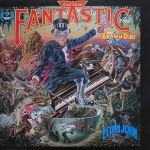
Captain Fantastic… – Number Six of Seven Consecutive Chart Topping Albums

More Reviews and Commentaries for the Music of Elton John

The Classic Elton John According to Wikipedia

Besides being the most commercially successful period, 1970–1976 is also held in the most regard critically. Within only a three-year span, between 1972 and 1975 John saw seven consecutive albums reach number one in the US, which had not been accomplished before. Of the six Elton John albums to make Rolling Stone’s list of “The 500 Greatest Albums of All Time” in 2003, all are from this period, with Goodbye Yellow Brick Road ranked highest at number 91; similarly, the three Elton John albums given five stars by Allmusic (Tumbleweed Connection, Honky Château, and Captain Fantastic) are all from this period. 

After 1975, good Elton John music is hard to come by. A few songs scattered among a few albums — pretty slim pickins. But the four or five albums he made in the early ’70s are nothing less than AMAZING (and amazing sounding, when you get the right pressings of course).

The albums that went to Number One are listed below in bold.

Three of his best, including his absolute best album, Tumbleweed, did not go to Number One, although they did make the top ten.

1969 Empty Sky 
1970 Elton John 
1971 Tumbleweed Connection
1971 11-17-70 [live] 
1971 Madman Across the Water 
1972 Honky Chateau 
1973 Don’t Shoot Me I’m Only the Piano Player
1973 Goodbye Yellow Brick Road 
1974 Caribou 
1975 Captain Fantastic and the Brown Dirt Cowboy
1975 Rock of the Westies 

Elton John Shootouts

Elton John is one of the handful of artists to produce an immensely enjoyable and meaningful body of work throughout the ’70s, music that holds up to this day. The music on his albums, so multi-faceted and multi-layered, will endlessly reward the listener who makes the effort and takes the time to dive deep into the sound of his classic releases.

Repeated plays are the order of the day. The more critically you listen, the more you are sure to discover within the exceedingly dense mixes favored by Elton and his bandmates. And the better your stereo gets the more you can appreciate the care and effort that went into the production of the recordings.

Elton John albums always make for tough shootouts. His producers’ (Gus Dudgeon being the best of them) and engineers’ (Ken Scott and Robin Geoffrey Cable, likewise the best) approach to recording — everything-but-the-kitchen-sink as a rule — make it difficult to translate their complex sounds to disc, vinyl or otherwise.

Everything has to be tuned up and on the money before we can even hope to get the record sounding right. Careful VTA adjustment could not be more critical in this respect.

If we’re not hearing the sound we want, we keep messing with the adjustments until we do. There is no getting around sweating the details when sitting down to test a complex recording such as this. If you can’t stand the tweaking tedium, get out of the kitchen (or listening room as the case may be). Obsessing over every aspect of record reproduction is what we do for a living. Pink Floyd’s recordings require us to be at the top of our game, both in terms of reproducing their albums as well as evaluating the merits of individual pressings.

When you love it, it’s not work, it’s fun. Tedious, occasionally exasperating fun, but still fun nonetheless.

Obsessed? You Better Believe It

Many of the Elton John albums you see listed above are records we admit to being obsessed with.

Currently we have identified about 150 that fit that description, so if you have some spare time, check out what we have to say about them.

Letter of the Week – “Talking Old Soldiers is possibly, no IS, the most holographic a vocal and piano recording that I’ve ever heard…”

One of our good customers had this to say about some Hot Stampers he purchased recently:

Hey Tom,   

Thank you VERY much for that one. Worth its weight in gold (last checked gold was $58.19 a gram, x 140 grams = $8,146.00) thus an absolute bargain for $750 – and have only listened to side two so far!

My god, Talking Old Soldiers is possibly, no IS, the most holographic a vocal and piano recording that I’ve ever heard, filling the room floor to ceiling and wall to wall with stunning realness right off the fresh master tape. Then into Burn Down The Mission, same thing, holy shxt! Best EVER.

More of those please and I owe you $7396.00. Lol.

All the best,
Mike S.

Mike, thanks so much for writing. As a special one time consideration, please keep the $7396 you owe us.

(more…)

Just the Right Amount of Tubey Magic on Madman Across the Water Is the Key

Hot Stamper Pressings of the Music of Elton John Available Now

You don’t need tube equipment to hear the prodigious amounts of Tubey Magic that exist on the best copies of Madman. For those of you who’ve experienced top quality analog pressings of Meddle or Dark Side of the Moon, or practically any jazz album on Contemporary, whether played through tubes or transistors, that’s the luscious sound of Tubey Magic, and it is all over the album.

The problem is that most British copies — the only ones that have any hope of sounding good in our experience — don’t have all the Tubey Magic that can be heard on the best copies. They are simply not as rich, tubey, and LUSH as the best that we’ve played.

This is the one quality that separates the winners of the shootout from the copies that came in second or third. Lushness isn’t the only thing to listen for of course. The rich copies can’t be too rich, to the point of being murky and muddy.

Achieving just the right balance of Tubey Magical Madman Sound with other qualities we prize such as space, clarity, transparency and presence is no mean feat.

It’s the rare copy that will do well in all these areas, and even our best Shootout Winning sides will have to compromise somewhere. There is always a balance to be struck between richness and clarity, with no copy able to show us the maximum amounts of both that we know are possible.

You’ll Know

Having said all that, it has been our experience that one copy in the shootout will make clear what the ideal blend of all the elements is — the right balance of Tubey Magic, clarity, space, weight, top end and much, much more.

When you find yourself lost in the music of Madman because the copy playing has the right sound, it shouldn’t be all that hard to recognize it. When the record is not only doing what it’s supposed to do, but doing more than you ever expected it could do, with more energy, more dynamics, more bass, more clarity, on a stage that’s wider, taller and deeper than you thought it could be, that’s when you know you have reached the highest level of sound.

(more…)