Columbia/Epic – Selections

Select commentaries and reviews for Columbia/Epic

Symphonie Fantastique – Three Mastering Options

Hot Stamper Pressings of the Music of Berlioz Available Now

UPDATE 2026

Years ago we played a reissue of the title you see pictured which prompted us to make some observations and ask some questions about the approach the mastering engineer might have taken.


And this one comes complete with the bonus 7″ entitled “Berlioz Takes a Trip,” in which Bernstein explores the work “with musical illustrations by the New York Philharmonic.”

Clocking in at around 45 minutes, Symphonie Fantastique is a difficult work to fit onto a single LP,  which means that the mastering engineer has three options when cutting the record:

  1. Compress the dynamics,
  2. Lower the level, or
  3. Filter the deep bass.

On this side two it seems that none of those approaches were taken by the engineer who cut this record in the early 80s — there’s plenty of bass, as well as powerful dynamics, and the levels seem fine.

How he do it? Who knows? Like so much in the world of records, it’s a mystery.

What’s Your Theory Then?

Side one, however, is bass shy. Did the engineer filter out the lower frequencies, or is it just a case of pressing variation being the culprit. Who can say?

If we had many more copies with these same stampers for side one, all with less bass, we might be able to draw a conclusion about that, one that might be highly probable but of course not dispositive, black swans being a regular part of our experience.

The very next copy we might find with those stampers could have plenty of bass.

Then we would be forced to say that our highly probable theory had been falsified conclusively.

(more…)

What to Listen For on Midnight Love

Hot Stamper Pressings of Soul, Blues, R&B, etc. Available Now

UPDATE 2026

In 2002 we put up a 3/3 copy of Midnight Love that really knocked our socks off. We wrote:


With two STUNNING Shootout Winning Triple Plus (A+++) sides, this Midnight Love is certainly as good a copy as we have ever heard – exceptionally quiet vinyl too.

Here are just a few of the things we had to say about this amazing copy in our notes: “round and punchy”…”jumping out of the speakers”…”good size and weight”…”spacious and relaxed percussion and vox”…”top detail” (side two).

Drop the needle on Sexual Healing then sit back and relax as the rich, warm sound of analog sets the mood.

There’s good frequency extension up top and down low, with plenty of meaty bass and silky highs (just check out those bells).

What made it so good? Glad you asked!

This copy has two qualities which are essential if this music is to  work its soulful magic: silky vocals and a big meaty bottom end.

Check out all the texture to the synths on Turn On Some Music – this is a highly resolving pressing which takes Marvin Gaye’s music — the last he would make before his death — to another level.

(more…)

Miles Davis In Person and the Sound of Tubes in 1961

Hot Stamper Pressings of the Music of Miles Davis Available Now
UPDATE 2025

We have two new lists for those who would like to know which Columbia label pressings win shootouts — one for 6-Eye winners and one for 360 Label winners.

The pressing we review below was one of the 6-Eye winners. Most of what we have to say about it revolves around the idea that in 1961 the tube mastering was key to the sound of the best copies.


Below you will find some of the notes I made while playing a killer copy we auditioned a while back.

Normally our notes for the sound of the records we are shooting out against each other fall into two categories: what the record is doing right and what the record is doing wrong.

You’ll see that in the case of this pressing there was nothing wrong with the sound to write about.

I could have found fault somewhere, but when a specific pressing is so clearly superior to its competition, what’s the point?

  • The right sound — big, rich, tubey and real.
  • Transparent.
  • Rich, smooth, balanced.
  • Horn gets huge and loud the right way.
  • Piano is full.
  • Solid bass.
  • No need to pick nits.

The bottom line: both sides are killing it.

Reissues

There are some very good sounding reissues from the 70s that will eventually make it to the site. Again and again my notes made it clear that on those reissue pressings, the sound could have used some tubes in the chain.

On this record, more than any other, the tubes potentially make all the difference.

Now keep in mind that we are only talking about 1961 tubes, not the stuff that engineers are using today to make “tube-mastered” records. Those modern records barely hint at the Tubey Magical sound of a record like this, if our experience with hundreds of them is any guide.

(more…)

Do The Original Domestic KC Pressings Always Beat the Later PC LPs?

Hot Stamper Pressings of Psychedelic Rock Recordings Available Now

Here is our description for the Super Hot (2+) copy that is currently on the site:

One of the most important records in my growth as an audiophile from 1971 to the present – my stereo was forced to evolve in order to play this kind of big production rock at the loud levels that the album needs in order to work its magic.

No matter how many times you play it, you will most likely hear – or at least gain more of an appreciation for – something new in the exceptionally dense, sophisticated soundfield Chris Kimsey creates for these songs.

And each time you make an improvement in the quality of your playback, this is the album that will show you exactly what you have just accomplished.


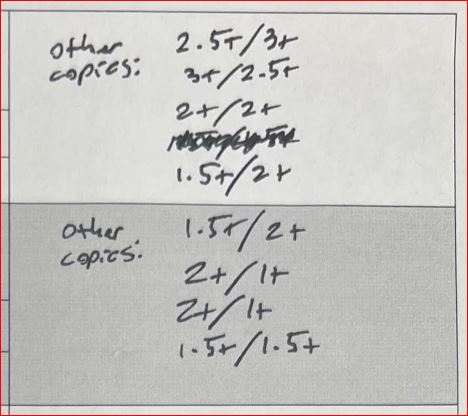
Overall, the best performers in our most recent shootout were UK pressings. They ranged in sound from the 3/3 Shootout Winning pressing (not shown) to the lowest graded British copy which earned grades of 1.5+/2+ (at the bottom of the top box).
On the left is a portion of the breakdown, minus the actual stamper numbers that earned the highest grades (for obvious reasons.)

We had six UK pressings, all with the same stampers — the five you see graded and the one hidden to the left that actually won the shootout. (Three sides earned White Hot Stamper grades, an unusual outcome and a good one for the bottom line.)

Note that with the “right stampers” you could have ended up with an incredible Demo Disc (copy #1) or just a very good sounding copy on side two mated to a passable side one (copy #6).

Finding six clean UK pressings is, as you can well imagine, neither cheap nor easy. We probably bought close to twice that many to end up with six that we’re in something close to audiophile playing condition.

As you can see from the grades, two of them were clearly inferior to the other four. In the case of this title, a small sample size could have been very misleading. Fortunately for us, we spent the money and the time it takes to track down a good-sized batch of UK pressings in order to avoid that possibility.

Next come the better domestic pressings. There was a 2+/2+ that outscored all the other domestic pressings, and four others that came in behind it, all with the same stampers.

Of the five copies that had those stampers, two had side two’s that scored sub-Hot Stamper grades, which marked them as unsaleable. (Perhaps we will offer them as one-sided records since their side one’s are so good.)

KC VS PC

We rarely have good luck with PC reissue copies when the originals come with the KC prefix, rarely meaning we find a PC winner maybe once out of every ten titles we play.

(more…)

Never Buy Any LP with this Columbia Label If You’re Looking for Good Sound

Columbia Pressings with Hot Stampers Available Now

If you are looking for good sound that is. I cannot remember ever playing a record with this later label that sounded any better than passable, and most of them are just plain awful.

We play mediocre-to-bad sounding pressings so that you don’t have to, a public service from your record-loving friends at Better Records.

You can find this one in our hall of shame, along with others that — in our opinion — are best avoided by audiophiles looking for hi-fidelity sound. Some of these records may have passable sonics, but we found the music less than compelling.  These are also records you can safely avoid.


UPDATE 2025

We have two new lists for those who would like to know which Columbia label pressings win shootouts — one for 6-Eye winners and one for 360 Label winners.

(more…)

The Turn Up Your Volume Test – Blood Sweat and Tears

Hot Stamper Pressings of the Music of Blood, Sweat and Tears Available Now

UPDATE 2025

This commentary was written about twenty years ago, back in the days when I could find clean 360 Label pressings of this album actually sitting in the bins of used record stores. The picture at the bottom says it all — I think we had more than forty copies to work through for our first shootout, pressings of the album that I had been buying (many from Robert Pincus, he was the B,S&T expert back then) since the late-80s. Blood, Sweat and Tears and I go way back.

You may notice that we rarely write about the album these days, and that’s simply because we are not able to find clean, early label pressings to play anymore. (The Red Label pressings can be good but they don’t come close to winning shootouts. Without at least some potential Shootout Winning copies, it makes no sense to do the shootout. The winners are the ones that pay for the losers, naturally, with some profit left over if things go as planned.)

Speaking of which: Our last shootout was quite a few years ago. If we somehow managed to luck into a few copies locally, it’s possible we could do the shootout tomorrow, but buying this title on Discogs and Ebay has been a nightmare, with upwards of 90% of the copies we buy ending up marked return to sender.

The cost in labor (and frustration) we incurred to pursue the album long ago forced us to move on, after plenty of swearing and licking of wounds of course. How is it that record sellers can be so oblivious to the scratches and wear on their consistently noisy vinyl offerings is beyond me.

For those of you who can’t devote the resources to finding a good copy on the Columbia 360 Label, the Gold CD put out long ago by Mobile Fidelity is excellent and well worth whatever you have to pay for it. And I mean that sincerely.


Our Old Commentary

In my opinion this is the BEST SOUNDING rock record ever made. I may be biased because I like the music so much, but played on a Big Speaker System a Hot Stamper pressing is nothing less than ASTOUNDING, the ultimate Demo Disc. It has the power of LIVE MUSIC.

You don’t find that on a record too often, practically never in fact. I put this record at the top of The Best Sounding Rock Records of All Time link (seen on the left) and said it was in a class of its own for good reason — IT IS IN A CLASS OF ITS OWN.

As I’ve noted before, this record is a milestone in the history of popular music. Not only is it The Most Successful Fusion of Rock and Jazz Ever. It’s also One of the Finest Recordings of Popular Music Ever.

The sound is nothing short of amazing. Just the drums alone are enough to win awards: the kick drum has real kick, the snare may actually be the best rock snare ever recorded, the cymbals shimmer like real cymbals; almost everything is right with this record. Especially the music.

Good Demo Disc, Good Test Disc Too

This is the kind of record that doesn’t fall into the good Demo Disc, bad test disc trap. It’s both a good Demo Disc and a good test disc; not too many records can make that claim. (Especially the kinds of records audiophiles tend to like.)

The good copies of this album sound good on almost any system. But the better systems reveal qualities to this recording that you are very unlikely to have ever heard on another record. That’s the Demo side.

On the test side, no matter what level your system is at, any change you make will be instantly obvious on this recording, for good or bad. Nothing can fool it. It’s too tough a test, the toughest I know of bar none. For this record to sound right, truly right, every aspect of its reproduction has to be at the highest level. Any shortcoming will be glaringly obvious. The record may still sound good, but it won’t really sound right. (Knowing what “right” means in this context makes all the difference in the world of course.)

One reason the turn up your volume test is such a great test — the louder the problem, the harder it is to ignore.

(more…)

Which Side of this Pressing Lacked Space, and How on Earth Did You Spot It?

Hot Stamper Pressings of the Music of Thelonious Monk Available Now

Our notes for a recent shootout winning copy read:

Monk’s Dream returns to the site for only the second time in over two years, here with INCREDIBLE Shootout Winning Triple Plus (A+++) grades or close to them throughout this black print Stereo 360 pressing.

These are just a few of the things we had to say about this killer copy in our notes: “big and weighty”…”great size and detail and very full”…”breathy sax jumping out of the speakers”…”very big and full piano”

In our notes you can see that side one fell short in one area, space, but how would anyone know that who hadn’t played a copy with even more space than this one? That’s why we do shootouts and you must do them too.

Both of these sides are rich, spacious, big and Tubey Magical, with less smear on the piano, a problem that holds many copies back. The sound found on these early Columbia 360 Label Stereo pressings is absolutely the right one for Monk’s music.

As you can see from the notes we took for this copy, we are not making any of this up!

This is why we do shootouts. If you really want to be able to recognize subtle (and sometimes not so subtle!) differences between pressings, you must learn to do them too.

And make sure to take notes about what you are hearing, good and bad.

One side falling short of the full Three Pluses happens all the time.

One out of five records that has one shootout winning side will have a matching shootout-winning other side.

(more…)

Buy Promos, Don’t Buy Promos — Honestly, Just Make Up Your Mind

Hot Stamper Pressings of Vintage Columbia Albums Available Now

Recently we conducted a shootout for a Columbia recording of jazz fusion music, one that we had auditioned a couple of times before and one for which we knew the music and the general quality of the sound well.

It’s not the record you see pictured. For now we’re keeping the title a mystery, consistent with the idea that we give out lots of bad stampers on this blog, sometimes really bad stampers, but almost never do we give out the good ones.

All the copies we had in our shootout were pressed domestically, and all were mastered by the legendary Robert Ludwig. No Nice Price junk, no imports, none of that crap. We might have made those mistakes in previous shootouts, but having done this shootout a number of times now, we know what works and what doesn’t.

When we do give out the best stampers, as in the case here, we tend to keep the title a mystery. We are not the least bit interested in putting ourselves out of business.

The discussion for today revolves around the idea held by a great many audiophiles that the promo pressings are going to be the best sounding pressings of almost any album they might happen to run across.

And, to be fair, in the case of this mysterious album, they’re potentially right.

Our best sounding copy was a promo pressing.

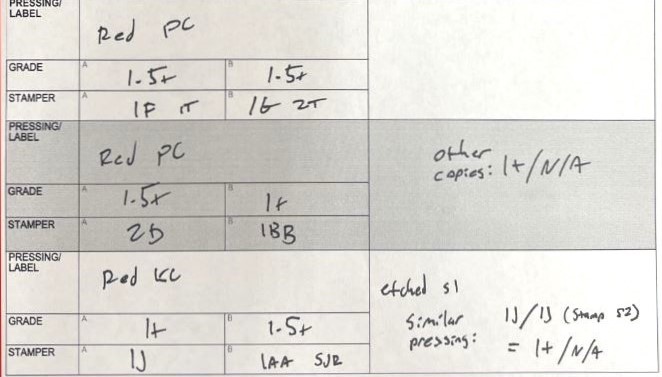
What interests me in these findings is that the other promo copy, the one you see at the bottom of the shootout sheet, earned 1.5+ on both sides. It came in last in the shootout, earning good, not great Hot Stamper grades.

If an audiophile collector were to go to Discogs, find the promo pressings, write down their stampers, and then check them against the copies he owned or might want to buy, he could either find himself with a top quality copy, or a far-from-as-good copy, depending on his luck.

Why one set of stampers sounds so much better than another set, or the same or similar set on a different pressing, is a mystery.

Does anyone have a practical way to get around the unfortunate reality that allows one set of stampers to sound great and the same or a similar set of stampers to sound not much better than decent?

Well, we can’t say there is a practical way, but we do know of an impractical one. We’ve been practicing and refining that one for more than twenty years.

(more…)

We Was Wrong about Sketches Of Spain on Six Eye

Hot Stamper Pressings of the Music of Miles Davis Available Now

Many, many years ago (15?) we had this to say about a killer Red Label pressing we had played at the time.


When you get a Hot Stamper like this one the sound is truly MAGICAL. (AMG has that dead right in their review.)

Tons of ambience, Tubey Magic all over the place; let’s face it, this is one of those famous Columbia recordings that shows just how good the Columbia engineers were back then. The sound is lively but never strained. Davis’s horn has breath and bite just like the real thing. What more can you ask for?

We Was Wrong in the Past About HP and Six-Eye Labels

In previous commentary we had written:

Harry Pearson added this record to his TAS List of Super Discs a few years back, not exactly a tough call it seems to us. Who can’t hear that this is an amazing sounding recording?

Of course you can be quite sure that he would have been listening exclusively to the earliest pressings on the Six Eye label. Which simply means that he probably never heard a copy with the clarity, transparency and freedom from distortion that these later label pressings offer.

The Six Eyes are full of Tubey Magic, don’t get me wrong; Davis’s trumpet can be and usually is wonderful sounding. It’s everything else that tends to suffer, especially the strings, which are shrill and smeary on most copies, Six Eyes, 360s and Red Labels included.


UPDATE

Over the course of the last fifteen or more years we’ve come to appreciate just how good the right Six Eye stereo pressing can sound.

Nowadays, all the copies earning the highest grades will be original stereo pressings. Other pressings can do well, earning grades of 2+ or so, but none will do as well as the originals.

This has never been our experience with Kind of Blue by the way. The later pressings have always done the best job of communicating the music on that album.


UPDATE #2

Our comments for Kind Of Blue are no longer true either. The Six-Eye pressings of the album win all the shootouts now.


The above shows just how wrong we were about the sound of some later label Columbia pressings we used to like.  The commentary below concerning early versus later RCA pressings is part and parcel of the same dynamic.

Back in 2010 we liked reissue pressings of Living Stereo recordings a lot more than we do now. Only the advent of top quality cleaning equipment and fluids and much improved playback made it possible for us to reproduce the early Shaded Dogs in all their glory.

When my system was darker and less revealing, a lot of records that were mastered to be cleaner and brighter sounded great to me. Records like RCA Red Seal pressings, some OJC jazz titles, and lots of other bad records that I used to like were a good complement to my system back in those days. Now, not so much.

When we encourage our readers to get good sound so they can recognize and acquire good records, it’s because we learned that lesson the hard way, by getting lots of great recordings wrong.

Live and learn is our motto, and progress in audio is a feature, not a bug, of record collecting at the most advanced levels.

“Advanced” is a code word for having little to no interest in any remastered pressing marketed to the audiophile community. If you want to avoid the worst of them, we are happy to help you do that. The more progress in audio you make, the more you will  regret having wasted your money on them, and we hate the thought of seeing your hard-earned money go down the drain.

(more…)

In the Market for New Speakers? See How Well They Handle the Energy of Far More Drums

Hot Stamper Pressings of the Music of Dave Brubeck Available Now

The drum solo Joe Morello lets loose on Far More Drums is one of the best on record. I was playing that song recently and it occurred to me that it is practically impossible for a screen or panel speaker of any design to reproduce the sound of those drums properly, regardless of how many subs you have.

Most of the music is not in the deeper bass anyway. It’s the whack of instruments whose energy is in the lower midrange and mid-bass that a screen speaker will struggle with.

A good large-driver dynamic speaker fed by fast electronics can handle the energy in that range with ease.

This is the album you need to take with you next time you head to your local stereo store to audition speakers.

It will help clarify the issues. Screen speakers do many things well, but drums are not one of them, at least in my experience they aren’t. If drums are important to you, do yourself a favor and buy a dynamic speaker, the bigger the better.

brubeck in the studio733

Time Further Out, like most of the classic Brubeck albums, is a big speaker record. It requires a pair of speakers that can move air with authority below 250 cycles and play at fairly loud levels. If you don’t own speakers that can do that, this record will never really sound the way it should.

(more…)