*That’s Funny

The most exciting phrase to hear in science, the one that heralds new discoveries, is not “Eureka!” (I found it!) but “That’s funny …”
— Isaac Asimov

Funny How You Rarely See Much Discussion of Records with Reversed Polarity

Hot Stamper Pressings of the Music of Harry Belafonte Available Now

UPDATE 2026

We mention below that we rarely have records with polarity issues on the site. To read more about any that may be active, please click here.


One of our good customers had this to say about some Hot Stampers he purchased recently (emphasis added):

Hey Tom, 

I bought the Harry Belafonte Carnegie Hall recently, a White Hot. I went to the On The Record site and came across the Offenbach Readers Digest discussion of reversed polarity. I had bought this record on your site a long time ago.

I listened to the record with the polarity reversed.

This is the first time I have heard this record sounding better.

Open, spacious and heard lots of macro and micro details, especially on side one, and the violin now is more natural as you described.

Btw, Do you have records with reversed polarity ready to hit the site? Please let me know.

Very interesting!

Hi,

Thanks for your letter. Glad I was able to help you get that Offenbach record to sound the way it should. It is a knockout performance with audio quality to match.

Funny how you rarely see much discussion of records with reversed polarity like Belafonte at Carnegie Hall.

Do most audiophiles have polarity switches on their preamps or phono stages?

Can they be bothered to go back and forth enough times to make sure they have the correct polarity setting for the records they play?

(more…)

Is It Hard for You to Imagine Similar Stampers Sounding So Different?

Hot Stamper Pressings of Living Stereo Recordings Available Now

Subtitle: it’s also hard to imagine that space and time are two aspects of the same reality, spacetime, but that’s why we employ rigorous scientific methods to test our theories and — in some cases — prove ourselves wrong.

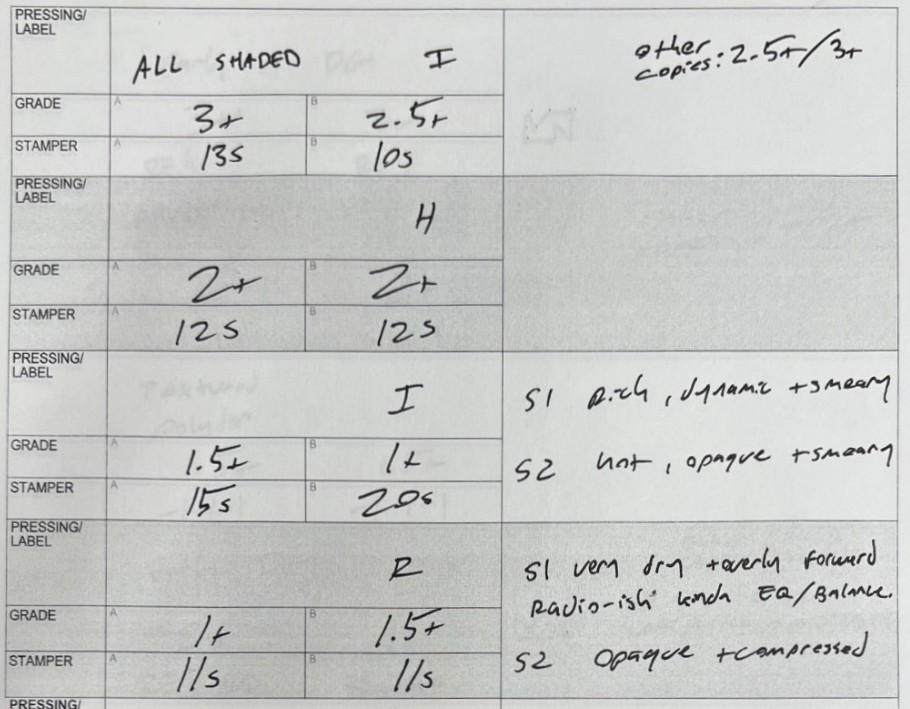
We here at Better Records like testing records. We want to know if the predictions we make about the titles we play are accurate, which is simply to say, do they match the data derived from our blinded shootouts?

In the case of the stampers for this mystery title, it turns out that whatever intuitions we may have had going in would have been no help at all. Who could possibly predict that, for sound quality on side one, 13s would substantially beat 12s, 12s would beat 15s, and that 15s would beat 11s.

(more…)

The “Not-So-Golden-Age” of RCA, Mercury, London and Others

Hot Stamper Pressings of Living Stereo Titles Available Now

We ran into a number of copies of this title that had what we like to call “old record sound,” which is surprisingly common on even the most revered Golden Age labels, RCA included.

No top, no real bottom, congested climaxes and a general shrillness to the sound — we’ve played Living Stereos by the dozens that have these shortcomings and many more.

Some audiophiles may be impressed by the average Shaded Dog pressing, but I can assure you that we here at Better Records are decidedly not of that persuasion.

Something in the range of five to ten per cent of the major label Golden Age recordings we play will eventually make it to the site. The vast majority just don’t sound all that good to us. (Many have second- and third-rate performances and those get tossed without ever making it to a shootout.)

The One Out of Ten Rule

If you have too many classical records taking up too much space and need to winnow them down to a more manageable size, pick a composer and play half a dozen of his works.

Most classical records display an irredeemable mediocrity right from the start. It does not take a pair of golden ears to hear it.

If you’re after the best sound, it’s the rare record that will have it, which makes clearing shelf space a lot easier than you might imagine. If you keep more than one out of ten, you’re probably setting the bar too low, if our experience is any guide.

(more…)

So You Actually Think an OJC Can Beat an Original Black Label Contemporary?

Hot Stamper Pressings of Contemporary Jazz Albums Available Now

Yes, we think that, because that’s what the evidence from our most recent shootout in 2025 showed us.

As you can see from the stamper sheet below, the A1/B2 stampers of our OJC, in a blinded test, came out on top.

Better mastering equipment? Better mastering skills? Better vinyl? Better pressing methods?

Who the hell knows?

Better yet, what audiophile or record collector with a lick of sense would even pretend to know?

Not us, that’s for sure. At this point we are very comfortable not having answers for the unanswerable questions we posed above.

But don’t rush off to buy the OJC of the Sonny Rollins record you see pictured. This commentary has nothing to do with that record. For now we’re keeping the title a mystery, consistent with the idea that we give out lots of the bad stampers on this blog, but rarely do we give out the good ones. (That said, here are some of the stampers that win shootouts, and we expect to be posting more soon, mostly for records we can no longer do shootouts for due to: 1.) a lack of interest, or 2.) unacceptably high costs for the best pressings, or 3.) or the fact that we are simply unable to find pressings that play quietly enough for audiophiles.)

So why is it that you can’t tell us the title of this record?

The cost of discovering the right stampers (aka R&D) is usually high, can sometimes take decades, and is fundamentally at the heart of how we make our money: by taking pressings we hope to be good, cleaning them up, playing them, and offering only those that actually do sound good, regardless of when they were made, who made them or why.

Once the shootout is done, the time for hoping and guessing is over. We have the evidence, and in our world that is the only thing that counts. That evidence may be provisional — we could prove ourselves wrong with the next shootout, and there have been times when that has happened — but for now this is the best information we have to work with.

Key Takeaways for this Mystery Record

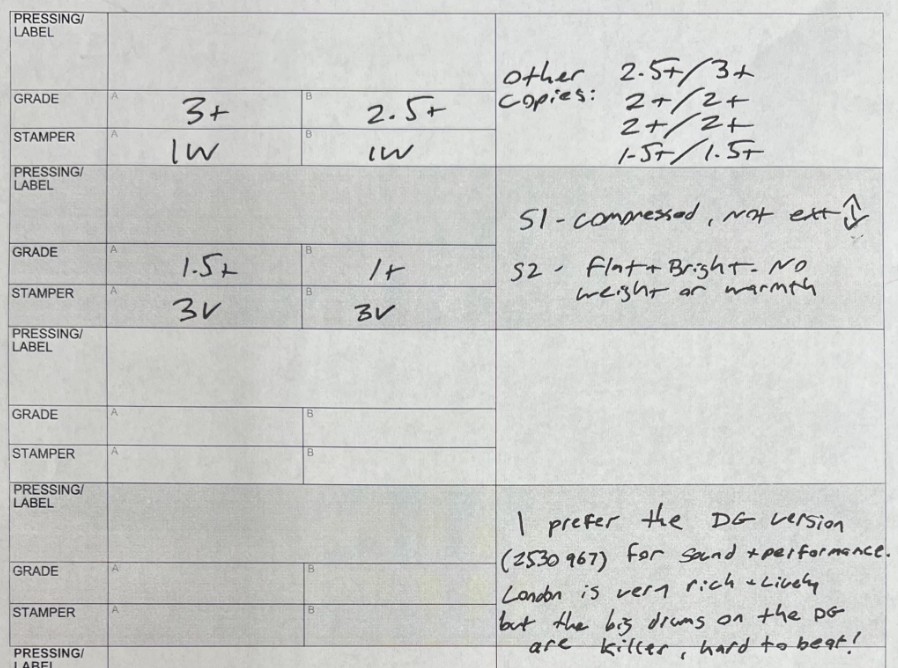
  • We did not have enough copies with the right stampers to find a 3+ side two. (The other copies earned grades of no better than 2+/2+.)
  • Which simply means that if we’re not hearing faultless or nearly-faultless sound on one side or another, the sound is not White Hot and does not deserve a 3+ grade. Fair’s fair after all.
  • The original pressing you see with D2/D4 stampers had some of that “old record” sound we find on far too many vintage pressings.
  • True, it was very big and full, but lacked top end, causing, among other things, the horns to get hot and hard.
  • Who wants to listen to a Sonny Rollins famous classic jazz record with horns that don’t sound right?

(more…)

Sure, 1s Wins, But Why Does 2s Do So Much Worse?

Hot Stamper Living Stereo Classical and Orchestral Titles Available Now

Below you will see a section of the stamper sheet for a shootout we did recently.

Keep in mind that, as usual, the album you see pictured is not the record we did the shootout for.

In the case of this mystery record, the 1s stamper was by far the best, with the Plum Label copies having later stampers (2s) earning a sub-Hot Stamper grade on side one.

The 1+ grade found on this side one means it’s simply not very good, the kind of sound we consider to be no better than passable, We do offer records with 1+ grades as Hot Stamper pressings.

What would be the point? You can find them on your own. The world is full of mediocre records. They sit in the bins of every record store you walk into and make up the bulk of record collections of both audiophiles and music lovers alike.

How Come?

Since, as we discovered recently, 1s wins, and wins handily, why does 2s/3s do so much worse?

I could guess, but that would violate our policy against pretending to know what cannot be known.

Something in the range of five to ten per cent of the major label Golden Age recordings we play will eventually make it to the site. The vast majority just don’t sound all that good to us. (Many have second- and third-rate performances and those get tossed without ever making it to a shootout.)

(more…)

Is This Really Robert Ludwig’s Doing? I Thought He Was One of the Good Guys

Hot Stamper Pressings of Rock and Pop Albums Available Now

Below is the complete shootout stamper sheet for a rock record whose name we do not plan to reveal at this time.

We could reveal it, since knowing the “right” stamper numbers appears to be of no help at all — the best stampers and the worst stampers are exactly  the same stampers! (Nothing new there.)

RL stands for Robert Ludwig and MD stands for Masterdisk.  As you can see, Robert Ludwig cut all seven of the pressings that made it to the shootout.

One of them actually won. “Robert Ludwig’s stuff cannot be beat!” might be the post on whatever audiophile forum you frequent. (If it’s Hoffman’s forum, it would more likely read “Robert Ludwig’s stuff cannot be beat except by Steve Hoffman!”)

Another pressings with those same markings came in next to last, with such mediocre-at-best sound that it would not qualify as a Hot Stamper at all. (1.5+ on both sides or better is the minimum grade for any record we sell.)

Robert Ludwig really screwed up the mastering of this title, another forum member might post.

Can they both be wrong? Of course they can. When has any information posted on a forum been reliable or free from error?

If you were to tell me you have the Robert Ludwig-mastered original pressing for this record and it sounds amazing, I would be inclined to agree with you that that is very possible. If, on the other hand, you were to tell me you have the Robert Ludwig-mastered original pressing for this record and it sounds terrible, I would say I happen to know firsthand that that’s possible too.

The most likely sound for any copy you might have is “good, not great,” because only two copies earned grades of 2+ or better on both sides. Two out of seven. (Which is disappointing because it hurts our bottom line when so few copies in a shootout will end up selling for much more than we invested in them in money and labor.)

(more…)

Is CTFR-1 Dark and Congested, or Flat and Bright?

Hot Stamper Pressings of Mercury Classical Records Available Now

For Mercury classical and orchestral recordings, the original RFR-1 pressings on the plum label are the way to go, right? 

In some cases, yes. The first pressings of Mercury albums often win our shootouts.

And for both sides of a copy to win a shootout, like our gold promo seen in the stamper sheet below, everything about the pressing must be right. We call records that win their shootout, earning 3+ grades on both sides, Top Shelf pressings. They are rare and special enough to have a section of their own on the site (which, as of this writing, has all of 19 records in it.)

What we find to be interesting about this specific shootout, however, is that we had two later pressings, both with the same stampers, and they sounded markedly different from each other. (Note that the stamper numbers you see below belong to a different album than the one shown above.)

If a collector were to tell you that that the CTFR pressings tend to be dark and congested, and you owned one with the exact same stampers, CTFR-1, you might be inclined to agree with this person.

But if you were the owner of the copy we played that was flat and bright, again, with CTFR-1 in the dead wax of both sides, you would think this person was 1.) Out of his mind, or, 2.) Deaf as a post, or, 3.) The owner of some very inaccurate playback equipment.

He could be all three, but in this case, an unusual one to be sure, his copy of the album doesn’t tell you anything about the sound of your copy of the album. They could match, or they could be completely different. Some records are like that. Not all that many, but definitely some.

Sample Sizes and One Man Bands

Those of us who play a variety of pressings of the same album know how easy it is to draw mistaken conclusions about records. CTFR-1 on this title is the perfect example of a record whose stampers don’t tell you much about its sound. (Even RFR-1 on side one of one copy was no better than “good,” quite a long ways from the best.)

(more…)

How Is It that the Earliest Pressings from the Tube Era Often Lack the Sound of Tubes?

Hot Stamper Pressings of Music on Island Records Available Now

Please note that the album you see pictured on the left is not the one we are discussing here.

It has been our experience going back many years that the earliest pressings for many records on the Island label are not very good.

To be fair, this one — again, not Mr. Fantasy — is not a bad sounding pressing.

With grades of 1.5+ on both sides, it fits comfortably in our section for good, not great sounding LPs. But the right reissues are a big step up in class sonically. They’re the ones that win shootouts, not these Pink Label LPs.

It’s big and clear but dry and spitty and badly needs tubes — or the sound of tubes — in the cutting chain.

That’s not supposed to happen, the early pressings are supposed to be the most Tubey Magical ones, with the reissues being less Tubey Magical — but in the world of records, when has that rule of thumb ever counted for anything?

Been There, Done That

We’ve run into so many sonically-flawed Pink Label Islands by now that hearing one sound lackluster if not actually awful doesn’t phase us in the least. Some of the other Pink Labels that never win shootouts can be found here.

(more…)

On this Wonderful Sounding London, Is Ted Burkett’s 2G Stamper the Way to Go?

Hot Stamper Pressings of Recordings by Decca Available Now

Before we go any further, let me say that the record you see pictured is not the record whose shootout and stampers we are about to discuss.

Yes, that’s right, the stamper numbers you see below belong to a different album.

We’ve lately been giving out much more stamper information than we used to, but for now we are keeping this title close to the vest.

What can we learn about the best sounding pressings of this vintage Decca recording, mastered by Mr. E and Mr. G, both outstanding mastering engineers?

It seems that Mr. G cut the better sounding pressing, our shootout winner as a matter of fact, but I can’t say whether the pressing that won was an original, since there were two differently-mastered Blueback pressings in the shootout, and one of them came in tied for last.

It was actually beaten by two copies of the Whiteback reissue. Those seem to be made from the same stampers as the winning pressing, but are those stampers the earliest or did they come later? Who knows?

Mr E. cut a version of the record that was quite a bit less impressive than most of the others, earning grades of 1.5 on side one and 2+ on side two.

Side one was dry and flat, side two rich but hard. We hear a lot of records with these shortcomings. If you play lots of classical music on vintage vinyl, you should be hearing them too.

And Your Point Is?

(more…)

Lee Konitz With Warne Marsh Is Yet Another Amazing Sounding Budget Reissue

Hot Stamper Pressings of Jazz Recordings Featuring the Saxophone Available Now

Here is how we described this wonderful reissue of the 1955 recording of Lee Konitz with Warne Marsh:

Incredible MONO sound throughout this reissue copy of Lee Konitz with Warne Marsh (only the second to hit the site in years).

Exceptionally spacious and three-dimensional, as well as relaxed and full-bodied – this pressing was a big step up over every other copy we played.

If you want to hear the Tubey Magic, size and energy of this wonderful session from 1955 – originally recorded by Tom Dowd and expertly remastered by George Piros – this pressing will definitely let you do that.

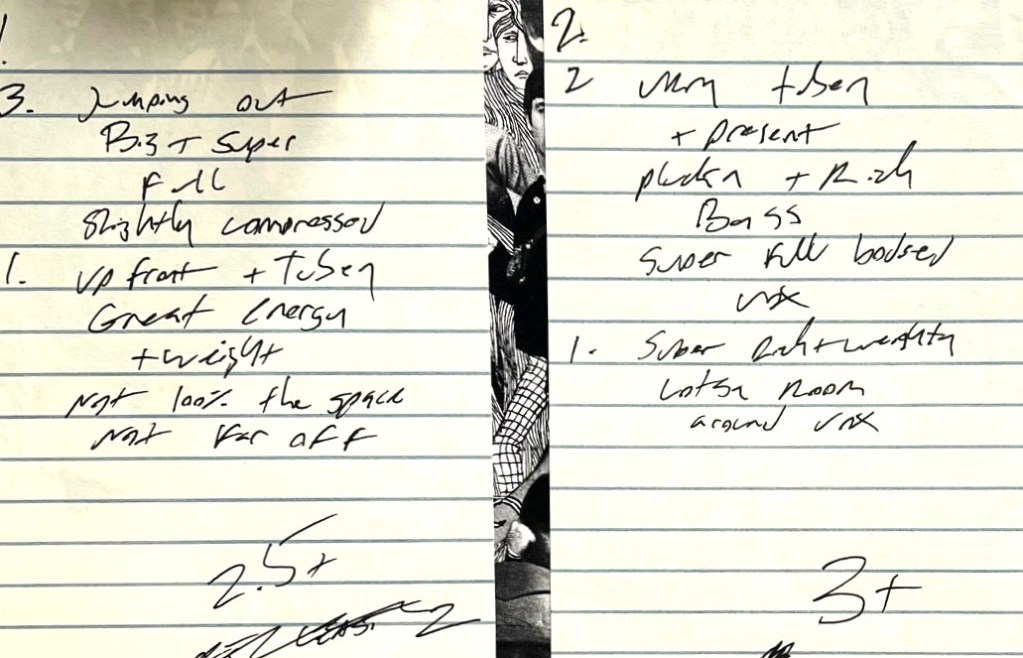
I hope these notes are able to speak for themselves. If you have trouble reading them, please drop me a line and I will translate them for you.

The horns are breathy and clear, yet full and rich as can be. There may be a good reason that this pressing sounds as good as it does: it was remastered by one of the greatest mastering engineers of all time, George Piros.

Tom Dowd is the original recording engineer, and this one album should be all the proof you need that when it comes to jazz in mono, the guy is hard to beat. Rock in stereo, there the record is quite a bit more spotty (see, or better yet, listen to Cream, The Young Rascals, Delaney and Bonnie and too many others to list).


UPDATE 2025

The listening panel for this record listened to it with the mono switch in as well as with the mono switch out on the EAR 324p phono stage we use.

Somewhat surprisingly, the sound got worse on this mono pressing playing with the mono switch activated.

That’s not supposed to be the way works, but in the world of records, when has that ever counted for anything?

Just another reminder to always stay skeptical. Never believe anything anybody tells you about audio. Test everything for yourself, and that includes our Hot Stamper pressings. Play them against the best other pressings you can find. We will happily take back any record that doesn’t trounce anything you have to play head to head with our records.

(more…)