Advice-WTLF, Classical

Here you will find listings of classical and orchestral titles with advice on what to listen for. This advice is offered to help you separate out the best pressings from the merely good ones.

Here are some of the things we’ve learned by critically listening to tens of thousands of records.

Do Pressings Remastered at 45 RPM Have Better Sound?

More Reviews and Commentaries for 45 RPM Pressings

No doubt some do, but based on our admittedly limited experience, we rather doubt any of the titles shown here, or from this series, are likely to be very good sounding.

I was going to write about the awful Holst The Planets with Previn from this series that I had played a few years back, but never got around to it.

Lots of punchy, powerful and deep bass — yes, 45 RPM mastering is known for that — but the dry, overly clean, clear, modern sound and the screechy strings made me take it off the turntable halfway through the first side. (We write more about EMI and Angel pressings here.)

If you want a good sounding pressing of The Planets, our favorite by far is Previn’s reading on EMI from 1974.

As usual, our advice is to accept no substitutes. There are a lot of bad sounding, poorly performed Planets out there.


(more…)

Sometimes Tubey Magic Comes at a Fairly Steep Price

Living Stereo Hot Stamper Orchestral Titles Available Now

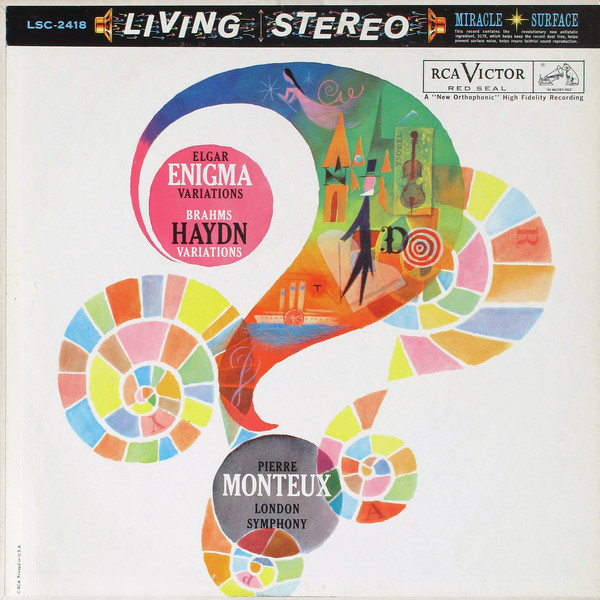
This famous Shaded Dog, containing two superb performances by Monteux and the LSO, has many of the Golden Age strengths and weaknesses we know well here at Better Records, having auditioned hundreds upon hundreds of these vintage pressings over the last twenty years or so. 

The wonderful sounding tube compressors that were used back in the day result in quieter passages that are positively swimming in ambience and low-level orchestral detail. Tube compression is often a large part of what we mean when we use the term Tubey Magic.

If you want to know what zero Tubey Magic sounds like, play some Telarcs or Reference Recordings from the 70s and 80s. Or a modern digital recording on CD.

But all that sweet and rich Tubey Magic comes at a price when it’s time for the orchestra to get loud.

It either can’t, or the louder passages simply distort from compressor overload.

Fortunately, on this copy the orchestra does not distort, it simply never gets as loud as it would in a real concert hall, clearly the lesser and more preferable of the two evils.

(more…)

What Do You Mean by “These Swan Lake Highlights Sound Like Live Music”?

Hot Stamper Pressings of the Music of Tchaikovsky Available Now

Kenneth Wilkinson engineered this album of Swan Lake Highlights for Decca in 1961 (one of the truly great years for top quality analog recordings).

Judging by the best pressings we played in our shootout, he did a great job. Knowing his work the way we do, this was to be expected. There are about 50 of his recordings for which we have done Hot Stamper shootouts, probably more than for any other engineer, and there are sure to be more added in the years to come.

It’s as wide, deep, and three-dimensional as any, which is, of course, all to the good, but what makes the sound of these recordings so special is the timbral accuracy of the instruments in every section.

Highlights of the recording include huge amounts of bass; a clear snare at the back of the hall (a good test for transparency, of both the record and of your system and room); full-bodied horns and strings, which never become blary or shrill; and of course huge amounts of space.

This is the kind of record that will make you want to take all your heavy vinyl classical pressings and put them in storage. They cannot begin to sound the way this record sounds. (Before you put them in storage or on Ebay please play them against this pressing so that you can be confident in your decision to rid yourself of their mediocrity.)

Quality record production is a lost art, and it’s been lost for a very long time.

(more…)

Skip the Classic Records Pressing of Ballet Music From The Opera

Hot Stamper Living Stereo Orchestral Titles Available Now

Classic Records ruined this album, as anyone who has played some of their classical reissues would have expected.

Their version is dramatically more aggressive, shrill and harsh than the Shaded Dogs we’ve played, with almost none of the sweetness, richness and ambience that the best RCA pressings have in such abundance.

In fact their pressing is just plain awful, like most of the classical recordings they remastered, and should be avoided at any price. 

Apparently, most audiophiles (including audiophile record reviewers) have never heard a top quality classical recording. If they had, Classic Records would have gone out of business immediately after producing their first three Living Stereo titles, all of which were dreadful and labeled as such by us way back in 1994. I’m not sure why the rest of the audiophile community was so easily fooled, but I can say that we weren’t, at least when it came to their classical releases. 

We admit to having made plenty of mistaken judgments about their jazz and rock, and we have the we was wrong entries to prove it.

The last review we wrote for the remastered Scheherazade, which fittingly ended up in our Hall of Shame, with an equally fitting sonic grade of F.

TAS Super Disc list to this day? Of course it is!

With every improvement we’ve made to our system over the years, their records have managed to sound progressively worse. (This is pretty much true for all Heavy Vinyl pressings, another good reason for our decision to stop buying them in 2007.) That ought to tell you something.

Better audio stops hiding and starts revealing the shortcomings of bad records.

(more…)

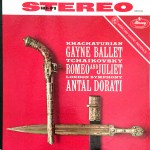
The Gayne Ballet on Mercury Can Be a Little Bright

Hot Stamper Pressings of Classical Masterpieces Available Now

UPDATE 2025

The review you see below was written more than ten years ago.

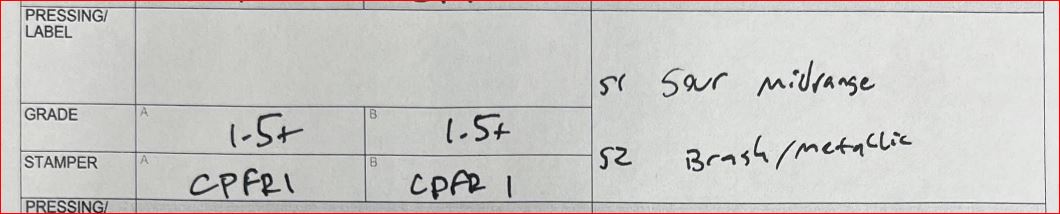
Having just done another shootout for SR 90209, Dorati’s recording of the two works, The Gayne Ballet and Romeo and Juliet, I can now confirm that there are some stampers that are indeed way too bright.

Side one of a recent copy had a sour midrange. Side two of the same copy was brash and metallic.

As for side two not sounding as good as side one in the older review before, seems we clearly got that wrong, the result, to some degree, of having an inadequate sample size.

Also,  we didn’t have as good a stereo as we do now, and we weren’t as good at doing shootouts back then either.


Our Old Review

This side one is truly DEMONSTRATION QUALITY, thanks to its superb low-distortion mastering. It’s yet another exciting Mercury recording. The quiet passages have unusually sweet sound.

This kind of sound is not easy to cut. This copy gets rid of the cutter head distortion and coloration and allows you to hear what the Mercury engineers accomplished.

(more…)

VTA – A Few Moments of Experimentation Can Really Pay Off

Basic Audio Advice — These Are the Fundamentals of Good Sound

Here we discuss what to listen for as you critically adjust your VTA.

While experimenting with the VTA for this record, we found a precise point where it all came together, far beyond whatever expectations we might have had for the sound at the time.

Practically out of nowhere we heard a solid, full-bodied, palpable violin that appeared to be floating between the speakers, an effect that, speaking for myself as a lifelong, obsessive audiophile — I fully appreciated for the magic trick that it is.

The sound of the wood of the instrument became so clear, the harmonic textures so natural, it was quite a shock to hear a good record somehow become an amazing one.

And all it took was a few moments of experimentation.

With the right VTA setting we immediately heard more harmonic detail, achieved, as is often not the case, with no sacrifice in richness.

That’s the clearest sign that your setup is right, or very close to it.

By the way, Robert Brook can get your front end tuned up and working right. We highly recommend his new service. It might just put you on the path to achieving the next level in audio. (You will definitely struggle to get there with a table, arm and cartridge that aren’t set up with a high degree of precision by a person who knows what they are doing, and Robert has been doing this work for years now.)
(more…)

Listening for Dry Strings on Espana

 Hot Stamper Pressings of the Music of Chabrier Available Now

On many copies the strings are dry, lacking some of the Tubey Magic heard on the better copies.

This is decidedly not our sound, although it can easily be heard on many London pressings, the kind we’ve played by the hundreds over the years.

If you have a rich sounding cartridge, perhaps with that little dip in the upper midrange that so many moving coils have these days, you will not notice this tonality issue nearly as much as we do.

Our 17Dx is ruler flat and quite unforgiving in this regard.  

It makes our shootouts much easier, but brings out the flaws in even the best pressings, exactly the job we require it to do.

We discussed the issue in a commentary entitled Hi-Fi beats My-Fi (if you are at all serious about audio).

Here are some of the other records we’ve discovered that are good for testing string tone and texture.

(more…)

A Lively Hall Creates the Right Sound for Dances of Old Vienna

Hot Stamper Pressings on Two of Our Favorite Labels, Decca & London

Wow, what a find! Dances of Old Vienna is a WONDERFUL sounding record with vintage Decca / London sound. Even as late as 1968 Decca was still able to produce recordings that are tonally correct from top to bottom and full of Tubey Magic.

There is not a trace of hyped-up sound to be found on this record. It’s unbelievably spacious and three-dimensional, with depth to rival any recording you may own.

The sound is especially spacious partly because the recording is of a fairly small ensemble, playing in a lively hall, exactly the kind of venue in which this music was meant to be heard.

(more…)

The “Not-So-Golden-Age” of RCA, Mercury, London and Others

Hot Stamper Pressings of Living Stereo Titles Available Now

We ran into a number of copies of this title that had what we like to call “old record sound,” which is surprisingly common on even the most revered Golden Age labels, RCA included.

No top, no real bottom, congested climaxes and a general shrillness to the sound — we’ve played Living Stereos by the dozens that have these shortcomings and many more.

Some audiophiles may be impressed by the average Shaded Dog pressing, but I can assure you that we here at Better Records are decidedly not of that persuasion.

Something in the range of five to ten per cent of the major label Golden Age recordings we play will eventually make it to the site. The vast majority just don’t sound all that good to us. (Many have second- and third-rate performances and those get tossed without ever making it to a shootout.)

The One Out of Ten Rule

If you have too many classical records taking up too much space and need to winnow them down to a more manageable size, pick a composer and play half a dozen of his works.

Most classical records display an irredeemable mediocrity right from the start. It does not take a pair of golden ears to hear it.

If you’re after the best sound, it’s the rare record that will have it, which makes clearing shelf space a lot easier than you might imagine. If you keep more than one out of ten, you’re probably setting the bar too low, if our experience is any guide.

(more…)

Violin and Piano Concerto Recordings that Fall Apart

Hot Stamper Pressings Featuring the Violin Available Now

Hot Stamper Pressings of Piano Concerto Recordings Available Now

Many of the vintage orchestral recordings we’ve auditioned over the years did a good job of capturing the lead instrument in a concerto — for example, the piano or violin — but fell apart completely when the orchestra came in, with unacceptable levels of congestion and distortion.

Orchestras are hard to record. Pianos and violins, not so much.

Here are some titles that often have congestion problems when they get loud. If you play your orchestral recordings at moderate levels, you may not be as bothered by this problem as we are, because we do not have the luxury of listening at moderate levels.

We have to put the records through the ringer, and one of the ringers they must go through is they must sound right at loud levels, because live music gets loud, and it does it without getting distorted or congested.

Congestion and distortion are problems for practically all the titles you rarely see on our site, the vintage pressings of recordings by EMI, DG, Philips, Columbia and dozens of others.

We discussed the problem here in more detail.