Good Sounding Digital – Reviews and Commentaries

Upper Midrange on The Nightfly

Hot Stamper Pressings of the Music of Donald Fagen Available Now

We just finished a big shootout for Donald Fagen’s first solo effort, released just two years after Gaucho and the end of Steely Dan and we gotta tell you, there are a lot of weak sounding copies out there. We should know — we played them. 

Robert Ludwig cut all the originals we played. Are you going to tell me that every copy with RL in the dead wax sounds the same as every other copy with those initials? The question answers itself.

What to Listen For

The upper mids on certain tracks of both sides have a tendency to be brighter than we would have liked.

Ruby Baby on side one can be that way, and the title track on side two has some of the wannabe hit single radio EQ that makes it less likely to please, so to speak.

Other records with a tendency to have boosted upper mids can be found here.

On a good copy the first track of each side should be all you need to hear.

Here are hundreds other titles with specific advice on what to listen for on some of the albums we’ve played in shootouts.

If you know how to do shootouts, you know how to find good sounding records.

(more…)

Shouldn’t a Digital Recording Sound the Same on CD and Vinyl?

Hot Stamper Pressings of the Music of Dire Straits Available Now

UPDATE 2026

These comments are taken from a reddit thread that Geoff Edgers and I were on years ago talking about Hot Stampers. I would add that the audience seemed to have very little experience with high-end audio. Based on the comments I read, most of them, like most audiophiles, especially audiophile record collectors, thought I was selling snake oil.

(Doesn’t it strike you as odd that no one ever seems to bring up the fact that we make a point of explaing to you exactly how to find your own snake oil?)

Someone asked a question about vinyl for digital recordings. Discussing the difference I typically hear between CDs and vinyl pressings, I offered the opinions you see below. (We might have been talking about Brothers in Arms; I honestly don’t remember and don’t think it matters anyway.)

For those of you newer to the blog, please keep in mind that, unlike a great many fans of analog, I actually like the sound of the hundreds of CDs I own and make a point to play them regularly for enjoyment. Properly mastered CDs can sound shockingly good.

In my experience, a good CD will wipe the floor with the vast majority of Heavy Vinyl records being made today. If you are buying modern remastered records, I highly recommend you stop and instead make the effort to find a good CD player and buy vintage — and even some of the better gold — CDs.


My comments:

Well, a too short version would be something like:

On the vinyl and on the CD the tonality should be identical.

If it is not you have problems and you need to do some work to find them and fix them.

Assuming correct tonality, the CD should be big, lively and clear, assuming you have a good CD player and a good CD.

(more…)

What to Listen For on Songs from the Big Chair

Hot Stamper Pressings of the Music of Tears For Fears Available Now

UPDATE 2026

Below you will find an excerpt from the commentary we wrote for an early Shootout Winning pressing we played many years ago.


There is one quality that the best copies always have and that the worst copies always lack: Frequency Extension, especially on the top end.

When you get a copy like this one, with superb extension up top, the grit and edge on the highs almost disappears. You can test for that quality on side one very easily with the percussive opening to Shout.

If plenty of harmonics and air are present at the opening, you are very likely hearing a high quality copy.

Side one here has smooth, sweet, analog richness and spaciousness I didn’t think was possible for this recording. The bass is full and punchy. When it really starts cooking, like in the louder, more dynamic sections of Shout or Mothers Talk, it doesn’t get harsh and abrasive like practically every other copy I’ve heard.

(more…)

Piano and Snare Testing with Love Over Gold

Hot Stamper Pressings of the Music of Dire Straits Available Now

UPDATE 2026

In 2017 we reviewed a copy of Love Over Gold that really knocked us out. This was sound we had never heard on the album before, so as you can imagine, we had to tell the world -s or at least that small part of the world that accepts the reality of Hot Stamper Pressings — all about it.

Since then we have noted the value of testing albums with pianos and snare drums as those seem to be key part of some recordings that are hard to get right, which of course is makes them good tests.


Telegraph Road does something on this copy that you won’t hear on one out of twenty pressings: It ROCKS. It’s got ENERGY and DRIVE.

Listen to how hard Allan Clark bangs on the piano on side one — he’s pounding that piano with all his might. No other copy managed to get the piano to pop the way it does here, so clear and solid.

Wow, who knew? Maybe this is the reason HP put the record on the TAS Super Disc List. (I rather doubt he’s ever heard a copy this good, but who’s to say?)

Best test for side two?

The snare drum on Industrial Disease. Play five copies of the album and listen on each of them for how much snap there is to the snare. It will be obvious which ones get the transient attack right and which ones don’t. (If none of them do, try five more copies!)

(more…)

The Best Pressings of Brothers in Arms Are Not Hard to Recognize

We try to be upfront with our customers that the Hot Stamper pressings of Brothers in Arms on our site have many nice qualities, but some of the best qualities of analog recordings from the 50s, 60s and 70s are not among them.

It would be foolish to pretend otherwise. We want our customers to know what to expect when they buy a modern recording, and, having played copies of this album (as well as Love Over Gold) by the score, we are qualified to tell them what even the best pressings do not do as well as we might like. In a recent listing we introduced one of the best sounding pressings from our last shootout this way:

  • Tonally correct from start to finish, with a solid bottom and fairly natural vocals (for this particular recording of course), here is the sound they were going for in the studio
  • Drop the needle on “So Far Away” – it’s airy, open, and spacious, yet still rich and full-bodied
  • We admit that the sound may be too processed and lacking in Tubey Magic for some
  • When it comes to Tubey Magic, there simply is none — that’s not the sound Neil Dorfsman, the engineer who won the Grammy for this album, was going for
  • We find that the best properly-mastered, properly-pressed copies, when played at good loud levels on our system, give us sound that was wall to wall, floor to ceiling, glorious, powerful and exciting — just not Tubey Magical

The notes you see below catalog the qualities of our 2025 Shootout Winner.

Side One

Track One (So Far Away)

  • Meaty guitar and bass
  • Big, weighty and present

Track Two (Money for Nothing)

  • Wide, full and weighty
  • Lots of punch

Side Two

Track One (Ride Across the River)

  • Tight, deep and weighty [bass]
  • Vocals are sweet and present
  • Most space yet
  • Rich too

Note that the person doing the listening confined himself to what the record was doing right. In the case of this Shootout Winning Top Shelf 3/3 pressing, there really wasn’t any aspect of the sound to find fault with. As far as we were concerned, the record was doing what the record was trying to do, and doing it better than any of the other copies we played, hence the high grades.

If you have five or ten early domestic pressings of Brothers in Arms, you can judge them accurately by limiting yourself to the qualities only found on the best of them. For any copy you might play, you could ask:

  • How big is it?
  • How big does it get when loud?
  • How weighty is it?
  • How present is it?
  • How wide is the soundstage?
  • How full-bodied is the sound?
  • How punchy is it?
  • How tight, deep and weighty is the bass?
  • How sweet and present are the vocals?
  • How much space does the recording have?
  • How rich is the sound?

If your equipment, room, electricity, etc. are good enough, and your front end is properly set up, all these questions can be answered with relatively little effort. You could even create a checklist of them after playing a few copies and hearing what the best of them did well.

(more…)

On Security, Robert Ludwig Let Us Down, Big Time

Hot Stamper Pressings of the Music of Peter Gabriel Available Now

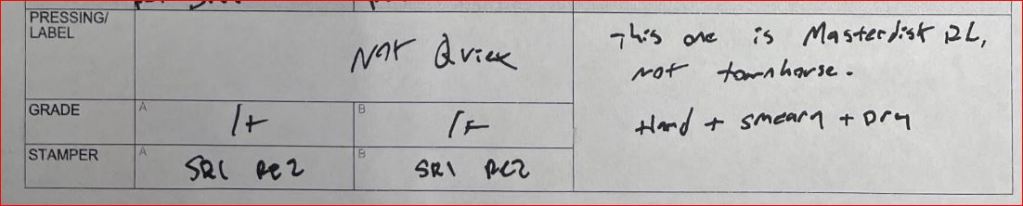
All the copies we had in our shootout were pressed domestically, and none of them were mastered by the legendary Robert Ludwig except for the one whose stampers you see below.

We awarded both sides of RL’s cutting a sub-Hot Stamper grade of 1+, which means the sound is passable at best, even after a good cleaning. (Without a good cleaning it would probably not even earn that single plus.)
We do not sell records with 1+ grades. We figure you can find those on your own. The world is full of them, as are most audiophile record collections.

1+ is actually a fairly good grade for many of the Heavy Vinyl pressings being made today. Some of the ones we’ve reviewed can be found in our Heavy Vinyl mediocrities section.

Any version of the album we sell will be noticeably — and probably dramatically — better sounding.

If you own any of those titles and didn’t pay much for them, you didn’t get ripped off too badly. You got something for your money. Not much, but something, and it would surprise us no end if any of them have been played much. Mediocre records tend to spend most of their lives sitting on record shelves. They’re not good enough sounding to bother with.

If you have any of these specific Heavy Vinyl pressings, something is wrong somewhere and it would be a good idea for you to figure out what before you flush any more money down the drain.

General Advice

On this title, forget the Brits. Every British pressing we played was badly smeared and veiled.

This took us somewhat by surprise because we happen to like the British PG pressings. However, So on British vinyl is awful too, so it’s clear (to us anyway) that the later PG records are bad on British vinyl and the early ones are better.

We are limiting our comments here to albums up through So. Anything after that is more or less terra incognita for us simply because we don’t care for any of the music he was making after 1986.

(more…)

The Best Pressings of Love Over Gold Have Surprisingly Natural Sound

Hot Stamper Pressings of the Music of Dire Straits Available Now

This modern album (1982) can sound surprisingly good on the right pressing.

On most copies the highs are grainy and harsh, not exactly the kind of sound that inspires you to turn your system up good and loud and get really involved in the music. I’m happy to report that the best pressings have no such problem – they rock and they sound great when playing loud.

We pick up every clean copy we see of this album, domestic or import, because we know from experience just how good the best pressings can sound.

What do the best copies have?

REAL dynamics for one.

And with those dynamics you need rock solid bass. Otherwise the loud portions simply become irritating.

A lack of grain is always nice — many of the pressings we played were gritty or grainy.

Other copies that were quite good in most ways lacked immediacy, and we naturally took serious points off for that.

The best copies of Love Over Gold are far more natural than the average pressing you might come across, and that’s a recognizable quality we can listen for and give weight to in our grading.

It’s key to the sound of the better pressings, which means in our shootouts it’s worth a lot of points. Otherwise you might as well be playing the CD.

Domestics or Imports?

(more…)

Testing for Life-Size Images and Living Presence

Hot Stamper Pressings of the Music of Paul McCartney Available Now

On the song Blackbird Paul moves the microphone, scraping it along the floor, which causes a huge wave of bass to spread through the room.

I was over at one of my customer’s houses a while twenty years ago, doing some testing with electronics and tweaks, and I remember distinctly that the microphone stand was shrunken and lean sounding in a way I had simply never heard before.

Now this customer, whose system was in the $100K range, had no idea what that microphone stand could really do. I did, because I’ve been hearing it do it for years.

Some speakers can’t move enough air down low to reproduce that sound properly.

And some speakers, usually those with woofers under 12 inches, shrink the size of images.

These are many things to test for for in a given system, dozens and dozens in fact, but two of the important ones are these: if it doesn’t have a solid foundation (read: a big bottom end), and it doesn’t have correctly-sized images for the instruments, that’s a system that is failing in fundamentally important ways. 

If you close your eyes, you’re not in the presence of full-size musicians. Ipso facto, the fidelity to the live event has been compromised.

That’s precisely what makes this a good test disc. The band is right there.

To the extent that you can make them sound live in your living room, you are getting the job done.

The last bit of resolution is not the point. Full-sized live musicians in your living room is the point. Either Paul and his band are in front of you, or they’re not.

When they’re not, it’s time to get to work and find out what part of the system is not doing its job.

Hint: you can be pretty sure it’s the speaker. Most audiophile speakers are not very good at moving enough air. You need multiple large dynamic drivers with plenty of piston area to do the job correctly. Speakers of that design are usually large and expensive. I recommend the original Legacy Focus (not the current model) as the best sounding, most affordable full-size speaker on the used market.

Make Me Better

The bulk of this commentary was written in 2006. Most of it is based on what we had learned from the shootout we’d just done, our first for the album.

I bought my first copy of Unplugged upon its release. I credit it with helping me advance in this hobby of ours. Back in those dark days of the 90s, although I was completely clueless at the time about pretty much everything having to do with vinyl and equipment, I can take some solace in the fact that everybody else appeared to be as clueless as I was.

This blog is dedicated to sharing some of what I’ve learned — with the unflagging help of my staff of course — about records and audio over the last fifty years.

Testing with Unplugged

This record is good for testing all of the following areas, and here are some links to other titles that will also make good test records for those of you looking to improve the quality of your analog playback:

(more…)

Graceland, Where Clarity Is King

Hot Stamper Pressings of the Music of Paul Simon Available Now

We regularly do shootouts for Graceland. Having played so many copies over the years we’re become quite familiar with the range of sound on the album, what constitutes good, better and best, and we understand precisely what qualities the premier copy must have in order to win one of our shootouts. 

Above all the thing Graceland has going for it sonically is CLARITY. It has many other good qualities as well: It can be open and spacious, tonally correct, with punchy, tight bass and present, breathy vocals.

The better copies have all these qualities to some degree, but the one thing a good copy must have is clarity, because that’s what’s especially good about the sound of Graceland. (more…)

Here’s How You Know You Have a Hot Stamper of Songs in the Attic

joelsongs600Hot Stamper Pressings of the Music of Billy Joel Available Now

It’s the side you play through to the end.

When the sound is right you want to hear more.

Since the opening track of this record is one of the keys to knowing whether it’s mastered and pressed properly, once you get past the sibilance hurdle on track one, the next step is to find out how the challenges presented by the rest of the tracks are handled on any given pressing. Some advice follows.

Actually, what you really want to know is how good each song can sound — what it sounds like when it’s right.

Once the quality of the mastering has been established, the fun part is to play the rest of the album, to hear it really come alive.

Side One

Miami 2017

This is usually the brightest cut on the first side, commonly found with some sibilance problems. On the high-res copies the sibilance is lessened, and the sound of the sibilance itself is much less transistory and spitty, with more of a silky quality, which is simply another way of saying it’s less distorted.

Of course one wouldn’t want the sibilance to be lessened by having a dull top end, but few of these pressings are dull. Most of them suffer from a brightness problem. The best copies keep the sibilance under control and balance the upper mids with extended highs. Without extension on the highs the sound will tend to be aggressive.

(more…)