Kenneth Wilkinson, Engineer – Reviews and Commentaries

For Concerto No. 1, This Is the Way the Piano Should Sound

Hot Stamper Living Stereo Classical and Orchestral Titles Available Now
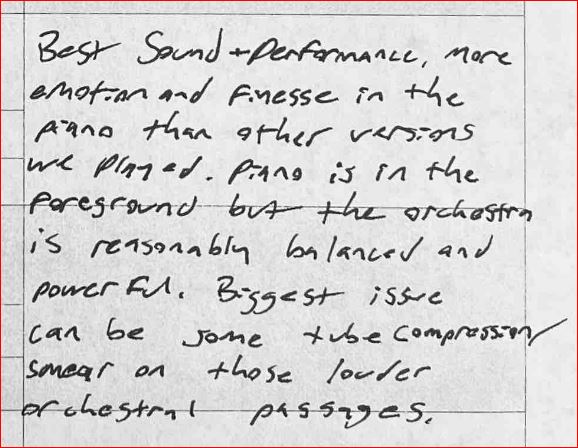
We love the huge, solid and powerful sound of the piano on this recording. This piano has weight and heft. As a result, it sounds like a real piano.

For some reason, a great many Rubinstein recordings are not capable of reproducing those all-important qualities in the sound of the piano.

Those are, as I hope everyone understands by now, the ones we don’t sell. If the piano in a piano concerto recording doesn’t sound solid and powerful, what is the point of playing such a record?

Or, to be more accurate, what is the point of an audiophile playing such a record? (Those of you who would like to avoid bad sounding vintage classical and orchestra records have come to the right place. We’ve compiled a very long list of them precisely for that purpose, and we’ve been adding to it regularly.)

No doubt Kenneth Wilkinson made sure the recording captured the weight of the piano he was listening to as it played all those years ago in the wonderful acoustics of Kingsway Hall.

The strings have lovely Living Stereo (Decca-engineered) texture as well.

As befits a Wilkinson recording from 1961, there is no shortage of clarity to balance out the Tubey Magical warmth and richness.

When you add in the tremendous hall space, weight and energy, this becomes a Demo Disc orchestral recording by any standard.


Notes from a 2024 Shootout

Our notes above point out that:

(more…)

Verdi, et al. / Ballet Music From The Opera

Hot Stamper Pressings of Living Stereo Recordings Available Now

UPDATE 2026

This review was written many, many years ago, so many years ago that I don’t think I knew that the Victrola reissue had consistently better sound than any Shaded Dog we had ever played.

But one thing I did know was that the sound had obvious and rather serious shortcomings, shortcomings that the fans of vintage vinyl never seemed to notice. The conventional wisdom according to which so many record collectors and record reviewers operate, including the vast majority of those who identify as audiophiles, may have blinded them to the reality of its defects.

It’s also rare and sells on the collector market for a lot of money. Those facts often blind record lovers too.

Someone with the original in his collection might pull it off the shelf where it has been sitting for years and show such a rare and valuable and therefore impressive record to you. I suspect that such a collector would be much less likely to play it for you.

Having to sit down and actually play the records we sell means that biases and prejudices of these kinds can have no effect on our judgments. The records get played against other pressings and we simply call them as we hear them.

Contrary to the conventional wisdom, the original is not that good of a record.

And the best news is that the reissue is a true Demo Disc of the highest order.


Our Old Review

This copy of LSC 2400 has vintage RCA Golden Age sound, for better and for worse. Even though the album was recorded by Decca, it’s got a healthy dose of Living Stereo Tubey Magic.

There will never be a reissue of this record that even remotely captures the richness of the sound found here.  

And the hall is HUGE — so spacious and three-dimensional it’s almost shocking, especially if you’ve been playing the kind of dry, multi-miked modern recordings that the 70s ushered in for London and RCA.

(more…)

Sometimes Tubey Magic Comes at a Fairly Steep Price

Living Stereo Hot Stamper Orchestral Titles Available Now

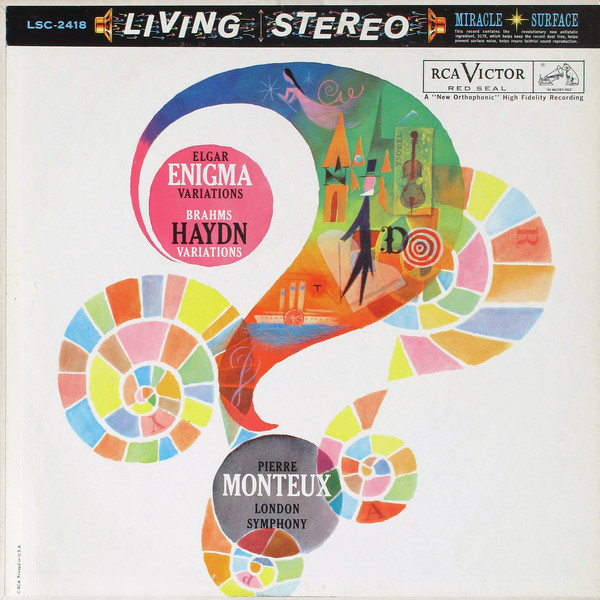
This famous Shaded Dog, containing two superb performances by Monteux and the LSO, has many of the Golden Age strengths and weaknesses we know well here at Better Records, having auditioned hundreds upon hundreds of these vintage pressings over the last twenty years or so. 

The wonderful sounding tube compressors that were used back in the day result in quieter passages that are positively swimming in ambience and low-level orchestral detail. Tube compression is often a large part of what we mean when we use the term Tubey Magic.

If you want to know what zero Tubey Magic sounds like, play some Telarcs or Reference Recordings from the 70s and 80s. Or a modern digital recording on CD.

But all that sweet and rich Tubey Magic comes at a price when it’s time for the orchestra to get loud.

It either can’t, or the louder passages simply distort from compressor overload.

Fortunately, on this copy the orchestra does not distort, it simply never gets as loud as it would in a real concert hall, clearly the lesser and more preferable of the two evils.

(more…)

What Do You Mean by “These Swan Lake Highlights Sound Like Live Music”?

Hot Stamper Pressings of the Music of Tchaikovsky Available Now

Kenneth Wilkinson engineered this album of Swan Lake Highlights for Decca in 1961 (one of the truly great years for top quality analog recordings).

Judging by the best pressings we played in our shootout, he did a great job. Knowing his work the way we do, this was to be expected. There are about 50 of his recordings for which we have done Hot Stamper shootouts, probably more than for any other engineer, and there are sure to be more added in the years to come.

It’s as wide, deep, and three-dimensional as any, which is, of course, all to the good, but what makes the sound of these recordings so special is the timbral accuracy of the instruments in every section.

Highlights of the recording include huge amounts of bass; a clear snare at the back of the hall (a good test for transparency, of both the record and of your system and room); full-bodied horns and strings, which never become blary or shrill; and of course huge amounts of space.

This is the kind of record that will make you want to take all your heavy vinyl classical pressings and put them in storage. They cannot begin to sound the way this record sounds. (Before you put them in storage or on Ebay please play them against this pressing so that you can be confident in your decision to rid yourself of their mediocrity.)

Quality record production is a lost art, and it’s been lost for a very long time.

(more…)

Skip the Classic Records Pressing of Ballet Music From The Opera

Hot Stamper Living Stereo Orchestral Titles Available Now

Classic Records ruined this album, as anyone who has played some of their classical reissues would have expected.

Their version is dramatically more aggressive, shrill and harsh than the Shaded Dogs we’ve played, with almost none of the sweetness, richness and ambience that the best RCA pressings have in such abundance.

In fact their pressing is just plain awful, like most of the classical recordings they remastered, and should be avoided at any price. 

Apparently, most audiophiles (including audiophile record reviewers) have never heard a top quality classical recording. If they had, Classic Records would have gone out of business immediately after producing their first three Living Stereo titles, all of which were dreadful and labeled as such by us way back in 1994. I’m not sure why the rest of the audiophile community was so easily fooled, but I can say that we weren’t, at least when it came to their classical releases. 

We admit to having made plenty of mistaken judgments about their jazz and rock, and we have the we was wrong entries to prove it.

The last review we wrote for the remastered Scheherazade, which fittingly ended up in our Hall of Shame, with an equally fitting sonic grade of F.

TAS Super Disc list to this day? Of course it is!

With every improvement we’ve made to our system over the years, their records have managed to sound progressively worse. (This is pretty much true for all Heavy Vinyl pressings, another good reason for our decision to stop buying them in 2007.) That ought to tell you something.

Better audio stops hiding and starts revealing the shortcomings of bad records.

(more…)

Pros and Cons of this Copy of Swings in High Stereo

Hot Stamper Pressings of Large Group Jazz Recordings Available Now

Side One

Big and spacious, yet clear, dynamic and energetic. The brass is never “blary” the way it can be on so many Big Band or Dance Band records from the 50s and 60s. (Basie’s Roulette records tend to have a bad case of blary brass as a rule.)

Sharp transients and mostly correct tonality and timbres, powerful brass — practically everything you want in a Hot Stamper is here!

The stage is exceptionally wide on this copy.

Listen to the top end on track two — man, that is some natural sound!

This side could use a bit more weight so we feel a grade of Super Hot (A++) gets it right.

(more…)

Delibes / Sylvia and Coppelia / Rignold

Hot Stamper Classical and Orchestral Pressings Available Now

UPDATE 2026

This review is from way back in 2008, from the olden days before we were doing regular shootouts for all the albums we sell, so take it for what it’s worth. (If you like the music of Delibes, our favorite recording of Coppelia can be found here.)

In 2008 we had been seriously into collecting the highest quality record pressings for more than thirty years, yet it was obvious that we still had a lot to learn.

In 2004 we started selling vintage vinyl with Hot Stampers, and practically every shootout we did taught us something new and interesting about records.

Much of that information ended up here, on a blog we’ve dedicated to teaching audiophiles how they can find better sounding pressings the way we did.

We wanted to share what we’ve discovered about the highest quality vinyl and, even more importantly, we wamted to prove that experimenting with records under rigorously controlled conditions is the only way to learn anything of value about them.

(more…)

It’s Already So Good, How Could It Get Any Better?

Hot Stamper Pressings of the Music of Berlioz Available Now

You may have noticed that most of the time when we give out the stampers for the top copies of an album, we do not identify the title of the record that has those Shootout Winning stampers.

As you can imagine, our huge investments in research and development make up a big part of our costs, costs that accrue over the course of years, decades even, and that must eventually be passed on to our customers.

But this title is an exception, because we are telling you straight out that the 1K pressings of CS 6101, Music of Berlioz, are the way to go.

It turns out that both the early Decca pressings (SXL 2134) and the London Bluebacks were cut by Tony Hawkins.

It’s unfortunate that this record did not sell well when it came out in 1959, which explains why we could find no evidence of copies with any stampers other than 1K.

Not that the work of any other mastering engineers was in any way needed. Mr. Hawkins did a wonderful job on the copies we played than managed to reproduce the glorious, Golden Age All Tube analog sound of the master tape, which may sound  tautological as all get out but I assure you is not.

No, sadly for us, that glorious sound could be found on one and only one pressing, the one we graded 3+/3+.

No other pressing earned a top grade on either side. Whatever caused the amazing pressings to come out differently from the very good ones happened in the plating and pressing stages of manufacturing, an area that did not involve the work of any of the Decca mastering engineers.

(more…)

On Ballet Music From The Opera, How Much Tubey Magic Is Too Much?

Hot Stamper Pressings of Living Stereo Recordings Available Now

UPDATE 2023

We have stopped buying the original LSC 2400 for the simple reason that it is not competitive with the budget VICS 1206 reissue from 1960 that replaced it in the RCA catalog.

The review we wrote for the Shaded Dog is probably close to twenty years old. There was a time when the shortcomings of the original RCA were not nearly as easy for us to recognize, but that time has long since past.

If any copy of the original, or any remastered version from the modern era sounds good to you, we can almost guarantee that you are mistaken about the quality of the sound, and, even better, we can offer you the pressing that makes our case better than any review can.


Our Old Review

The hall is HUGE — so transparent, spacious and three-dimensional it’s almost shocking, especially if you’ve been playing the kind of dry, multi-miked modern recordings that the 70s ushered in for London and RCA. (Many of Solti’s recordings from the decade are not to our liking, for reasons we lay out here.)

EMI recordings may be super spacious but much of that space is weird, coming from out-of-phase back channels folded in to the stereo mix. And often so mid-hall and distant. Not our sound, sorry.

We strongly believe that there will never be a modern reissue of this record that even remotely captures the richness of the sound found on the best of these Living Stereo original pressings.

Here are some of the strengths and weaknesses we noted on a copy we played way back when.

Side One

Big and lively. The Tubey Magical colorations are a bit much for us, with too much tube smear on the strings and brass to earn more than a single plus. 

Side Two

Even bigger and more spacious, with some smear caused by the serious amounts of tube compression being used, of course, but the quiet passages are magical. [Which is precisely what heavy tube compression is designed to accomplish.]

The Victrola Reissue

We much prefer the sound of the Victrola reissue, VICS 1206, which came out in 1966.

As for the Victrola pressing, we’re guessing — how could we possibly know for sure? — that less tube compression was used in the mastering.

It’s still plenty tubey, but more to our taste for not being overly tubey.

(more…)

Mozart / Symphonies Nos. 40 & 41 on Speakers Corner

Hot Stamper Pressings of the Music of Mozart Available Now

One of the better Speakers Corner Deccas. When they released this title on Heavy Vinyl in 1998, it became one of the few Speakers Corner classical recordings we carried and recommended. 

We knew it sounded good, but up until recently [recently being 2010 or so], when we started collecting and playing the better vintage Deccas and Londons, we sure didn’t know it could sound as good as the best of those pressings do.

Below are some thoughts from a recent classical listing that we hope will shed light on our longstanding aversion to the sound of these modern remasterings. 

Transparency

What is lost in these newly remastered recordings? Lots of things, but the most obvious and bothersome is TRANSPARENCY.

Modern records are just so damn opaque. We can’t stand that sound. It drives us crazy. Important musical information — the kind we hear on even second-rate regular pressings — is simply nowhere to be found. That audiophiles as a group — including those that pass themselves off as champions of analog in the audio press — do not notice these failings does not speak well for either their equipment or their critical listening skills.

It is our contention that no one alive today is capable of making records that sound as good as the vintage ones we sell.


UPDATE 2025

The guy who cut this pressing sometime this century did a great job — it sounds like a vintage record, and better than any of the vintage pressings of the title we have ever played — but we don’t know who it is because he wasn’t credited on the jacket for his mastering!

Perhaps we should be more clear and say that it is the Big Name mastering engineers who can’t seem to cut a good record these days,


Once you hear our Hot Stamper pressings, those 180 gram records you own may never sound right to you again. They sure don’t sound right to us, but we are in the enviable position of being able to play the best properly-cleaned older pressings (reissues included) side by side with the newer ones.

This allows the faults of the current reissues to become much more recognizable, to the point of actually being quite obvious. When you can hear the different pressings that way, head to head, there really is no comparison. (more…)