Older Orchestral – Reviews and Commentaries

Lincoln Mayorga, Pianist – Reverse Your Polarity!

Hot Stamper Pressings of Direct-to-Disc Recordings Available Now

This Sheffield Direct-to-Disc LP is one of the top Sheffields.

Lincoln Mayorga is an accomplished classical pianist: this is arguably his best work. (I had a chance to see him perform at a recital of Chopin’s works early in 2010 and he played superbly — for close to two hours without the aid of sheet music I might add.) 

You might want to try reversing the phase when playing this LP; it definitely helps the sound, a subject we discuss below.

With the polarity reversed, this is a top quality solo piano recording in every way.

This is one of the pressings we’ve discovered with reversed polarity.

(more…)

Suites for Solo Cello on the Later Label – Ouch!

Hot Stamper Pressings of Mercury Recordings Available Now

UPDATE 2021

The discussion here is for a Oval label copy of Suites for Solo Cello (SR 90370) we reviewed in 2010. These days the Oval label pressings from the early 60s almost never sound very good to us. We no longer buy them and we certainly don’t bother to put them in shootouts.

This record on the Oval Label would be very unlikely to qualify as a Hot Stamper pressing anymore, although we liked it just fine in 2010, as you can see from our old review.

In 2024 we actually put an Oval Label pressing of SR 90370 in a shootout and it did about as poorly as we would have expected. What a waste of time and money. Never again.

(more…)

Shootout Winning Stampers for La Boutique Fantasque Revealed

Hot Stamper Pressings of the Music of Rossini Available Now

UPDATE 2026

Our current favorite recording of La Boutique Fantasque is the one Solti recorded for Decca in 1957.

It belongs to that very special group of roughly 150 orchestral recordings which have the potential to offer the discriminating (and well-heeled) audiophile the best performances of major works with by far the highest quality sound.

It has been our experience that modern remastered pressings simply cannot compete with the best pressings of these landmark recordings.

The Fiedler (LSC 2084) is still a very good record, but we no longer see much reason to carry it when the Solti is better in almost every way (and quieter as a rule to boot).

Below we have reproduced our full stamper sheet, including the Shootout Winning stampers, which happen to be 3S/4S for this album.

(more…)

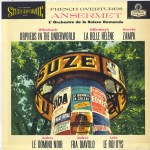
French Overtures with Ansermet Had One Awfully Good Sounding Side in 2009

Hot Stamper Pressings of the Music of Jacques Offenbach Available Now

Reviewed back in 2009 in our pre-shootout days.

This Minty London Blueback LP has a WONDERFUL Tubey Magical Super Hot Stamper side one.

I have never heard this music sound better. Of course Ansermet is exactly the right conductor for these light and colorful orchestral pieces; the performances are uniformly superb.

But as audiophiles we want to make sure the sound is what it should be, and here side one does not disappoint. The string tone is perfection. I defy anyone to find a Heavy Vinyl reissue with string tone even remotely as good. In my experience there is simply no such record.

With vintage classical records there are always trade-offs of course. Here the loudest passages suffer from some mild compressor distortion, so common on these early pressings. A small price to pay for sound this lovely I say.

The Zampa overture by Herold is probably the best sound on the album — it’s gorgeous!

Side two is not quite as good. We rated it A Plus, with real weight and energy but a bit too much compression and distorton in the loud passages to be completely satisfying.


UPDATE 2025

Nowadays we would never list a record for sale as a Hot Stamper pressing with a grade of 1+ on either side.

And, more importantly, the grades we awarded these two sides were just estimates.

We did not put this copy in a shootout with a batch of similar pressings.

We played the record, liked what we heard on side one, liked what we heard on side two a bit less, and offered it to our customers with the description of the strengths and weaknesses you read about.

We could not have begun to conduct a shootout for this early London. Back in those days we simply could not find enough copies of such a rare title to make such a thing happen.

As for the compressor distortion on side one that we heard, it’s entirely possible that with better cleaning and better playback that the distortion we thought we heard would disappear. Blaming the record is rarely the ideal approach for making progress in audio.

(more…)

Grieg / Peer Gynt Suites – Were We Wrong? Probably

Hot Stamper Pressings of the music of Edvard Grieg Available Now

Below are the notes for a later pressing we played many years ago. I doubt if we would like this Red Seal pressing much now. The later RCA pressings we’ve played lately left much to be desired.

I get the feeling it lacks Tubey Magic, as well as weight in the lower registers, and we are much less tolerant of those two shortcomings now than we were then.

Our review from 2008

Fiedler is wonderful here, which is to be expected. What’s unusual about this Red Seal is how good the sound is. It’s extremely transparent and tonally correct.

It sounds to me like a flat transfer.

Some tubey colorations would be nice, especially in the louder passages.

The sound also lacks a bit of weight in the bottom end.

But these faults are mostly made up for by the tremendous clarity and freedom from distortion that this pressing has. I doubt if the Shaded Dog has those qualities.

(more…)

Bose Salutes the Sound Of Mercury Records (and Some Audio Lessons Learned Long Ago)

Hot Stamper Pressings of Mercury Recordings Available Now

This Bose / Mercury Demonstration LP is autographed by none other than Amar G. Bose. The autograph reads “To EMI, with regards and best wishes, Amar G. Bose.”

Bose may not have ever made very good speakers, but they sure knew good recordings when they heard them. This LP has excerpts from some of the top Mercury titles, including music by Copland (El Salon Mexico), Kodaly (Hary Janos Suite), Mussorgsky/ Ravel (Pictures At An Exhibition), and Rimsky-Korsakov (Russian Easter Overture).

I played one of these Bose records years ago and was surprised at how good it sounded. The transfers of the Mercury tapes were excellent. I guess that makes sense — if you want to show off your speakers you had better use a well-mastered record for the demonstration.

I was duped into buying my first real audiophile speaker, Infinity Monitors, when the clever salesman played Sheffield’s S9 through them. I bought them on the spot. It was only later when I got home that none of my other records sounded as good, or even good for that matter. That was my first exposure to a Direct to Disc recording.

To this day I can still picture the room the Infinity’s were playing in. It was a watershed moment in my audiophile life.

And of course I couldn’t wait to get rid of them once I’d heard them in my own system with my own records. I quickly traded them in for a pair of RTR 280-DRs. Now that was a great speaker! A 15 panel RTR Electrostatic unit for the highs; lots of woofers and mids and even a piezo tweeter for the rest. More than 5 feet tall and well over 100 pounds each, that speaker ROCKED.

(more…)

Bruch & Mozart Violin Concertos / Heifetz in 2010

Years ago we wrote:

This is a very old review, probably from the early 2010s, so take it for what it’s worth. I suspect we could find a much better sounding copy of the album today than we could back then, before we had the cleaning systems and playback equipment we do now.

All that turned out to be true.

In 2024 we did another shootout for the album, our first in more than ten years! I am happy to say the sound was a knockout on the best copies, some of the finest violin concerto sound we have ever heard.

Live and learn is our motto, and progress in audio is a feature, not a bug, of record collecting at the most advanced levels. (“Advanced” is a code word for having little to no interest in any remastered pressing marketed to the audiophile community. If you want to avoid the worst of them, we are happy to help you do that.)

Our comments from 2010:

(more…)

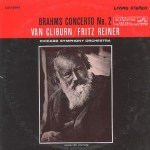
In 2005 We Were (Probably) Way Off the Mark for Brahms’ Piano Concerto No. 2

Hot Stamper Pressings of Living Stereo Titles Available Now

UPDATE 2024: This is a very old review. We would no longer agree with the assertion that the White Dog pressings are better sounding than the Shaded Dogs. In our recent shootout, the first one I can remember since 2005 — that was 19 years ago! — the White Dogs did not do nearly as well as the Shaded Dogs we have on hand.

This White Dog pressing is the best sounding copy I’ve ever heard, much better than the earlier pressings. The piano doesn’t break up like it does on those, especially in the second movement.

Finally the piano sounds right – solid and with the correct overtones. It goes without saying that this is an exceptionally good performance as well.

One of the best of the Cliburn recordings which, as you may know, are rarely any good, the worst of them being LSC 2252 and the best of them being, probably, LSC 2507.


This is an Older Classical/Orchestral Review

Most of the older reviews you see are for records that did not go through the shootout process, the revolutionary approach to finding better sounding pressings we started developing in the early 2000s and have since turned into a veritable science.

We found the records you see in these older listings by cleaning and playing a pressing or two of the album, which we then described and priced based on how good the sound and surfaces were. (For out Hot Stamper listings, the Sonic Grades and Vinyl Playgrades are listed separately.)

We were often wrong back in those days, something we have no reason to hide. Audio equipment and record cleaning technologies have come a long way since those darker days, a subject we discuss here.

Currently, 99% (or more!) of the records we sell are cleaned, then auditioned under rigorously controlled conditions, up against a number of other pressings. We award them sonic grades, and then condition check them for surface noise.

As you may imagine, this approach requires a great deal of time, effort and skill, which is why we currently have a highly trained staff of about ten. No individual or business without the aid of such a committed group could possibly dig as deep into the sound of records as we have, and it is unlikely that anyone besides us could ever come along to do the kind of work we do.

(more…)

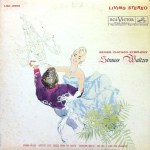
Are these Strauss Waltzes as Good as Some Say? As Good as We Thought?

The original, favorable review for this album you see further down is from at least ten years ago and probably more like fifteen.

When we revisited the copies we had of this title more recently, we felt the sound was badly lacking in many respects, with no real extension up top nor much weight to the bottom, the very definition of boxy sound.

Many of the vintage classical records we audition have sound that we liked well enough in the past but now no longer meet our standards. Those pressings might sound fine on an old school stereo (or its modern equivalent), but we have something very different to play our records on, courtesy of the many revolutionary changes in audio that have dramatically altered the quality of analog playback over the last twenty five years.

We much prefer Boskovsky’s performances for Decca for waltzes and the like, by Strauss or anyone else.

TAS List Thoughts

We wanted to like the record, it’s on the TAS List for cryin’ out loud, shouldn’t it at least be pretty good?

It very well may be amazingly good, we can’t say it is or it isn’t. In order to be more sure of our opinion, we would need a great deal more data to back it up. We would need to have a large number of copies on hand, clean them all and play them in order to make it possible to find the killer stamper that may be hiding in the pile, assuming one might be.

(more…)

Rachmaninoff / Concerto No. 3 / Janis – Wrong Again?

More of the music of Sergei Rachmaninoff (1873-1943)

In 2007 we raved about this title:

Outstanding! Sounds just like the already very good shaded dog, in many ways better. (I don’t have that one around to compare anymore but this LP has that same natural, smooth sound, while being cut a bit cleaner.) 

We have two copies of this Victrola, both with the same stamper numbers, and this is definitely the better of the two sonically. It has more presence, more transparency and better dynamics.

In preparation for our latest big shootout, we decided to give the Victrola another listen, and the one copy we had on hand was not impressive to say the least. It was dark, thin and flat.

Three strikes and it was out. Seems as though we were wrong.

Did we have better copies in 2007? Perhaps.

Our advice: skip it. If you do buy one, buy it for cheap.

(more…)