Side to Side Differences

These are just a small fraction of the records we’ve found to be good for recognizing side to side differences.

Side One Had Tubey Colorations Missing from Side Two

Hot Stamper Pressings of Vintage Columbia Albums Available Now

An undiscovered gem from 1967 on the 360 Columbia label.

Side two of this record blew our minds with its White Hot Stamper sound.

Musically and sonically this record is nothing short of wonderful.

Who knew? You could play fifty vintage piano recordings and not find one as good as this.

Tchaikovsky, Liszt, Beethoven, Debussy, Mozart — these shorter pieces and excerpts were composed by those with the greatest gift for melody, men who’ve produced works that have stood the test of time, enchanting audiences over the centuries with works of such beauty and charm.

Here at Better Records we have never been fans of Columbia classical LPs. To be clear, the fault more often than not has to be in the mastering, not the recording. We’ve raved about so many great copies of titles in the past, only to find that the next three or four LPs we pick up of the very same titles sound godawful.

There are some amazing Bernstein recordings out there, but the amount of work it takes to find the one that sounds good is overwhelming — how can such great recordings be mastered so poorly so often?

Side One

A++, with a huge, rich, sweet, natural sounding piano. The more you listen, the more apparent it becomes that, as natural as it may seem at first blush, there are still some old school tubey colorations that make the sound not quite as lifelike as one might wish.

And the confirmation of that finding comes as soon as you flip the record over.

(more…)

This Pressing of Carmen Had Dry Strings on One Side, Rich Strings on the Other

Hot Stamper Pressings on Decca and London Available Now

My notes for side two on a copy we recently auditioned read:

Could use more tubes.

Strings could be a bit smoother.

Needs a bit more weight down low.

My notes for side one:

Side one had all of this and more!

Some Common Issues with Londons and Deccas

Many London and Decca pressings lack weight down low, which thins out the sound, easily heard in the lower strings, which sound washed out.

On some sides of some copies the strings are dry, lacking Tubey Magic. This is decidedly not our sound, although it can easily be heard on many London pressings, the kind we’ve played by the hundreds over the years.

If you have a rich sounding cartridge, perhaps with that little dip in the upper midrange that so many moving coils have these days, you will not notice this tonality issue nearly as much as we do.

Our 17Dx is ruler flat and quite unforgiving in this regard. It makes our shootouts much easier, but brings out the flaws in all but the best pressings, exactly the job we require it to do.

Here are some other records that are good for testing string tone and texture.

(more…)

Why Did Suite No. 2 Sound Better than Suite No. 5?

Hot Stamper Pressings of the Music of J.S. Bach Available Now

We described our most recent Shootout Winning pressing of SR-90370, Bach’s Suites Nos. 2 and 5 for Solo Cello this way:

An early Mercury label pressing of Starker’s legendary 1963 recording of Bach’s sublime music for solo cello with INCREDIBLE Shootout Winning Triple Plus (A+++) grades or close to them.

The bass-boosted, muddy, veiled and ambience-challenged sound of the typical modern Heavy Vinyl remaster is nowhere to be found here.

I would bet money that whatever version is currently available has plenty of shortcomings along those lines, which may be acceptable to the mid-fi crowd but is positively ruinous on the high-fidelity systems that our customers have (or why on earth would they keep paying these prices?)

Some Mercury pressings from the 50s have absolutely amazing sound – we should know, we’ve played them by the score

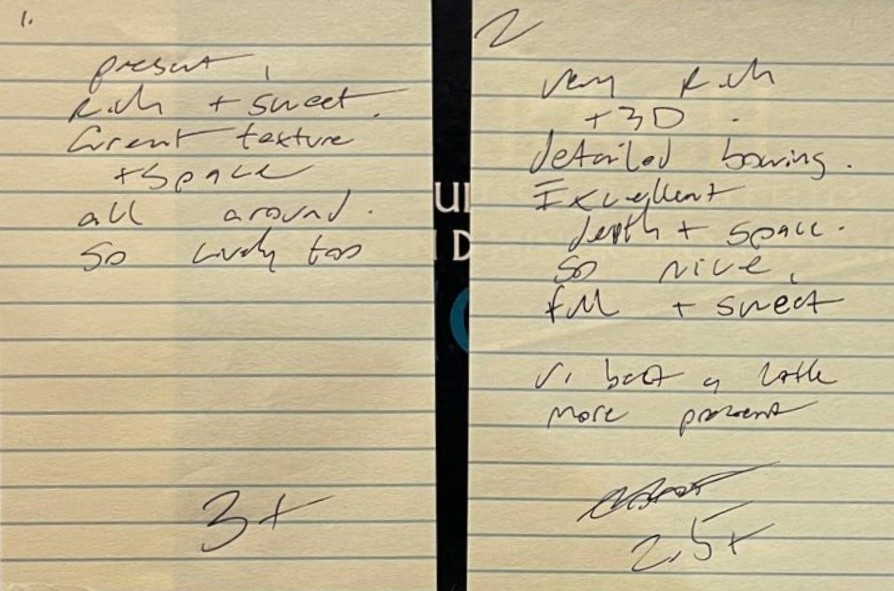
Side one was killer in every way, and the way we know that is we played a bunch of copies and nothing could beat it. This side one took top honors for having exactly the sound we described above.

  • Present
  • Rich and sweet
  • Great texture and space all around
  • So lively too

Side two is another matter. We came across a side two that was slightly better than the side two you see here.

(more…)

The Best Reissue Pressings of Way Out West Are Amazing Sounding

Hot Stamper Pressings of Contemporary Jazz Albums Available Now
When it comes to Contemporary recordings, sometimes the originals are the best sounding pressings. Other times, regardless of how good the originals may be, the best reissues, which is to day the right reissues, somehow manage to beat them.

This is undeniable — at least it is to those of us who audition records without regard to preconceived notions of which pressings are sure to have the best sound, based on attributes such as who mastered them, what label they have, what country they’re from, as well as a host of other things that collectors tend to look for.

We hold a different view. Foundational to understanding the nature of the vinyl LP is the idea that rules were made to be broken — the rules I just mentioned and others just like them.

The winners cannot be predicted. They can only be discovered.

Which is precisely why we do shootouts: to find out which pressings have the best sound, not which ones should have the best sound, or used to have the best sound, or might have the best sound, or were told will have the best sound.

Not only do we not care what anybody else thinks is the best pressing. It’s worse than that. We don’t even care what we used to think was the best pressing.

The current best evidence is the best evidence and that’s all there is to it. When new evidence overturns our previous understanding, then we naturally change our views. It’s the main reason we have no qualms about admitting our mistakes. If you let the evidence guide you in your search for the best sounding pressings, one thing you can be sure of is that you will get a lot of things wrong, and we have.

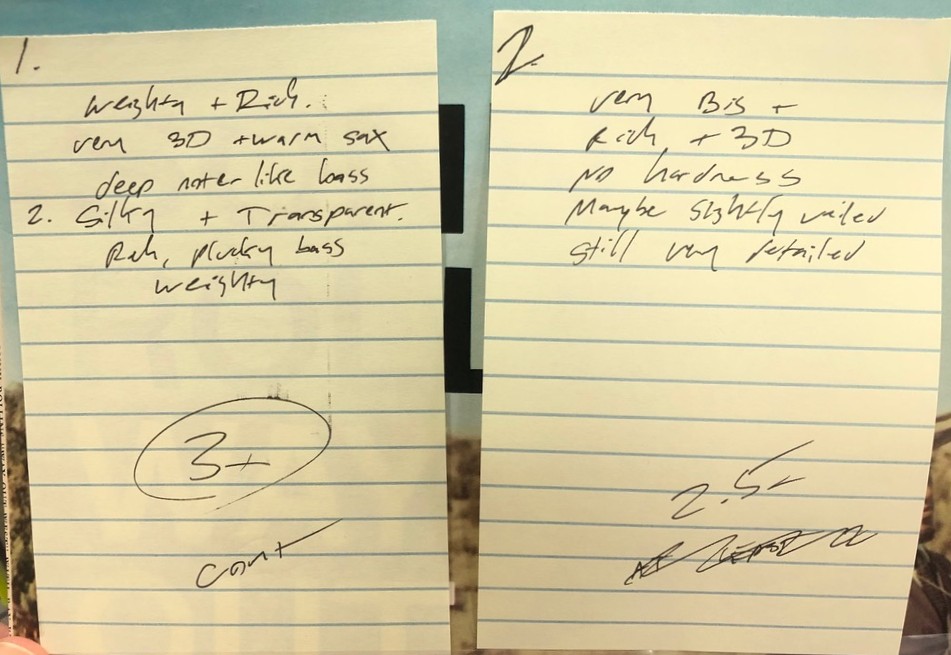
Not long ago we came across a Shootout Winning pressing of Way Out West with absolutely amazing sound. You can see the notes we took below. We described it this way:

This copy has superb 1957 Contemporary stereo sound – big, open and natural throughout. It’s one of our favorite Rollins records – one listen to this copy and you will know exactly why we love the recordings engineered by Roy DuNann.

Side One

Track One

  • Weighty and rich
  • Very 3-D and warm sax
  • Deep note-like bass

(more…)

Listening for Side to Side Differences on Beethoven’s Quartets

Hot Stamper Pressings of Violin Recordings Available Now

This RCA White Dog pressing of the Quartet in C-Sharp Minor contains what many consider to be Beethoven’s greatest string quartet, with SUPERB better than Super Hot Stamper sound on BOTH sides, each of which rated grades of A++ to A+++.

The reason we held back on the full Three Plus White Hot Stamper designation is simple: each side had slightly more of a fairly important quality that the other side lacked.

When you play this record at home see if you don’t agree with us that this is an AMAZING sounding chamber music record, with minor, albeit recognizable and appreciable differences in its strengths on each side.

We’ve always found it odd that reviewers of audiophile records (and records in general for that matter) never seem to notice these sonic differences from side to side. The differences seem quite obvious to us, as I’m sure they do to you, dear reader, or you wouldn’t be on this site.

After all, most of the records we offer have different grades for their two (or four or six and sometimes even eight) sides, different sonic grades as well as different surface grades.

Having played vintage records by the tens of thousands, to us this is to be expected.

(more…)

Breezin’ – “Hot Stamper” MoFi Reviewed

Hot Stamper Pressings of the Music of George Benson Available Now

UPDATE 2026

Having heard so many good sounding copies of this album, it is unlikely we would find much to like on the MoFi. But we can’t deny that we did, a long time ago, after cleaning and playing three MoFi copies, two of which were awful.


Sonic Grade: B-

Another MoFi reviewed, and surprisingly this one isn’t awful.

It has an excellent side two backed with a pretty good side one.

Side two has excellent bass — for a MoFi — and lots of energy — for a MoFi.

It’s slightly smooth, but overall it’s very musical. The best domestic copies are going to eat its lunch, but try to find one that sounds good. Most of them are awful. 

This MoFi copy, though lacking in many ways, is much better sounding than the other MoFi copies we played it against, which were muddy and compressed.

Side one of this copy has some of that sound. Side one lacks the transients we found on other copies and it’s a tad recessed and compressed. However, it does have relatively good bass definition and the strings are nicely textured.

(more…)

What to Listen For on Queen’s The Game

Hot Stamper Pressings of the Music of Queen Available Now

UPDATE 2026

Years ago we wrote:

The best sounding side ones were rarely as good as the best sounding side twos.

Not sure if that’s still true but you can check your own copy and see how the two sides compare.

Here some other records that often display side to side differences.


Our Old Commentary

Even the good side ones tended to have a trace of harmonic distortion and compression that is simply nowhere to be found on the good side twos. How and why this is we have no idea. Since every copy had the same sonic issues, we discounted it in our grading.

Only the better copies bring the hits on side one to life and give them the size and power we know they can have.

(more…)

A Random Copy of 52nd Street Tells You What, Exactly?

Hot Stamper Pressings of the Music of Billy Joel Available Now

Sonic Grade:

Side One: F / Side Two: C+

The Impex (Cisco) 180 gram remastering of 52nd Street was cut by Kevin Gray, under the direction of Robert Pincus (aka Mr Record), at the now defunct AcousTech Mastering in Camarillo. We noted the following in a recent review for a much superior (how could it not be?) Hot Stamper pressing:

Side one is a joke (not much ambience, resolution, energy, etc.) but side two is actually quite good. Side two fixes the biggest problem with the album: hard, honky vocals.

In his review appearing in The Absolute Sound, Neil Gader plucks two songs out of the album’s nine as especially worthy of praise. Oddly enough they’re both on side two. If I didn’t know the album as well as I do, I might wonder why. 

In our review we went on to say:

But at a cost. It still sounds like a modern record, with not much in the way of space, transparency, richness, resolution and the like. You know, all that ANALOG stuff that old dinosaurs like us like our records to have.

For those of you who have thirty three dollars to spend, you could do a lot worse on side two. Side one is pretty bad and you would have a hard time doing worse.

Allow me to now quote Mr. Gader from The Absolute Sound, October 2011, Issue 216, Pg. 129

The Impex 180-gram remastering by Kevin Gray is superb. It replaces the spongy timing and dull top of the original Columbia LP with expansive space and sharp details. Its vivid and brightened treble is welcome compared to the warm but smothered original. Listen for Joel’s doubled harmonies, the pennywhistle in “Rosalinda’s Eyes,” and the burning horn section in “Half a Mile Away,” and you’ll hear what a difference a great remastering makes.

Mr. Gader has a bad original pressing, and like most reviewers he makes the mistake of assuming that other originals, and probably all the originals, perforce sound like his. Speaking from experience, they most assuredly do not. We will not be addressing his specific complaints in this commentary for one simple reason.

Nothing in his review describes the sound of the best copies

(more…)

It Only Took Us Six Years to Find Another Killer Copy of Down In L.A.

Hot Stamper Pressings of Hippie Folk Rock Albums Available Now

UPDATE 2025

Our comments about our Hot Stamper winner from 2019 appear below.

Note that we could not even find White Hot sound on either side, and side two, at 1+, does not even qualify as a Hot Stamper these days, which means it would never be offered for sale on the site.

This was a tough shootout!

We had a lot more research and development to do, and six years later we had the killer copy to prove that it could be done. In 2025, we found a pressing that made it all worthwhile.


This is one of the BEST copies we’ve played in many years, close to five I would guess. Brewer and Shipley’s first and only release for A&M has long been a Desert Island disc in my world. I consider it one of the top debuts of all time, although it’s doubtful many will agree with me about that since I have yet to meet anyone who has ever even heard of this album, let alone felt as passionate as I do about it.

To me this is a classic of Hippie Folk Rock, along the lines of The Grateful Dead circa American Beauty, surely a touchstone for the genre. It’s overflowing with carefully-crafted (B and S apparently were obsessive perfectionists in the studio) inspired material and beautifully harmonized voices backed by (mostly) acoustic guitars. The Beatles pulled it off masterfully on Help and Rubber Soul. (more…)

Symphonie Fantastique – Three Mastering Options

Hot Stamper Pressings of the Music of Berlioz Available Now

UPDATE 2026

Years ago we played a reissue of the title you see pictured which prompted us to make some observations and ask some questions about the approach the mastering engineer might have taken.


And this one comes complete with the bonus 7″ entitled “Berlioz Takes a Trip,” in which Bernstein explores the work “with musical illustrations by the New York Philharmonic.”

Clocking in at around 45 minutes, Symphonie Fantastique is a difficult work to fit onto a single LP,  which means that the mastering engineer has three options when cutting the record:

  1. Compress the dynamics,
  2. Lower the level, or
  3. Filter the deep bass.

On this side two it seems that none of those approaches were taken by the engineer who cut this record in the early 80s — there’s plenty of bass, as well as powerful dynamics, and the levels seem fine.

How he do it? Who knows? Like so much in the world of records, it’s a mystery.

(more…)