Chris Kimsey, Engineer – Reviews and Commentaries

Some Speakers Don’t Let Frampton Come Alive

Hot Stamper Pressings of the Music of Peter Frampton Available Now

When I was first getting serious about audio in the mid-70s, electrostatic and screen-type speakers were quite common in audio showrooms. Classical music aficionados in particular seemed to prefer them to other designs. They were more often than not big, open and clear, and never boxy or sour.

Another quality they had going for them was that they were exceptionally transparent.

Alas, they were inadequate or wrong in almost every way a speaker can be, but transparency was their strong suit and everybody could hear it. All of the qualities noted above — big, open, clear — worked together to fool a great many audiophiles into thinking that theirs was the right approach to reproducing music.

(Circa the Pretzel Logic era, Becker and Fagen of Steely Dan fame were apparently big fans of Magnepan speakers, to the consternation of everyone else in the band — especially the engineers, one imagines — who thought they were overly-smooth, incapable of reproducing the frequency extremes high and low, soft, and lacking in their ability to reproduce many of the most important aspects of music, energy especially. Count me among their harshest critics.)

It was my good fortune at the time that I liked to play my rock music good and loud, so screens, panels and full-range electrostats were never going to cut it for me.

I once heard the giant Magnaplanar 1D system — a series of ten panels that stretched all the way across the long wall of the audio showroom I frequented at the time, standing about 7 feet tall to boot — try to reproduce a favorite Peter Frampton record of mine. (It was Wind of Change, a Desert Island Disc I still play regularly to this day.)

(more…)

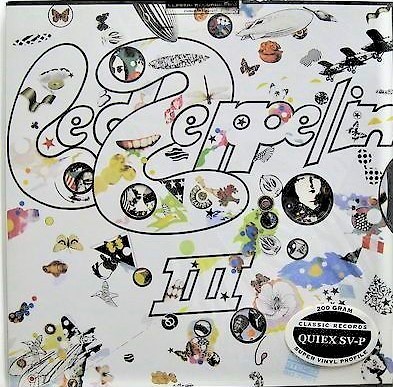
Always wanted to have a Plum and Orange pressing? Here’s your chance!

Hot Stamper Pressings of the Music of Led Zeppelin Available Now

We should have titled this one “here was your chance,” since this pressing sold very quickly.

Over the years most Plum and Orange pressings were disposed by us of on ebay for the benefit of collectors and those audiophiles who might be ill-informed enough to think that early British pressings would have the best sound for Led Zeppelin III.

They do not. They can, however, sound reasonably good in some cases with the proper cleaning.

However, they are not even Double Plus (A++) good, which sounds like something from the novel 1984 but is in fact a Very Good grade and guaranteed to trounce any and all copies of the album you have ever heard.

No, the best Zeppelin album we have played to date with the early label in this case earned a grade of Single Plus to Double Plus, which we describe as “[a] wonderful sounding side with many impressive qualities, notably better than a Single Plus copy. A big step up from the typical pressing.”


UPDATE:

We do not even offer Single Plus copies on the site anymore. Although their faults would be less obvious to anyone who went through the shootout process with the album, such faults are much too bothersome to us precisely because we did go through that process.

Once you know what is right, it’s very easy to spot what is wrong.

This is the foundational principle of Hot Stampers.

(more…)

The Glorious Big Speaker Sound of Wind of Change

Hot Stamper Pressings of the Music of Peter Frampton Available Now

A while back we discussed the kind of sound that Glyn Johns managed to get for the likes of Humble Pie and The Who:

But oh what a glorious sound it is when it’s working. There’s not a trace of anything phony up top, down low or anywhere in-between. This means it has a quality sorely at odds with the vast majority of audiophile pressings, new and old, as well as practically anything recorded in the last twenty years, and it is simply this: The louder you play it, the better it sounds.

Chris Kimsey knew how to get the Big Rock Sound onto tape about as well as anybody who ever lived. His work on this album set me on a path I would would follow for the next fifty years.

Wind of Change is the very definition of a big speaker record, one that requires the highest-resolution, lowest-distortion components to bring out its best qualities. If you have a system like that, you should find much to like here.

I bought my first copy in 1972 while still in high school and it quickly became one of my favorite records.

All these years later it still is.

It’s records like this that shaped my audio purchases and pursuits. It takes a monster system to even begin to play this record right, and that’s the kind of stereo I’ve always been drawn to.

A stereo that can’t play this record, or The Beatles, or Ambrosia, or Yes, or the hundreds of other amazing recordings we put up on the site every year, is not one I would want to own.

This is Peter Frampton’s Masterpiece as well as a personal favorite of yours truly.

(more…)

How Do the The Mastering Lab Pressings of Sticky Fingers Sound?

Hot Stamper Pressing of the Music of The Rolling Stones Available Now

A listing for an early domestic Hot Stamper pressing for Sticky Fingers will typically be introduced like this:

If you have never heard one of our Hot Stamper pressings of the album, you (probably) cannot begin to appreciate just how amazing the sound is.

A landmark Glyn Johns / Andy Johns recording, our favorite by the Stones, a Top 100 Title (of course) and 5 stars on Allmusic (ditto).

After hearing so much buzz about it, we finally broke down and ordered a German TML pressing about a year ago. Having played scores of phenomenally good sounding copies of the album over the past fifteen or so years, we were very skeptical that anyone could cut the record better than the mastering engineers who inscribed Rolling Stones Records into the dead wax on the early pressings. (I could find no mastering engineers credited.)

Well, the results were not good. As we suspected would be the case, we were not impressed in the least with what The Mastering Lab — one of the greatest independent cutting houses of all time, mind you — had wrought.

Their version is not really even good enough to charge money for. It might have earned a grade of One Plus, just under the threshold for a Hot Stamper that we would put on the site these days. Decent, but not much more than that.

Wait, There’s More

We subsequently learned that it is the British TML pressings that are supposed to be the best.

So we got one of those in, an A3/B4 copy.

Better, but good enough? Barely.

Here are the notes for the copy we played. For those who have trouble reading our writing, I have transcribed the notes as follows:

Side One

Track one:

Weighty, a bit veiled or smeary. Backing vox kinda lost.

Track three:

Very full, rockin’ but not the sparkle/space.

Kinda compressed.

Not as huge.

Side Two

Track two:

Not as rich, clear.

A bit pushy/dry vox.

No real space.

Thick drums

Track one:

This works better.

A bit hard, but full and lively.

This Sound?

Is this the sound audiophiles are raving about?

(more…)

Do The Original Domestic KC Pressings Always Beat the Later PC LPs?

Hot Stamper Pressings of Psychedelic Rock Recordings Available Now

Here is our description for the Super Hot (2+) copy that is currently on the site:

One of the most important records in my growth as an audiophile from 1971 to the present – my stereo was forced to evolve in order to play this kind of big production rock at the loud levels that the album needs in order to work its magic.

No matter how many times you play it, you will most likely hear – or at least gain more of an appreciation for – something new in the exceptionally dense, sophisticated soundfield Chris Kimsey creates for these songs.

And each time you make an improvement in the quality of your playback, this is the album that will show you exactly what you have just accomplished.


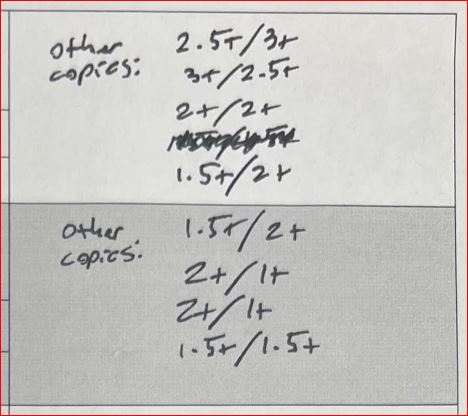
Overall, the best performers in our most recent shootout were UK pressings. They ranged in sound from the 3/3 Shootout Winning pressing (not shown) to the lowest graded British copy which earned grades of 1.5+/2+ (at the bottom of the top box).
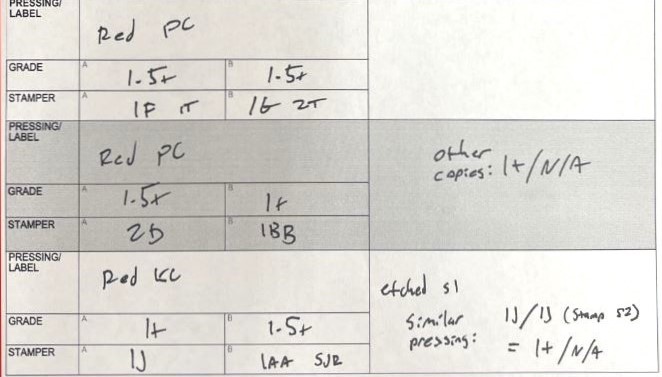
On the left is a portion of the breakdown, minus the actual stamper numbers that earned the highest grades (for obvious reasons.)

We had six UK pressings, all with the same stampers — the five you see graded and the one hidden to the left that actually won the shootout. (Three sides earned White Hot Stamper grades, an unusual outcome and a good one for the bottom line.)

Note that with the “right stampers” you could have ended up with an incredible Demo Disc (copy #1) or just a very good sounding copy on side two mated to a passable side one (copy #6).

Finding six clean UK pressings is, as you can well imagine, neither cheap nor easy. We probably bought close to twice that many to end up with six that we’re in something close to audiophile playing condition.

As you can see from the grades, two of them were clearly inferior to the other four. In the case of this title, a small sample size could have been very misleading. Fortunately for us, we spent the money and the time it takes to track down a good-sized batch of UK pressings in order to avoid that possibility.

Next come the better domestic pressings. There was a 2+/2+ that outscored all the other domestic pressings, and four others that came in behind it, all with the same stampers.

Of the five copies that had those stampers, two had side two’s that scored sub-Hot Stamper grades, which marked them as unsaleable. (Perhaps we will offer them as one-sided records since their side one’s are so good.)

KC VS PC

We rarely have good luck with PC reissue copies when the originals come with the KC prefix, rarely meaning we find a PC winner maybe once out of every ten titles we play.

(more…)

How Does the Abbey Road Half-Speed of Sticky Fingers Sound?

Hot Stamper Pressings of the Music of The Rolling Stones Available Now

A listing for an early domestic Hot Stamper pressing for Sticky Fingers will typically be introduced this way:

If you have never heard one of our Hot Stamper pressings of the album, you (probably) cannot begin to appreciate just how amazingly well-recorded an album it is.

It is truly a landmark Glyn Johns / Andy Johns / Chris Kimsey recording, as well as our favorite by the Stones, a Top 100 Title (of course) and one that earned 5 stars on Allmusic (ditto).

5 stars: “With its offhand mixture of decadence, roots music, and outright malevolence, Sticky Fingers set the tone for the rest of the decade for the Stones.”

However, we found the new Half-Speed Heavy Vinyl pressing mastered by Miles Showell at Abbey Road to be seriously lacking in “outright malevolence.” It’s so tame that even at high volume it would be unlikely to disturb the most innocuous afternoon tea in the back garden of a country estate.

Brown Sugar is:

  • It’s smaller
  • Not as weighty or lively
  • Tonally pretty close

Sway is:

  • Tonally pretty close
  • Just missing some weight and dynamics

Oh, is that all? Well then, not as bad as it could have been, right?

1.5+, which means it would qualify for our lowest Hot Stamper grade. But no record that does not earn at least that grade on both sides can make it to our site, and when we flipped the album over, side two let us down even more than side one.

Bitch is:

  • A little sandy up top

I Got the Blues is:

  • Missing the dynamics

Grade for side two: 1+. Substandard. Not good enough to sell.

Usually our notes are filled with disgust about how awful sounding the current crop of remastered pressings tends to be.

Those interested in reading such notes have plenty to choose from. Here are some from 2024 through 2025. (At some point this year the number of awful sounding Heavy Vinyl pressings we’ve reviewed will hit 200!)

But this version isn’t awful. It’s just not very good. The sound quality is middling.

The sound of other audiophile pressings of Sticky Fingers, including one mastered by the venerable Robert Ludwig, was much, much worse.

As far as audiophiles are concerned, this new release should be regarded as nothing more than a waste of money.

The Question Before the House

We’ve asked this question before, but it’s worth asking again:

Can this really be the sound audiophiles are clamoring for?

It shouldn’t be, but apparently it is.

However, it’s not as though we haven’t run into this issue hundreds and hundreds of times before. Audiophiles and the reviewers who write for them regularly rave about one Heavy Vinyl pressing after another being The Greatest of All Time, yet we have never found a single instance in which this was true for any of the modern reissues they have seen fit to crown.

Except for this one.

Three Little Words

Our explanation for the mistaken judgments audiophiles and reviewers make so consistently has never been all that complicated. As you may have read elsewhere on this blog:

More evidence, if any were needed, that the three most important words in the world of audio are compared to what?

No matter how good a particular copy of a record may sound to you, when you clean and play enough of them you will almost always find one that’s better, and often surprisingly better.

You must keep testing all the reissues you can find, and you must keep testing all the originals you can find.

Shootouts are the only way to find these kinds of very special records. That’s why you must do them.

Nothing else works. If you’re not doing shootouts (or buying the winners of shootouts from us), you simply don’t have top quality copies in your collection, except in the rare instances where you just got lucky. In the world of records luck can only take you so far. The rest of the journey requires effort.

If you would like to hear what you’ve been missing, there’s a small chance we have a Hot Stamper pressing of the album in stock.

(more…)

How Does the Brass Sound on Your Copy of Sticky Fingers?

Hot Stamper Pressing of the Music of The Rolling Stones Available Now

The best copies have texture and real dynamics in the brass.

The bad copies are smeared, grainy and unpleasant when the brass comes in.

Toss those bad ones and start shooting out the good ones.

Believe me, if you find a good one it will be worth all the work.


One customer observed that the recording was “deliberately a bit muddy and smeared…” and he was mostly right about that. We replied as follows;

You are spot on with your observation about the sound being deliberately muddy.

Glyn Johns loves his tube compressors. They can make some tracks murkier than many of us would like, but they work positive wonders most of the time.

A lot of the smearing you reference is from uncleaned or improperly cleaned vinyl. Once we got our cleaning regimen dialed in, a lot of the smear we used to hear so often stopped being a problem.

3-Dimensionality also greatly improves with clean, fully restored vinyl. A lot of old records just sound like old records until you learn how to clean them right.

Play It Loud

Even through the noise of the bad vinyl you can hear the audio magic. The sound is exactly what you want from a Stones album: deep punchy bass and dynamic grungy guitars.

This record is to be played loud like it says on the inner sleeve and the surface noise is to be ignored.

The louder you play it, the less bothersome the noise will be.

This album ROCKS and it was not made to be listened to in a comfy chair with a glass of wine.

(more…)

Chris Kimsey Engineered Two of My All Time My Favorite Records

Hot Stamper Pressings of Chris Kimsey Engineered Albums Available Now

I have two personal favorites among his many excellent recordings.

Both are Must Own records in my book. Masterpieces even.

Ten Years After – A Space in Time and Peter Frampton – Wind of Change.

If you have not heard one or both of these classics, check them out. They are the very definition of the kind of Big Production Rock I have been listening to since I first fell in love with them back in the early Seventies. That was about fifty years ago and I still play them regularly for enjoyment. I have never tired of either of them in all that time and I doubt I ever will.

I’m sure you have plenty of records you feel the same way about in your collection. These are two of mine.

They are the very definition of big speaker albums. The better pressings have the kind of energy in their grooves that is sure to leave most audiophile systems begging for mercy.

This is the Audio Challenge that awaits you. If you don’t have a system designed to play records with this kind of sonic firepower, don’t expect to hear them the way Chris Kimsey wanted you to.

Both albums want to rock your world, and that’s exactly what our Hot Stamper pressings are especially good at doing.

(more…)

Some Girls Need (Needs?) Fullness

Hot Stamper Pressing of the Music of The Rolling Stones Available Now

In the commentary for a recent Hot Stamper pressing, we described the sound we were looking for on the Stones’ brilliant 1978 album, Some Girls:

One of the keys to getting this album to sound right is fullness. Many copies lack weight to the bottom end, which robs this funky music of its very foundation. Other copies suffer from lean, thin-sounding vocals — do you think that’s the sound Mick Jagger (or engineer Chris Kimsey) was going for?

Some of the qualities we found in short supply on the average copy were warmth, richness, sweetness and ambience — you know, all that Analog Stuff we know and love.

Most copies are too thin and grainy for serious audiophile listening, but this one is a different story. It’s not easy to find great sound for The Stones, so take this one home for a spin if you want to hear this band bring these songs to life in your very own listening room.

Not many copies have this kind of clarity and transparency, or this kind of big, well-defined bottom end.

The sound of the hi-hat is natural and clear on this pressing, as are the vocals, which means that the tonality in the midrange is correct, and what could be more important than a good midrange? It’s where the music is.

Not only is it hard to find great copies of this album, it ain’t easy to play ’em either, which is why this recording ranks high on our difficulty of reproduction scale.

You’re going to need a hi-res, super low distortion front end with careful adjustment of your arm in every area — VTA, tracking weight, azimuth and anti-skate — in order to play this album properly.

If you’ve got the goods, you’re gonna love the way our Hot Stamper pressings sound.

Play it with a budget cart/table/arm and you’re likely to hear much less magic than we did.

(more…)

Sticky Fingers – Worst Version Ever!

Hot Stamper Pressing of the Music of The Rolling Stones Available Now

Mastered by Robert Ludwig. (Scroll down to find links to more of Robert Ludwig’s work.)

Digitally remastered using UV22 Super CD encoding by Apogee Electronics, Santa Monica, California.

This RTI 180g copy (with the zipper cover) is one of a series of five titles Bob Ludwig cut in the 90s. According to the man, after cutting the record he chanced upon a consumer copy and was shocked to hear how bad it sounded.   

It sounded, according to him, nothing like the record he had cut. Somehow they had botched the pressings and ruined the sound. How this could happen I can’t imagine.

Bob says that’s what they did and we’ll take him at his word, out of respect for one of the all-time great mastering engineers, RL himself. He promptly sold off all his analog mastering equipment and got out of the game.

Can you blame him? According to him they put his name all over a record the sound of which they had ruined. Guess I would stop making records too if that were the case.

By the way, the sound was dismal on every title from that series we played except for Heart’s, which was okay, certainly better than the average pressing out there, but no Hot Stamper by any stretch of the imagination. 

(more…)