Month: April 2025

The Reissues Consistently Beat the Originals on this Mystery Mercury

Hot Stamper Pressings of Mercury Classical Records Available Now

For Mercury classical and orchestral recordings, the original FR pressings on the plum labels are the way to go, right? 

In some cases, yes. We talk about how much better the FR pressings for The Firebird are compared to the much more common, and still quite good, M2 reissue pressings here.

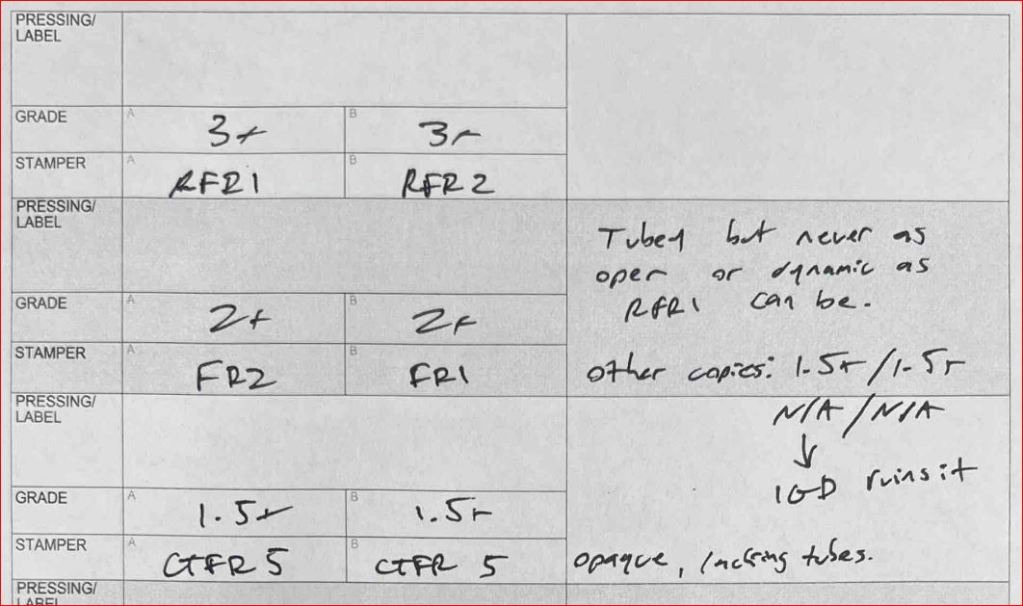
The stamper numbers you see below belong to a different album.

The notes for the FR originals we played read:

  • Tubey but never as open or dynamic as RFR-1 can be.

The better of the three FR pressings we played was not a bad sounding record, earning a grade of 2+. They’re just not as good sounding as the RFR reissues, which, of course, are the ones that win shootouts.

Something to keep in mind: A Super Hot Stamper Mercury orchestral record is guaranteed to be dramatically better than any Heavy Vinyl reissue ever made.

(more…)

“Why would you want to go into a room and just play a record by yourself?”

In Geoff Edgers’ Washington Post article about audiophiles, somebody asks “why would you want to go into a room and just play a record by yourself?”

I would answer the question with a question of my own:

Why would you go to a museum and just look at a painting by yourself?

You don’t need anybody around you to help you understand a painting. You just look at the painting and you experience looking at a painting.

When I listen to a record, I want the experience of listening to the record. I don’t need anybody else around. I don’t need anybody talking to me. I want it to take me from the beginning to the end. And at the end I should feel like I still want more.

For me, that’s what a good record and a good stereo is all about. That’s the reason some of us describe ourselves as audiophiles.

The shortest definition of an audiophile is a “lover of sound.” I love good sound and I’ve spent more than forty years building a stereo system that has what I think is very good sound. (What others think of it has never been of much concern, and I don’t know why it would be.)

It’s in a darkened room with no windows [1] because music sounds better in a darkened room with no windows and the door closed. (In our old studio, the stereo sounded better with the door at the end of the hallway open. This one sounds better with the door behind the left speaker closed. There is no rule to follow here. Whatever sounds the best, sounds the best.)

There is one chair and it is located in the only sweet spot in the room. (Yes, there can only be one sweet spot.)

I go in there to put myself in the living presence of the musicians who performed on whatever record I choose to play.

Music is loud and so I play the stereo at levels as close to those of live music as I can manage.

The system creates a soundfield that stretches from wall to wall and floor to ceiling. With the speakers pulled so far out into the room, they have often been known to disappear, leaving only three-dimensional imaging of great depth and precision (especially in the case of orchestral music).

By listening this way, I am able to completely immerse myself in the music I play, with no distractions of any kind.

This way of listening is more intense and powerful and transportive than any other I have known (outside of the live event of course).

That’s what I am trying to achieve with my system and the best records I can find to play on it: an experience that is so intense and powerful that I find myself completely transported out of the real world I exist in, and into the imaginary world created by the producers, engineers and musicians responsible for making the record.

If you want this kind of experience, you need more than good music. You need a good recording of that music, and, if you’re an analog sort of person with high standards, you need an exceptionally good pressing of that recording.

At the highest levels of sound quality, for us audiophiles it can’t just be about the music. You really do need all three: good music, well recorded, then mastered, pressed and cleaned properly.

Depending on your tastes and standards, good music can easily be found most everywhere. Good music with good sound, at least on vinyl, is much more rare, and good sounding music reproduced well is, in my experience, very rare indeed.

Some people are upset and put off by what they consider to be our “extreme” approach to records and audio. It bothers them that we constantly say that doing records and audio is harder than it looks. To them it seems so easy.

Naturally, we believe there is ample evidence to support our views on the subject. I refer those who disagree with us to the many hundreds of commentaries on this blog.

And, if I may paraphrase Jesus, upset folks will always be with us.


[1] In the picture below you can see how bright the back of the soundroom is. Until I watched the video again recently, I had completely forgotten that we had installed a solatube skylight in the ceiling at the far end of the room.

Why did we do that? Because there is no electricity being used in this room that is not going to the stereo. There is a light by the turntable that runs off batteries. When we tried plugging that light into the electrical circuits, even the ones separated from the ones the system uses, the sound became degraded — flatter, harsher, less transparent, less open, etc.

We needed more light in the room to do our work, so we put a solatube well behind the listener, which allowed us to leave the area around the speakers mostly dark. This worked like a charm.

We spents months testing the electricity going to everything in the space we rent, including the testing of the isolation transformers we use (about six as I recall) for our computers and record cleaning machines.

All of the experiments we carried out were done without the listener knowing what had been changed. Notes were taken and combinations of changed evaluated.

I did this kind of thing over the course of years in the house I owned in Thousand Oaks, where we had the studio set up in the master bedroom, so I knew exactly how to go about it. If you ever manage to do this kind of work for your own stereo — assuming you take it to the level we took it to — the one thing you are guaranteed to take away from the experience is how shocking the before and after difference can be.

We don’t talk about it much because it’s just too complicated and so few audiophiles will choose to make use of our experience. I doubt if even one out of a hundred of our customers would. Robert Brook and a handful of others at most would be my guess.

But good electricity is key to good sound, and, if I may be so bold, it’s the most obvious source of problems in home audio systems.


Further Reading

Judas Priest – Defenders of the Faith

More Judas Priest

  • With solid Double Plus (A++) sound from start to finish, we guarantee you’ve never heard Defenders of the Faith sound this good
  • If you want to hear this music explode out of the speakers and come to life the way the band wanted you to hear it, this record will do the trick
  • These sides are bigger and richer and have more of the rock solid energy that’s missing from the average copy
  • 4 stars: “…there’s a remarkably high percentage of hidden gems waiting to be unearthed, making Defenders possibly the most underrated record in Priest’s catalog.”

(more…)

Tom Petty and the Heartbreakers – Long After Dark

More Tom Petty

  • With solid Double Plus (A++) grades from top to bottom, this vintage pressing is doing just about everything right
  • Both sides are rich and full-bodied with tight bass, and brimming with Petty’s unique brand of straight ahead rock and roll, best exemplified by the radio smash “You Got Lucky”
  • Rolling Stone raves, “Tom Petty and the Heartbreakers play a finely crafted brand of meat-and-potatoes rock. They shudder to a stop for the occasional ballad or showy guitar figure, but the next surging chorus is never far away. They’ve been honing that sound for five albums now, and Petty has gradually hoisted himself into the company of such masterful travelers of Route 66 as Seger and Springsteen. …overall, Long after Dark is Petty’s most accomplished record.”

Long After Dark boasts the monster rocker You Got Lucky and very good sound considering that the album was recorded in 1982, not an especially good year (or decade) to be recording rock music.

Finding The Best Sound

Energy and rock and roll rhythmic drive are of course paramount.

Many copies were brighter than ideal, which is nothing new for Petty’s body of work but nonetheless far from the sound we find most pleasing.

Some copies in our shootout were dark and small; we took serious points off for both of these shortcomings.

The climaxes of the songs should be as uncompressed and uncongested as possible to earn our higher grades. When the music gets loud it should stay tonally correct and undistorted, and not all copies can do that, not at the serious levels we like to play our records.

(more…)

Duran Duran – Rio

More Duran Duran

  • Here is a superb British EMI import pressing (one of only a handful of copies to hit the site in sixteen months) with two solid Double Plus (A++) sides
  • Forget the dubby domestic LPs with their boosted mids – this is the way the album is supposed to sound, and the difference is not a small one
  • This kind of record often shows up from overseas in beat-to-death shape – few survived, and that reality is compounded by the fact that even fewer record dealers know how to properly grade their records (hence our prices)
  • 4 1/2 stars: “The original Duran Duran’s high point, and just as likely the band’s as a whole, its fusion of style and substance ensures that even two decades after its release it remains as listenable and danceable as ever… From start to finish, a great album that has outlasted its era.”

(more…)

Sonny Rollins – Saxophone Colossus

  • With two STUNNING Shootout Winning Triple Plus (A+++) sides, this 60s Gold Label Prestige Mono pressing is certainly as good a copy as we have ever heard
  • An especially good sounding recording and one that we rarely have on the site, and copies in true mono are the rarest of them all
  • The sound is everything that’s good about Rudy Van Gelder‘s recordings – it’s present, spacious, full-bodied, Tubey Magical, dynamic and, most importantly, alive
  • Need I even mention have completely this Hot Stamper pressing will obliterate any and all Heavy Vinyl contenders you may have heard? No? OK, good, I won’t mention it
  • If the drum opening of “St. Thomas” doesn’t do it for you, I don’t know what will
  • Marks in the vinyl are sometimes the nature of the beast with these vintage LPs – there simply is no way around them if the superior sound of vintage analog is important to you
  • 5 stars: “Sonny Rollins recorded many memorable sessions during 1954-1958, but Saxophone Colossus is arguably his finest all-around set… Essential music[.]”
  • This is a Must Own jazz album from 1957 that belongs in every jazz-loving audiophile’s collection

(more…)

On Brighter Days, The Best Pressings Have Choruses that Really Soar

Hot Stamper Pressings with Big, Clear and Lively Choruses Available Now

A recent White Hot Stamper pressing of L&M’s fourth release demonstrated pretty convincingly just what an amazing Demo Disc this album can be.

At about the 1:15 mark (and again at 3:10), the song’s chorus is a great test for weight, resolution, dynamic energy, and freedom from strain in the loudest parts.

When the whole band is really belting it out, the shortcomings of any copy will be exposed, assuming you are playing the album at good loud levels on big dynamic speakers.

It was a key test every pressing had to pass. That’s what makes it a good test disc.

When the music gets loud you want it to get better, with more size, energy and, especially, emotional power, just the way that song would be heard in concert.

Any strain or congestion in the choruses we hear in our shootout results in the pressing being downgraded substantially.

Hot Stampers are all about the life of the music, and when this music gets lively, it needs to be clear and clean.

This is of course one of the biggest issues we have with Heavy Vinyl.

Heavy Vinyl almost never gets up and almost never gets going the way vintage records do.

“Lifelss and boring” are the adjectives we most commonly use to describe those we audition, and who wants to listen to lifeless, boring records?

(more…)

Letter of the Week – “I just figured this was just a bad recording…”

Hot Stamper Pressings of the Music of Steely Dan Available Now

This week’s letter is from our good friend Roger, who, like us, is a GIANT Steely Dan fan. Apparently he had tried every copy of Katy Lied he could get his hands on and practically had given up on the album — until he decided to shell out the princely sum of Three Hundred Clams ($300, probably not the last piaster he could borrow, but a pretty hefty chunk of dough for a fairly common used LP from 1975) to Better Records, with the hope that we might actually find a way to put him in touch with the real Dr. Wu.

Let’s just say it seems that Roger got his money’s worth — and maybe a little more.

The title of his letter is: 

Katy Lied? Are you sure?

I tried your Hot Stamper Steely Dan Katy Lied. You gotta be kidding me. Are you sure this is the same recording? I remember your saying that this one is your favorite SD record and I could never understand why, at least until I heard this secret recording. Other than the HS copy you basically had a choice between the dull and lifeless bland US pressing, or the Mobile Fidelity version, which has those indescribable phasey, disembodied instruments and voices that sound unmusical to me.

I even tried British and Japanese pressings with no luck. I just figured this was just a bad recording, which made sense in light of all the press about the problems during the recording and mixing sessions, and I don’t think I bothered to listen to it again for at least the past 5 years.

But wow, this is clearly in another league. The voices and instruments are in three dimensions, the bass and dynamics are far far better, the saxes are up-front and breathy. I couldn’t believe how good Daddy Don’t Live in that New York City No More and Chain Lightning sounded. Even my subwoofer that I roll off at 30Hz got a good workout. It sounds like live music. So how did you sneak your tape recorder into the studio sessions, anyway?

Roger, we’re so happy to know that your love for Katy Lied has finally been requited after all these years. The reason we go on for days about the sound of practically every track on the album is that we love it just as much as you do.

We struggled ourselves from one bad pressing to another. Eventually, with better cleaning fluids, better equipment and tons of pressings at our disposal, we broke through the Bad ABC Pressing Barrier and discovered the copies that had the real Katy Lied Magic.

We Are Heartened

Everything you said was true. We are especially heartened by the fact that you cited Chain Lightning as a high point of the album we sent you. Your copy, earning a grade of A+ for side two, was a couple of steps down from the best — but it still sounds great! You don’t have to buy the Ultimate Copy to get sound that beats the pants off any “audiophile” pressing, any import, any anything, man.

It’s Not About The Money

You and I both know it’s not about the three hundred bucks. It’s about some of the best music these guys ever made. It’s about their ambitious yet problem-plagued recording surviving the record label’s mass-production-on-the-cheap, opting to stamp the sound on a slice of not-particularly-good vinyl. It’s about the search for that rare pressing with the kind of sound that conveys the richness and sophistication of Becker and Fagen’s music, music that I’ve been listening to since 1975 and do not expect to tire of any time soon (so far so good: as of 2013 this is still my favorite Dan album). [Still true as of 2022.]

So what if it took thirty years to finally get hold of a good one? With a little luck we’ll both be listening to this album for another thirty years, and that works out to the very un-princely sum of ten bucks a year.

I wish I could have sneaked a tape recorder into the studio. I sure wouldn’t have gone in for that crazy DBX Noise Reduction system they used. That alone would have saved us all a decade or two of suffering (unless you like the sound of two trash can lids crashing into each other).

(more…)

Shelly Manne & His Men – The West Coast Sound, Vol. 1

More Shelly Manne

  • This early MONO pressing was doing practically everything right, with both sides earning INCREDIBLE Shootout Winning Triple Plus (A+++) grades or close to them
  • The first track here is by far the best sounding — it’s amazing and the perfect illustration of just how good 1956 mono sound can be if you know what you are doing
  • The sound may be a bit dated but the horns are enchantingly sweet and Tubey Magical, with solos that show off the jazz chops of “His Men” about as well as any Manne and His Men album ever has
  • Tube mastering is essential for this recording – without vintage tubes in the chain, you end up with the kind of modern sound that the average OJC pressing suffers from (this is especially noticeable on side two of the OJC pressings we played, which were mostly awful)
  • Contemporary in 1956 was making some awfully good jazz records, with room-filling, natural and realistic mono sound, the kind of sound that still holds up today and doesn’t need a lot of “mastering help” to do it
  • Good luck finding quieter early copies of this title — we sure couldn’t do it, not with top quality sound anyway
  • 5 stars: “The music has plenty of variety yet defines the era… Highly recommended and proof (if any is really needed) that West Coast jazz was far from bloodless.”
  • If you’re a fan of West Coast Jazz, this is a Top Title from 1956, and one that certainly belongs in any right-thinking audiophile’s collection.

(more…)

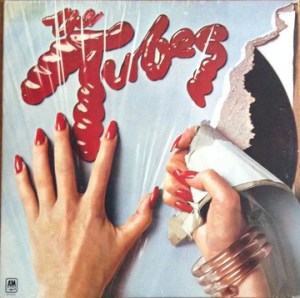
The Tubes – Self-Titled

More of The Tubes

  • The Tubes’ self-titled debut returns to the site after an eighteen month hiatus, here with with INCREDIBLE Shootout Winning Triple Plus (A+++) sound or close to it from start to finish
  • This copy is simply bigger, richer, fuller, and livelier than practically all others we played
  • Their music is definitely not for everyone – I saw them live many years ago and they did put on one helluva show, but you have to be a fan of eccentric pop or none of it will make any sense
  • This is the band’s best sounding album as far as we know. Roughly 100 other listings for the best sounding album by an artist or group can be found here
  • In our opinion, the first album is the only Tubes record anyone needs. Click on the link to see more titles we like to call one and done
  • “Produced by Al Kooper, this debut by the notorious San Francisco group is best known for the blazing anthem ‘White Punks on Dope.’ Although the Tubes’ raison d’être was their shock-rock stage dynamic, Bill Spooner, Fee Waybill, and company could, on occasion, deliver some offbeat pop splendor.”

(more…)