*Mono v Stereo

Commentary making the case for our preference for either mono or stereo on some of the titles we’ve auditioned.

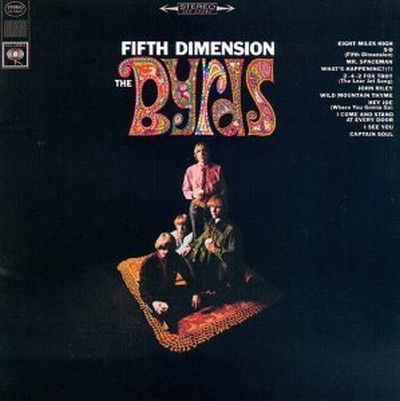
The Byrds in Mono – How Do The Original Pressings Sound?

Hot Stamper Pressings of Folk Rock Albums Available Now

Congested and compressed, with no real top, who in his right mind could put up with that kind of sound on a modern audiophile system?

Can the apologists for mono really be taking this ridiculously crappy sound seriously?

I hope not, but I suspect that is exactly what they are doing. The question is: why?

They seem to like the congested, distorted, top-end-lacking Beatles records in mono, so why not The Byrds?

To these ears, the monos for both bands have a lot in common.

And what they have in common is sound we want nothing to do with.

Now, to be fair, we’ve stopped buying these monos, so there may actually be a good copy or two out there in the used record bins that does have good sound.

In our defense, who really has the time to play records with so little potential for good sound?

What about the Sundazed mono pressings?

The best Columbia stereo copies on the original label are rich, sweet and Tubey Magical — three areas in which the Sundazed reissues are seriously lacking.

Does anyone still care? We simply cannot be bothered with these bad Heavy Vinyl pressings. If you’re looking for mediocre sound just play the CD. I’m sure it’s every bit as bad.

(more…)

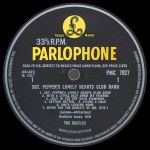
Sgt. Pepper on Yellow and Black Parlophone

Hot Stamper Pressings of the Music of The Beatles Available Now

UPDATE 2026

This commentary was written in 2010, prompted by our good fortune in finding a clean, -1/-1 original pressing of Sgt. Pepper, at a local record store, in stereo no less.

Since that time I believe we have played at least one other early pressing. We are unlikely to play another.

The originals have almost nothing in common with the amazing pressings that end up winning our shootouts, none of which have ever been mastered in the 60s to the best of my knowledge, although it is possible that ten or fifteen years ago, before we really got to know the record the way we know it now, there might have been one or two from that decade.

Since then the cutoff is somewhere in the mid-70s. We leave the specific years for you to figure out.

Of course, if you bought a White Hot Stamper copy from us, you know at least one of the stampers for at least one of the sides that wins a shootout, and perhaps both if you happened to have purchased a 3/3 Top Shelf copy. (At the time of this writing there are a total of seven on the site, out of about 500 records. Needless to say, they are very hard to find.)

Certainly nothing from 1967 and nothing on the original label.

And definitely nothing in mono.


We had the opportunity not long ago to audition a very clean original early pressing of the album and were frankly quite taken aback by how just plain AWFUL it was in every respect. No top end above 8k or so, flabby bass, muddy mids — this was as far from Hot Stamper sound as you could get.

To be fair, we have played exactly one copy on our current system. (Played an early copy or two long ago but on much different equipment, so any judgments we might have made are highly suspect.) Perhaps there are good ones. We have no way of knowing whether there are, and we are certainly not motivated to find out given the price that original Sgt. Pepper’s pressings on the Yellow and Black label in audiophile playing condition are fetching these days.

(more…)

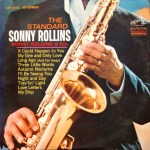
Great in Stereo, Bad in Mono. What Else Is New?

Hot Stamper Pressings of Jazz Piano Recordings Available Now

On this record, we say stick with stereo.

This album is much more common in mono than stereo, but we found the sound of the mono pressing we played deeply unsatisfying.

Where is the wall to wall space of the live club?

It has been shrunken down into the area between the speakers.

Much of the ambience disappeared with it, destroying the illusion the album was trying to create, that you are actually there with Ramsey and his rhythm section.

In mono, you really aren’t.

For albums that actually can sound sound good in mono, so good they can win shootouts, click here.

(more…)

Getz Au Go Go on Polygram – Isn’t This Record Supposed to Be Stereo?

Hot Stamper Pressings of Bossa Nova Albums Available Now

As part of our recent [probably from 2011] shootout for the album, one of the pressings we played was a later reissue, most likely from the late 70s or early 80s.   

As a general rule we make a point to go out of our way to play practically any copy we can get our hands on, in the off chance that a reissue will beat the original. It’s happened plenty of times. Those of you with White Hot Stamper shootout winning copies of some of our favorite titles know what I’m talkin’ about.

Imagine our surprise when this pressing — in a stereo jacket, with a label with the word “stereo” printed right on it — turned out to be dead MONO.

The sound was godawful — small, flat, and bereft of the ambience that makes this recording so enjoyable. The same would probably be true for the mono originals, but since I haven’t played one of those in decades I will just say that that would be no more than a guess, albeit an educated one.

Yet another reason not to believe a word you read on an album jacket or label.

A public service from your record loving audiophile friends here at Better Records. (more…)

Hey, Maybe Rudy Van Gelder IS as Bad a Mastering Engineer as They Say

Hot Stamper Pressings of Recordings by Rudy Van Gelder Available Now

It’s certainly a proposition worth considering, mostly because so many audiophiles seem to believe it. Or maybe in spite of their believing it, skeptics such as myself being the troublemakers they always are.

So let’s dig down into the dirt of a record that Rudy both recorded and mastered.

None of the Rudy Van Gelder cuttings we played of Eric Dolphy’s 1961 release of Out There were better than passable, and some had sides that were downright awful sounding, as you can plainly see from our notes.

The copies that won our most recent shootout were mastered by George Horn, and the best of them sound amazing. Here are some comments we made for the album years back as well as the Allmusic review:

Insanely good sound throughout with both sides earning Shootout Winning Triple Plus (A+++) grades. This copy was doing it all right: rich, full-bodied and Tubey Magical yet still super open and spacious.

“A somber and unusual album by the standards of any style of music, Out There explores Dolphy’s vision in approaching the concept of tonality in a way few others — before, concurrent, or after — have ever envisioned.” – 5 stars

As you will see from our notes, we played some very disappointing early pressings. All the early pressings we had on hand were expensive to acquire, the vintage jazz pressing market being what it is: expensive and full of optimistic record graders of questionable skill. (For these kinds of vintage pressings we probably return 70-80% of what comes our way.)
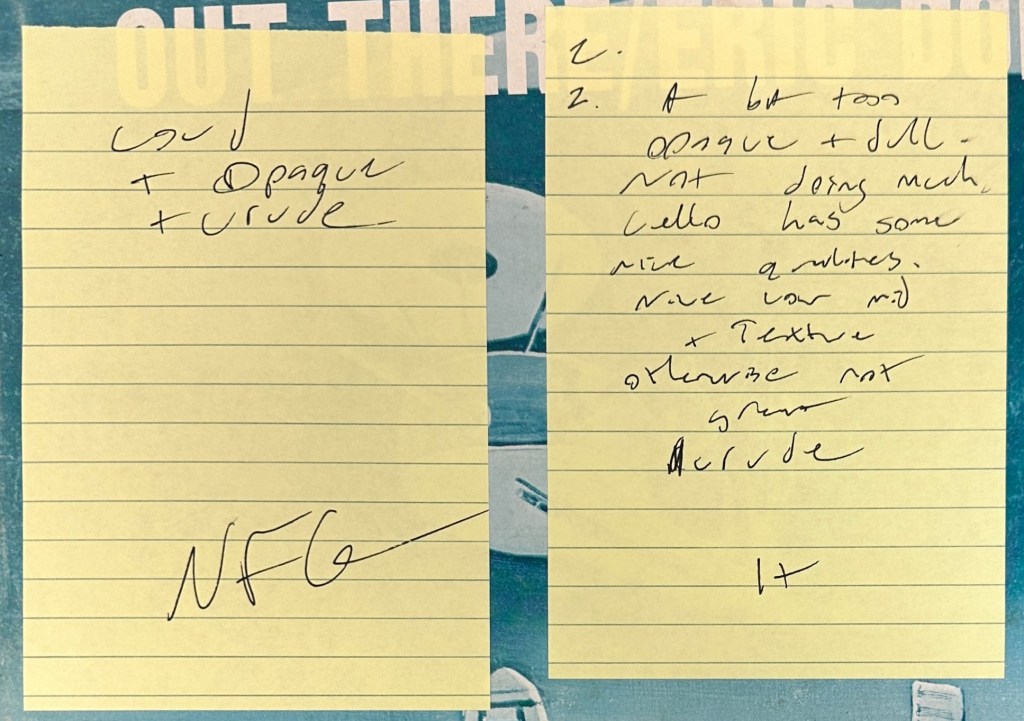
We have to pay top dollar to get copies that are clean, even on the 60s and 70s reissue labels. Noisy old jazz records are simply not saleable to audiophiles no matter how good they sound.

None of the early copies we played earned grades good enough to bother pursuing, not when there are wonderful sounding vintage reissues from the 80s available. On a more positive note, this being our first shootout for the album in many years, we certainly learned a lot, so let’s just chalk up the losses to the cost of doing business. Our newfound knowledge of the best pressings will continue to pay dividends for years to come now that we know what the right stampers tend to be.

The original recording of Out There was released in 1961 and was not available in stereo until 1969. (Prestige was famous for being an anti-stereo holdout long after everyone else in the jazz world had come to terms with the superiority of two channels over one. Apparently the age-old controversy over mono versus stereo is ongoing, which is why we write about it so often.)

The first record you see pictured below is the mono reissue from 1965, released with a different cover and pressed on the lovely dark blue Prestige label. It, like the stereo reissue below it, was mastered by RVG.

A word to the audiophile types who like to do their own hunting: we rarely buy vintage jazz reissue records from the 60s and 70s that were not mastered by RVG. Their track record is poor, with maybe one winner out of ten, if that.

Back to this mono reissue from 1965. It’s a mess on side one, NFG, with side two being passable at best, earning one plus.

The second record you see, the one with a different cover, is the stereo reissue from 1969, also on the dark blue label and mastered by RVG.

It too is a mess, with side one being good, not great, but side two earning a less-than-Hot Stamper grade of 1+.

Side One

  • Loud and opaque and crude
  • NFG

Side Two

  • A bit too opaque and dull
  • Not doing much
  • Cello (played by Ron Carter no less!) has some qualities
  • Nice lower mids and texture
  • Otherwise not great
  • Crude
  • 1+

(more…)

On Please Please Me, Which Is More 3-Dimensional, Mono or Twin Track?

Hot Stamper Pressings of the Music of The Beatles Available Now

With all due respect to George Martin, we’ve played a number of mono pressings of Please Please Me in the past twenty or so years and have never been particularly impressed by any of them.

The monos jam all the voices and instruments together in the middle, stacking them one in front of the other, and lots of musical information gets mashed up and simply disappears in the congestion. 

But is twin track stereo any better?

Yes, when you do it the way Norman Smith did on Please Please Me.

Twin Track stereo (which is actually not very much like two-track stereo, I’m sure Wikipedia must have a listing for it if you’re interested) is like two mono tracks running simultaneously. It allows the completely separate voices to occupy one channel and the completely separate instruments to occupy another, with no leakage between them.

On some stereos it may seem as though the musicians and the singers are not playing together the way they would if one were hearing them in mono. They are in fact recorded on two separate mono tracks, the instruments appearing in the left channel and the singers in the right, separated as much as is physically possible.

Stuck in their individual stereo speakers, so far apart from one another, the members of the band don’t even seem to be playing together in the same room.

That’s on some stereos, and by some stereos I mean stereos that need improvement. Here’s why.

Three-Dimensional Mono?

In the final mixing stage, Norman Smith added separate reverb to each of the two channels, sending the reverb for the sound recorded in each channel to the opposite channel. This has the effect of making the studio, the physical space that The Beatles appear to be in, seem to stretch all the way from the right channel, where the Beatles’ voices are heard, to the back left corner of the studio, where the reverb eventually trails off.

(more…)

There’s a Very Good Chance We Were Wrong about Mulligan Meets Getz

More of the Music of Stan Getz /More of the Music of Gerry Mulligan

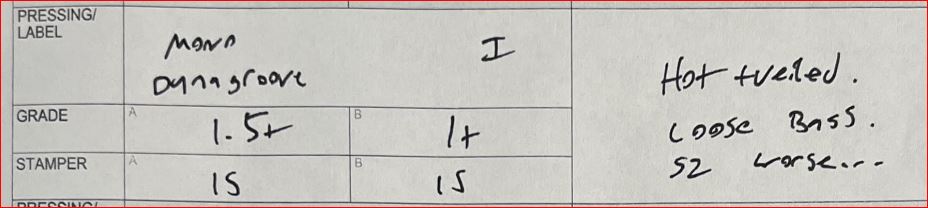
This is an album that we were probably wrong about in 2021 when the following Hot Stamper two-pak pressing went up for sale on the site. (The pressings we liked at the time are long gone by now.) Here is what we wrote back then:

Mulligan and Getz’s 1957 collaboration arrives on the site with this superb 2-pack offering Nearly Triple Plus (A++ to A+++) sound on both sides – just shy of our Shootout Winner

Full, rich, and spacious with tons of Tubey Magic and, better yet, not the least bit dry, hard or transistory

Practically impossible to find in stereo with audiophile playing surfaces – it took two different pressings to get two good sides, and they are very good indeed

The reissues we discovered in 2025 trounced the originals (in both stereo and mono) as well as the early reissues (on the Verve T Label) we played in our shootout, as you can see from the stamper sheet notes below:

Our mistaken judgment is simply the result of ignorance. In 2021 we simply had no idea just how good this recording could sound on vintage vinyl. We hadn’t done our homework properly, and because of that we came up with the wrong answer.

We only discovered the right pressings, with the right stampers, pressed in the right era, and mastered by the right guy, sometime in 2024 or so. We bought a bunch of those and in 2025 did the shootout with all kinds of copies, just to keep everybody honest.

That was the year much better sounding reissue copies that look like the one you see on the left came along. As we noted in the listing:

  • Leave it to Better Records to figure out a complicated title with a long history such as this one – originals, reissues, monos, stereos, we had to play them all to find a copy that sounds as good as this one does.
  • Full, rich, and spacious with an abundance of Tubey Magic and, better yet, not the least bit dry, hard or transistory.

Some quick notes:

Bowtie Label Stereo

  • Veiled and dry
  • Tons of reverb
  • 1.5+ at best (a good, not great Hot Stamper grade)

Our understanding is that Steve Hoffman chose to use the mono tapes as the source material for his DCC Gold CD because he felt there was too much reverb on the stereo tape. We heard too much reverb too.

What tapes our wonderful sounding reissues are made from we have no way of knowing. They do not suffer from too much reverb, that much we can tell you. The best pressings we offer sound great, and quite a bit better than any Gold CD will. However, if money is tight, the Gold CD is not a bad way to go for this music.

T Label Stereo

  • Dry, some squawk
  • 1+, what we would call passable sound

Mono Early Pressings

  • Rich but hot horns
  • 1.5+ at best

Lessons Learned

In this case, the conventional wisdom that the stereo originals would be the best sounding turned out to be incorrect.

Our lengthy commentary about conventional wisdom seeks to make the case that, although the most common record collecting approaches are more often right than wrong, there is simply no way to know what approach — original versus reissue, import versus domestic, mono versus stereo — will work the best for any given title.

(more…)

Born Under a Bad Sign in Mono – Maybe Passable, Maybe Not

Hot Stamper Pressings of Electric Blues Albums Available Now

The Shootout Winning early stereo pressing that we played recently was indeed a very special record. Everything we said about it in our review was true:

These are just a few of the the things we had to say in our notes: “big and tubey and 3D”…”jumping out of the speakers”…”very full vox”…”weighty and rich”…”great energy”…”so much room and detail.”

No other copy came close to this one, and we had a bunch, many of which earned minimal grades of 1.5+ because,  on this record, you really have to know what to look for in the dead wax.

But nothing of the sort can be said of the early Blue Label mono pressing we played. It was barely passable on side one, and we didn’t even bother to play side two since no pressing that earns a grade of 1+ on either side can be considered a Hot Stamper.

Here is what we heard on side one:

  • Hard and dark
  • Vocals get lost
  • Sounds a little faster (sped up)

And that was enough. Who wants to play a record with that kind of sound? Or one that’s been sped up?

If you’re one of those music lovers who’s still holding a torch for mono, Born Under a Bad Sign is not a hill you want to die on.

We personally don’t care one way or the other if any particular mono record has good sound or bad. We just play them and call them as we hear them. We called this one “meh” and recommend you steer clear of it if you are looking for good sound.

(more…)

The Mono Recut of Revolver from 1981 Is a Ripoff

Hot Stamper Pressings of Revolver Available Now

A great sounding record in stereo, potentially anyway, but this later reissue in mono is so awful it deserves a special place in our hall of shame.

My notes for side one: hard, sour, no bass.

Side two: dumbass small mono, so unclear.

Is it the worst version of the album ever made? That’s hard to say. There is no shortage of competition, that’s for sure.

But it may be the worst sounding version of the album we’ve ever played, and that should be good enough for any audiophile contemplating spending money on this kind of rubbish.

We love the mono mix of For No One, but not when it sounds like this.

The only Beatles vinyl we offer on our site are stereo pressings. Our reasons for doing this are straightforward enough.

The Beatles records in mono, contrary to the opinion of audiophiles and music lovers alike, virtually never have the presence, energy and resolution found on the best stereo copies. If your stereo cannot resolve all the information on the tape, sure, Twin Track Stereo (used on the first two albums, hard-panned multi-track afterwards) ends up sounding like some of the instruments are stuck in the speakers, hard left and hard right, with nothing but a hole in the middle.

But there is a great deal of information spreading into the middle when we play those records here, and nothing feels stuck in the speakers that doesn’t sound like it was supposed to be heard coming directly from one of the speakers.

It is our contention that the best audio equipment, properly tweaked, can show you a world of musical information that exists only on the stereo pressings, information that the mono mixes mostly obscure.

(more…)

How Do the Original Mono Pressings of Mingus Dynasty Sound?

Hot Stamper Pressings of the Music of Charles Mingus Available Now

Although this album is fairly common in mono, we found the sound of the mono pressing we played seriously wanting. It’s dramatically smaller and more compressed than even the worst of the other pressings we played in our shootout.

We will never buy another, and of course we would never sell a record that sounds as bad as this mono pressing does.

For those looking for the best sound, the mono pressing is hard to take seriously, and for that reason, we say skip it.

For records reviewed on the blog that sound their worst in mono, click here.

Are You a Jazz Collector or an Audiophile?

If you’re a jazz collector, of course you want the mono. If you’re an audiophile who likes jazz, you should want the stereo.

And if you are a very serious audiophile who has a great deal of time and money tied up in his equipment and room, someone whose motto might best be summarized as “nothing but the best,” then you need one of our killer Hot Stamper pressings of the album.

(more…)