boomy-bass

Obscured By Cloudy Japanese Vinyl

Hot Stamper Pressings of the Music of Pink Floyd Available Now

When I was just getting up to speed in audio and exploring the world of music available on vinyl in the 70s, many of the stereo stores I frequented carried Japanese pressings. They were widely believed to have superior sound relative to their domestic counterparts — in this case, the mass-produced pressings I would see at the Tower Records right across from the Sports Arena in my hometown of San Diego. I went there at least once a week, probably more like two or three times.

Tower was far and away the best place to go record shopping in those days. The store was huge and they had dramatically more stock than Licorice Pizza or The Wherehouse.

They also had a separate section for Half-Speed mastered pressings from a number of labels, which of course was the first place in the store I would visit, digging through the bins to see what new remastered titles may have been produced for audiophiles searching for the ultimate in sound quality.

Of course, I identified as just such a person. In terms of sound quality, and with the extremely limited knowledge I had acquired at the time, I believed I set a high standard for the sound of the records I bought. I was willing — eager even, you could even say excited — to pay whatever premium price I had to for a record that was sure to deliver superior sound quality. To me, in the late 70s, that meant two things: direct to disc recordings, and Half-Speed mastered pressings.

(There was a another category of records that did not fall into the above two, best exemplified by American Grammaphone and the Fresh Aire series, but the less said about those schlocky releases the better, other than to point out that some of their titles are TAS list carryovers from HP’s time running the Super Disc list, specifically Fresh Aire 2 and 3, both best avoided.)

And, like any other open-minded individual, when it came to Japanese vinyl I was willing to give a few a spin.

However, the more of them I bought, the more clear it became to me that even the best of them sounded mediocre (veiled, smeary and dubby from second generation tapes) and more often than not they were just plain awful. (Second generation tape issues being the main problem, of course, with the additional insult of poor tonality, the result of being mastered using wacky equalization, typically with added brightness where none was needed.)

Pink Floyd

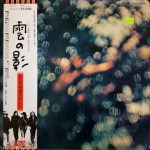
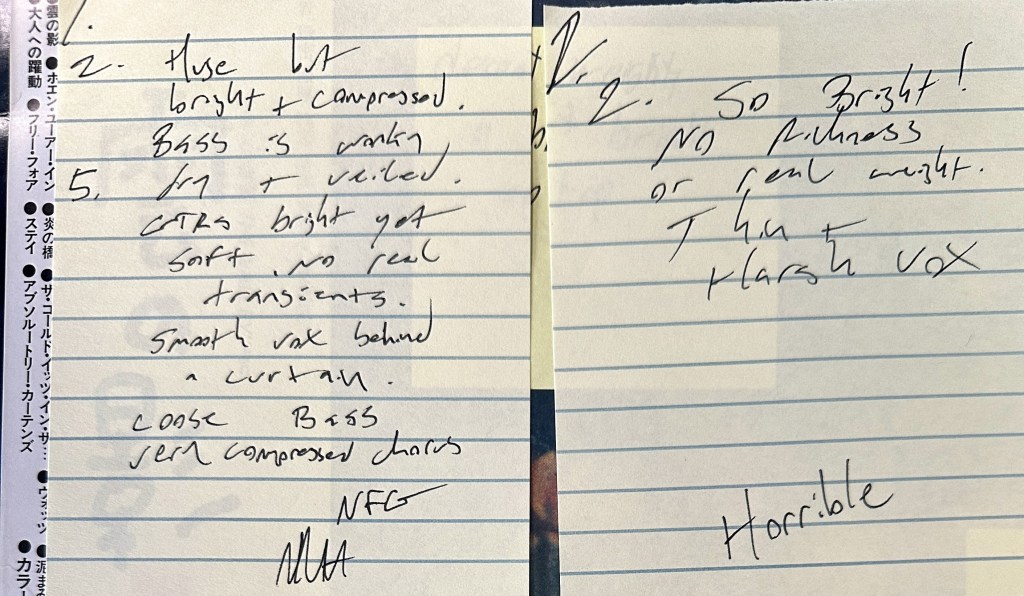
The notes for the Pink Floyd album you see below, Obscured by Clouds, were written sometime in March of 2025 as part of the shootout we conducted for the album.

If we assume it would be an audiophile who would be attracted to this pressing, perhaps for its quieter playing surfaces, perhaps operating under the assumption that the Japanese engineers mastering the record would be more likely to do a better job as well, then what we have here is a textbook case of an audiophile bullshit pressing.

One that sounds nothing like the album is supposed to, based on having played a number of exceptionally good sounding copies, all British and all on the Green Harvest label, mastered from good tapes, sometimes by the legendary Harry T. Moss. We feel we are more than qualified to make these judgments. If we can’t make them, nobody can.
Discogs allows us to glean some information regarding the desirability of this Japanese reissue with the record buying public currently in the market for Pink Floyd vinyl who register on their site.

(more…)

“KEV” Didn’t Have a Clue How to Master Teaser and the Firecat

Hot Stamper Pressings of the Music of Cat Stevens Available Now

In 2025, in preparation for a new shootout, we ordered a copy of Teaser from overseas that supposedly had the right stampers — we know what they are and we are only interested in copies with the right ones — and were sent this “KEV” pressing by accident.

Accident is right — whoever KEV is, he sure has no business mastering records if the one we played is anything to go by.

Discogs has an entry for it, current price around $10. (Apparently the word got out about the sound of this miserable pressing.)

  • This release is the pink ring Island Label. No Sterling etchings. (KEV) in matrix.
  • Side 1 has 9514 hashed out and 9154 etched above
  • Matrix / Runout (A-side runout. etched): ILPS 9154A-1K 1 KEV B
  • Matrix / Runout (B-side runout. etched): ILPS 9154B-1K 1 KEV B

Our notes read:

  • Loud, congested and hot.
  • Big, wonky bass.
  • Opaque and so compressed that it pumps.

And the best line of all:

  • Not too different sounding from the 2021 remaster that’s on Spotify. (!)

I looked up that 2021 release, mastered at Abbey Road Studios, and it appears they remixed it for some reason, as those who work at Abbey Road are wont to do, the result of which seems to be one disaster after another.

(more…)

Capriccio Italien on Classic Records and How Badly I Missed the Boat

More of the Music of Peter Ilyich Tchaikovsky

More of the Music of Nikolai Rimsky-Korsakov

Years ago, around 2005 if memory serves, I played a copy of the Classic Records pressing of LSC 2323 and thought it was pretty good.

I thought it was better than the Shaded Dog copies I had compared it to, which, based on hundreds of other Classic Records titles I had auditioned, was unexpected to say the least.

Little did I know that the Shaded Dog pressings on this title are not remotely competitive with the early reissues.

The best of the Shaded Dog pressings we could find, which just happened to have a 1s side one, came in tied for last with the one 70s Red Seal pressing we thought sounded good enough to make the shootout.

(Some inside baseball: most of the Shaded Dogs and Red Seals were needle-dropped, and all but two were eliminated before the shootout. It takes time and wastes money to clean and play pressings that sound hopeless, so a quick elimination round often precedes the cleaning process.)

Back then it was tough to wrap my head around the idea that a Classic Record classical title could actually be better sounding than a Shaded Dog — it had never happened, so I knew there had to be more to the story.

Finding the time to do the serious investigation of LSC 2323 that would be necessary to get to the bottom of it was not in the cards, so I shelved the project for close to the next twenty years.

The title would have to wait until 2024 to go through a proper shooout, and when it did, naturally the Classic was part of the mix, which is the way we do things here at Better Records. Every record gets the chance to show us what it can do, to be evaluated fairly without the listener having any way to know which pressing is playing.

It turns out that side one of the Classic was passable, but side two — the side I had probably never played — was every bit as bad as most of their other classical offerings.

Side One, Second Movement (Tchaikovsky)

  • Big, but bright and compressed
  • Gets loud but opaque and hot
  • Good weight

Side One, First Movement

  • Bright and blurry bells
  • Sort of tubey but a mess
  • Grade: 1+ (passable, but no Hot Stamper)

Side Two (Rimsky-Korsakov)

  • Big but boomy and smeary
  • Brass is edgy and opaque
  • No top end or space
  • Peaks are hot and congested
  • Grade: NFG

To recap: In 2005 I was impressed with Classic’s pressing of LSC 2323. That was only twenty years ago, yet I could not have been more wrong. I thought my stereo was great — I’d owned top quality equipment since 1975 by then — thirty sodding years — so my audiophile credentials would surely dwarf those of the vast majority of forum posters who write about audiophile pressings today. How reliable should we expect their reviews to be?

(more…)

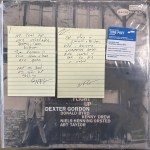
Kevin Gray Returns to the Scene of the Crime for One Flight Up

Hot Stamper Pressings of Blue Note Recordings Available Now
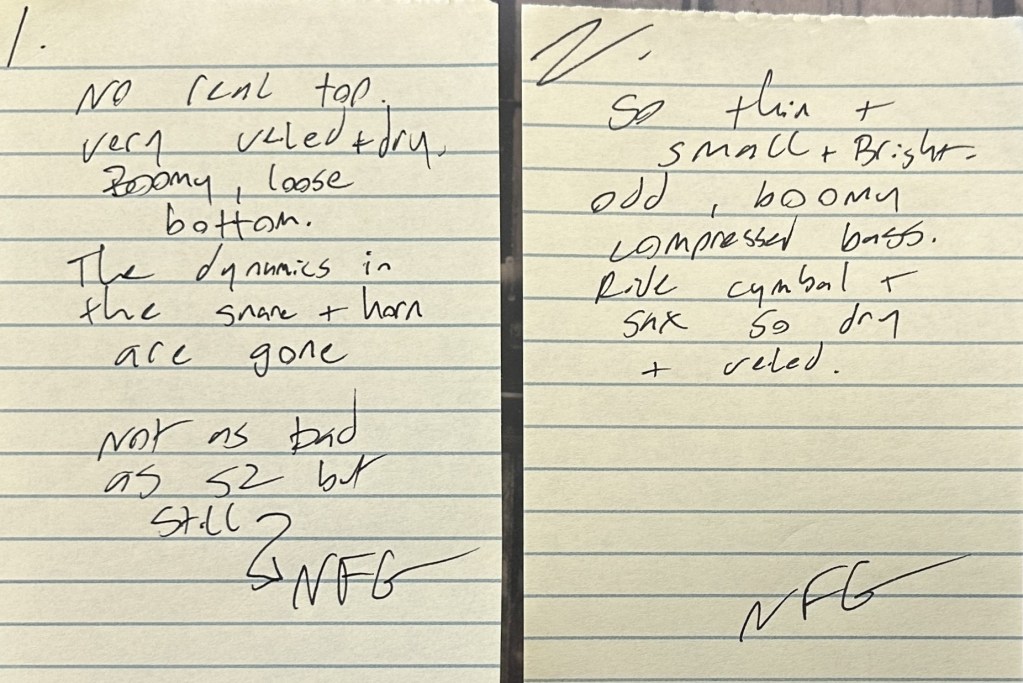
Robert Brook wrote about the Tone Poets remastered pressing of One Flight Up a few year back. We noted at the time:

We have never heard the Tone Poets pressing that Robert played against the Van Gelder cutting he discusses in his commentary.

We have one in stock and are just waiting to do the shootout for the album so that we can compare it to the better pressings we know we will find.

You may have read that we were knocked out by a killer copy way back in 2007. We expect to be no less knocked out in 2023.

Make that 2025. (Clean Blue Note pressings are hard to come by.)

Robert concludes with the strengths and weaknesses of the two pressings. Here is an excerpt:

Overall, the Tone Poet is closed, distant and frankly boring to listen to. Where is the energy of the music? Where is the presence of these musicians? Where is the studio space?

Now that we’ve played the Tone Poets pressing against the best Blue Notes we could find, we know exactly what he means!

Kevin Gray had previously cut the record for Cisco and made a real mess of it, so we are not the least bit surprised that this newer version is every bit as bad sounding as that one.

Why anyone is hiring this hack to make records is a mystery to those of us who play them, and if for some reason it isn’t a mystery to you, it should be.

How inaccurate and unrevealing does a stereo have to be in order to hide the shortcomings of this incompetently mastered record? If you have such a stereo — and there seem to be plenty of them out there in audio land, judging by the fact that Tone Poets is still in business — now is the time to get rid of it, or, at the very least, start making major improvements.

You might want to consider taking some audio advice from us along those lines.

Robert Brook has plenty to say on that subject as well.

Here are the notes we took while playing the Tone Poets pressing after completing our shootout. We had already heard some killer copies, the White Hot shootout winners, so we knew just how good the record could sound.

Side One

(more…)

Jazz Impressions of Black Orpheus Is a Bloated Mess at 45 RPM from Hoffman, Gray and Kassem

Hot Stamper Pressings of Jazz Piano Recordings Available Now

We played an amazing Hot stamper copy that got the bottom end on this album as right as we’ve ever heard. The contribution of the bass player was clear and correctly balanced in the mix, which we soon learned to appreciate was fundamentally important to the rhythmic drive of the music.

The bass was so tight and note-like you could see right into the soundstage and practically picture Monte Budwig plucking and bowing away.

This is precisely where the 45 RPM pressing goes off the rails.

The bloated, much-too-heavy and poorly-defined bass of the Heavy Vinyl remaster makes a mess of the Brazilian and African rhythms inherent in the music. If you own that $50 waste of money, believe me, you will not be tapping your foot to Cast Your Fate to the Wind or Manha de Carnival.

Our rule of thumb: he better the system, the more second-rate Hoffman’s remastered records will sound when they aren’t just terrible.

Is this the worst version of the album ever made? That’s hard to say.

But it is the worst sounding version of the album we’ve ever played, and that should be good enough for any audiophile contemplating spending money on this kind of trash. Take our advice and don’t do it.

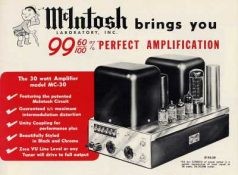
If you like the sound of old McIntosh tube equipment like the Mac 30s shown here, a sound Steve Hoffman apparently cannot get enough of, these remastered records have your name all over them.

We don’t sell junk like this, but every other audiophile record dealer does, because most of the current group of mastering engineers making records for audiophiles have somehow gotten into their heads that this is the way records should sound.

We’ve been telling them they are wrong about that for years now, that good records have never sounded this way, but the collectors and audiophiles of the world keep buying their wares, so why should they listen to us?

If you want to know what a properly-mastered, properly-pressed copy sounds like, we put the last one up in 2023.

(more…)

Chad and Bernie Step on Another Rake

Hot Stamper Pressings of the Music of Art Pepper Available Now

Just in time for Record Store Day — what could be better?

In the interest of streamlining the process of getting reviews like this up on the blog, we’ll try to stick mostly to the facts and let the description of the strengths and weaknesses of the pressings speak for themselves.

One quick note: the sonic qualities you see described below are the ones we heard with the mono switch on our EAR 324P phono stage activated.

Without the switch set to mono, the sound is even thicker and darker.

Yes, as bad as this pressing sounds, you can make it worse if you don’t switch your preamp or phono stage to mono. Hard to believe but it’s true!

The notes for side one can be seen below. For side one we started with the second track.

Side One

Track Two / Red Pepper Blues

  • Boomy low end
  • Sax is stuck [in the speakers]
  • And lacking in breath and space

(more…)