tas-list-bad

The titles listed here have no business being called Super Discs.

If This Is Your Idea of a Reference Record, You Are in Real Trouble

Hot Stamper Pressings of TAS List Super Disc Albums Available Now

An astoundingly bad Sound Show!!

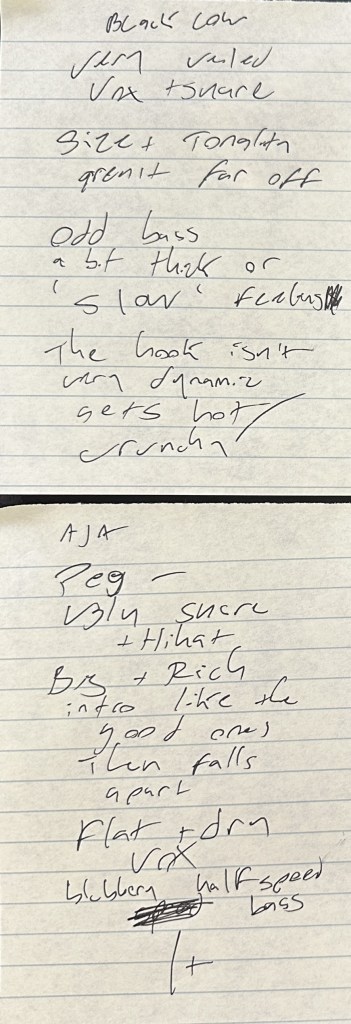
An audiophile hall of shame pressing and a Half-Speed mastered disaster if there ever was one. If this Reference LP isn’t the perfect example of a pass/not-yet record, I can’t imagine what would be. It is just awful.

Mastered by none other than Stan Ricker. RR-7 also appears to still be on Harry Pearson’s TAS List.

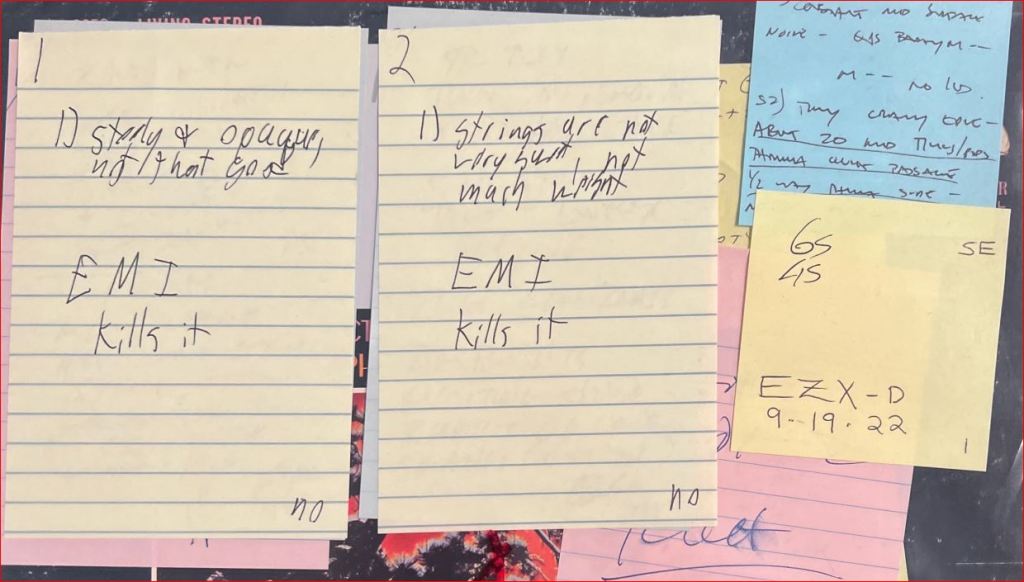
My recent notes can be seen below. (The 1 in the upper left hand corner is my abbreviation for side one, which seems to be the worst side of the two here.)

Track two, the Red Norvo selection, is a real mess, highlighting the problems typically caused by Half Speed Mastering, especially at the hands of one of the most notorious “Audiophile” Mastering Engineers of All Time, the late Stan Ricker. Who cut as many bad sounding records as SR/2 himself? No one I can think of comes close.

His records, with few exceptions, suffer from bad bass (probably bloated and poorly defined in this case, my notes don’t say but after playing these records for thirty years I doubt I’m very off with this guess) and phony, boosted highs, which cause the striking of the mallets to be emphasized in an especially unnatural and unpleasant way.

Arthur Lyman had dramatically better sound in the 50s.

How come none of the audiophiles at Reference Records bothered to figure out how he did it?

Can anybody take sound like this seriously?

(more…)

The Classic Records Pressing of Finlandia Is Dreadful

More of the music of Jean Sibelius (1865-1957)

More of the music of Edvard Grieg (1843-1907)

Sonic Grade: F

Classic Records ruined this album. Their version is dramatically more smeared and low-rez than our good vintage pressings, with almost none of the sweetness, richness and ambience that the best RCA pressings have in such abundance.

[This turns out not to be true, as we discovered to our chagrin in 2014.]

In fact their pressing is just plain awful, like most of the classical recordings they remastered, and should be avoided at anything other than a nominal price.

Our current favorite pressing is this one on a budget Decca reissue. Go figure.

(more…)

Speakers Corner Mucks Up a Classic Mercury, Part Two

More of the Music of Sergei Rachmaninoff (1873-1943)

For some background, in 2005 we were still selling Heavy Vinyl. We were fans of DCC and Cisco and carried many of the Speakers Corner remasters.

But things were starting to look grim. With every improvement to our playback system, these modern reissues seem to be falling further and further behind.

In the late-’90s, Classic had released some Mercury titles which we’d auditioned and disliked immensely. In 2005 it was Speakers Corner’s turn to have at the Mercury catalog, and they went a different way, finding a “new sound” for the legendary recordings, completely unlike any vintage pressing we’d ever heard.

This was very upsetting. I felt the need to say something.

By 2007 it was clear that Heavy Vinyl was a lost cause and had no business being sold by any audiophile record dealer who cared about sound quality, most especially me. And that was the end of it. This Mercury was one of the records that helped me see the error of my ways.


Part 1 of this discussion of Speakers Corner’s Mercury Series can be found here.

A blog entry on the site from 2005 about the new Mercury reissue series that was coming out noted that:

I am expecting the new Rach 3rd (90283) later this week, and will report my findings as soon as I have a had a chance to evaluate it.

[A few weeks later I followed up with this:]

The news on 90283 is here. It came today. Are you ready? In one sentence:

The most opaque, dull and lifeless 180 gram reissue in the history of the world.

My blog entry from 2005 continues below, transcribed practically word for word.

I hope it’s becoming clear to people now that this series is an enormous fraud perpetrated against all right thinking (right listening?) audiophiles. I can’t imagine a worse sounding record. It makes the most opaque ’70s Phillips or London LP sound positively transparent next to this thick piece of crap. I pulled out my late label copy, far from the best sounding pressing I’ve ever heard, and it killed the new version. The trumpets sound like they’re playing from under a pile of blankets on this 180 gram LP. The sound is so bad it defies understanding.

And the sad thing, in some ways the saddest aspect of this very sad affair, is that I can safely predict right now, with absolutely no fear of being proved wrong, that every major record dealer will rave about it. Mark my words. Every one. Except me of course. But I’m not one of the majors. Thank god I don’t have to sell crap like this to make a living.

And every audiophile who reads a rave review in a dealer’s catalog or on a website should take it for precisely what it is: a naked grab for his money, nothing more, nothing less. It’s all about the money. It’s not about the sound. It’s not about the music. It’s just about money.

Any record dealer who would stoop low enough to take money for a record this bad is telling you something very important about his business: he either can’t tell a good record from a bad one, or he doesn’t care. Either one would make me take my business elsewhere. How do these guys stay in business? (Maybe the fact that most of their catalogs are now given over to equipment explains it.)

And you should be outraged at this kind of fraud. If you give money to retailers who so obviously have nothing but contempt for you, you share in the blame. You’re keeping these guys in business. It makes me think of the scene in Network where Howard the veteran newscaster talks directly to his audience:

So, I want you to get up now. I want all of you to get up out of your chairs. I want you to get up right now and go to the window. Open it, and stick your head out, and yell: ‘I’m as mad as hell, and I’m not gonna take this anymore!’

I want you to get up right now. Sit up. Go to your windows. Open them and stick your head out and yell – ‘I’m as mad as hell and I’m not gonna take this anymore!’ Things have got to change. But first, you’ve gotta get mad!…You’ve got to say, ‘I’m as mad as hell, and I’m not gonna take this anymore!’

After playing this new Mercury, I was filled with questions.

What is to become of the record business?

Do we really need records that sound worse than the worse sounding CDs, at twice the price?

(more…)

The Graceland Remastering Disaster, Part 2

Hot Stamper Pressings of the Music of Paul Simon Available Now

Click on the link below to read the story behind an interview conducted by a well-known reviewer of an engineer who was tasked (by whom I wonder?) with remastering Graceland on Heavy Vinyl.

He apparently had never played an original Sterling-mastered copy of Graceland. Either that, or this  engineer thought the original “needed improvement,” the kind supplied by taking a hatchet to the sound of the original tape.

Analogplanet Visits Sterling Sound and Interviews Mastering Engineer Ryan K. Smith

The interviewer apparently does not know how bad the new version sounds, but we had no trouble recognizing its awfulness here at Better Records. As a public service, we soon set about describing what we heard when we put this remastered piece of junk to the test.

Up against a properly-mastered, properly-pressed early pressing, it earned a failing grade.

Is it the worst version of the album ever pressed on vinyl? Hard to imagine it would have much competition. 

The title of our review gives away the game:

The reviewer who interviewed the remastering engineer responsible for this and no doubt many other awful sounding records has never been able to tell a good record from a bad one, and he carries on that tradition with Graceland.

Ryan Smith, the hack who cut this album, has done quite a lot of work for Analogue Productions. We can’t say we’ve played many of his recuts, but the ones we have played are hopelessly bad, with the overly smooth sound so much in vogue today.

We played his recut of Scheherazade, and rather than just give it the failing grade it deserved, we explained how any audiophile could go about using its mistaken EQ in order to recognize what is wrong with it, and of course, others like it.

(Contrary to popular opinion, it is no better than Bernie Grundman’s bad sounding version from the 90s, the one he cut for Classic Records.)

One of my good customers read this rave review from this same reviewer for the Texas Hurricane Box Set and made the worst mistake any audiophile can make: he believed it.

“His overdriven Stratocaster sound is one that guitar aficionados never tire of hearing live or on record, especially when it’s well recorded. … Yet again, Chad Kassem sets high the box set reissue bar delivering a “must have” package for SRV fans, every bit the equal of the one Doors fans have come to cherish. …every one of these records betters the originals and by a considerable margin. It is not even close…You’ve never heard these albums sound like this. That is a 100 % guaranty. …this is an impeccably produced box set physically and especially sonically. It’s the best these albums have ever and probably will ever sound.” — Music = 9/11; Sound = 10/11 — Michael Fremer

Sure, he’s out $400, but on the bright side he’s now learned a lesson he is very unlikely to forget.

(more…)

The Hunter – A Cisco Disaster

More of the Music of Jennifer Warnes

More Reviews and Commentaries for Audiophile BS LPs

Sonic Grade: F

An Audiophile Hall of Shame pressing from Cisco/Impex/Boxstar.

Some of the worst sound I have ever heard in my life. An absolute disgrace, both sonically and musically. 

If you like your Heavily-Processed Big Production Pop [1] to sound as unnatural as possible, this is the album for you.

Not one instrument sounds remotely like it should, and that is surely an insult to audiophiles of every stripe.

The problem was that so many self-identified audiophiles did not seem bothered by the execrable sound, certainly not the way we were.

Oh, but it’s on vinyl! That solves all the problems with the recording, doesn’t it?

Yes, the CD was bad, but the vinyl was no better. I had them both and couldn’t tolerate the sound of either of them.


[1] Note that some of our favorite records are on this list. Yes, they are heavily-processed, “unnatural” recordings, but the engineers, producers and artists who worked on these albums were attempting to create a unique sound for the music they were making, not recreate one, and in many cases the results of their efforts are some of the most powerful and enjoyable albums we’ve ever played.


The only album we like by Ms Warnes is Famous Blue Raincoat

It is her Masterpiece, a Core Collection record, and a clear case of One and Done.

When you have a good copy of Famous Blue Raincoat, you have all the Jennifer Warnes you will ever need.

(more…)

Boy, Was We Ever Wrong About Solti’s Rite of Spring

Hot Stamper Pressings of the Music of Igor Stravinsky Available Now

This is a VERY old and somewhat embarrassing commentary providing the evidence for just how wrong we were about the sound of Solti’s 1974 recording for Decca.


Here is what we had to say about the album in 2008:

This is an amazing recording, DEMO QUALITY SOUND, far better than the Decca heavy vinyl reissue that came out in the 2000s. [That part is no doubt true.]

This record is extremely dynamic; full of ambience; tonally correct; with tons of deep bass. Because it’s a more modern recording, it doesn’t have the Tubey Magic of some Golden Age originals, but it compensates for that shortcoming by being less distorted and “clean.” Some people may consider that more accurate. To be honest with you, I don’t know if that is in fact the case.

However, this record should not disappoint sonically and the performance is every bit as exciting and powerful as any you will find. The Chicago Symphony has the orchestral chops to make a work of this complexity sound effortless.


Skip forward to the present, roughly ten years later. We had three or four copies on hand to audition when we surveyed the work a couple of years ago in preparation for a big shootout.

The Solti did not make the cut. It was not even in the ballpark.

(more…)

If You Own This Classic Records Pressing, I’ll Bet It’s Pristine

Hot Stamper Pressings of Classical Masterpieces Available Now

If I were in charge of the TAS Super Disc list, I would not have put this record on it.

Here are some others that we do not think qualify as Super Discs.

When Classic Records was blowing out its unsold inventory through the Tower Records Classical Annex in Hollywood many years ago — apparently they had run into some financial trouble — this was a title you could pick up for under ten bucks. I remember it being $7, but my memory may not be correct on that point. Whatever the price, it was cheap.

And even at that price it seemed nobody really wanted it.  Which is as it should be. Heavy Vinyl or no Heavy Vinyl, a bad record is a bad record and not worth the bother of sitting down and listening to it.

If you own this record, my guess is it is pristine.

If you played it at all, you played it once and put it away on a shelf where it probably sits to this very day. Good records get played and bad records don’t. If you have lots of pristine records on your shelves, ask yourself this question: Why don’t I want to play them?

You may not like the implications of the answer: They aren’t very good.

And that means you should never have bought them in the first place. But we all make mistakes.

Owning up to them may be hard, but it is the only way to make any real progress in this hobby.

The One Out of Ten Rule

If you have too many classical records taking up space and need to winnow them down to a more manageable size, pick a composer and play half a dozen of his works. You may be surprised at how lackluster the sound is on the majority of them.

Most classical records display an irredeemable mediocrity right from the start.

(more…)

Rhapsodies – Classic Records Reviewed

More of the music of Franz Liszt (1811-1880)

The lower strings are wonderful on the original — wall to wall, with that rosiny texture we love. I wrote at the time — this is twenty or so years ago — that the Classic pressing took that rich, dark sound and brightened it up, ruining it in the process.

Cellos and double basses just don’t sound like that. On the best pressings of LSC 2471, their timbre is Right On The Money. Of course, that’s the real thing, not some audiophile rebutchering. 

Now if you’re a Classic Records fan, and you like that brighter, more detailed, more aggressive sound, the original is probably not the record for you.

We don’t like that sound and we don’t like most Classic Records. They may be clean and clear but where is the RCA Living Stereo Magic that made people swoon over these recordings in the first place?

Bernie manages to clean that sound right off the record, and that’s just not our idea of hi-fidelity.

(more…)

Gaite Parisienne Is Just More Smeary Dreck from Classic Records

More of the Music of Jacques Offenbach (1819-1880)

Sonic Grade: F

The last time I played the Classic I thought it was nothing but a smeary mess, as awful as their awful Scheherazade. If I were to play it today, I’m guessing it would join the other Classic Records entries in our audiophile hall of shame.

Here are some other records we played and found had smeary strings. They did not last long on our turntable.

I love Arthur Fiedler‘s performance with the Boston Pops and the 1954 two track RCA Living Stereo sound, but finding an original Shaded Dog pressing in clean condition under $500 with the right stampers is all but impossible nowadays.

If you want to go that way, more power to you. 

This 1954 2-track recording is RCA’s first stereo recording of the work. 1954. Can you believe it? A few mics and two channels and it blows away most of the classical recordings ever done! Some old record collectors and tube lovers say classical recording quality ain’t what it used to be. This record proves it.

Click on this link to read more reviews and commentaries for Gaite Parisienne.

(more…)

Scheherazade Is a Classic Records Disaster

Hot Stamper Pressings of the Music of Rimsky-Korsakov Available Now

An audiophile record hall of shame pressing and a Heavy Vinyl disaster poorly mastered for the benefit of audiophiles looking for easy answers and quick fixes.

In 2009 or 2010, during our testing of the TT Weights turntable products, the record I played again and again — close to a hundred times over the course of two days — was a wonderful White Dog pressing of LSC 2446. The sound was glorious, some of the finest reproduction of a large orchestral work I have ever heard.  

(Late in life, Harry Pearson disgraced himself by putting this Classic Record on his TAS list of Super Discs.)

A week later I was still testing the system, and again using Scheherazade. A friend brought over his Classic pressing, probably the same one I would have sold him in the mid-90s. Now we could compare the two.

It was a massacre. The sound on the reissue is simply AWFUL.

There is no transient information anywhere on that Heavy Vinyl pressing whatsoever.

No instruments have any texture — not the strings, not the woodwinds, nothing.

There is no air going through the flutes.

There is no rosin on the bow of the solo violin.

The tympani are a blurry mess.

Triangle: okay.

Bass drum: okay.

Everything else: FAIL.

Not having played it in years, I could not believe how much worse the record sounded than I remember. The gulf between the real thing and the Classic wannabe was now so huge that the reissue was nothing less than positively UNPLEASANT to listen to.

Enjoyment? Out of the question.

TAS List? The original is, but the Classic is too. Now how messed up is that?

Disgraceful, that’s all I have to say about it.

If I were in charge of the TAS Super Disc list, obviously I would not have put this record on it.

Here are some others that we do not think qualify as Super Discs.

Here are some Hot Stamper pressings of TAS List titles that actually have audiophile sound quality, guaranteed.

And if for some reason you disagree with us about how good they sound, we will be happy to give you your money back.

Our favorite performance of Scheherazade is Ansermet’s with the Suisse Romande from 1961.

(more…)