1974-all

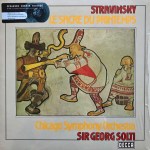
Boy, Was We Ever Wrong About Solti’s Rite of Spring

Hot Stamper Pressings of the Music of Igor Stravinsky Available Now

UPDATE 2026

This is an old and somewhat embarrassing commentary providing the evidence for just how wrong we were about the sound of Solti’s 1974 recording for Decca.


Here is what we had to say about the album in 2008:

This is an amazing recording, DEMO QUALITY SOUND, far better than the Decca heavy vinyl reissue that came out in the 2000s. [That part is no doubt true.]

This record is extremely dynamic; full of ambience; tonally correct; with tons of deep bass. Because it’s a more modern recording, it doesn’t have the Tubey Magic of some Golden Age originals, but it compensates for that shortcoming by being less distorted and “clean.” Some people may consider that more accurate. To be honest with you, I don’t know if that is in fact the case.

However, this record should not disappoint sonically and the performance is every bit as exciting and powerful as any you will find. The Chicago Symphony has the orchestral chops to make a work of this complexity sound effortless.


Skip forward to the present, roughly ten years later. We had three or four copies on hand to audition when we surveyed the work a couple of years ago in preparation for a big shootout.

The Solti did not make the cut. It was not even in the ballpark.

(more…)

Holst and Previn – A Planets for the Ages

Hot Stamper Pressings of the Music of Holst Available Now

Fortunately for audiophiles who love The Planets but are disappointed by most performances, a group that includes us to be sure, the amazing sound found on this copy is coupled with a superb performance.

As you might imagine, on a big system this would make for a powerful listening experience, which is exactly the experience we ourselves had during our recent shootout. This copy actually deserves its place on the TAS List.

The brass is so BIG and POWERFUL on EMI’s recording that other orchestras and recordings frankly pale in comparison. Until I heard one of our top EMI pressings show me brass with this kind of weight and energy, I simply had no idea it was even possible to play the work this powerfully. The lower brass comes in, builds, gaining volume and weight, then calms down, but soon returns and builds relentlessly, ever and ever louder. Eventually the trumpets break out, blasting their way forward and above the melee the heavier brass has created below.

Quite honestly I have never heard anything like it, and I heard this work in concert in late 2012! In live performance, the members of the brass section, being at the back of the stage, were at least 100 feet away from me, perhaps more. When playing the best EMI pressings, the brass were right there in front of me, eight to ten feet away. In a way this is of course unnatural, but that fact takes nothing away from the subjective power of the experience.

Only the conductor can stand at the podium, but the EMI producers and engineers (the two Christophers in this case) have managed to put the listener, at least in this movement, right there with him.

(more…)

These Two Return to Forever Albums Didn’t Make the Grade

Hot Stamper Pressings of Jazz Rock Fusion Albums Available Now

Pictured are two Return to Forever albums we auditioned at some point — who knows when? — and found wanting (especially at the prices we charge).

Without going into specifics — our notes are long gone at this point — we’ll just say these two albums suffer from weak music, weak sound, or both, and therefore do not deserve a place in most audiophile collections — unless that audiophile happens to be a huge fan of the band.

My guess is that if these two records are sitting in your collection, they have not been played in many years, if ever. If you own either of these two albums, pull them out and play them. You may find that making more room on your shelves for records you actually enjoy is easier than you thought.

Our Pledge of Service to You, the Discriminating Audiophile 

We play mediocre-to-bad sounding pressings so that you don’t have to, a free service from your record-loving friends at Better Records.

Having the wherewithal to audition so many records puts us in a unique position to help audiophiles looking for higher quality sound. (Or, more accurately, that small subset of audiophiles looking for the highest quality pressings who also have a great deal of disposable income to devote to them.)

Yes, we have the obvious resources that would be needed, the staff and the budget.

More important than either of those, we came up with a new (sort of) and much more successful (definitely) approach.

We’ve learned through years of experimentation that there is no reliable way to predict which pressings will have the best sound for any given album.

The impossibility of predicting the sound of pressings is something that we’ve learned to accept as axiomatic. As a scientifically-oriented person and a born skeptic, this was a concept I was quick to embrace.

The more time I spend in this hobby, the more I realize it is beyond dispute. Like it or not — and, based on what I read on forums and such, there are apparently a goodly number of audiophiles who don’t like it — it is the undeniable reality underlying the nature of vinyl pressings.

Our Seven Step Program

With that in mind, finding better sounding pressings of any given recording can be achieved by following these seven steps:

(more…)

The Planets – Testing with Mars and Saturn

More of the music of Gustav Holst (1874-1934)

Mars on the first side and Saturn on the second present serious challenges to any recordings of the work you may own, especially if you own the overrated Mehta recording on the TAS List.

Generally speaking, the White Hot copies stand apart from the pack with more top end extension, and/or more lower end weight. Our notes will typically say “extended highs and lows,” and those are hard to come by, on any record.

Let’s get to the specifics of the two movements we feel are the best test for The Planets as a whole.

The War Test — Side One

War, the first movement, has the string players “bouncing” their bows upside down to create the effect you hear. It’s not fingers plucking the strings; it’s the wood of the bows bouncing on the strings. The quality of that technique is so obvious and correct sounding on the good copies and so blurry and indistinct on the bad ones that you could almost judge the whole first side by that sound alone. When it’s right it’s really right. 

And of course the players are spread out wider and the soundfield is so much more transparent when these types of sonic qualities are brought out. This bouncing bow test makes it easy to separate the better copies from the also-rans when it comes to smear, resolution, transparency and the like.

The Saturn Test — Side Two

(more…)

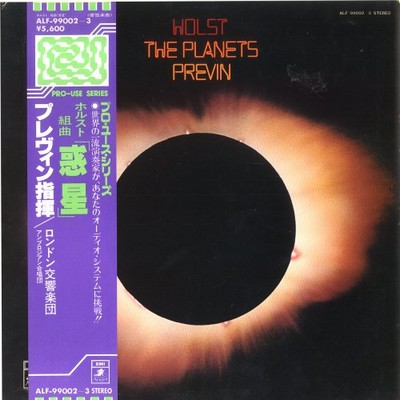
The Planets on Pro-Use Japanese Vinyl at 45 RPM Is Just Awful

More of the music of Gustav Holst (1874-1934)

This EMI 45 RPM Japanese Import 2 LP set is considered one of the great Planets by many audiophiles, but it’s not, based on our playing of a copy we had years ago, which means it belongs in our audiophile hall of shame.

The best copies on British or Dutch EMI vinyl are clearly better than this “audiophile” pressing.

What could be less surprising?

This is precisely why we dislike Japanese pressings as a rule — they sound like this audiophile trash.

Our favorite performance of The Planets can be found here.

The Big Picture from a Lifelong Audiophile

You may have seen the following text in another listing, but it bears repeating.

There is nothing new under the sun, and that is especially true when it comes to bad sounding audiophile records. The world is full of them.

There has been one big change from the days when I self-identified as a freshly minted audiophile in the 70s.

Yes, the records being marketed to audiophiles these days may have second- and third-rate sound, but at least now they have good music. That’s progress, right?

The title reviewed above is a good example of the kind of crap we newbie audiophiles used to put up with back in the old days, long before we had anything resembling a clue.

This one clearly belongs on our list of bad audiophile records.

You might be asking: What kind of audio fool was I? to buy a dumbass record like this.

It’s a fair question. Yes, I admit I was foolish enough to buy records like this and expect it to have good music, or at least good sound. Of course it had neither. Practically none of these kinds of records ever did. Sheffield and a few others made some good ones, but most Direct to Disc recordings were crap.

As clueless as I was, even back in the day I could tell that I had just thrown my money away on this lipsticked-pig in a poke.

But I was an audiophile, and like a certain Mr. Mulder, I wanted to believe. These special super-hi-fidelity records were being made for me, for special people like me, because I had expensive equipment and regular records are never going to be good enough to play on my special equipment, right?

To say I was wrong to think about audio that way is obviously an understatement. Over the course of the last forty years, I (and to be fair, my friends and my staff) have been wrong about a lots of things in the worlds of records and audio.

You can read more about many of the things we got wrong under the heading: live and learn.

The good news? Audio progress is real and anyone who goes about doing audio the right way can achieve the equivalent of miracles.

(more…)

Peter Frampton – Somethin’s Happening (and It’s Not Very Good)

This is Frampton’s third album, released in 1974.

A year later he would put out the wonderful Frampton album, tour it, and record the tour, which became Frampton Comes Alive.

Finally the world would have the opportunity to hear what a talented songwriter, singer, guitarist and all around performer the man had always been, starting with Humble Pie and reaching his zenith with his first solo album, Wind of Change, his Magnum Opus and a Desert Island Disc for your truly.

All the songs from this album that he played live are dramatically better in live performance than they are in the studio on this album.

Frampton produced Somethin’s Happening and unfortunately for all concerned the production is piss-poor, as is the sound.

I’ve never heard this record sound better than passable, whether on domestic or British vinyl. I gave up finding something better decades ago. The album is just not worth it.

As far as Peter Frampton’s body of work through the 70s is concerned, it is clearly his worst sounding album. 

The records he released in the 80s are even worse — no surprise there — and the music is every bit as bad.

Stravinsky / Le Sacre du Printemps – Speakers Corner Reviewed

More of the music of Igor Stravinsky

We used to think this was one of the better Speakers Corner Deccas.

Having recently played the London pressing of the same performance (CS 6885), cut by Decca of course, we think we are almost certainly wrong about the quality of the sound, but who knows? Maybe Speakers Corner remastered the record properly and fixed its shortcomings.

Hah, just joking. In our experience that has never happened and we think it is very unlikely that it ever will.

Years ago we wrote the following:

Wow! What a performance! What dynamic full bodied sound! To be fair, I pulled out my original London, one of those awful mid-’70s English pressings that are never quiet, and yes, some of the ambience on the original is missing here on the new version, but everything else seems right: dynamics, tonality, the frequency extremes (including some pretty awesome deep bass).

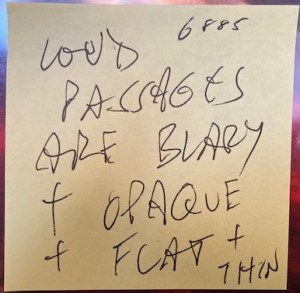
Some of the above could be right, the parts about the tonality and such. Speakers Corner could have added some bass and lower midrange to make the sound less thin, and taken out some of the upper midrange to make the loud passages less blary, but it certainly doesn’t solve the most serious issues we had with the recording, which is the fact that it is opaque and flat, two qualities that are the death of orchestral music on vinyl.

Here are the notes we made for the London.

The two paragraphs you see reproduced below are also full of bad advice we had given out in the past:

1. Can’t be sure we would still feel that way but I’m guessing this is a good record if you can pick one up at a cheap price. 

2. If you have a quiet original, great, consider yourself lucky. As few of you have any copy at all, I recommend this one. The alternative is to miss Solti’s energetic performance and the precision of the Chicago Symphony, one of the few orchestras capable of making sense out of this complex and infuriating work. (At least it used to infuriate audiences. Now our modern ears can take a difficult work like this and appreciate the complex rhythms and atonality as the expression of a truly original mind.

This paragraph we would still agree with wholeheartedly:

This is not music to play while you are having dinner. This is music to engage the mind fully. It belongs in any collection. Yours in fact. Unless you have small speakers, in which case you would be wasting your money, as small speakers cannot begin to reproduce the power of this work in the hands of Solti and the CSO [or anybody else for that matter].

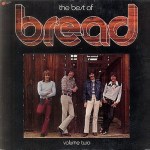
Bread / The Best of Bread Vol. 2 – Reviewed in 2010

Hot Stamper Pressings of Radio Friendly Albums Available Now

This very nice looking Elektra Butterfly Label LP has the best sound I’ve ever heard for this compilation. Keep in mind that this is an album of mostly weak material, not in the class with the first ’Best of Bread’ by a long shot.

However, some of these songs sound quite good here, easily better than the typical Bread album from which they are taken. Listen to ‘Been Too Long On The Road’ or ‘He’s A Good Lad’ to hear the best sounding Bread.

This is an Older Review.

Most of the older reviews you see are for records that did not go through the shootout process, the revolutionary approach to finding better sounding pressings we developed in the early 2000s and have since turned into a fine art.

We found the records you see in these older listings by cleaning and playing a pressing or two of the album, which we then described and priced based on how good the sound and surfaces were. (For out Hot Stamper listings, the Sonic Grades and Vinyl Playgrades are listed separately.)

(more…)