vin-Dec-w

We judged these vintage Decca and London records to have unacceptable sound based solely on the specific pressings we played.

We can’t say that other pressings don’t sound better. We just don’t plan on playing any more copies to find out.

London Orchestral Records from the 70s and the Problem of Opacity

Decca and London Hot Stamper Pressings Available Now

The average copy of this 1976 recording has that dry, multi-miked modern sound that the 70s ushered in for many of the major labels, notably London and RCA.

How many Solti records are not ridiculously thick and opaque? One out of ten? If that. We’re extremely wary of records produced in the 70s; we’ve been burned too many times.

And to tell you the truth, we are not all that thrilled with most of what passes for good sound on Mehta‘s London output either, especially those recorded in Royce Hall. If you have a high-resolution system, these recordings, like those on Classic Records Heavy Vinyl that we constantly criticize, leave a lot to be desired.

Opacity is a real dealbreaker for us. Most of the classical records we play from later eras simply do not have the transparency essential to transporting us from our listening room into the concert hall.

One thing you can say about live classical music, it is never opaque. (It can be dry though. Some concert halls have that sound.)

No recording in our experience — our experience having been informed by playing thousands upon thousand of them — can ever be remotely as transparent as live music.

If you have any doubts, next time you come home from the concert hall, take a moment to put on a favorite recording of the same music. You may be in for quite a shock.

Other Deccas and Londons that we’d cleaned and played and found to be disappointing can be seen here.

For more on the subject of opacity on record, click here.

Here are some of the other records we’ve discovered that are good for testing string tone and texture.

(more…)

This Tony Hawkins-Mastered Pressing Sure Was a Letdown

Hot Stamper Pressings of Orchestral Spectaculars Available Now

This London original pressing with 1K/1K stampers (the work of Tony Hawkins) was so bright, dry, and shrill I could hardly stand it for more than the minute it took me to realize it was not going to get any better. The sound is bad enough to send it right into our hall of shame.

There are a number of other Deccas and Londons that we’ve played over the years that were disappointing, and they can be found here.

The copy we had back in 2010 was a very good sounding record, or so we thought.

Maybe we were wrong! It’s not as though we don’t admit to the possibility. You can read all about it below.

(more…)

Mehta’s Petrushka Is Just Not Very Good

Hot Stamper Pressings of Orchestral Imports on Decca & London

We’re big fans of Decca/London Records in general, but in this case the sound and the performances of this album are simply not good enough. 

We had three original UK pressed copies of CS 6554 and none of them sounded right to us.

What’s worse, Mehta and the Los Angeles Phil. play the work poorly. How this album got released I have no idea. Maybe it was a case of a contract is a contract. Or maybe others like it and we are simply wrong about the sound and the performance. Who can say?

This London might be passable on an old school system, but it was too unpleasant to be played on the high quality modern equipment we (and we hope our customers) use.

There are quite a number of others that we’ve run into over the years with similar shortcomings. Here they are, broken down by label.

(more…)

The “Not-So-Golden-Age” of RCA, Mercury, London and Others

Hot Stamper Pressings of Living Stereo Titles Available Now

We ran into a number of copies of this title that had what we like to call “old record sound,” which is surprisingly common on even the most revered Golden Age labels, RCA included.

No top, no real bottom, congested climaxes and a general shrillness to the sound — we’ve played Living Stereos by the dozens that have these shortcomings and many more.

Some audiophiles may be impressed by the average Shaded Dog pressing, but I can assure you that we here at Better Records are decidedly not of that persuasion.

Something in the range of five to ten per cent of the major label Golden Age recordings we play will eventually make it to the site. The vast majority just don’t sound all that good to us. (Many have second- and third-rate performances and those get tossed without ever making it to a shootout.)

The One Out of Ten Rule

If you have too many classical records taking up too much space and need to winnow them down to a more manageable size, pick a composer and play half a dozen of his works.

Most classical records display an irredeemable mediocrity right from the start. It does not take a pair of golden ears to hear it.

If you’re after the best sound, it’s the rare record that will have it, which makes clearing shelf space a lot easier than you might imagine. If you keep more than one out of ten, you’re probably setting the bar too low, if our experience is any guide.

(more…)

Beethoven Symphony No. 7 – This London with Solti Didn’t Make the Grade

Hot Stamper Classical and Orchestral Imports on Decca & London

In our survey for the work, we played a number of the better known recordings from the top conductors and orchestras around the world.

Here is what we heard when we dropped the needle on an early pressing of CS 6093, released in 1959.

Our notes read:

  • Awful,
  • so dry,
  • steely,
  • crude,
  • bad

In other words, it just sounded like an old record. The world is full of records that don’t sound very good. As a matter of fact they undoubtedly make up the bulk of large record collections.

And if you just happen to be the proud owner of a big record collection, how can you possibly find the time to play more than a small fraction of it in any given year. Or even over the course of a decade for that matter.
The fact is that you can’t. Which, on the upside, means that, as far as you know, all your records sound great!

No need to buy another copy of whatever title you care to name. What for? You haven’t played it in twenty years and probably won’t get around to pulling it off the shelf for a spin for at least another twenty.

Here’s hoping your kids like old records because they are going to end up with an awful lot of them.

Back to the Beethoven 7th. What a beautiful cover!

But what good is a beautiful cover when the record sounds as bad as this one does?

(more…)

Why are the First Pressings of this Title the Worst Sounding?

Hot Stamper Pressings of Recordings by Decca Available Now
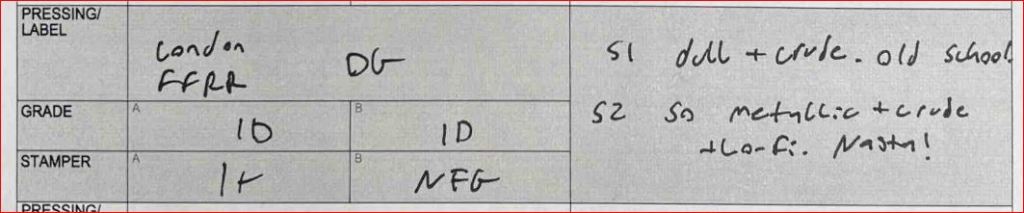
The record you see pictured is not the record we are discussing in this posting. The stamper numbers you see below belong to a different album.

We’ve lately been giving out much more stamper information than we used to, but for now we are keeping this title close to the vest.

We happen to know the best stampers for this album, but somehow a copy with the “bad” stampers ended up in our shootout. It did about as badly as they usually do.

Of course, the person sitting in the listening chair had no idea that a copy with the worst stampers was playing. The jackets and labels of this pressing are identical to the copies with the good stampers.

He simply heard what the recording actually sounds like when it’s mastered badly and registered his complaints.

Side One

  • Dull and crude. Old school.
  • 1+

Side Two

  • So metallic and crude and lo-fi. Nasty!
  • NFG

Apparently Mr. D, real name: Jack Law, did a piss-poor job mastering this album. Another engineer would come along sooner or later and master the record right, so right that it became one of our favorite Demo Discs for sound and performance.

How did this pig’s ear eventually manage to become a silk purse?

Simple. It was always a great recording, it just needed to be mastered right, and whoever got the job to remaster it knocked it out of the park the first time through.

(more…)

Maazel’s Pines of Rome Is Another Title Not Fit for a Super Disc List

Hot Stamper Pressings of The Pines of Rome Available Now

Sonic Grade: C (at best)

I found a bit of commentary in a listing for Scheherazade, and right away it was clear to me that the shootout we did for that title showed us a recording that had much in common with the one we had done more recently for The Pines of Rome.

Here it is, with the necessary changes having been made.

We did a monster shootout for this music in 2021, one we had been planning for more than twenty years. On hand were quite a few copies of the Reiner on RCA; the Ansermet on London; the Maazel on Decca and London (the Decca being on the TAS List), the Kempe on Readers Digest, and quite a few others we felt had potential.

The only recordings that held up all the way through — the last movement being a real Ball Breaker, for both the engineers and musicians — were those by Reiner and Kempe. This was disappointing considering how much time and money we spent finding, cleaning and playing about twenty or so other pressings.

We learned from that first big go around something that we think will remain true for the foreseeable future: the 1960 Reiner recording with the Chicago Symphony on RCA just can’t be beat.

Could other pressings be better sounding? Of course they could.

Would we ever buy another copy? Not a chance.

The notes for the Decca pressing I played, mastered by G, Ted Burkett, can be seen above.

Hey, here’s an idea.

Why don’t you buy a bunch of them and see if any of them do not have the problems described on my notes.

If you find a good one, please let me know the stampers so I can go out and find one myself.

The above is of course all in good fun. We both know that there is not a snowball’s chance in hell that anyone reading this commentary is going to go out and buy some Decca pressings of The Pines of Rome, clean them up, play them one by one and then critique their strengths and weaknesses.

The most likely thing is that, if you have any Decca pressing of Maazel’s Pines, it’s sitting on a shelf collecting dust. Odds are it has not been played in a very long time.

Which should tell you something. Good records get played and bad ones sit on shelves.

(more…)

The Early London Pressings Of Schubert’s 9th Are Awful

Hot Stamper Classical and Orchestral Imports on Decca & London

There are plenty of Deccas and Londons that we’ve cleaned and played over the years that were disappointing, and some of them can be found here.

What was most striking about this shootout was how poorly the original London Bluebacks (CS 6061) fared when going head to head with the best vintage reissues. In fact, they were so obviously inferior I doubt we would have even needed another pressing to know that they could not possibly be considered Hot Stampers.

The two we had were crude, flat, full of harmonic distortion, and both had clearly restricted frequency extremes.

In other words, it just sounded like an old record, and not a very good one at that. The world is full of them.

But I remember liking the Blueback pressings I played ten or twenty years ago.

Did I have better copies, or was my system not capable of showing me the shortcomings I so clearly heard this time around? Since this is a question that cannot be answered with any certainty, we’ll have to leave it there.

Our favorite performance of the work is this one with Krips and the LSO, but on a much later reissue pressing produced by Decca in the 70s. Imagine that!

(more…)

Neither of These Tchaikovsky 5ths Made the Grade

More of the music of Peter Ilyich Tchaikovsky (1840-1893)

We’ve been playing quite a number of different pressings of Tchaikovsky’s Symphony No. 5 lately, hoping to find a 5th that would really knock us out.

Most have left us unimpressed with the quality of the sound, and in the case of this Solti on London, the performance.

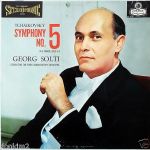
London CS 6117. Solti conducts the Paris Conservatory Orchestra.

The sound is OK. It’s fairly tubey and there’s a decent amount of energy to the recording.

The problem is not the sound, the problem is that the performance is terrible. Our main listening guy said he could hardly recognize the music!

DG SLPM 138 658. Mravinsky conducting the Leningrad Phil on an early pressing from 1961.

Big energy and a great performance but the string tone is shrill and smeary.

We are very used to hearing this kind of sound on Deutsche Grammophon records. This is why you see so few of that label’s pressings on our site.

How Did We Figure All of This Out?

There are more than 2000 Hot Stamper reviews on this blog. Do you know how we learned so much about so many records?

Simple. We ran thousands and thousands of record experiments under carefully controlled conditions, and we continue to run scores of them week in and week out to this very day.

(more…)

Gorgeous Cover, Bad Sound

Hot Stamper Pressings of the Music of Felix Mendelssohn Available Now

UPDATE 2025

Our favorite recording of the work can be found here.


Awful sound. It’s bright, dry and flat, with strident strings.

The sound is much too unpleasant to be played on high quality modern equipment.

If your system is dull, dull, deadly dull, the way older systems tend to be, this record has the hyped-up, bright and aggressive sound that is sure to bring it to life in no time.

There are scores of commentaries on the site about the huge improvements in audio available to the discerning (and well-healed) audiophile. It’s the reason Hot Stampers can and do sound dramatically better than their Heavy Vinyl or audiophile counterparts: because your stereo is good enough to show you the difference.

With an Old School system, you will continue to be fooled by bad records, just as I and all my audio buds were fooled thirty and forty years ago. Audio has improved immensely in that time. If you’re still playing Heavy Vinyl and other audiophile pressings, there’s a world of sound you don’t know you’re missing.

(more…)