 Hot Stamper Pressings Featuring the Violin Available Now
In this case, since the label is different but the stampers are the same, it’s the label that tells you how good your pressing may — heavy accent on the may — sound.
Lately we’ve been having exceptionally good luck with the early label pressings of many of the London violin concerto records we’ve done shootouts for, especially those performed by Ruggiero Ricci.
However, the notes you see below do not belong to the wonderful Sibelius record pictured here.
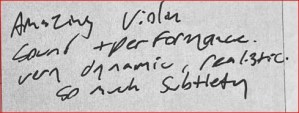 They belong to another London record. We give out lots of bad stampers on this blog, but almost never do we give out the good ones. (When we do give out the best stampers, we usually keep the title a mystery, as is the case of the record here. To see the other titles whose Shootout Winning stampers have been revealed, please click here. The list to date is short but not to worry, more are on their way.)
The amazingly good sounding pressing on the early label took the recording to another level. Our shootout notes read:
- Amazing violin sound and performance.
- Very dynamic and realistic.
- So much subtlety.
Scroll down to see out Key Takeaways from this shootout.

Key Takeaways
- The top four copies all had the same stampers, yet the sound varied noticeably from side to side, from Super Hot (A++) to White Hot (A+++), with one earning the grade between, Nearly White Hot (A++ to A+++).
- We’ve done this shootout a few times before. Since we know that the best copies are going to be on the early label, those are mostly the copies we’ve been stocking up on whenever possible.
- We also buy the second label copies if the price is right, and in this case we had a couple on hand to play, both of which earned a Super Hot stamper grade on one side and something slightly lower on the other.
- They aren’t as big as the best, nor do they extend as much up high or down low.
- Keep in mind that even worst of the second label copies are still very good sounding records, beating practicallly any orchestral recording that can be found on Heavy Vinyl (with only two exceptions we know of, one of which is this lovely title).
- The second labels are fairly impressive, but it is unlikely you would find yourself calling them amazing.
- Amazing is what you say when you play that one very special original pressing out of four and can hardly believe what your ears are telling you.
- How many audiophiles will go to the trouble of finding, buying, cleaning and playing four original copies in order to find the one with sound that soars above the rest? Let’s just say we only know of one, and he writes a blog very much like this one.
What It Takes
If you have big speakers and you play them at loud levels in a large enough room, on the highest quality equipment, tweaked and tuned to within an inch of its life, you can get a lot closer to the sound of live music in the home than most audiophiles will ever be able to experience for themselves.
Under those circumstances, how high up the sound extends on any given copy becomes obvious once you find the copy that extends the farthest. Same with the low end. The one that goes the deepest tells you how deep the recording can go, and that becomes the standard against which all the other copies are judged.
This is why we do shootouts, and why you must do them too, if owning the highest quality pressings is important to you.
Why We Love Vintage Violin Concerto Records
If you want to know why people drool over Golden Age recordings like this one, listen to the violin. Careful — when you hear it you may find yourself drooling too.
The staging of the orchestra and violin is exactly the way we want to hear it in our heads. Whether it would really sound this way in a concert hall is impossible to say — concert halls all sound different — but the skill and the emotion of the playing is communicated beautifully on this LP. This is a sweetheart of a record, full of the Tubey Magic for which London recordings are justly famous.
There is a richness to the sound of the strings that is exceptional, yet clarity and transparency are not sacrificed in the least.
It’s practically impossible to hear that kind of string sound on any recording made in the last thirty years (and this of course includes practically everything pressed on Heavy Vinyl). It may be a lost art but as long as we have these wonderful vintage pressings to play, it’s an art that is not being lost on us.
It’s also as wide, deep and three-dimensional as any, which is, of course, all to the good, but what makes the sound of these recordings so special is the timbral accuracy of the instruments in every section.
I don’t think the Decca engineers could have cut this record any better — it has all the orchestral magic one could ask for, as well as the resolving power, clarity and presence that are missing from so many Golden Age records.
This is the kind of record that will make you want to take all your Heavy Vinyl classical pressings — especially this group — and put them in storage. They cannot begin to sound the way this record sounds.
(Before you put them in storage or on Ebay, please play them against this pressing so that you can be confident in your decision to rid yourself of their insufferable mediocrity.)