rachmpiano

Rachmaninoff – Piano Concerto No. 3 / Janis / Dorati

More of the Music of Sergei Rachmaninoff

  • Outstanding sound for this classic Byron Janis Mercury album, with both TAS-approved sides earning solid Double Plus (A++) grades or BETTER
  • The piano is huge and weighty, the strings rich and highly resolving, and the overall presentation is powerful, balanced, dynamic and exciting like few other piano concerto recordings we have ever had the pleasure to audition
  • Not only is this the consistently best sounding copy we have had to offer in years, but we are happy to report that the vinyl is reasonably quiet for a Mercury stereo pressing of this vintage
  • If you have the system to play a record as big and powerful as this Mercury from 1961, we cannot recommend it any more highly
  • There are about 175 orchestral recordings we’ve awarded the honor of offering the best performances with the highest quality sound, and this record certainly deserve a place on that list.
  • This is one of the two Must Own Mercury piano concerto recordings, the other being SR 90300, which often suffers from inner groove distortion — not to worry, as a matter of grading policy, we check the inner grooves of every record we offer on the site

Not only is the sound amazing — yes, it’s on the TAS Super Disc list, and for good reason: a copy as good as this one really is a Super Disc — but this copy has another vitally important characteristic that most copies of the record do not: no Inner Groove Distortion.

We can’t begin to count the times we have had to return (or toss) a copy of one of these famous Byron Janis records because the piano breakup for the last inch or so of the record was just unbearable. That’s a sound no serious listener could possibly tolerate, yet I would venture to guess that a great many Mercury piano concerto recordings suffer from this kind of groove damage.

Enough about those typically bad copies, let’s talk about how good this one is.

This is an early Mercury Plum label stereo pressing of one of Byron Janis’s most famous performances (along with the Rachmaninoff 1st; it’s also a longtime member of the TAS super disc list).

The sound is rich and natural, with lovely transparency and virtually no smear to the strings, horns or piano. What an amazing recording! What an amazing piece of music.

The recording is explosively dynamic and on this copy, the sound was positively jumping out of the speakers. In addition, the brass and strings are full-bodied, with practically no stridency, an unusual feat the Mercury engineers seem to have accomplished while in Russia.

Big, rich sound can sometimes present problems for piano recordings. You want to hear the percussive qualities of the instrument, but few copies pull off that trick without sounding thin. This one showed us a piano that was both clear and full-bodied.

With huge amounts of hall space, weight and energy, this is Demo Disco quality sound by any standard. Once the needle has dropped you will quickly forget about the sound (and all the money you paid to get it) and simply find yourself in the presence of some of the greatest musicians of their generation, captured on the greatest analog recordings of all time.

(more…)

Piano Concerto Testing and Inner Groove Distortion

Hot Stamper Pressings of the Music of Rachmaninoff Available Now

The piano is huge and weighty, the strings rich and highly resolving, and the overall presentation is powerful, balanced, dynamic and exciting like few other piano concerto recordings we have ever had the pleasure to audition.

Not only is the sound amazing — yes, it’s on the TAS Super Disc list, and for good reason: a copy as good as this one really is a Super Disc — but this copy has another vitally important characteristic that most copies of the record do not: no inner groove distortion.

We can’t begin to count the times we have had to return (or toss) a copy of one of these expensive Byron Janis records because the piano breakup for the last inch or so of the record was just unbearable. That’s a sound no serious listener could possibly tolerate, yet I would venture to guess that many Mercury piano concerto recordings suffer from this kind of groove damage.

As a matter of grading policy, we check the inner grooves of every record we offer on the site,

The Sound

The sound is rich and natural, with lovely transparency and virtually no smear to the strings, horns or piano. What an amazing recording! What an amazing piece of music.

The recording is explosively dynamic — on the best copies the sound comes jumping out of the speakers. In addition, the brass and strings are full-bodied, with practically no stridency, an unusual feat the Mercury engineers seem to have accomplished while in Russia (and not as often in the states).

Big, rich sound can sometimes present problems for piano recordings. You want to hear the percussive qualities of the instrument, but few copies pull off that trick without sounding thin. This one showed us a piano that was both clear and full-bodied.

With huge amounts of hall space, orchestral weight and performance energy, this is Demo Disc quality sound by any standard. Once the needle has dropped you will quickly forget about the sound (and all the money you paid to get it!) and simply find yourself in the presence of some of the greatest musicians of their generation, captured on one of the greatest analog recordings of all time.

Fine and Cozart

The piano is huge and powerful, yet the percussive and lighter qualities on the instrument are clearly heard in proper relation to the orchestra as a whole.

I simply cannot criticize the work that Fine and Cozart have achieved with this recording, and believe me, there are very few records in this world about which I could not find something to criiticize. After all, it is our job, and we like to set very high standards for the work we do.

Lately we have been writing quite a bit about how good pianos are for testing all aspects of your system, room, tweaks, electricity and the rest, not to mention turntable setup and adjustment.

  • We like our pianos to sound natural (however one chooses to define the term).
  • We like them to be solidly weighted.
  • We like them to be free of smear, a quality that for some reason is rarely mentioned in most audiophile reviews.

Our twenty or so of our favorite piano concerto recordings with top quality sound can be found here.

To read the 50 reviews and commentaries we’ve written for some of the greatest piano concerto recordings ever pressed on vintage vinyl, please click here

(more…)

Heavy Vinyl Super Discs – “Nobody should have to listen to sound like that.”

More of the music of Sergei Rachmaninoff (1873-1943)

This entry links up a few of the commentaries I wrote as I went back through the Classic catalog, comparing their pressings to both originals and reissues.

We take to task Classic Records, The Absolute Sound, and Chesky, as you will see below.

This commentary was written in 2005, prompted at the time by a rave review in TAS for one of the new Speakers Corners Mercury reissues. I detested the sound of the first one I heard, and subsequent releases only confirmed that the mastering of the Mercury catalog for Speakers Corner was an abomination — an affront, in my none-too-humble opinion, to all right-thinking audiophiles.

As for my commentary, it should be obvious that these awful remastering labels have not gone out of business, but instead have prospered, making millions of dollars from audiophiles eager to lay down their hard earned money for one Heavy Vinyl pressing after another, often of the same title even.

When Harry Pearson — of all people! This is the guy who started the Living Stereo craze by putting those forgotten old records on the TAS list in the first place — gave a rave review to the Classic Records reissue of LSC 1806, I had to stand up (in print anyway) and say that the emperor clearly had removed all his clothing, if he ever had any to begin with. (And now he has a CD List? Ugh.)

This got me kicked out of TAS by the way, as Harry does not take criticism well. I make a lot of enemies in this business with my commentary and reviews, but I see no way to avoid the fallout for calling a spade a spade.

Is anybody insane enough to stand up for LSC 1806 today?

Considering that there is a die-hard contingent of people who still think Mobile Fidelity is the greatest label of all time, there may well be “audiophiles” with substandard audio equipment or weakened powers of observation and discrimination, or both (probably both, as the two go hand in hand), that still find the sound of that steely stringed Classic pressing somehow pleasing to the ear. Hey, anything is possible.

(more…)

Speakers Corner Ruins a Classic Mercury, Part One

More of the Music of Sergei Rachmaninoff (1873-1943)

This commentary was written in 2004.

We carried Heavy Vinyl back then, and for that, knowing what I know now, I can only apologize.

Back then, I thought I knew a great deal more about records and  how to reproduce them than I actually did.  Yes, I have to admit it: I suffered from the Dunning-Kruger effect.

On the bright side, there is one very powerful benefit that I gained from being so mistaken. Having failed to recognize my own shortcomings, the signs that someone thinks they know more than they do are easy for me to spot. Here is one of my favorite examples. I link to it a lot.

If you want to see the effect played out in the cyber world, go to any audiophile forum and start reading any thread about records you find there. The D-K effect is hard to miss. Some of the experts on these forums have even convinced themselves that they know things that cannot be known, which is always a sure sign they know a great deal less than they think they do.  

Our Old Commentary

Some thoughts on the new 180 gram Mercury reissues by Speakers Corner and a bunch of other record related stuff.

The Absolute Sound weighed in with their view of the series:

Speakers Corner has given these recordings the respect they deserve. The packaging is gorgeous: a black album titled “The Living Presence of 20th Century Music” and displaying the Mercury logo holds the three records with their original covers and liner notes. In addition, there are informative annotations on the music and Dorati, and a history of Mercury Living Presence…They sound at least as good and in some ways better than the originals…There are no negatives and not enough superlatives to describe these magnificent reissues. It’s rare that performance, sound, and musical value combine at this level in a recording.

Arthur B. Lintgen, The Absolute Sound, February/March 2004

Let me start by saying that I have not listened to a single one of the new Mercury titles.

Now that that’s out of the way, let me state for the record that the chances of the above statements being true are so close to zero that they cannot be calculated by anything but the latest Cray computer.

Has Speakers Corner produced a single classical record that’s better than a well-mastered, properly-pressed vintage pressing? One or two. Maybe. [These days we would say zero is the right number.]  So what are the chances they did so with these? Almost none I would say.

The above review reminds me of the nonsense I read in TAS and elsewhere in the mid-’90s regarding the supposed superiority of the Classic Living Stereo reissues. After playing their first three titles: 1806, 1817 and 2222, I could find no resemblance between the reviews I read and the actual sound of the records I heard.

The sound was, in a word, awful. To this day I consider them to be the Single Worst Reissue Series in the History of the World. [Presently there are too many contenders for that title to hold that view anymore.]

(more…)

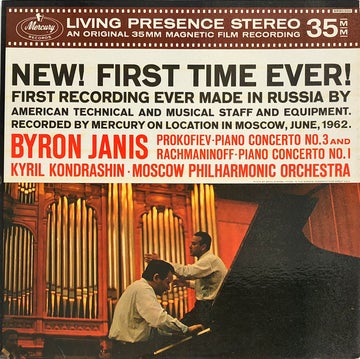
Prokofiev & Rachmaninoff / Piano Concertos / Janis / Kondrashin

More of the music of Sergei Prokofiev

More of the music of Sergei Rachmaninoff

  • This pressing has White Hot Stamper (A+++) sound on side one – sound that must be experienced to be believed! – backed with stunning Triple Plus (A+++) sound on the second side – exceptionally quiet vinyl too 
  • The finest recordings of the Prokofiev No. 3 and Rachmaninoff No. 1 – these performances by Janis are legendary, and with phenomenal sonics such as these, the combination of sound and performance here is virtually unmatched in our experience
  • So big, so, rich, so transparent, so dynamic and full of life, we guarantee you have never heard a better piano concerto record in your life
  • This is one of the two Must Own Mercury piano concerto recordings, the other being SR 90283, which often suffers from inner groove distortion — not to worry, as a matter of grading policy, we check the inner grooves of every record we offer on the site
  • For a more complete list, the highest quality recordings of piano concertos that we’ve auditioned to date can be found here
  • To see more of the best orchestral recordings with top quality sound we know of, click here

This is a superb early Mercury Plum label stereo pressing of two of Byron Janis’s most famous performances (along with the Rachmaninoff 3rd, which is every bit as good). It’s a longtime member of the TAS Super Disc list.

The recording is explosively dynamic and on this copy, the sound was positively jumping out of the speakers. In addition, the brass and strings are full-bodied and rich, with practically no stridency, an unusual feat the Mercury engineers seem to have accomplished while in Russia.

Big, rich sound can sometimes present problems for piano recordings. You want to hear the percussive qualities of the instrument, but few copies pull off that trick without sounding thin. This one showed us a piano that was both clear and full-bodied.

With huge amounts of hall space, weight and energy, this is Demo Disc Quality sound by any standard. Once the needle has dropped you will quickly forget about the sound and simply find yourself in the presence of some of the greatest musicians of their generation captured on some of the greatest analog recordings of all time.

(more…)

Speakers Corner Mucks Up a Classic Mercury, Part Two

More of the Music of Sergei Rachmaninoff (1873-1943)

For some background, in 2005 we were still selling Heavy Vinyl. We were fans of DCC and Cisco and carried many of the Speakers Corner remasters.

But things were starting to look grim. With every improvement to our playback system, these modern reissues seem to be falling further and further behind.

In the late-’90s, Classic had released some Mercury titles which we’d auditioned and disliked immensely. In 2005 it was Speakers Corner’s turn to have at the Mercury catalog, and they went a different way, finding a “new sound” for the legendary recordings, completely unlike any vintage pressing we’d ever heard.

This was very upsetting. I felt the need to say something.

By 2007 it was clear that Heavy Vinyl was a lost cause and had no business being sold by any audiophile record dealer who cared about sound quality, most especially me. And that was the end of it. This Mercury was one of the records that helped me see the error of my ways.


Part 1 of this discussion of Speakers Corner’s Mercury Series can be found here.

A blog entry on the site from 2005 about the new Mercury reissue series that was coming out noted that:

I am expecting the new Rach 3rd (90283) later this week, and will report my findings as soon as I have a had a chance to evaluate it.

[A few weeks later I followed up with this:]

The news on 90283 is here. It came today. Are you ready? In one sentence:

The most opaque, dull and lifeless 180 gram reissue in the history of the world.

My blog entry from 2005 continues below, transcribed practically word for word.

I hope it’s becoming clear to people now that this series is an enormous fraud perpetrated against all right thinking (right listening?) audiophiles. I can’t imagine a worse sounding record. It makes the most opaque ’70s Phillips or London LP sound positively transparent next to this thick piece of crap. I pulled out my late label copy, far from the best sounding pressing I’ve ever heard, and it killed the new version. The trumpets sound like they’re playing from under a pile of blankets on this 180 gram LP. The sound is so bad it defies understanding.

And the sad thing, in some ways the saddest aspect of this very sad affair, is that I can safely predict right now, with absolutely no fear of being proved wrong, that every major record dealer will rave about it. Mark my words. Every one. Except me of course. But I’m not one of the majors. Thank god I don’t have to sell crap like this to make a living.

And every audiophile who reads a rave review in a dealer’s catalog or on a website should take it for precisely what it is: a naked grab for his money, nothing more, nothing less. It’s all about the money. It’s not about the sound. It’s not about the music. It’s just about money.

Any record dealer who would stoop low enough to take money for a record this bad is telling you something very important about his business: he either can’t tell a good record from a bad one, or he doesn’t care. Either one would make me take my business elsewhere. How do these guys stay in business? (Maybe the fact that most of their catalogs are now given over to equipment explains it.)

And you should be outraged at this kind of fraud. If you give money to retailers who so obviously have nothing but contempt for you, you share in the blame. You’re keeping these guys in business. It makes me think of the scene in Network where Howard the veteran newscaster talks directly to his audience:

So, I want you to get up now. I want all of you to get up out of your chairs. I want you to get up right now and go to the window. Open it, and stick your head out, and yell: ‘I’m as mad as hell, and I’m not gonna take this anymore!’

I want you to get up right now. Sit up. Go to your windows. Open them and stick your head out and yell – ‘I’m as mad as hell and I’m not gonna take this anymore!’ Things have got to change. But first, you’ve gotta get mad!…You’ve got to say, ‘I’m as mad as hell, and I’m not gonna take this anymore!’

After playing this new Mercury, I was filled with questions.

What is to become of the record business?

Do we really need records that sound worse than the worse sounding CDs, at twice the price?

(more…)

Rachmaninoff / Concerto No. 3 / Janis – Wrong Again?

More of the music of Sergei Rachmaninoff (1873-1943)

In 2007 we raved about this title:

Outstanding! Sounds just like the already very good shaded dog, in many ways better. (I don’t have that one around to compare anymore but this LP has that same natural, smooth sound, while being cut a bit cleaner.) 

We have two copies of this Victrola, both with the same stamper numbers, and this is definitely the better of the two sonically. It has more presence, more transparency and better dynamics.

In preparation for our latest big shootout, we decided to give the Victrola another listen, and the one copy we had on hand was not impressive to say the least. It was dark, thin and flat.

Three strikes and it was out. Seems as though we were wrong.

Did we have better copies in 2007? Perhaps.

Our advice: skip it. If you do buy one, buy it for cheap.

(more…)

Rachmaninoff / The Complete Piano Concertos – Wild / Horenstein

More of the Music of Sergei Rachmaninoff

xxxxx

  • An excellent copy of this wonderful original 4 LP Box Set with roughly Double Plus (A++) orchestral sound across these 8 magical sides
  • The vinyl is as quiet as we can find it – like most Shaded Dogs and Mercs, Mint Minus Minus is about the best you can hope for
  • We have been readying this shootout for probably twenty years – we had 8 box sets to play, 32 discs in all, searching for the best sound we could find on these famous TAS List records
  • There is not much chance we will be able to do such a comprehensive shootout in the near future — we find at most one nice set per year, which means the next big shootout is a very long way off
  • Wild’s playing of the Rhapsody On A Theme Of Paganini here is one of our favorites on vinyl
  • Some old record collectors (like me) say classical recording quality ain’t what it used to be – here’s all the proof anyone with two working ears and top quality audiophile equipment needs to make the case
  • “Rachmaninoff’s music . . . changes as the composer goes along, moving from Romantic to a tentative Modernism in such works as the fourth piano concerto and the Symphonic Dances. In this sense, he walks a path similar to Puccini’s, incorporating new approaches to extend that [which was] already essentially his. Certainly, the works here show these changes, as the composer picks up more experience, both in writing and in hearing music.”

(more…)

Rachmaninoff / Piano Concerto No. 3 – Years Ago We Liked a Mono Pressing

Hot Stamper Mercury Pressings Available Now

CBFR-1/CBFR-2. This Mono pressing sounds SUPERB, much smoother and more natural than I remember the Stereo pressings sounding. What’s interesting about these Monos is they’re not mastered by Robert Fine. They are mastered by someone with the initials J.J., who apparently does all the Mono mastering. The reason Mercury Monos can sound as good as they do is because they have their own separate microphone feed and their own separate Mono tape recorder dedicated all to themselves. (London did the same thing and that’s why so many London Monos are amazing sounding.)

I don’t think you can find a better sounding Rachmaninoff 3rd on Mercury than this one. 

[UPDATE: Of course we no longer agree with that.  The best stereo copies are in an entirely different league. The mono can be good, but it cannot be great in the way the stereo pressings can be.] (more…)

Rachmaninoff / Piano Concerto No. 2 on Domestic STS – Would It Still Hold Up?

Reviews and Commentaries for the Music of Sergei Rachmaninoff

This is a twenty year old review of a pressing we have not played in many years, so please take what we say with a very large grain of salt.

Beating that in mind, if you see one for cheap in your local record store, give it a good look and, for the five bucks they will probably be asking, take a chance to see if the record actually does have the sound we heard all those years ago.

Folks, what we are offering here is THE SLEEPER Hot Stamper pressing of all time. Side one earned an amazingly good grade of A++ with side two every bit as good. The buyer of this album is going to be SHOCKED when he sees what pressing it is. 

For those of you who cherish pressings for their best sound and performances — as opposed to the typical audiophile collector who prefers the “right” original labels on his records, of course produced only in the “right” countries — this is the record for you.

Hold it up for your (right-thinking or otherwise) audiophile friends to witness before you put it on your table and BLOW THEIR MINDS.

How did this kind of sound get produced so cheaply, so late in the game? From what tape, by what engineer? It is a mystery to me, one that is very unlikely to be explained to anyone’s satisfaction.

Side One

A++ Super Hot Stamper sound — rich strings, clear horns, a piano that is full-bodied and natural, with a solid low end (the kind you rarely hear on record but is always so strikingly obvious in the presence of the real instrument).

A bit of compression holds it back from A+++. What a record!

Side Two

A++, not quite as rich as side one but lively, transparent, present, with zero smear (always a problem with piano recordings — you want to hear those hammers striking the strings clearly). 

(more…)