dull-sound

These records are dull sounding.

Speakers Corner Mucks Up a Classic Mercury, Part Two

More of the Music of Sergei Rachmaninoff (1873-1943)

For some background, in 2005 we were still selling Heavy Vinyl. We were fans of DCC and Cisco and carried many of the Speakers Corner remasters.

But things were starting to look grim. With every improvement to our playback system, these modern reissues seem to be falling further and further behind.

In the late-’90s, Classic had released some Mercury titles which we’d auditioned and disliked immensely. In 2005 it was Speakers Corner’s turn to have at the Mercury catalog, and they went a different way, finding a “new sound” for the legendary recordings, completely unlike any vintage pressing we’d ever heard.

This was very upsetting. I felt the need to say something.

By 2007 it was clear that Heavy Vinyl was a lost cause and had no business being sold by any audiophile record dealer who cared about sound quality, most especially me. And that was the end of it. This Mercury was one of the records that helped me see the error of my ways.


Part 1 of this discussion of Speakers Corner’s Mercury Series can be found here.

A blog entry on the site from 2005 about the new Mercury reissue series that was coming out noted that:

I am expecting the new Rach 3rd (90283) later this week, and will report my findings as soon as I have a had a chance to evaluate it.

[A few weeks later I followed up with this:]

The news on 90283 is here. It came today. Are you ready? In one sentence:

The most opaque, dull and lifeless 180 gram reissue in the history of the world.

My blog entry from 2005 continues below, transcribed practically word for word.

I hope it’s becoming clear to people now that this series is an enormous fraud perpetrated against all right thinking (right listening?) audiophiles. I can’t imagine a worse sounding record. It makes the most opaque ’70s Phillips or London LP sound positively transparent next to this thick piece of crap. I pulled out my late label copy, far from the best sounding pressing I’ve ever heard, and it killed the new version. The trumpets sound like they’re playing from under a pile of blankets on this 180 gram LP. The sound is so bad it defies understanding.

And the sad thing, in some ways the saddest aspect of this very sad affair, is that I can safely predict right now, with absolutely no fear of being proved wrong, that every major record dealer will rave about it. Mark my words. Every one. Except me of course. But I’m not one of the majors. Thank god I don’t have to sell crap like this to make a living.

And every audiophile who reads a rave review in a dealer’s catalog or on a website should take it for precisely what it is: a naked grab for his money, nothing more, nothing less. It’s all about the money. It’s not about the sound. It’s not about the music. It’s just about money.

(more…)

Sorry, This Is Just Not Our Sound and Never Will Be

coltranegiant45x

Hot Stamper Pressings of the Music of John Coltrane Available Now

The sound of the 45 RPM 2 disc version of Giant Steps cut by Bernie Grundman did not exactly tickle our fancy.

It sounded thick, dull, and entirely too smooth.

It reminded us of the awful Deja Vu Bernie remastered years ago for Classic Records.

As is the case with so many of the Heavy Vinyl reissues released these days, the studio ambience you hear on these pressings is a pitiful fraction of the ambience the real pressings have encoded in their grooves.

Real pressings like, you know, the ones mass-produced by Atlantic, original and reissue alike. What’s Bernie’s excuse?

(more…)

Some OJC Pressings of Waltz for Debby Can Be Pretty Good

Hot Stamper Pressings of the Music of Bill Evans Available Now
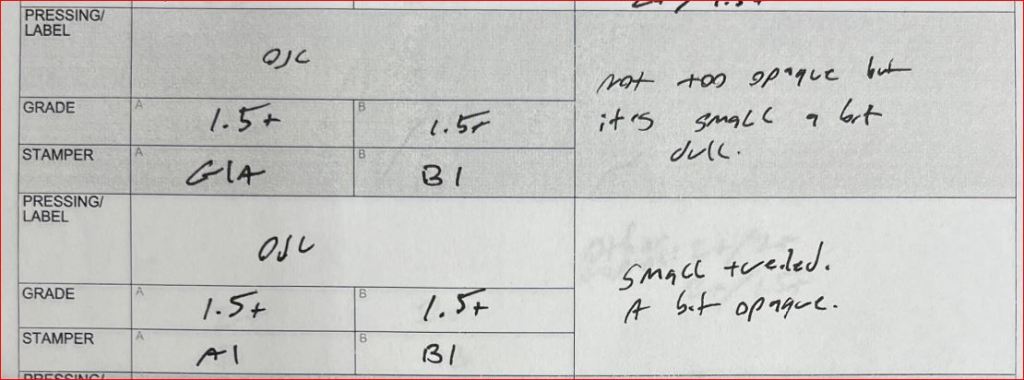
During our most recent shootout for Waltz for Debby, we took the opportunity to play the early OJC that first came out in the 80s. We found the OJC pressings with the stampers identified below had good, not great sound.

I remember playing the Analogue Productions version from 1992, mastered by Doug Sax, and being shocked at how overly rich, murky, thick and unnatural it sounded. I knew the AP Way Out West was bad. Was every title that Analogue Productions remastered going to sound like it was being played by 50’s JBL speakers powered by Mac 30s?

This was the sound audiophiles had always wanted? This was the sound that made them think they were listening to the master tape? (To prove that bad ideas never die — that sooner or later they return in a different guise — there is a Mr. Hutchison who makes records that sound very similar to those Chad was making in the early 90s. The more things change…)

Back to the OJC of Waltz for Debby. A local fellow who had requested my 1990s catalog, the one in which I say the OJCs just kill the new AP Heavy Vinyl pressings, came over and bought some OJCs, the ones I thought sounded very good, which were the only ones we carried. They were all of  ten bucks each.

He promptly went home, played them and called me to tell me just how awful his AP vinyl of the album sounded and how much better his OJC was in comparison, at less than half the price. I’m sure I said something along the lines of “Tell me something I don’t know!” My credibility established beyond all doubt, he and I soon became fast friends.

I never reviewed the Waltz for Debby on AP, but I wrote reviews for three other AP titles: Way Out West, Chet, and Jazz Giant. Spoiler alert: I thought all three were unbelievably awful.

The G1A/B1 OJC pressing we played suffered these problems:

  • It’s opaque but not too opaque
  • It’s small and a bit dull

(more…)

Why are the First Pressings of this Title the Worst Sounding?

Hot Stamper Pressings of Recordings by Decca Available Now
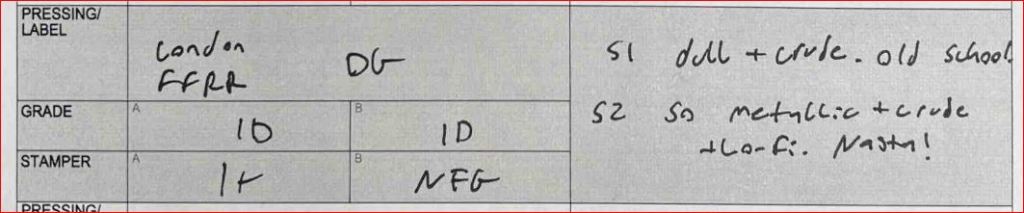
The record you see pictured is not the record we are discussing in this posting. The stamper numbers you see below belong to a different album.

We’ve lately been giving out much more stamper information than we used to, but for now we are keeping this title close to the vest.

We happen to know the best stampers for this album, but somehow a copy with the “bad” stampers ended up in our shootout. It did about as badly as they usually do.

Of course, the person sitting in the listening chair had no idea that a copy with the worst stampers was playing. The jackets and labels of this pressing are identical to the copies with the good stampers.

He simply heard what the recording actually sounds like when it’s mastered badly and registered his complaints.

Side One

  • Dull and crude. Old school.
  • 1+

Side Two

  • So metallic and crude and lo-fi. Nasty!
  • NFG

Apparently Mr. D, real name: Jack Law, did a piss-poor job mastering this album. Another engineer would come along sooner or later and master the record right, so right that it became one of our favorite Demo Discs for sound and performance.

How did this pig’s ear eventually manage to become a silk purse?

Simple. It was always a great recording, it just needed to be mastered right, and whoever got the job to remaster it knocked it out of the park the first time through.

(more…)

The Wall Sounds Terrible on these “Audiophile” Rip-offs

Hot Stamper Pressings of the Music of Pink Floyd Available Now

This Japanese import is one of the dullest, muddiest, worst sounding copies of The Wall we have ever played. It is clearly made from a second generation tape (or worse!).

Is it the worst version of the album ever made? Hard to imagine it would have much competition.

And somehow this pressing, or one very much like it, ended up as on the TAS Super Disc List. I would hope that the copy Harry played sounded a whole lot better than this one.

The version on the TAS Super Disc list is EMI 4814, which I believe is the British original. Conventional wisdom? Is The Absolute Sound capable of any other?

And the CBS Half-Speed is every bit the mudfest that the Half-Speed is.

How is it that the worst sounding pressings are so often marketed to audiophiles as superior to their mass-produced counterparts? In our experience, more often than not they are just plain awful, inferior in every way but one: surface quality.

And the knock on these CBS Half-Speeds is that they are made from the same vinyl CBS used to press all their other records.

I remember buying them back in the late-70s at Tower Records. They were only $12.99 when Mobile Fidelity pressings were $17.99, garnering a premium price because they were pressed in Japan. Fool that I was, I bought plenty of both, not to mention those made by Nautilus, Direct Disk Labs and plenty of others too painful to think about.

Dear audiophiles, stop collecting crappy audiophile pressings with quiet vinyl and just switch to CD already. You’ll be getting better sound and saving yourself a lot of money to boot. You simply cannot defend analog with this kind of junk.

(more…)

We Expected Better from Frühbeck De Burgos, But We Didn’t Get It

Hot Stamper Pressings of Orchestral Spectaculars Available Now

We love the skill De Burgos brings to orchestral showpieces such as these, but the sound is not up to par for us. We’ve heard better. A lot better.

Bolero is shrill at the climax and the whole of side two was dull and opaque.

This EMI from 1976 might be passable on an old school system, but it was much too unpleasant to be played on the high quality modern equipment we use.

There are quite a number of other records that we’ve run into over the years with similar shortcomings. Here are some of them, a very small fraction of what we’ve played, broken down by label.

Note that there is no list of EMI’s. There are simply too many bad ones to make listings for.

  • London/Decca records with weak sound or performances
  • Mercury records with weak sound or performances
  • RCA records with weak sound or performances

The EMI classical albums we have reviewed to date can be found here.


Label:   His Master’s Voice – ESD 7019
Released:   1976

Ravel – Bolero
Chabrier: Espana – Rhapsody For Orchestra

Prokofiev – Symphony No.1 In D Major (Classical)

Stravinsky: Fireworks, Op.4
Stravinsky: Circus Polka (1942) (Composed For A Young Elephant)

(more…)

Driving My Car into a Ditch

Hot Stamper Pressings of the Music of The Beatles Available Now

Mobile Fidelity made a mess of Drive My Car on their Half-Speed mastered release of Rubber Soul in 1982.

Perhaps it’s more accurate to say Stan Ricker, MoFi’s go-to mastering engineer, did.

He equalized out far too much upper midrange and top end.

What fuels the energy of the track are the cow bell, the drums and other percussion. Instead of a scalpel, Mobile Fidelity took a hatchet to this slightly bright track, leaving a dull, lifeless, boring mess.

Some Parlophone copies may be a little bright and lack bass, but at least they manage to convey the musical momentum of the song.

Even the purple label Capitol reissues can be quite good. A bit harsher and spittier, yes, but in spite of these shortcomings they communicate the music, which ought to count for something.

As much as I might like some of the MoFi Beatles records [not so much anymore], and even what MoFi did with some of the other tracks on Rubber Soul, they sure sucked the life out of Drive My Car.

We all remember how much fun that song was to hear when it would come on the radio. Playing it on a very high quality stereo should make it more fun, not less.

If you’ve got a Rubber Soul with a Drive My Car that’s no fun, it’s time to get another one.

By The Way

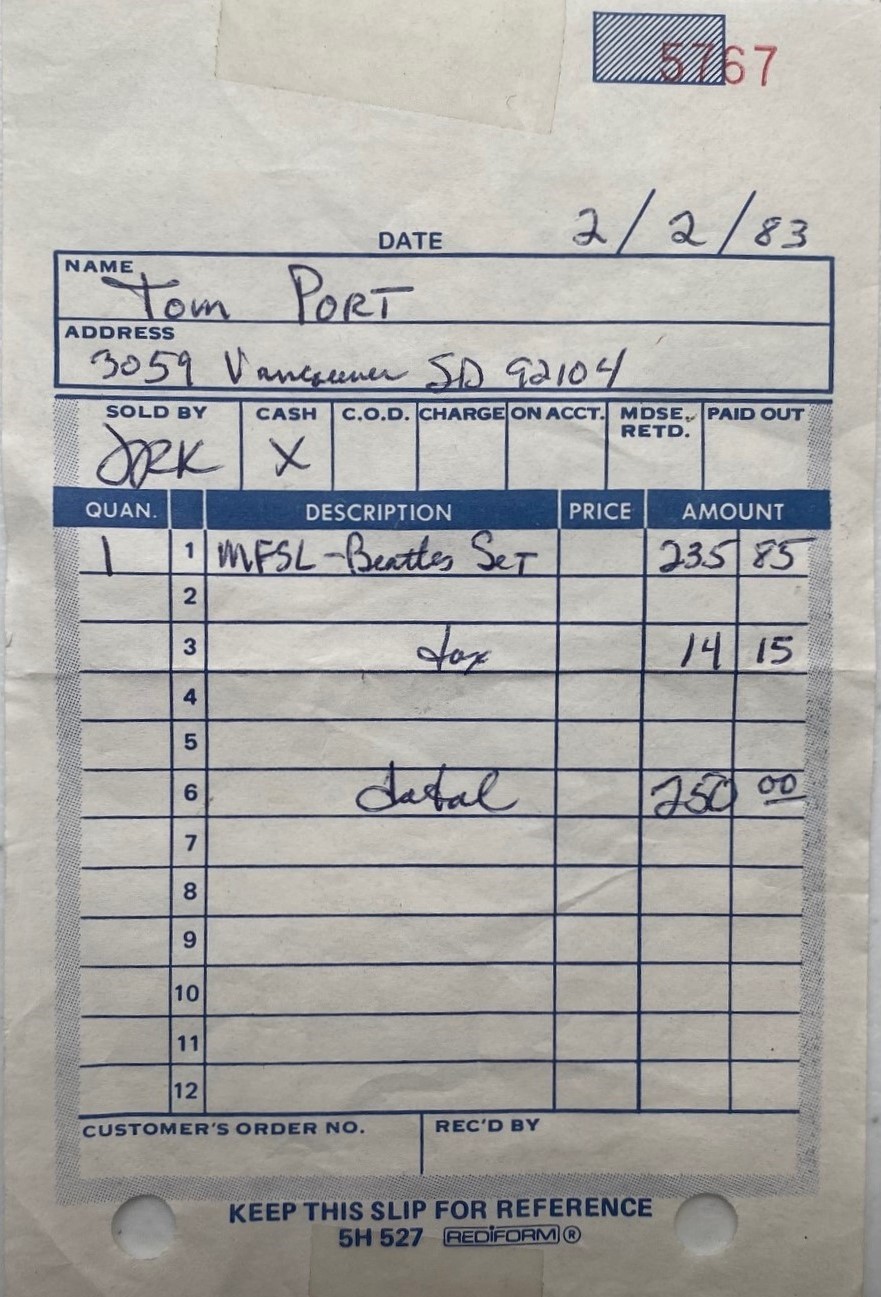
The best $250 — to the penny! — I ever spent on records is the price I paid for my brand new, still-in-the-shipping-carton MoFi Beatles Box. I ordered it in 1982 when I first learned of it, and it finally came the next year. I already owned all The Beatles albums MoFi had done by that point, including the UHQR of Sgt. Peppers, which, like a fool, I got rid of once the set came out.

(more…)

On Sweetnighter, Watch Out for Sourness, Slowness and Smear

Hot Stamper Pressings of the Music of Weather Report

What surprised us most about the dozen or so copies that we played years ago for a shootout was how wrong most copies of this album sound. They’re SOUR in the midrange. On this kind of music, a sour midrange is the kiss of death.

Those copies that aren’t sour are frequently just plain dull. On a recording like this, so full of percussion — which, to be honest, it’s a record that LIVES OR DIES on the quality of its percussion — dullness is devastating.

And so is slowness. If you have old school tube equipment — great for vintage RVG recordings but way too slow to keep up with this fast-paced and percussion-heavy music — this record is not going to do what it desperately wants to do: get your feet tappin’.

Smear is also another thing to watch out for — smear kills what’s good about this record. The percussion transients lose their snap and the harmonics get lost. The less smeary sides really bring out the funky magic of the recording.

(more…)

Music From Peer Gynt – Another Cisco Disaster

Hot Stamper Pressings of the Music of Edvard Grieg Available Now

An audiophile hall of shame pressing from Cisco / Impex /  Boxstar / Whatever.

Pretty bad, on a par with the transistory, shrill crap Classic Records had been dishing out for years, but in the opposite direction tonally: it’s dull and dead as a doornail.

I often mention on this blog that Cisco’s releases (as well as DCC’s) had to fight their way through Kevin Gray’s transistory, opaque, airless, low-resolution cutting system. We discuss that subject in more depth here.

Our favorite recording of Peer Gynt is the one by Otto Gruner-hegge and the Oslo Philharmonic from 1959.

(more…)

It Took Us More than Twenty Years to Figure Out What Was the Problem

Hot Stamper Pressings of the Music of Neil Young Available Now

Years ago — precisely how many we can’t really say, the old listings for those records have been deleted — we thought the original pressings in the nameless cover you see pictured had the best sound.

We thought the pressings that came in this early cover were the ones that were made from the original mix, the mix that Neil later disowned. (More on that below.)

We had played a number of copies that came in the original cover, and they sounded better to us than the others we had auditioned.

Our mistake was not understanding that pressings made with the first mix and pressings made with the second mix both came in the early cover, and both were pressed on the Reprise Two Tone label.

Here is what we wrote some years ago:

It turns out the remixed pressings we’d been selling for years were not the way to hear this album at its best. Neil wanted his voice to sound clearer and more present than the first mix, but the approach the engineers took to increase the clarity and presence was simply to boost the middle and upper midrange, a boost that seriously compromises the wonderful Tubey Magic found in the rich lower midrange of the original mix.

Neil may have liked the sound of his voice better on the new mix, played back on whatever mediocre-at-best stereo he was using at the time, but we here at Better Records are of a decidedly different opinion. On a modern, highly-resolving system Neil’s voice will not sound the least bit “buried” on the original mix, not on the better pressings anyway. Of course, the better ones are the only ones we sell.

If you want to hear this album sound right, we strongly believe that the original mix is the only way to go. And if you want to hear this album sound really right, better-than-you-ever-thought-possible right, you need a copy that was mastered, pressed and cleaned properly, and that means a Hot Stamper from Better Records.

It turns out the stampers for the pressings we like are the ones made from the remixed tapes.

(more…)