lacks-depth

This Tsar Saltan Is Diffuse, Washed Out, Veiled, and Vague

Hot Stamper Pressings of the Music of Rimsky-Korsakov Available Now

Sonic Grade: C (at most)

Year ago we cracked open the Speakers Corner pressing of The Tale of Tsar Saltan in order to see how it would fare in a head to head comparison with a pair of wonderful sounding Londons we were in the process of shooting out at the time. Here are the differences we heard.

The soundstage, rarely much of a concern to us at here at Better Records but nevertheless instructive in this case, shrinks roughly 25% with the new pressing. Depth and ambience are reduced by about the same amount.

But what really bothered me was this:

The sound was just so vague.

There was a cloud of musical instruments, some here, some there, but they were very hard to SEE. On the Londons we played they were clear. You could point to each and every one. On this pressing that kind of pinpoint imaging was simply nowhere to be found. (Here are some other records that are good for testing vague imaging.)

Case in point: the snare drum, which on this recording is located toward the back of the stage, roughly halfway between dead center and the far left of the hall. As soon as I heard it on the reissue I recognized how blurry and smeary it was relative to the clarity and immediacy it had on the earlier London pressings we’d played. I’m not sure how else to describe it — diffuse, washed out, veiled — just vague.

(Here are some other records that are good for testing the sound of the snare drum.)

This particular Heavy Vinyl reissue is more or less tonally correct, which is not something you can say about many reissues these days. In that respect it’s tolerable and even enjoyable. I guess for thirty bucks it’s not a bad deal.

But… when I hear this kind of sound only one word comes to mind, a terrible word, a word that makes us recoil in shock and horror. That word is DUB. This reissue is made from copy tapes, not masters.

Copies in analog or copies in digital, who is to say, but it sure ain’t the master tape we’re hearing, of that we can be fairly certain. How else to explain such mediocre sound?

Yes, the cutting systems being used nowadays to master these vintage recordings aren’t very good; that seems safe to say.

Are the tapes too old and worn?

Is the vinyl of today simply not capable of storing the kind of magical sound we find so often in pressings from the 50s, 60s and 70s?

Could the real master tape not be found, and a safety copy used to master the album instead?

To all these questions and more we have but one answer: we don’t know.

We know we don’t like the sound of very many of these modern reissues and I guess that’s probably all that we need to know about them. If someone ever figures out how to make a good sounding modern reissue, we’ll ask them how they did it. Until then it seems the question is moot. (Someone did, which proves it can be done!)

Back in 2011 we stopped carrying Heavy Vinyl and most other audiophile LPs of all kinds. (These we like.)

So many of them don’t even sound this good, and this kind of sound bores us to tears.

(more…)

Kevin Gray Sacrifices Another Blue Note to the Lo-Fi Crowd

Hot Stamper Pressings of Blue Note Recordings Available Now

We did a shootout for Cornbread in 2023 and again in 2025. For our latest one, we were fortunate to be able to include both the Tone Poets pressing that came out in 2019 as well as the 75th Anniversary Blue Note pressing from 2014.

Here is the way we described a Hot Stamper that ended up being the best sounding pressing we played on one of its sides, and coming in second on the other side.

  • The sound is everything that’s good about Rudy Van Gelder‘s recordings – it’s present, spacious, full-bodied, Tubey Magical, dynamic and, most importantly, alive in that way that modern pressings never are
  • Exceptionally spacious and three-dimensional, as well as relaxed and full-bodied – this pressing was a big step up over nearly all other copies we played

After hearing a copy of the album that sounded as good as that one, the Tone Poets pressing would have had to be at least a bit of a letdown, right?

To be fair, all it really has to be is good sounding. For $30, the price of the average copy that sells on Discogs, can you really expect great?

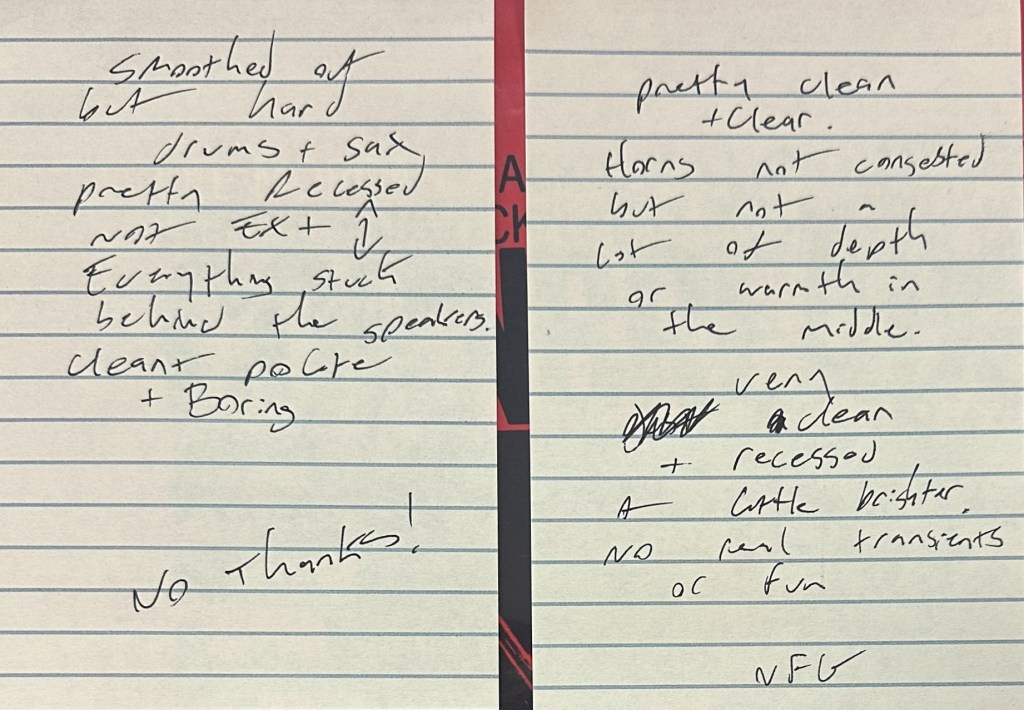
I don’t know what any of the purchasers of these Tone Poets records — of this or any other title — are expecting for their thirty bucks, but I can tell you what they are getting. We took notes while their remastered pressing played, and here’s what we heard.

Side One

(more…)

How Do the Early Pressings of The Poll Winners Sound?

Hot Stamper Pressings of Contemporary Jazz Albums Available Now

A recent Shootout Winning copy with the early stereo badge cover was described this way:

Stunning sound throughout this vintage Black Label Stereo Records pressing, with both sides earning Shootout Winning Triple Plus (A+++) grades or close to them

Roy DuNann always seems to get the real sound out of the sessions he recorded – amazingly realistic drums in a big room; Tubey Magical guitar tone; deep, note-like bass, and on and on

4 1/2 stars: “The choice of material, the interplay between the three players, and the lead work all meld together beautifully on The Poll Winners, making it a classic guitar album in a small-group setting.”

Musically, all true. Sonically, not so much. The early D1/D2 stampers on the early Black Label might be passable on side one (1+), but side two was just a mess (NFG).

Side One

Track Two

  • A bit bright and flat

Track One

  • Very clear but lacking richness, weight and depth
  • Thin, and bright up top
  • 1+

Side Two

Track One

  • Narrow stereo field
  • Weird tape hiss
  • Metallic top end
  • Very recessed and weird
  • Nope

A different Stereo Badge Cover copy sporting a Black Label won the shootout by the way. Go figure.

(more…)

An Insult to Aaron Copland on Reference Records

Hot Stamper Pressings of Orchestral Music Available Now

Yet another Reference Record we’ve reviewed and found wanting.

In all the years I was selling audiophile records, one of the labels whose appeal made no sense to me whatsoever (along with their long-forgotten TAS list brethren, American Gramaphone and Telarc) was Reference Records.

Back then, when I would hear one of their orchestral or classical recordings, I was always left thinking, “Why do audiophiles like these records?”

I was confused, because at that time, back in the 80s, I had simply not developed the listening skills that today make it so easy to recognize the faults of their recordings.

I made the mistake of thinking that other audiophiles with more advanced equipment and more refined listening skills must be hearing something I was not.

I had trouble putting my finger on what I didn’t like about them, but now, having worked full time (and then some!) for more than twenty years to develop better critical listening skills, the shortcomings of their records, or, to be more accurate, the shortcomings of this particular copy of this particular title, took no time at all to work out.

My transcribed notes for RR-22:

  • Lean tonality
  • No real weight
  • No Tubey Magic
  • Blurry imaging when loud
  • No real depth
  • Bright tonal balance

Is this the sound you are looking for in an audiophile record?

Shouldn’t you be looking for audiophile quality sound?

Well, you sure won’t find it here.

On our current playback system, this Reference Record is nothing but a joke, a joke played on a much-too-credulous audiophile public by the ridiculously inept and misguided engineers and producers who worked for Reference Records.

This is a reference for something? For what?

As I wrote about another one of their awful releases, if this is your idea of a reference record, you are in real trouble.

It would be hard to imagine that anyone who has ever heard a good vintage classical recording — here are some of our favorites — could ever confuse this piece of audiophile trash with actual hi-fidelity orchestral sound.

(more…)

Maazel’s Pines of Rome Is Another Title Not Fit for a Super Disc List

Hot Stamper Pressings of The Pines of Rome Available Now

Sonic Grade: C (at best)

I found a bit of commentary in a listing for Scheherazade, and right away it was clear to me that the shootout we did for that title showed us a recording that had much in common with the one we had done more recently for The Pines of Rome.

Here it is, with the necessary changes having been made.

We did a monster shootout for this music in 2021, one we had been planning for more than twenty years. On hand were quite a few copies of the Reiner on RCA; the Ansermet on London; the Maazel on Decca and London (the Decca being on the TAS List), the Kempe on Readers Digest, and quite a few others we felt had potential.

The only recordings that held up all the way through — the last movement being a real Ball Breaker, for both the engineers and musicians — were those by Reiner and Kempe. This was disappointing considering how much time and money we spent finding, cleaning and playing about twenty or so other pressings.

We learned from that first big go around something that we think will remain true for the foreseeable future: the 1960 Reiner recording with the Chicago Symphony on RCA just can’t be beat.

Could other pressings be better sounding? Of course they could.

Would we ever buy another copy? Not a chance.

The notes for the Decca pressing I played, mastered by G, Ted Burkett, can be seen above.

Hey, here’s an idea.

Why don’t you buy a bunch of them and see if any of them do not have the problems described on my notes.

If you find a good one, please let me know the stampers so I can go out and find one myself.

The above is of course all in good fun. We both know that there is not a snowball’s chance in hell that anyone reading this commentary is going to go out and buy some Decca pressings of The Pines of Rome, clean them up, play them one by one and then critique their strengths and weaknesses.

The most likely thing is that, if you have any Decca pressing of Maazel’s Pines, it’s sitting on a shelf collecting dust. Odds are it has not been played in a very long time.

Which should tell you something. Good records get played and bad ones sit on shelves.

(more…)

Analogue Productions and Sterling Produce a Disastrous Scheherazade

Hot Stamper Pressings of the Music of Rimsky-Korsakov Available Now

Wikipedia has a nice entry for some of Rimsky-Korsakov’s ideas behind the final movement of the piece:

These [later] works resemble brightly colored mosaics, striking in their own right and often scored with a juxtaposition of pure orchestral groups. The final tutti of Scheherazade is a prime example of this scoring. The theme is assigned to trombones playing in unison, and is accompanied by a combination of string patterns. Meanwhile, another pattern alternates with chromatic scales in the woodwinds and a third pattern of rhythms is played by percussion.

Wikipedia

Could not have said it better myself!

We’ve written at length about the thrills to be had when playing the last movement of Scheherazade — not brilliantly, to be sure, as the writer for Wikipedia has done, but serviceably I hope. Unfortunately, not every pressing of Reiner’s performance is able to communicate the musical values of the work the way the best pressings can.

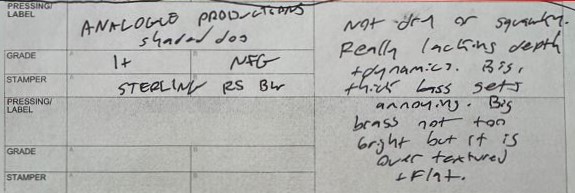
As you can see from our notes for the this Heavy Vinyl Analogue Productions pressing, the thrill was barely there on the first side, and by the second side it was completely gone.

The notes from our 2024 shootout read:

  • Not dry or squawky
  • Really lacking depth and dynamics.
  • Big, thick bass gets annoying.
  • Big brass not too bright but it is over-textured and flat.

Plenty of modern records suffer from these as well as lots of other shortcomings. For some reason, the writers for The Absolute Sound who put this crappy LP on their Super Disc list didn’t seem bothered by them the way we were.

If you own this pressing, here are the kinds of things you might want to listen for in order to recognize its many, and quite serious, failings.

When played head to head against any properly-mastered vintage vinyl LP, this pressing will fall short in a number of important areas. Linked below are titles we’ve found to be good for testing these same qualities in a recording.

(more…)

The Pines of Rome with Maazel – Not the Pressing You Want

Hot Stamper Pressings of Orchestral Music Available Now

I played a lot of different pressings of this music a while back, trying to find recordings worthy of a shootout.

My notes for this one read:

  • Very multi-miked.
  • No depth, but the stage is wide.
  • Not warm but dynamic.

There are a lot of DG recordings that have this kind of sound. We’ve played them by the score. Most went directly into the trade bin.

We simply do not sell classical records with this kind of second-rate sound regardless of how good the performances may be.

We learned from our first big shootout for these works something that we think will remain true for the foreseeable future: the 1960 Reiner recording with the Chicago Symphony on RCA just can’t be beat.

Our Job

Our job is to find you good sounding pressings.

That’s the reason we carry:

(more…)

Is the Heavy Vinyl from 2012 the Best Sounding Sgt. Pepper?

beatlessgtHot Stamper Pressings of Sgt. Peppers Available Now

You might agree with some reviewers that EMI’s engineers did a pretty good job with the new stereo pressing of Sgt. Pepper mastered by Sean Magee from the 2009 digitally remastered tapes.

In the March 2013 issue of Stereophile Art Dudley weighed in, finding little to fault on this title but being less impressed with most of the others in the new box set. His reference disc? The MoFi UHQR! Oh, and he also has some old mono pressings and a domestic Let It Be.

Now there’s a man who knows his Beatles. Fanatical? Of course he is! We’re talkin’ The Beatles for Chrissakes.

When I read the reviews by writers such as these, I often get the sense that I must’ve fallen through some sort of Audio Time Warp and landed back in 1982. How is it that our so-called experts evince so little understanding of how records are made, how variable the pressings can be, and, more importantly, how absolutely crucial it is to understand and implement rigorous protocols when attempting to carry out comparisons among pressings.

Critically comparing LPs is difficult and time-consuming. It requires highly developed listening skills. I didn’t know how to do it in 1982. I see no evidence that the audiophile reviewers of today are much better at it now than I was in 1982.

Just to take one example: They all seem to be operating under the same evidence-free conceit: that the original is the benchmark against which other pressings must be compared.

To those of us who have played Beatles pressings by the hundreds, this is patent nonsense. To cite just one instance, a recent Hot Stamper listing notes [inaccurately as it turns out, see below]:

We defy any original to step into the ring with it. One thing we can tell you, it would not be a fair fight. The cutting equipment to make a record of this quality did not exist in 1967, not at EMI anyway.

We had the opportunity not long ago to audition a very clean original early pressing of the album and were frankly taken aback by how AWFUL it was in virtually every respect. No top end above 8k or so, flabby bass, murky mids — this was as far from Hot Stamper sound as one could imagine. If it were a Heavy Vinyl or Audiophile pressing we would surely have graded it F and put it in our Hall of Shame.

To be fair we have played exactly one early copy of the record on our current system. (Played a copy or two long ago but on much different equipment, so any judgments we might have made must be considered highly suspect.) Perhaps there are good ones. We have no way of knowing whether there are, and we are certainly not motivated to find out given the price that original Sgt. Pepper’s are fetching these days.

We can tell you this much: no original British pressing of any Beatles album up through Pepper has ever impressed us sonically. We’ve played plenty and have yet to hear one that’s not congested, crude, distorted, bandwidth-limited and full of tube smear. (The monos suffer from all of these problems and more of course, which is only natural; they too are made with the Old School cutting equipment of the day.)

If that’s your sound more power to you. It’s definitely not ours. The hotter the stamper, the less congested, crude, distorted, bandwidth-limited and smeary it will be. (Or your money back.)


UPDATE 2023

There is a copy of a Beatles album on the original label that was competitive with our best 70s pressings, this one. We explained why it’s not a problem to admit we were wrong about the album in question, For Sale, this way:

This finding about For Sale is precisely why live and learn is our motto.

We don’t know it all, and we’ve never claimed that we did. We constantly learn things about pressings in our daily shootouts. That should not be too surprising, as record shootouts are the only way to learn anything about the sound of records that’s actually worth knowing.

Start doing your own experiments and your record knowledge might just take off the way ours has. 99% of what we think we know about the sound of records we’ve learned in shootouts over the course of the last twenty years.

Here is our advice on getting started.

Before this, the only Beatles record we would sell on the Yellow and Black Parlophone label was A Collection of Oldies… But Goldies. That title does have the best sound on the early label. In numerous shootouts, no Black and Silver label pressing from the ’70s was competitive with the best stereo copies made in the ’60s.

Until now, it was clearly the exception to our rule. From With the Beatles up through Yellow Submarine, the best sounding Beatles pressings would always be found on the 70s reissue label.


The Best Pepper Pressings

How did we come to find the best Sgt. Peppers pressings? Our recent commentary about a wonderful Benny Carter record on the original Contemporary Black Label may serve to shed some light on the process.

(more…)

Boy, Was We Ever Wrong About Solti’s Rite of Spring

Hot Stamper Pressings of the Music of Igor Stravinsky Available Now

This is a VERY old and somewhat embarrassing commentary providing the evidence for just how wrong we were about the sound of Solti’s 1974 recording for Decca.


Here is what we had to say about the album in 2008:

This is an amazing recording, DEMO QUALITY SOUND, far better than the Decca heavy vinyl reissue that came out in the 2000s. [That part is no doubt true.]

This record is extremely dynamic; full of ambience; tonally correct; with tons of deep bass. Because it’s a more modern recording, it doesn’t have the Tubey Magic of some Golden Age originals, but it compensates for that shortcoming by being less distorted and “clean.” Some people may consider that more accurate. To be honest with you, I don’t know if that is in fact the case.

However, this record should not disappoint sonically and the performance is every bit as exciting and powerful as any you will find. The Chicago Symphony has the orchestral chops to make a work of this complexity sound effortless.


Skip forward to the present, roughly ten years later. We had three or four copies on hand to audition when we surveyed the work a couple of years ago in preparation for a big shootout.

The Solti did not make the cut. It was not even in the ballpark.

(more…)