ryan-smith

Porgy and Bess Gets the Speakers Corner Treatment, from Sterling No Less

Hot Stamper Pressings of Pop and Jazz Vocals Available Now

Here is how we described a recent Shootout Winning copy of Porgy and Bess.

Spacious, full-bodied and Tubey Magical, with Ella and Louis front and center, this is the sound you want to hear on their brilliant collaboration from 1958.

Two vocal giants came together to perform Gershwin’s timeless opera, revered by both music lovers and audiophiles to this day. If you’ve never heard exceptionally well recorded male and female vocals from the 50s, this is a great opportunity to have your mind blown.

Speakers Corner contracted Ryan Smith at Sterling to remaster their Heavy Vinyl pressing in 2013, which might sound like a wise move — Sterling has a good reputation around these parts, even if RKS does not — but the results were disastrous.

Or maybe it wasn’t such a good idea after all. Our notes tell the story of the sound, and it’s not pretty. Painful is actually the word that comes to mind.

Pity our poor listening panel that had to sit through a record that sounds as bad as this one does.

(This is a four sided set but we could not see the point in playing all of them when the first two sucked so badly.)

(Technically they don’t “have to” play these Heavy Vinyl pressings. We don’t force our talented staff to waste their time on modern records. They do it because they choose to, in order to have a better idea of what the competition is up to. Turns out the competition is up to no good.)

Our two sentence review should tell you everything you need to know. Let us hope it saves you from throwing your money away the way we did.

  • Loud, dry and pinched.
  • Hot vocals, no space, very sour and lacking bass.

When the voice is wrong, the sound is wrong. What more do you need to know?

And when the voice is wrong on a legendary recording such as this, you have a worthless piece of vinyl no matter how much you may have paid for it. (Current price on Discogs: about a hundred bucks.)

(more…)

Analogue Productions and Sterling Produce a Disastrous Scheherazade

Hot Stamper Pressings of the Music of Rimsky-Korsakov Available Now

Wikipedia has a nice entry for some of Rimsky-Korsakov’s ideas behind the final movement of the piece:

These [later] works resemble brightly colored mosaics, striking in their own right and often scored with a juxtaposition of pure orchestral groups. The final tutti of Scheherazade is a prime example of this scoring. The theme is assigned to trombones playing in unison, and is accompanied by a combination of string patterns. Meanwhile, another pattern alternates with chromatic scales in the woodwinds and a third pattern of rhythms is played by percussion.

Wikipedia

Could not have said it better myself!

We’ve written at length about the thrills to be had when playing the last movement of Scheherazade — not brilliantly, to be sure, as the writer for Wikipedia has done, but serviceably I hope. Unfortunately, not every pressing of Reiner’s performance is able to communicate the musical values of the work the way the best pressings can.

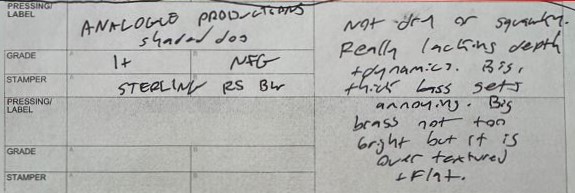
As you can see from our notes for the this Heavy Vinyl Analogue Productions pressing, the thrill was barely there on the first side, and by the second side it was completely gone.

The notes from our 2024 shootout read:

  • Not dry or squawky
  • Really lacking depth and dynamics.
  • Big, thick bass gets annoying.
  • Big brass not too bright but it is over-textured and flat.

Plenty of modern records suffer from these as well as lots of other shortcomings. For some reason, the writers for The Absolute Sound who put this crappy LP on their Super Disc list didn’t seem bothered by them the way we were.

If you own this pressing, here are the kinds of things you might want to listen for in order to recognize its many, and quite serious, failings.

When played head to head against any properly-mastered vintage vinyl LP, this pressing will fall short in a number of important areas. Linked below are titles we’ve found to be good for testing these same qualities in a recording.

(more…)

What to Think When a New Version of Graceland Is Completely Unrecognizable?

Hot Stamper Pressings of the Music of Paul Simon Available Now

Where did this thick, dull, bloated, opaque turd come from?

Having played at least 50-75 copies of the album over the last ten years, I can honestly say I have never heard one that sounded like this new version (maybe some record club copy we picked up by accident did, can’t say it never happened).

Can that possibly be a good thing?

Well, in favor of that proposition, I guess you could say it sounds less like a CD now.

On the other side of the ledger, it now sounds a great deal more like a bad LP.

We listen to piles of pressings of Graceland regularly. We know what the album generally sounds like, the range from bad to good, and we know what qualities the very best copies must have in order to win one of our shootouts.

Above all the one thing Graceland has going for it sonically is CLARITY. It can be open and spacious, tonally correct, with punchy, tight bass and present, breathy vocals. The best of the best copies have all these qualities, but the one quality any good copy must have is clarity, because that’s what’s good about the sound of the record. Without clarity the music doesn’t even work.

The new version has been “fixed.” It got rid of all that pesky grit and grain and CD-like sound from the original digital mix by simply equalizing them away.

Cut the top, cut the upper mids, boost the lower mids and upper bass and voila – now it’s what Graceland would have sounded like had it been all analog from the start, AAA baby!

Or at least analog for those who don’t know what good analog sounds like.

But it never was all analog, and trying to make it sound that way just ruins the one quality that it actually had going for it — clarity.

VTA

You can adjust your VTA and other table settings until you’re blue in the face, you’ll never get this pressing to sound right, and you’ll certainly never get it to sound very much like any Sterling original pressing I’ve ever heard.

The digital spit and grit is still there, under the darker EQ. And now it’s even worse — Simon’s voice has a thick, dull blanket over it, but you can still hear the spit underneath it.

You could probably take the CD and equalize it to sound like this record. But what would be the point?

The Bright Side

Well, perhaps there is a point to this equalization madness.

The CD already exists. It has a sound.

The original record has a sound too, and it’s a fairly common LP in the used bins. You could buy two or three for not that much money and try to find one you like better than the vinyl version you probably already own.

(more…)

A Simple Listening Test Makes It Easy to Judge Pressings of Scheherazade

Hot Stamper Orchestral Pressings Available Now

The Classic reissue of LSC 2446, as well as the Analogue Productions version from 2013 (the original 33 is the only one I have played, mastered by Ryan Smith at Sterling), are both disasters for many reasons, but they do have one specific failing that is easy to recognize.

Both pressings are worth further discussion and analysis because they provide an easy test that can show you how wrong they are.

When reading the commentary below, keep in mind that what is bad about the Classic Records reissue from 1995 is what is bad about the Analogue Productions remaster put out many years later.

As I noted for some of the Classic Heifetz titles a while back, for all I know the CDs for his Living Stereo recordings may have better sound. That’s probably the first place to go, considering Classic’s rather poor track record regarding the remastering of his music.

Case in point: The Living Stereo CDs I own (both the CD and the SACD) of Scheherazade are dramatically better than the awful Classic Records pressing of it.

Audiophiles who don’t notice what is wrong with the Classic pressing need to get hold of a nice RCA White Dog pressing to see just how poorly the Classic stacks up. (They could even find one that’s not so nice and listen through the surface noise. The difference would still be obvious.)


UPDATE 2025

It has been many years since a White Dog pressing won a shootout. In our last listing for a Hot Stamper White Dog pressing in 2024, we noted:

Now that we know which stampers have the potential to win our shootouts, the right Shaded Dog originals have lately been coming out on top, although the White Dog pressings can still sound quite good, just not as good.

No White Dog earned a higher grade than 2+, and none of the three WD pressings we had on hand earned 2+ on both sides.

Our notes for the various sides of the WD pressings read: “a bit brash, sometimes squawky, dry and bright,” and the like.

Those of you looking for the best sound should stick to the Shaded Dog label originals. They are rich and lush in a way that the WD reissues in our experience never are. I used to swear by the WD reissues, but I see now how wrong I was. My judgments were colored by a darker, less revealing stereo than the one we use now, and that makes all the difference in the world.


Back to LSC 2446

The solo violin in the left channel at the opening of the first movement should be all it takes to hear what is wrong with the modern remastered pressings.

Anyone has ever attended a classical music concert will have no trouble recognizing that the violin on any of the Heavy Vinyl pressings, including the Analogue Productions pressing, is completely wrong and sounds nothing like a violin in a concert hall would ever sound.

And I mean ever.

No matter where you might be sitting.

No matter how good or bad the hall’s acoustics.

The violin on these Heavy Vinyl pressings is dark, it’s veiled, and it’s overly rich, as well as lacking in overtones.

Solo violins in live performance never sound like that.

They are clear, clean and present. You have no trouble at all “seeing” them, no matter where you sit.

(more…)

The Graceland Remastering Disaster, Part 2

Hot Stamper Pressings of the Music of Paul Simon Available Now

Click on the link below to read the story behind an interview conducted by a well-known reviewer of an engineer who was tasked (by whom I wonder?) with remastering Graceland on Heavy Vinyl.

He apparently had never played an original Sterling-mastered copy of Graceland. Either that, or this  engineer thought the original “needed improvement,” the kind supplied by taking a hatchet to the sound of the original tape.

Analogplanet Visits Sterling Sound and Interviews Mastering Engineer Ryan K. Smith

The interviewer apparently does not know how bad the new version sounds, but we had no trouble recognizing its awfulness here at Better Records. As a public service, we soon set about describing what we heard when we put this remastered piece of junk to the test.

Up against a properly-mastered, properly-pressed early pressing, it earned a failing grade.

Is it the worst version of the album ever pressed on vinyl? Hard to imagine it would have much competition. 

The title of our review gives away the game:

The reviewer who interviewed the remastering engineer responsible for this and no doubt many other awful sounding records has never been able to tell a good record from a bad one, and he carries on that tradition with Graceland.

Ryan Smith, the hack who cut this album, has done quite a lot of work for Analogue Productions. We can’t say we’ve played many of his recuts, but the ones we have played are hopelessly bad, with the overly smooth sound so much in vogue today.

We played his recut of Scheherazade, and rather than just give it the failing grade it deserved, we explained how any audiophile could go about using its mistaken EQ in order to recognize what is wrong with it, and of course, others like it.

(Contrary to popular opinion, it is no better than Bernie Grundman’s bad sounding version from the 90s, the one he cut for Classic Records.)

One of my good customers read this rave review from this same reviewer for the Texas Hurricane Box Set and made the worst mistake any audiophile can make: he believed it.

“His overdriven Stratocaster sound is one that guitar aficionados never tire of hearing live or on record, especially when it’s well recorded. … Yet again, Chad Kassem sets high the box set reissue bar delivering a “must have” package for SRV fans, every bit the equal of the one Doors fans have come to cherish. …every one of these records betters the originals and by a considerable margin. It is not even close…You’ve never heard these albums sound like this. That is a 100 % guaranty. …this is an impeccably produced box set physically and especially sonically. It’s the best these albums have ever and probably will ever sound.” — Music = 9/11; Sound = 10/11 — Michael Fremer

Sure, he’s out $400, but on the bright side he’s now learned a lesson he is very unlikely to forget.

(more…)

Stevie Ray Vaughan Box Set – One Customer’s Take on the Analogue Productions 45 RPM Remaster

A good customer bought some SRV Hot Stampers from me a while back. He then told me he was going to spend $400 on the AP SRV Box Set

Hey Tom,

For kicks on this issue of heavy vinyl vs. hot stampers, I’m tempted to order the ‘Texas Hurricane’ box set — 45rpm, 200g etc. — and shoot it out against the SRV records I’ve got from you.

Would you be interested to know how that goes?

In the admittedly unlikely event that the heavy vinyl smoked the hot stampers, would you take them back? Easy to sell the heavy vinyl on without losing money, but not so much the hot stampers.

Just an idea… I’m delighted with what I have from you, but so curious to learn more by comparing etc. Could be fuel for a cool blog post in due course…

CF

I replied:

Oh, I think you are in for quite a shock, and of course we would take our copies back, but I would give you very good odds that that will never happen as long as you have two working ears.

A few weeks go by.

Tom,

So the results are in … after listening to Texas Hurricane (at 45rpm) and comparing to the White Hot Stamper versions of the same albums I can say… as a musical experience it’s incomprehensible. It just doesn’t rock, doesn’t uplift, and it’s veiled, so you lose the whole meaning of this music, the energy, soul, life.

I wasted $400 to find this out. Any chance you have another customer who’d like to relieve me of it to do their own shootout?

I’ll never doubt you again : )

CF

Good to know you will never doubt me again! Always think back to the sour taste in your mouth and the painful throbbing in your brain from playing this heavy vinyl garbage and perhaps you will never be tempted again. If you feel the urge to cross over to the dark side, please email me and I will do my best to talk you out of it. That way lies madness (and audio frustration).

TP

Here’s the $32,000 Question

Is this a bad sounding record?

I don’t know, never played it.

Is it worth it to you to spend $400 to find out?

Does Analogue Productions have a pretty good track record to rely on in these matters?

Or are they, as I have been saying since 1995, one of the worst labels of all time?

In another commentary I wrote: (more…)