 More of the music of Jean Sibelius (1865-1957)
More of the music of Edvard Grieg (1843-1907)
Sonic Grade: F
Classic Records ruined this album. Their version is dramatically more smeared and low-rez than our good vintage pressings, with almost none of the sweetness, richness and ambience that the best RCA pressings have in such abundance.
[This turns out not to be true, as we discovered to our chagrin in 2014.]
In fact their pressing is just plain awful, like most of the classical recordings they remastered, and should be avoided at anything other than a nominal price.
Our current favorite pressing is this one on a budget Decca reissue. Go figure.
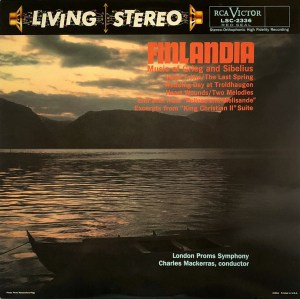 If you’re tempted to pick one up for a few bucks to hear how badly mastered their version is, go for it. If you actually want a record to play for enjoyment, don’t bother — it’s a complete waste of money.
It is yet another example of a record that has no business being on the TAS List.
Most audiophiles (including audiophile record reviewers) have never heard a classical recording of the quality of the best Living Stereo pressings like those we sell. If they had, Classic Records would have gone out of business immediately after producing their first three Living Stereo titles, all of which were dreadful and described as such by us way back in 1994.
I’m not sure why the rest of the audiophile community was so easily fooled, but I can say that we weren’t, at least when it came to their classical releases.
Classical Music on Vinyl — An Overview
We sometimes mention the benefits to be gained from listening to classical music on a regular basis. Once a week is a good rule of thumb for playing a recording from the classical world I should think.
We all love our rock, jazz, folk and the rest, but there is something about classical music that has the power to restore a certain balance in your musical life that, for whatever reason, cannot be accomplished by other kinds of music. Perhaps it grounds your listening experience in something less immediately gratifying, yet the experience is both deeper and more enriching over time.
Once habituated to the effect, the changes in one’s mood are easy to recognize.
Moving Beyond the Average
Of course it should be pointed out that the average classical record is at best a mediocrity and more often than not a sonic disaster. There are many excellent pressings of rock and jazz, but when it comes to classical music — by its nature so much more difficult to record (and reproduce!) — the choices narrow substantially.
Most of what passed for good classical sound when I was coming up in audio — the DGs, EMIs, Sheffields and other audiophile pressings — are hard to take seriously when played on the modern high quality equipment of today.
We probably audition at least five or ten records for every one we think might pass muster in a future shootout, and we’re pulling only from the labels we know to be good. We wouldn’t even waste our time playing the average Angel, Columbia or DG, or EMI for that matter. The losers vastly outweigh the winners, and there are only so many hours in a day. Who has the time to hunt for so few needles in so many haystacks?
Commitment of Resources
With the above in mind, it should be clear that assembling a top quality classical collection requires much more in the way of resources — money and time — than it would for any other genre of music. We are happy to do some of that work for you — our best classical pressings are amazing in almost every way — potentially saving you a lifetime of work. But we do so at a price; the service we provide is time-consuming to carry out and, as you may have noticed, vintage classical records are not getting any cheaper or easier to find.
On the positive side, every Hot Stamper we sell is 100% guaranteed to satisfy in every way: music, sound, and playing condition. Ideally this means less work for you and more time for listening enjoyment on a weekly basis, or more if you can manage to carve it out of your schedule.