flat-sound

These records sounded flat to us. They were badly lacking in depth and three-dimensionality, two qualities that vintage vinyl pressings often have in abundance.

Audiophiles Should Skip Swingin’ the ’20s on OJC

Hot Stamper Pressings of Contemporary Jazz Records Available Now

This album is fairly common on the OJC pressing from 1988, but more recently we’ve found the sound of the OJC pressings we’ve played seriously wanting. They have the kind of bad reissue sound that plays right into the prejudices of record collectors and audiophiles alike, the kind for whom nothing but an original will do.

They were dramatically smaller, flatter, more recessed and more lifeless than even the worst of the ’70s LPs we played. (We tend to like those, by the way.)

The lesson? Not all reissues are created equal. Some OJC pressings are great — including even some of the new ones — some are awful, and the only way to judge them fairly is to judge them individually, which requires actually playing a large sample.

Since virtually no record collectors or audiophiles like doing that, they make faulty judgments – OJC’s are cheap reissues sourced from digital tapes, run for the hills! – based on their biases and reliance on inadequate sample sizes.

You can find those who subscribe to this approach on every audiophile forum there is. The methods they have adopted do not produce good results, but as long as they stick to them, they will never have to worry about discovering that inconvenient truth.

(more…)

We Don’t Offer Domestic Pressings of Pour Down Like Silver for One Very Simple Reason

Hot Stamper Pressings of the Music of Richard Thompson Available Now

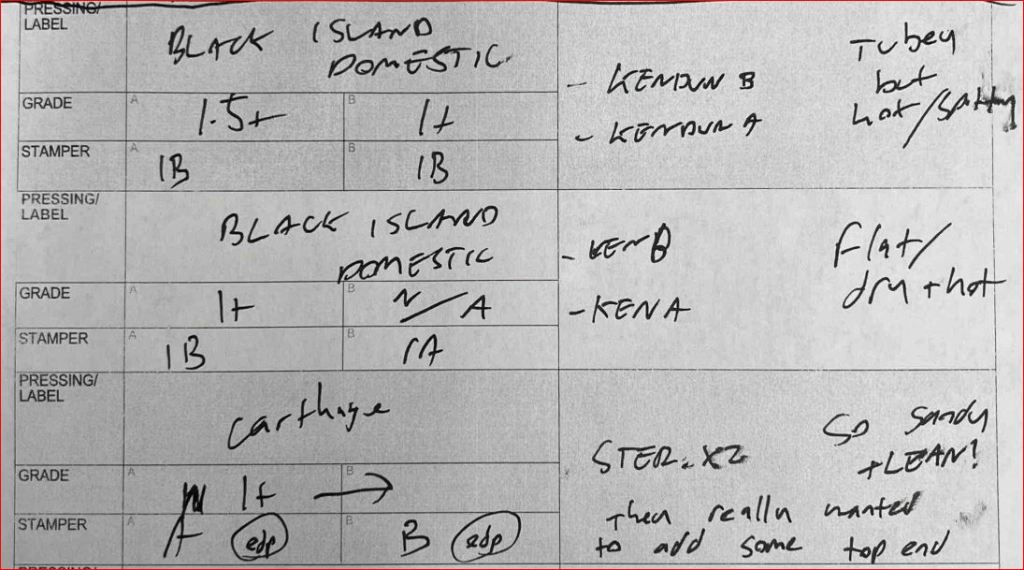
In spite of the fact that the domestic pressings of this Richard and Linda Thompson classic from 1974 were mastered by the likes of Kendun and Sterling — two of the greatest mastering houses of all time, — they have never impressed us with their sound quality.

The biggest problems with this record would be obvious to even the casual listener: gritty, spitty vocals; lack of richness; bright tonality; lack of bass; no real space or transparency, etc.

The domestic Island pressings did not do nearly as well in our shootout as the best Island imports, no surprise there as the early UK records were mastered by one of our favorite engineers.

Avoid the Carthage pressings mastered by Sterling. They came in last in our shootout.

The domestic breakdown follows:

Black Island Domestic #1

  • Tubey but hot and spitty.

Black Island Domestic #2

  • Flat, dry and hot (glary or bright)

Carthage Domestic recut from 1983, Sterling on both sides

  • So sandy and lean! They really wanted to add some top end (!)

Defending the Indefensible

(more…)

Getz Au Go Go on Polygram – Isn’t This Record Supposed to Be Stereo?

Hot Stamper Pressings of Bossa Nova Albums Available Now

As part of our recent [probably from 2011] shootout for the album, one of the pressings we played was a later reissue, most likely from the late 70s or early 80s.   

As a general rule we make a point to go out of our way to play practically any copy we can get our hands on, in the off chance that a reissue will beat the original. It’s happened plenty of times. Those of you with White Hot Stamper shootout winning copies of some of our favorite titles know what I’m talkin’ about.

Imagine our surprise when this pressing — in a stereo jacket, with a label with the word “stereo” printed right on it — turned out to be dead MONO.

The sound was godawful — small, flat, and bereft of the ambience that makes this recording so enjoyable. The same would probably be true for the mono originals, but since I haven’t played one of those in decades I will just say that that would be no more than a guess, albeit an educated one.

Yet another reason not to believe a word you read on an album jacket or label.

A public service from your record loving audiophile friends here at Better Records. (more…)

Coltrane’s Sound – Forget the 70s Reissues

Hot Stamper Pressings of the Music of John Coltrane Available Now

This is yet another superb Tom Dowd recording of Coltrane in his prime, with support from the brilliant McCoy Tyner and Elvin Jones.

Just don’t bother with the later Red and Green Atlantic pressings.

Every one we’ve ever played was flat, dry, and thin. They sound like most of the cheap reissues that Atlantic churned out in the ’70s.

Don’t get me wrong; there are some good sounding records on the Red and Green label, but you really have to know what you are doing — or be really lucky — to find them.

We’ve played them by the score, and found relatively few winners among a slough of losers. If you want to take your chances on some, knock yourself out, more power to you, but expect to come up with nothing to show for your time and money almost every time. That’s been our experience anyway.

And be very thankful if you happen to run into one of these early Atlantic stereo pressings, especially if it plays quietly. Few Classic Coltrane albums survived the jazz lovers of the day and their awful turntables.

(more…)

Kevin Gray Sacrifices Another Blue Note to the Lo-Fi Crowd

Hot Stamper Pressings of Blue Note Recordings Available Now

We did a shootout for Cornbread in 2023 and again in 2025. For our latest one, we were fortunate to be able to include both the Tone Poets pressing that came out in 2019 as well as the 75th Anniversary Blue Note pressing from 2014.

Here is the way we described a Hot Stamper that ended up being the best sounding pressing we played on one of its sides, and coming in second on the other side.

  • The sound is everything that’s good about Rudy Van Gelder‘s recordings – it’s present, spacious, full-bodied, Tubey Magical, dynamic and, most importantly, alive in that way that modern pressings never are
  • Exceptionally spacious and three-dimensional, as well as relaxed and full-bodied – this pressing was a big step up over nearly all other copies we played

After hearing a copy of the album that sounded as good as that one, the Tone Poets pressing would have had to be at least a bit of a letdown, right?

To be fair, all it really has to be is good sounding. For $30, the price of the average copy that sells on Discogs, can you really expect great?

I don’t know what any of the purchasers of these Tone Poets records — of this or any other title — are expecting for their thirty bucks, but I can tell you what they are getting. We took notes while their remastered pressing played, and here’s what we heard.

Side One

(more…)

How Do the Early Pressings of The Poll Winners Sound?

Hot Stamper Pressings of Contemporary Jazz Albums Available Now

A recent Shootout Winning copy with the early stereo badge cover was described this way:

Stunning sound throughout this vintage Black Label Stereo Records pressing, with both sides earning Shootout Winning Triple Plus (A+++) grades or close to them

Roy DuNann always seems to get the real sound out of the sessions he recorded – amazingly realistic drums in a big room; Tubey Magical guitar tone; deep, note-like bass, and on and on

4 1/2 stars: “The choice of material, the interplay between the three players, and the lead work all meld together beautifully on The Poll Winners, making it a classic guitar album in a small-group setting.”

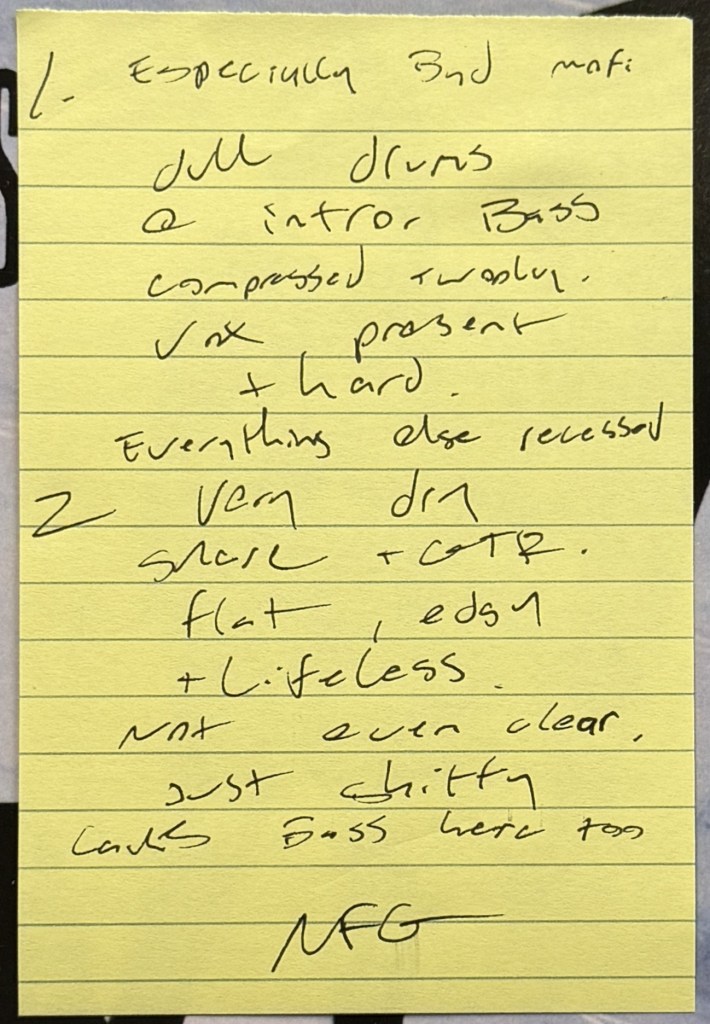
Musically, all true. Sonically, not so much. The early D1/D2 stampers on the early Black Label might be passable on side one (1+), but side two was just a mess (NFG).

Side One

Track Two

  • A bit bright and flat

Track One

  • Very clear but lacking richness, weight and depth
  • Thin, and bright up top
  • 1+

Side Two

Track One

  • Narrow stereo field
  • Weird tape hiss
  • Metallic top end
  • Very recessed and weird
  • Nope

A different Stereo Badge Cover copy sporting a Black Label won the shootout by the way. Go figure.

(more…)

VICS 1069 – In 2004 We Mistaked Finlandia on VICS for a Demo Disc

Hot Stamper Pressings of the Music of Sibelius Available Now

UPDATE 2024

We played a 4S/1S copy of this record, VICS 1069, and thought it sounded terrible.

It was flat and bright with splashy cymbals and crude brass.

Even if we assume the copy we played many years ago could have been much better than this latest pressing — which is doubtful but certainly possible — there is no reason to pursue this version of the album when there are known top quality pressings of this very same performance on Decca.


Our Old Review

DEMO QUALITY SOUND and quiet surfaces too.

I don’t know when I’ve heard this album with better sound. This one may be better than the best Shaded Dog for all I know — it’s that good.

You’ll notice that there is a copy of this very same record on the website for $1.99. That one sounds dull. I don’t think you’ll be able to find a better sounding copy of this record than the pressing we are selling here, because it really is an exceptionally good sounding record. If it weren’t, it would be more like $1.99.

(more…)

I’m Starting to Get a Bad Feeling About Record Store Day

Hot Stamper Pressings of the Music of Neil Young Available Now

For some reason, don’t ask me why, they keep hiring Chris Bellman to make Heavy Vinyl reissues of Neil Young’s albums, even though he has shown again and again that he has no idea what these recordings are supposed to sould like.

So far he’s ruined After the Gold Rush and Neil Young’s Greatest Hits, and there may be others he’s remastered to death, but no copies of those have come our way so we really don’t know, or care to know, to be honest.

If this is your idea of analog, you are most likely in the wrong hobby and should consider finding a different one. At the very least you are wasting your time and money on worthless crap vinyl pressings put out by the legion of Heavy Vinyl Grifters who emerge from the bowels of the earth on Record Store Day, targeting their rip-off LPs at the low- to mid-fi vinyl collector types who have yet to figure out what a giant scam the whole thing is.

These records have virtually no redeeming features, none that we could find anyway. Allow us to catalog the shortcomings of the three sides that comprise the 2017 Record Store Day release of Harvest Moon.

For the first time in five years we had finally been able to do a shootout for the imports we like, so we knew exactly how good the best pressings could sound. Long story short, they sure don’t sound like this!

Side One

Track Two (From Hank to Hendrix)

  • Blary harmonica
  • Much more treble
  • Still flat and dry
  • Just louder with less bottom
  • Edgy vocals in the chorus

(more…)

Is CTFR-1 Dark and Congested, or Flat and Bright?

Hot Stamper Pressings of Mercury Classical Records Available Now

For Mercury classical and orchestral recordings, the original RFR-1 pressings on the plum label are the way to go, right? 

In some cases, yes. The first pressings of Mercury albums often win our shootouts.

And for both sides of a copy to win a shootout, like our gold promo seen in the stamper sheet below, everything about the pressing must be right. We call records that win their shootout, earning 3+ grades on both sides, Top Shelf pressings. They are rare and special enough to have a section of their own on the site (which, as of this writing, has all of 19 records in it.)

What we find to be interesting about this specific shootout, however, is that we had two later pressings, both with the same stampers, and they sounded markedly different from each other. (Note that the stamper numbers you see below belong to a different album than the one shown above.)

If a collector were to tell you that that the CTFR pressings tend to be dark and congested, and you owned one with the exact same stampers, CTFR-1, you might be inclined to agree with this person.

But if you were the owner of the copy we played that was flat and bright, again, with CTFR-1 in the dead wax of both sides, you would think this person was 1.) Out of his mind, or, 2.) Deaf as a post, or, 3.) The owner of some very inaccurate playback equipment.

He could be all three, but in this case, an unusual one to be sure, his copy of the album doesn’t tell you anything about the sound of your copy of the album. They could match, or they could be completely different. Some records are like that. Not all that many, but definitely some.

Sample Sizes and One Man Bands

Those of us who play a variety of pressings of the same album know how easy it is to draw mistaken conclusions about records. CTFR-1 on this title is the perfect example of a record whose stampers don’t tell you much about its sound. (Even RFR-1 on side one of one copy was no better than “good,” quite a long ways from the best.)

(more…)

On this Wonderful Sounding London, Is Ted Burkett’s 2G Stamper the Way to Go?

Hot Stamper Pressings of Recordings by Decca Available Now

Before we go any further, let me say that the record you see pictured is not the record whose shootout and stampers we are about to discuss.

Yes, that’s right, the stamper numbers you see below belong to a different album.

We’ve lately been giving out much more stamper information than we used to, but for now we are keeping this title close to the vest.

What can we learn about the best sounding pressings of this vintage Decca recording, mastered by Mr. E and Mr. G, both outstanding mastering engineers?

It seems that Mr. G cut the better sounding pressing, our shootout winner as a matter of fact, but I can’t say whether the pressing that won was an original, since there were two differently-mastered Blueback pressings in the shootout, and one of them came in tied for last.

It was actually beaten by two copies of the Whiteback reissue. Those seem to be made from the same stampers as the winning pressing, but are those stampers the earliest or did they come later? Who knows?

Mr E. cut a version of the record that was quite a bit less impressive than most of the others, earning grades of 1.5 on side one and 2+ on side two.

Side one was dry and flat, side two rich but hard. We hear a lot of records with these shortcomings. If you play lots of classical music on vintage vinyl, you should be hearing them too.

And Your Point Is?

(more…)