pi-con-comm

Letters and commentaries on piano concerto recordings we’ve played.

For Concerto No. 1, This Is the Way the Piano Should Sound

Hot Stamper Living Stereo Classical and Orchestral Titles Available Now
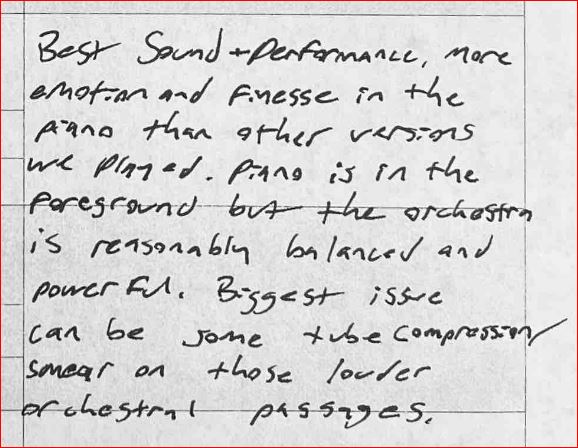
We love the huge, solid and powerful sound of the piano on this recording. This piano has weight and heft. As a result, it sounds like a real piano.

For some reason, a great many Rubinstein recordings are not capable of reproducing those all-important qualities in the sound of the piano.

Those are, as I hope everyone understands by now, the ones we don’t sell. If the piano in a piano concerto recording doesn’t sound solid and powerful, what is the point of playing such a record?

Or, to be more accurate, what is the point of an audiophile playing such a record? (Those of you who would like to avoid bad sounding vintage classical and orchestra records have come to the right place. We’ve compiled a very long list of them precisely for that purpose, and we’ve been adding to it regularly.)

No doubt Kenneth Wilkinson made sure the recording captured the weight of the piano he was listening to as it played all those years ago in the wonderful acoustics of Kingsway Hall.

The strings have lovely Living Stereo (Decca-engineered) texture as well.

As befits a Wilkinson recording from 1961, there is no shortage of clarity to balance out the Tubey Magical warmth and richness.

When you add in the tremendous hall space, weight and energy, this becomes a Demo Disc orchestral recording by any standard.


Notes from a 2024 Shootout

Our notes above point out that:

(more…)

An Amazing Recording Held Back by Truly Awful Mercury Mastering

Hot Stamper Mercury Pressings Available Now

This Mercury 35mm recording was released through Philips after they’d bought the Mercury label back in the 60s.

Philips would go on to release the mostly dreadful Golden Import pressings that were made from all the most famous Mercury recordings, but of course they sounded a great deal more like Philips recordings than Mercury recordings once they had been remastered.

Some things never change. Do you like the sound Steve Hoffman brought to the DCC vinyl releases? You can be sure you will get plenty of that sound and very little of any other. We call that My-Fi. Once we learned to recognize it, something we admit took us longer than it should have, we became ardently opposed to it.

If you think that the right way to remaster records is to make them sound more like you want them to sound and less like the scores of vintage pressings sounded before, you and I are clearly in different camps. (One listen to a Hot Stamper pressing may be all that it takes to get you to switch camps.)

This album was recorded by Robert Fine and Wilma Cozart, then mastered by George Piros, all members of the legendary Mercury team, revered by the audiophile cognoscentias as true giants , and with good reason. We count ourselves among Mercury’s biggest fans.

It is instructive to note that the Philips mastering in this case is dramatically superior to the mediocre Mercury mastering by Robert Fine, which may strike you as counterintuitive, but is nonetheless a fact that cannot be denied once you have played a sufficient number of copies of each version, as we have.

(more…)

Skip the Beethoven Piano Concerto No. 5 with Curzon

Hot Stamper Pressings of Recordings by Decca Available Now

We tried the pressings of CS 6019 mastered by Stan Goodall first, but they turned out to have sound that was disappointing.

Nothing surprising there. Happens all the time.

In the spirit of adventure, we thought we would take another crack at the album after learning that Tony Hawkins had also cut some pressings. Maybe he did a better job.

You never know, right?

No dice. Both were at best passable. In our world, the world of Hot Stamper pressings with exceptionally good sound, that’s a death sentence. We don’t sell passable sounding records, not at the prices we charge. Audiophiles can find those on their own.

If you like this Beethoven piano concerto, consider trying some copies of the recording Rubinstein made for RCA. (Stick with the Shaded Dog pressings for best results.)

(more…)

LSC 2429 – Grieg & Liszt with Rubinstein – You Can Do Better

Hot Stamper Pressings of the Music of Grieg Available Now

UPDATE 2026

This is a very old review of LSC 2429, which we ourselves may no longer agree with.

If you see this record in the bins for cheap, give it a try, but don’t pay a lot on our say-so.

Our two favorite recordings of the Grieg Piano Concerto are the Decca with Lupu and Previn from 1973 and Rubinstein’s for RCA in 1962. Either one should be superior to the Living Stereo Shaded Dog we review here.


The strings are RICH in the best Living Stereo tradition, but unlike so many classical pressings we play, the tubey magical string tone comes with virtually no tube smear. The textures and overtones are fully intact.

(more…)

Brahms / Piano Concerto No. 1 on Speakers Corner Heavy Vinyl

UPDATE 2026

This review was written in the 90s, back in the days when we were selling Heavy Vinyl records. We had auditioned it and found it to be one of the better releases from Speakers Corner.

Based upon that very unreliable assessment from many, many decades ago, it might still be one of the better Heavy Vinyl pressings from the label. If you can pick one up for cheap, give it a try and see if we were right that it’s “good.”

Of course, the right London pressing would be a huge step up in sound quality for those who have the means to acquire one.


Our Old Review

One of the best of the Speakers Corner heavy vinyl reissues. As you may know they have gone way downhill lately. Haven’t played this LP in a while but I remember liking it quite a bit back in the day.

As a general rule, this Heavy Vinyl pressing will fall short in some of the following areas when played head to head against the vintage pressings we offer:

(more…)

Grieg / Piano Concerto – Speakers Corner

Hot Stamper Pressings of the Music of Edvard Grieg Available Now

We used to think this was one of the better Speakers Corner Deccas.

We haven’t played a copy of this record in years, but back in the day we liked it, so let’s call it a “B” with the caveat that the older the review, the more likely we are to have changed our minds. Not sure if we would still agree with what we wrote back in the ’90s when this record came out, but here it is anyway.


One of the best Deccas — superb sound and music that belongs in your life!

This performance also includes Franck’s “Variations Symphoniques” and Litolff”s “Scherzo from Concerto Symphonique, Op. 102”.


Our two favorite recordings of the Grieg Piano Concerto are the Decca with Lupu and Previn from 1973 and Rubinstein’s for RCA in 1962.

This Speakers Corner title may be good, but our Hot Stamper classical and orchestral pressings will be dramatically more transparent, open, clear and just plain REAL sounding, because these are all the areas in which Heavy Vinyl pressings tend to fall short in our experience.  For more on that subject, see here and here.

(more…)

Piano Concerto Testing and Inner Groove Distortion

Hot Stamper Pressings of the Music of Rachmaninoff Available Now

The piano is huge and weighty, the strings rich and highly resolving, and the overall presentation is powerful, balanced, dynamic and exciting like few other piano concerto recordings we have ever had the pleasure to audition.

Not only is the sound amazing — yes, it’s on the TAS Super Disc list, and for good reason: a copy as good as this one really is a Super Disc — but this copy has another vitally important characteristic that most copies of the record do not: no inner groove distortion.

We can’t begin to count the times we have had to return (or toss) a copy of one of these expensive Byron Janis records because the piano breakup for the last inch or so of the record was just unbearable. That’s a sound no serious listener could possibly tolerate, yet I would venture to guess that many Mercury piano concerto recordings suffer from this kind of groove damage.

As a matter of grading policy, we check the inner grooves of every record we offer on the site,

The Sound

The sound is rich and natural, with lovely transparency and virtually no smear to the strings, horns or piano. What an amazing recording! What an amazing piece of music.

The recording is explosively dynamic — on the best copies the sound comes jumping out of the speakers. In addition, the brass and strings are full-bodied, with practically no stridency, an unusual feat the Mercury engineers seem to have accomplished while in Russia (and not as often in the states).

Big, rich sound can sometimes present problems for piano recordings. You want to hear the percussive qualities of the instrument, but few copies pull off that trick without sounding thin. This one showed us a piano that was both clear and full-bodied.

With huge amounts of hall space, orchestral weight and performance energy, this is Demo Disc quality sound by any standard. Once the needle has dropped you will quickly forget about the sound (and all the money you paid to get it!) and simply find yourself in the presence of some of the greatest musicians of their generation, captured on one of the greatest analog recordings of all time.

Fine and Cozart

The piano is huge and powerful, yet the percussive and lighter qualities on the instrument are clearly heard in proper relation to the orchestra as a whole.

I simply cannot criticize the work that Fine and Cozart have achieved with this recording, and believe me, there are very few records in this world about which I could not find something to criiticize. After all, it is our job, and we like to set very high standards for the work we do.

Lately we have been writing quite a bit about how good pianos are for testing all aspects of your system, room, tweaks, electricity and the rest, not to mention turntable setup and adjustment.

  • We like our pianos to sound natural (however one chooses to define the term).
  • We like them to be solidly weighted.
  • We like them to be free of smear, a quality that for some reason is rarely mentioned in most audiophile reviews.

Our twenty or so of our favorite piano concerto recordings with top quality sound can be found here.

To read the 50 reviews and commentaries we’ve written for some of the greatest piano concerto recordings ever pressed on vintage vinyl, please click here

(more…)

VICS-1030 Can Have Passable Sound for Chopin’s Piano Concerto No. 1

Hot Stamper Pressings of Living Stereo Recordings Available Now

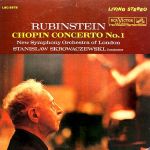
Our favorite recording for performance and sound is the Living Stereo from 1961, LSC 2575, with Rubinstein at the piano and Skrowaczewski conducting the New Symphony Orchestra of London.

This Victrola pressing, VICS-1030, with Graffman performing, had good, not great sound. We’ve played them before and none of them was ever better than middling.

Some specifics we noted in the sound:

  • The piano was loud and clear, close-miked.
  • Boxy sound, could be richer
  • Orchestration not too compressed but veiled and small.
  • Not a standout performance.

A decent-enough record I suppose, but lacking in too many of the qualities our customers are looking for, especially at the prices we charge.


This is what we had to say about the sound of our Shootout Winner for LSC 2575:

We love the huge, solid and powerful sound of the piano on this recording. This piano has weight and heft. As a result, it sounds like a real piano.

For some reason, a great many Rubinstein recordings are not capable of reproducing those seemingly all-important qualities in the sound of the piano.

Those are, as I hope everyone understands by now, the ones we don’t sell. If the piano in a piano concerto recording doesn’t sound solid and powerful, what is the point of playing such a record?

Or, to be more accurate, what is the point of an audiophile playing such a record? (Those of you who would like to avoid bad sounding vintage classical and orchestral records have come to the right place. We’ve compiled a very long list of them for precisely that purpose, and we add to it regularly, a public service from your friends here at Better Records.)

(more…)

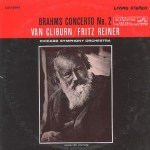
White Dogs or Shaded Dogs on the Brahms Piano Concerto No. 2?

Hot Stamper Pressings of Living Stereo Titles Available Now

UPDATE 2024: The review you see below is quite old. We no longer agree with the statement we made back then that the White Dog pressings are better sounding than the Shaded Dogs.

In our recent shootout, the first one I can remember since 2005 — that was 20 years ago! — the White Dogs did not do nearly as well as the Shaded Dogs we played.


This White Dog pressing is the best sounding copy I’ve ever heard, much better than the earlier pressings. The piano doesn’t break up like it does on those, especially in the second movement.

Finally the piano sounds right – solid and with the correct overtones. It goes without saying that this is an exceptionally good performance as well.

One of the best of the Cliburn recordings which, as you may know, are rarely any good, the worst of them being LSC 2252 and the best of them being, probably, LSC 2507.

Seems we got some of this one wrong. Live and learn is our motto, with mea culpa running a close second.

It’s possible that our mistaken judgment about the superiority of the White Dog pressings in 2005 was mostly the result of sample sizes that were much too small. However, I was operating as a one man band back when I was doing all the classical shootouts, so my chances of getting the wrong answer were fairly high, a reality I have documented on this blog in some detail.

I also was not able to clean the records under comparison very well, a problem that has been solved — and then some — by a great many improvements in techniques, machinery and fluids over the last twenty years.

What we could do back then and what we can do now, after twenty years of constant improvement, are as different as night and day, a subject we write about quite a bit under the heading of audio progress.

I’ve also made a habit of admitting my mistakes in the hopes that other audiophile reviewers would consider following suit. To my knowledge this has yet to happen, but hope springs eternal!

(more…)

Now That’s the Way a Piano Should Sound!

On the best copies the rich texture of the strings is out of this world — you will have a very hard time finding a DG with better string tone.

The best pressings of this recording have none of the shortcomings of the average DG: it’s not hard, shrill, or sour.

DG made plenty of good records in the 50s and 60s, then proceeded to fall apart, like most labels did. This is one of their finest. It proves conclusively that at one time — 1962 to be exact — they clearly knew exactly what they were doing.

Without question this is a phenomenal piano recording in every way.

I don’t know of another recording of the work that gets the sound of the piano better. On the better copies, the percussive quality of the instrument really comes through.

It’s amazing how many piano recordings have poorly-miked pianos.

These bad sounding pianos are either too distant, lack proper reproduction of the lower registers, or somehow smear the pounding of the keys into a blurry mess.

Are they badly recorded?

Or perhaps it is a mastering issue?

Maybe a pressing issue?

To be honest, it’s probably all three.

Lately we have been writing quite a bit about how good pianos are for testing your system, room, tweaks, electricity and all the rest, not to mention turntable setup and adjustment.

  • We like our pianos to sound natural (however one chooses to define the term)
  • We like them to be solidly weighted
  • We like them to be free of smear, a quality that is rarely mentioned in the audiophile reviews we read

Other records that we have found to be good for testing and improving your playback can be found here.

(more…)