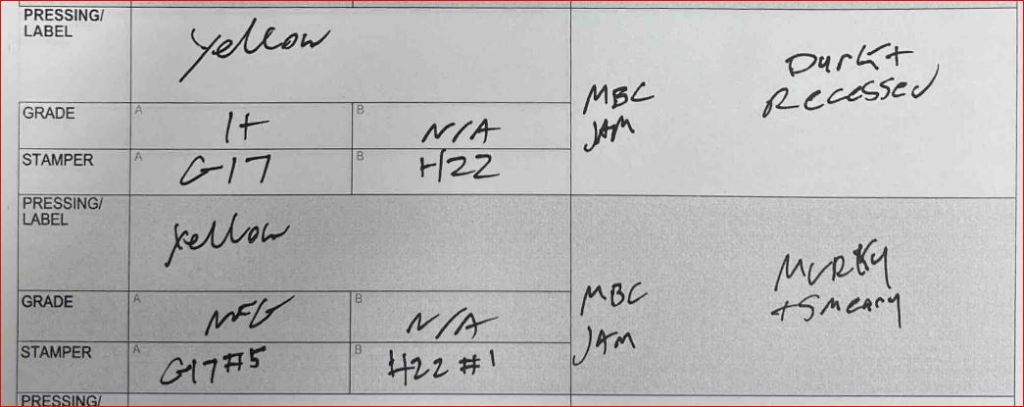
smeary-sound

Smear, a blurring or loss of sharpness of individual notes, refers to missing transient information, the kind most often associated with tube gear.

However, smear occurs with every kind of gear, especially high-powered amps, the kind typically required to power the inefficient speakers audiophiles seem to favor these days.

When we got rid of our tube equipment and high-powered amps, some of the smear in our records disappeared with them.

Once that happened, the smear that is commonly heard on modern Heavy Vinyl repressings became much more noticeable and, as might be expected, even more annoying.

This Tsar Saltan Is Diffuse, Washed Out, Veiled, and Just So VAGUE

Hot Stamper Pressings of the Music of Rimsky-Korsakov Available Now

Sonic Grade: C (at most)

Year ago we cracked open the Speakers Corner pressing shown here in order to see how it would fare up against a pair of wonderful sounding Londons we were in the process of shooting out at the time.

Here’s what we heard in our head to head comparison.

The soundstage, rarely much of a concern to us at here at Better Records but nevertheless instructive in this case, shrinks roughly 25% with the new pressing. Depth and ambience are reduced by about the same amount.

But what really bothered me was this:

The sound was just so VAGUE.

There was a cloud of musical instruments, some here, some there, but they were very hard to SEE. On the Londons we played they were clear. You could point to each and every one. On this pressing that kind of pinpoint imaging was simply nowhere to be found. (Here are some other records that are good for testing vague imaging.)

Case in point: the snare drum, which on this recording is located toward the back of the stage, roughly halfway between dead center and the far left of the hall. As soon as I heard it on the reissue I recognized how blurry and smeary it was relative to the clarity and immediacy it had on the earlier London pressings we’d played. I’m not sure how else to describe it — diffuse, washed out, veiled — just vague.

(Here are some other records that are good for testing the sound of the snare drum.)

This particular Heavy Vinyl reissue is more or less tonally correct, which is not something you can say about many reissues these days. In that respect it’s tolerable and even enjoyable. I guess for thirty bucks it’s not a bad deal.

But… when I hear this kind of sound only one word comes to mind, a terrible word, a word that makes us recoil in shock and horror. That word is DUB. This reissue is made from copy tapes, not masters.

Copies in analog or copies in digital, who is to say, but it sure ain’t the master tape we’re hearing, of that we can be fairly certain. How else to explain such mediocre sound?

Yes, the cutting systems being used nowadays to master these vintage recordings aren’t very good; that seems safe to say.

Are the tapes too old and worn?

Is the vinyl of today simply not capable of storing the kind of magical sound we find so often in pressings from the 50s, 60s and 70s?

Could the real master tape not be found, and a safety copy used to master the album instead?

To all these questions and more we have but one answer: we don’t know.

We know we don’t like the sound of very many of these modern reissues and I guess that’s probably all that we need to know about them. If someone ever figures out how to make a good sounding modern reissue, we’ll ask them how they did it. Until then it seems the question is moot. (Someone did, which proves it can be done!)

Back in 2011 we stopped carrying Heavy Vinyl and most other audiophile LPs of all kinds. (These we like.)

So many of them don’t even sound this good, and this kind of sound bores us to tears.

(more…)

Sterling Cut By Far the Best Sounding Pressings of I’m Ready

Hot Stamper Pressings of Soul, Blues, R&B, etc. Available Now

Forget the reissue copies that come in the cover you see to the left, the one with a thin black border.

If you want to hear this album right, a Hot Stamper early domestic pressing is the only way to go.

And take it from us, you need to see the Sterling mark in the dead wax of your pressing to have any hope of hearing audiophile-quality sound.

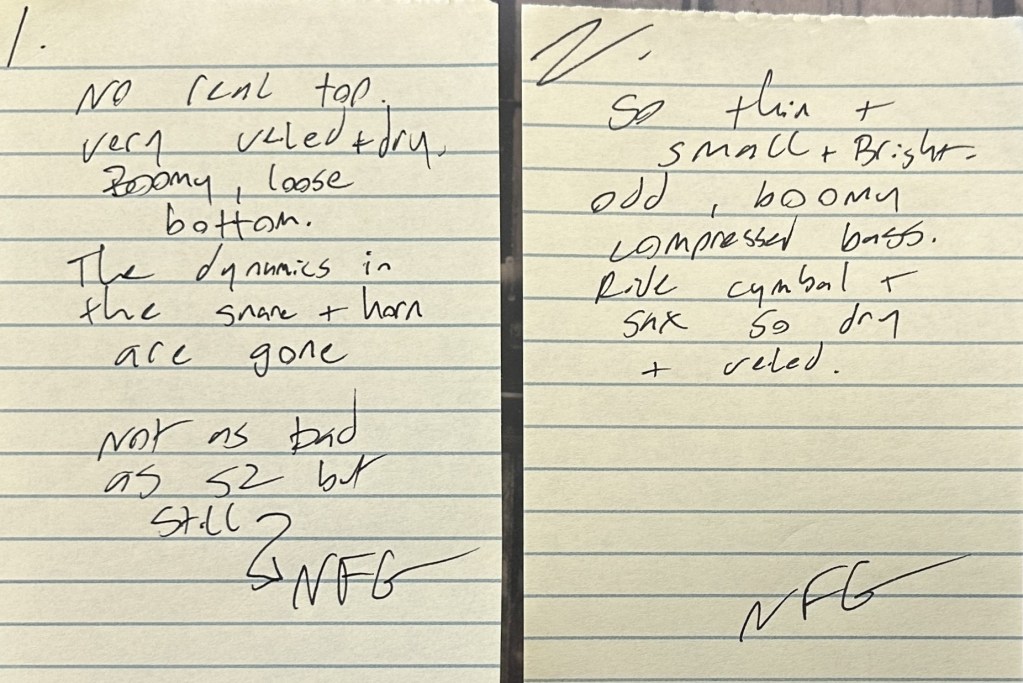
As you can see from the notes above, the two reissue non-Sterling copies we played had hopelessly bad sound.

One was smeary, hard and hot.

The other was the brightest and most spitty.

Note that we didn’t deem it necessary to play side two of either copy. A one plus side one rules out the possibility of it being a Hot Stamper pressing.


Consider taking our moderately helpful advice concerning the pressings that consistently win our shootouts.

Based on our experience, I’m Ready sounds its best:

(more…)

Compression Works Its Magic on The Christmas Eve Suite

Hot Stamper Pressings of the Music of Rimsky-Korsakov Available Now

Some notes about the compression effects we heard on side two of a Blueback pressing of The Christmas Eve Suite album back in 2012. We wrote:

Side two is even more transparent and high-rez than side one. The texture on the strings and the breathy quality of the woodwinds make this a very special pressing indeed.

The horns are somewhat smeary and do get a bit congested when loud.

There is more compression on this side two than there was on the best copy we played, and that means low level detail is superb, but louder parts, such as when the more powerful brass instruments come in, can present problems.

Note how good The Flight of the Bumble Bee sounds here.

Compression is helping bring out all the ambience and detail in the recording, and there’s no downside because the orchestra is playing softly, unlike the piece that precedes it.

A classic case of compression having sonic tradeoffs.

(more…)

Casino Royale from Canada – Not Fit for Us Audiophiles

Hot Stamper Pressings of the Music of Burt Bacharach Available Now

I can honestly say that until we discovered the Hot Stampers for this album, I never thought this record deserved the praise The Absolute Sound’s Harry Pearson heaped upon it.

One of only thirteen entries in the Best of the Bunch: Popular section?

Not that hard to believe if, like me, you think a number of the titles there don’t really deserve to be called Super Discs in the first place. (See here and here and plenty more where those two came from.)

In case you are tempted to pick up a Canadian pressing of the album, don’t. Judging by the one we had, they are godawful.

(more…)

How Can Sound This Bad Possibly Earn a 10?

Hot Stamper Pressings of the Music of Bob Dylan Available Now

Maybe if the scale goes from 1 to 100, sure, I could see it. Yeah, 10 out of 100 sounds about right.

But the scale goes to 11, which makes a grade of 10 risible to anyone who has played this seriously flawed pressing. Here is how we described its sound many years ago:

We found this mono reissue to be flat as a pancake and dead as a doornail, like most of the Sundazed records we’ve played, starting way back in the early 2000s. No, they never got any better.

In our experience, Sundazed is one of the worst record labels of all time. This pressing is just more evidence to back up our low opinion of them.

Obviously we may have a low opinion of them, but a famous audiophile reviewer seemed to find the sound to his liking. He wrote:

Sundazed’s reissue gives the original a run for the money and remains true to the original, though it suffers in the bass, which while deep and reasonably well defined, is not as tightly drawn or focused. The upper mids on the original also bloom in a way that the reissue’s don’t, giving the reissue a slightly darker, recessed sound, but there’s still sufficient energy up there since Dylan’s close-miked vocals pack an upper midrange punch. If the vocals or harmonica sound spitty and unpleasantly harsh, it’s your system, not the record [!] – though there’s plenty of grit up there. On the plus side, the overall clarity and transparency of the reissue beats the original. [!] A really fine remastering job.

Of course we find every word of this review arrant nonsense, except the discussion of the qualities he praises in the original relative to the reissue. It’s been twenty years since this remastered pressing came out, does anybody still like the sound of it? Anybody? Let’s hope not.

The intro to his review boldly declares a respect for Sundazed (and Classic Records and Analogue Productions) that we find puzzling after playing so many of their rarely-better-than-awful-sounding records. (Here is a commentary from 2007 that puts our antipathy in perspective. And no, modern records have no improved since then, if the releases from 2024 are any indication.)

Sundazed’s decision to issue Blonde on Blonde using the much sought after mono mix is indicative both of the company’s dedication to doing what’s musically correct, and of the vinyl marketplace’s newfound maturity. There was a time a few years ago when no “audiophile” vinyl label would dare issue a mono recording; audiophiles wouldn’t stand for it was the conventional wisdom. Perhaps back then it was even true. Today, with Sundazed, Classic, Analogue Productions and others issuing monophonic LPs on a regular basis (and one has to assume selling them as well) listeners are appreciating the music for music’s sake, and equally importantly, for the wonderful qualities of monophonic sound reproduction.

My grade might be 2 out of 11. No audiophile should be fooled by the crap sound of this pressing, and no audiophile should believe a word of this review.

Reviewer incompetence? We’ve been writing about it for more than 25 years. From the start we knew we could never begin to do much more than scratch the surface of preposterous record reviews in need of rebuttal. The audiophile world is drowning in this sh*t.

(more…)

Brain Salad Surgery on Shout Heavy Vinyl

Hot Stamper Pressings of the Music of Emerson, Lake and Palmer Available Now

If you’re a fan of Emerson, Lake and Palmer’s fifth album, and you know, or at least suspect, that the British original pressings are more than likely to be better sounding than most, you might find yourself in a bit of a quandary, pocketbook-wise.

Early British pressings in audiophile playing condition aren’t easy to find, and they don’t tend to be cheap when you do find them.

Ah, but there is a fairly cheap and exceptionally easy solution: just buy the Shout Heavy Vinyl reissue from 2008.

It says it’s made from the master tape, it has a replica of the original packaging, and even comes with a poster.

What could go wrong?

The sound could be shit — NFG in our shorthand — that’s what could go wrong.

  • The top end could be overly-textured, tizzy and hot, the kind that constantly calls attention to itself.
  • The bass could be smeary and thick.
  • And the overall presentation of the music could be veiled and recessed.

Alas, the money you thought you were saving buying this potentially wonderful flat, quiet pressing made from the master tapes ends up flushed down the tubes. Now what?

Now you have to do what you should have done to begin with: find yourself a real British pressing.

(more…)

So at 45 RPM – One Side Bad, Another Awful, What’s a Mother to Do?

Hot Stamper Pressings of the Music of Peter Gabriel Available Now

In 2016 a version of So came out using this currently popular vinyl format:

2 180g discs / 45 RPM / Deluxe, Numbered, Limited Edition /Half Speed mastered

As of this writing, there are 15 copies on Discogs, the cheapest of them starting at $139.77.

Sounds like it must be pretty good for that kind of money!

This So release was mastered by a fellow named Matt Colton, who has been doing this kind of work for a very long time, judging by the fact that he has 3,775 technical credits under his name on Discogs.

That did not stop this particular 2 LP set from being one of the worst sounding albums we have played in quite a while.

Let’s take a closer look at the specifics. We played sides one and four of the two-disc, four-sided album. That was more than enough to evaluate the sound quality.

(more…)

For Top Quality Sound on Maiden Voyage, Skip the Black B

Blue Note Pressings with Hot Stampers Available Now

The three copies we had in our recent shootout for Maiden Voyage on the 70s Black B label did poorly.

Like a lot of the records we play when they weren’t mastered properly, they were small, smeary and weak. Considering how bad they sounded, it’s possible — accent on the word possible — that someone remastering the album for a modern audience could do a better job than Blue Note was doing in the late-70s.

This, of course, is not our standard, nor should it be anyone else’s.

Below you will find links to other records with the same problems as this Blue Note reissue.

(more…)

The Electric Recording Company Does My Favorite Things No Favors

Hot Stamper Pressings of the Music of John Coltrane Available Now

My Favorite Things happens to be one of our favorite Coltrane records, but we much prefer the stereo pressing of the album. (This is almost always the case when an album has been recorded in stereo, as My Favorite Things was in 1960, later released on Atlantic vinyl in 1961.)

We even tell you what to listen for to help you separate the best pressings from the merely good ones: the piano.

A solid, full-bodied, clear and powerful piano. As we focused on the sound of the instrument, we couldn’t help but notice how brilliant McCoy Tyner is. This may be John Coltrane’s album, but Tyner’s contribution is critically important to the success of My Favorite Things.

The engineering duties were handled by Tom Dowd (whose work you surely know well) and Phil Iehle, who happens to be the man who recorded some of Coltrane’s most iconic albums for Atlantic: Giant Steps (1960) and Coltrane Jazz (also in 1961).

Our last shootout for My Favorite Things was in 2018, not exactly yesterday, but in our defense let me just say that we have done plenty of other Coltrane albums from this period and feel as though we would have no trouble recognizing the sound his engineers were going for.

Unfortunately for those of you who have bought into the idea that the Electric Recording Company produces records with audiophile quality sound, you will find an utterly alien My Favorite Things, one nobody has ever heard before and one that no audiophile should want anything to do with.

Allow us to lay out the specifics of our complaints:

Notes for Side One

  • Big and full but smeary, flat and dull sax
  • No space or depth anywhere
  • Bloated bass
  • A mess

Notes for Side Two

  1. Side two is even worse
  2. Where is the breathy detail of the sax?

Electric Recording Company

We’ve played a few other ERC releases produced by the gentleman who owns The Electric Recording Company, a Mr. Pete Hutchison.

As you no doubt know, we would not be correct in using the term “mastered.” He does no mastering. He does “transferring.” He transfers the tapes to disc and puts them in nice jackets of his own design.

(more…)

Seriously, This is Your Idea of Analog?

Audiophile Quality Pressings of Orchestral Music Available Now

Whether made by Klavier or any other label, starting at some point in the mid-90s, many Heavy Vinyl pressings started to have a shortcoming that nowadays we find insufferable: they are just too damn smooth.

Smeary, thickdullopaque, and lacking in ambience, this record has all the hallmarks of the modern Heavy Vinyl reissue.

The sound is smeary, thick and opaque because, among other things, the record was mastered by Doug Sax from a copy tape, and not all that well either.

It is yet another murky audiophile piece of trash from the mastering lathe of the formerly brilliant Doug Sax. He used to cut the best sounding records in the world. Then he started working for Analogue Productions and never cut a good record again as far as I know.

On this record, in Doug’s defense it’s only fair to point out that he had dub tapes to work with, which is neither here nor there as these pressings are not worth the dime’s worth of vinyl used to make them.

Maybe the hearing-challenged Chad Kassem wanted this sound — almost all his remastered titles have the same faults as this Klavier — and simply asked that Doug cut it to sound real good like analog spossed to sound in the mind of this kingpin, which meant smooth, fat, thick and smeary.

Yes, this is exactly what some folks think analog should sound like.

Just ask whoever mastered the Beatles records in 2014. Somebody boosted the bass and smoothed out the upper midrange, and I don’t think they did that by accident. They actually thought it was good idea.

Harry Moss obviously would not have agreed, but he’s not around anymore to do the job right.

(more…)