10-2024

Billy The Kid / Rodeo – How Do the Record Club Copies Sound?

Hot Stamper Pressings of Classical Masterpieces Available Now

Without anyone knowing, a Record Club pressing found its way into one of our shootouts a few years back. Because the person doing the listening has no idea what pressing is on the table, biases and prejudices cannot affect the grading or the outcome of the shootout.

It earned Two Pluses, not enough to win a shootout, but enough to put practically any orchestral record made in the last thirty years to shame. We noted at the time:

This spectacular Demo Disc recording is clear, rich, dynamic, transparent and energetic – here is the BIG, BOLD sound we love. There is a note on the inner sleeve that says this was a Record Club of America purchase in 1973.

Can you imagine that a Record Club was offering records in 1973 that were better sounding than anything being made today? Astonishing.

There are about 150 orchestral recordings we think offer the best performance coupled with the highest quality soundThis record has earned a place on that list.

If you’re a fan of orchestral showpieces such as these, this recording from 1967 belongs in your collection.

(more…)

Compression Works Its Magic on The Christmas Eve Suite

Hot Stamper Pressings of the Music of Rimsky-Korsakov Available Now

Some notes about the compression effects we heard on side two of a Blueback pressing of The Christmas Eve Suite album back in 2012. We wrote:

Side two is even more transparent and high-rez than side one. The texture on the strings and the breathy quality of the woodwinds make this a very special pressing indeed.

The horns are somewhat smeary and do get a bit congested when loud.

There is more compression on this side two than there was on the best copy we played, and that means low level detail is superb, but louder parts, such as when the more powerful brass instruments come in, can present problems.

Note how good The Flight of the Bumble Bee sounds here.

Compression is helping bring out all the ambience and detail in the recording, and there’s no downside because the orchestra is playing softly, unlike the piece that precedes it.

A classic case of compression having sonic tradeoffs.

(more…)

Yet Another James Taylor Desert Island Disc

Hot Stamper Pressings of the Music of James Taylor Available Now

Musically this is one of Taylor’s best. Every track is good and many are wonderful. (More on that here.)

There are five or six James Taylor records that are Desert Island Discs for me. I know they probably wouldn’t let me take six of the same artists’ records to my island, but I would hope they would make an exception for James Taylor’s LPs, because they really do set a standard that few other popular performers can meet.


JT is an album we think we know well, one that checks off a number of boxes for us here at Better Records:

(more…)

With Abraxas, MoFi Manages to Disgrace Itself Even Further

Hot Stamper Pressings of the Music of Santana Available Now

The remastered Abraxas never got past the first elimination round; it had to have been one of the worst half-speeds I have ever heard. Dead, dead, dead as a doornail.

Is it the worst version of the album ever made? Hard to imagine it would have much competition.

Santana’s first album on MoFi is a record we admit to having liked a bit when it first came out. Since then we have changed our minds. It’s just too damn compressed and lifeless. The Whomp Factor on this pressing is Zero. Since whomp is critical to the sound of Santana’s music, it’s Game Over for us. The review below is exactly what we wrote at the time the record came in. We tried to like it, but it’s clear to us now that we tried to like it too hard. Please accept our apologies.

I noted in my old blog: “But now I would have to say that the MoFi LP is far too lifeless to be acceptable to anyone, even those with the worst kinds of audiophile BS systems.”

(more…)

Motown Still Had It in 1982

Hot Stamper Pressings of the Music of Marvin Gaye Available Now
With two superb Shootout Winning Triple Plus (A+++) sides, this Midnight Love is certainly as good a copy as we have ever heard.

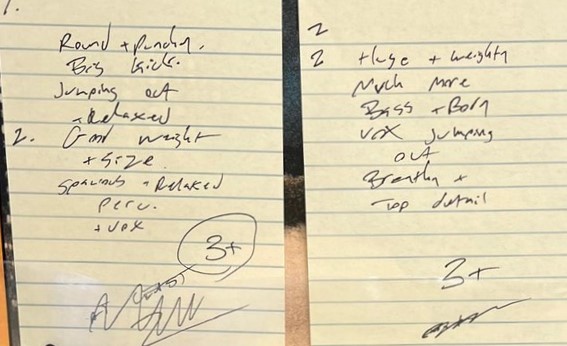
Here are just a few of the things we had to say about this amazing copy in our notes: “round and punchy”…”jumping out of the speakers”…”good size and weight”…”spacious and relaxed percussion and vox”…”top detail” (side two).

Our post-it notes tell the album’s story. (By the way, if you like reading our post-it notes, we’re putting more and more of them on the blog these days. We talk about the importance of taking notes as part of the shootout advice we share. This post will help you with the basics.)

Drop the needle on “Sexual Healing,” then sit back and relax as the rich, warm sound of analog sets the mood!

There’s good frequency extension up top and down low, with plenty of meaty bass and silky highs (check out those bells).

This copy has two qualities which are essential for this music to really work its soulful magic: silky vocals and a BIG meaty bottom end.

Check out all the texture to the synths on Turn On Some Music – this is a highly resolving pressing which takes Marvin Gaye’s music — the last he would make before his death — to another level.

Many copies of Midnight Love suffer from a phony hi-fi-ish quality, sacrificing much of the warmth that is the all-important hallmark of analog. Is that any way to listen to this great Soul Classic? (My sources say no.)

Hey, want to find your own top quality copy?

Consider taking our moderately helpful advice concerning the pressings that consistently win our Hot Stamper shootouts.

(more…)

What to Listen For on Eine Kleine Nachtmusik

Hot Stamper Pressings of the Music of Mozart Available Now

On most copies the strings are slightly drier and more harsh and steely than one would want, occasionally turning strident in the louder passages.

As always, proper VTA adjustment — by ear — is critical to getting the strings to sound their best.

More advice on setting your VTA.

An extended top end helps the harmonics of the stringed instruments immensely.

Here are some other records that are good for testing string tone and texture.

The more resolving copies will show you more of the hall, which greatly adds to the sense that you are listening to live music, not a record.

(more…)

Are Reviews Objective?

Robert Brook has a blog which he calls

A GUIDE FOR THE DEDICATED ANALOG AUDIOPHILE

Robert recently addressed an issue that came up when someone left a comment about the sound of Tone Poets reissues vis-a-vis the the pressings that Rudy Van Gelder mastered, to wit:

“To say anything other than the difference (between the T.P. and the RVG) is subjective is misleading the audience.”

Robert explains in the post linked below that he has worked very hard to make his system as neutral as he possibly can, and why he thinks that is a good idea. He also notes that he isn’t done, that there is plenty of work left to do, and that a more revealing, more truthful system is his one and only goal.

Any piece of equipment, or tweak, or setup adjustment that brings him closer to the sound his critical listening skills tell him are an improvement is to be adopted. They have passed passed the “more truthful” test.

Are My REVIEWS Objective?

There are scores, maybe even hundreds of posts on this very blog to explain what we do and how we do it.

We tell you about our playback system and why it’s good at its job.

In addition, practically every listing on our site has standardized text detailing the three areas that are key to understanding our vintage vinyl offerings. They include:

  1. What sonic attributes our Hot Stampers have.
  2. How we go about finding records with these attributes, and
  3. What we’re listening for in order to distinguish superior pressings from common ones.

(more…)

Two Reviews of Child Is Father to the Man – Fremer Vs. Better Records

Hot Stamper Pressings of the Music of Blood, Sweat and Tears Available Now

In 2010 MF reviewed both the Sundazed and Speakers Corner Heavy Vinyl pressings of the album.

I think his review is mistaken on a number of counts, and mostly unhelpful. The commentary below will discuss his errors in more detail, in the hopes that you, dear reader, will not make the same mistakes yourself. 

He talks about his history with the album for a while, and then notes:

Anyway, the original “360 Sound” edition of this record sounds fantastic. It’s a high quality Columbia studio recording, with vivid harmonics, impressive transparency and dynamics, shimmering highs and tight extended bass. The soundstage is expansive and the images tightly presented. I’m not sure it can get much better than the original given how well-pressed Columbia records were in those days, especially if you have a clean original.

We, however, seem to hold precisely the opposite view. I quote from our review:

Why did it take us so long [to do a Hot Stamper shootout]? Let me ask you this: have you ever played this album? The average copy of this record is a sonic MESS. Even the best copies have problems.

We then go on to discuss in detail what most copies do wrong and what to listen for in order to find a copy that gets it right. (More on that later.)

Shortcomings? What Shortcomings?

Fremer continues:

There are two reissues of this. One is from Sundazed and there’s a far more expensive one from Speakers Corner…

The Speakers Corner reissue, which uses the wrong label art is pressed at Pallas and consequently it’s quieter and better finished overall. However, the Sundazed copy I got was very well finished and reasonably quiet, but not as quiet.

On the other hand the Speakers Corner version was somewhat more hyped up at the frequency extremes and cut somewhat hotter, but not objectionably so. The Sundazed sounds somewhat closer to the original overall, so for half the price, you do the math.

“Somewhat hyped up”? We liked it a whole lot less than Mr. Fremer apparently did. Early last year I gave it a big fat F for failure, writing at the time:

This is the worst sounding Heavy Vinyl Reissue LP I have heard in longer than I can remember. To make a record sound this bad you have to work at it.

What the hell were they thinking? Any audiophile record dealer that would sell you this record should be run out of town on a rail. Of course that won’t happen, because every last one of them (present company excluded) will be carrying it, of that you can be sure.

Just when you think it can’t get any worse, out comes a record like this to prove that it can. I look forward to Fremer’s rave review.

(more…)

Iron Butterfly – Dubby Da-Vida

More of the Music of Iron Butterfly

The craziest thing we learned in our shootout from many years ago is that something close to half of all the yellow label, authentic, non-record-club Atco copies we played had clearly been mastered from a dub tape on side two, the side with In-A-Gadda-Da-Vida.

We’re guessing that at some point after 1968, when it came time to recut the record, the cutting master for side two was either damaged or couldn’t be found.

Not a problem the label says to itself, we have a safety tape we can copy and use for side two.

Problem solved, except for the fact that on those copies In-A-Gadda-Da-Vida sounds like a cassette playing on a machine with clogged heads. The sound is smeary, veiled, small and recessed — all but unlistenable.

That was a shock, but the other shock we experienced was much more to our liking: hearing that the sound of the best copies is actually surprisingly good.

The tonal balance is right on the money, but of course, because this is a compilation, it is made from copies of master tapes, not real master tapes themselves, so it will always have that blurry, smeary, recessed, flat, opaque, airless, sub-generation-tape sound. In short, it’s dubby.

(more…)