smeary-sound

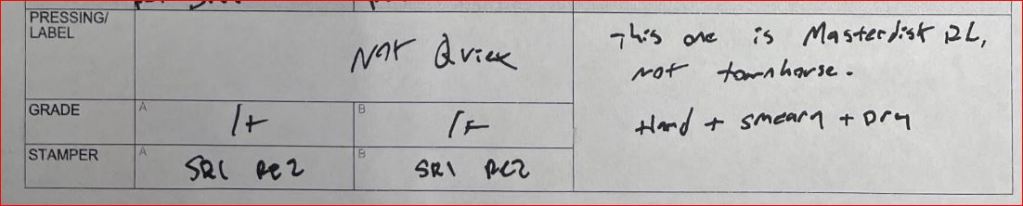
Smear, a blurring or loss of sharpness of individual notes, refers to missing transient information, the kind most often associated with tube gear.

However, smear occurs with every kind of gear, especially high-powered amps, the kind typically required to power the inefficient speakers audiophiles seem to favor these days.

When we got rid of our tube equipment and high-powered amps, some of the smear in our records disappeared with them.

Once that happened, the smear that is commonly heard on modern Heavy Vinyl repressings became much more noticeable and, as might be expected, even more annoying.

This London from 1961 Didn’t Make the Grade

Hot Stamper Classical and Orchestral Imports on Decca & London

1961 just happens to be one of the greatest years for high quality analog recordings. Just check out this amazing group of albums, all recorded or released that year.

This London LP was released in 1961, right in the heart of the Golden Age, so we figured it had a good chance of displaying the kind of relaxed, immersive, smooth, rich, Tubey Magical Decca sound we absolutely cannot get enough of here at Better Records.

As we were preparing to do the shootout with the six copies of CS 6202 we had amassed over the years, we suddenly ran into a big problem.

(Cue sound effect of record being scratched here.)

(more…)

Capriccio Italien on Classic Records and How Badly I Missed the Boat

More of the Music of Peter Ilyich Tchaikovsky

More of the Music of Nikolai Rimsky-Korsakov

Years ago, around 2005 if memory serves, I played a copy of the Classic Records pressing of LSC 2323 and thought it was pretty good.

I thought it was better than the Shaded Dog copies I had compared it to, which, based on hundreds of other Classic Records titles I had auditioned, was unexpected to say the least.

Little did I know that the Shaded Dog pressings on this title are not remotely competitive with the early reissues.

The best of the Shaded Dog pressings we could find, which just happened to have a 1s side one, came in tied for last with the one 70s Red Seal pressing we thought sounded good enough to make the shootout.

(Some inside baseball: most of the Shaded Dogs and Red Seals were needle-dropped, and all but two were eliminated before the shootout. It takes time and wastes money to clean and play pressings that sound hopeless, so a quick elimination round often precedes the cleaning process.)

Back then it was tough to wrap my head around the idea that a Classic Record classical title could actually be better sounding than a Shaded Dog — it had never happened, so I knew there had to be more to the story.

Finding the time to do the serious investigation of LSC 2323 that would be necessary to get to the bottom of it was not in the cards, so I shelved the project for close to the next twenty years.

The title would have to wait until 2024 to go through a proper shooout, and when it did, naturally the Classic was part of the mix, which is the way we do things here at Better Records. Every record gets the chance to show us what it can do, to be evaluated fairly without the listener having any way to know which pressing is playing.

It turns out that side one of the Classic was passable, but side two — the side I had probably never played — was every bit as bad as most of their other classical offerings.

Side One, Second Movement (Tchaikovsky)

  • Big, but bright and compressed
  • Gets loud but opaque and hot
  • Good weight

Side One, First Movement

  • Bright and blurry bells
  • Sort of tubey but a mess
  • Grade: 1+ (passable, but no Hot Stamper)

Side Two (Rimsky-Korsakov)

  • Big but boomy and smeary
  • Brass is edgy and opaque
  • No top end or space
  • Peaks are hot and congested
  • Grade: NFG

To recap: In 2005 I was impressed with Classic’s pressing of LSC 2323. That was only twenty years ago, yet I could not have been more wrong. I thought my stereo was great — I’d owned top quality equipment since 1975 by then — thirty sodding years — so my audiophile credentials would surely dwarf those of the vast majority of forum posters who write about audiophile pressings today. How reliable should we expect their reviews to be?

(more…)

Carnival of the Animals on Klavier Is Another Doug Sax-Mastered Disaster

Hot Stamper Pressings of the Music of Saint-Saens Available Now

Yet another murky, smeary audiophile piece of vinyl trash from the mastering lathe of the formerly brilliant Doug Sax. He used to cut the best sounding records in the world. (Exhibit A: this one.)

Then he started working for perhaps the worst record label of all time and to my knowledge never cut a good sounding record again.

This record may be on the TAS Super Disc list, but we don’t think it belongs there. Instead, it belongs on the bad TAS list that we created specifically for these far-from-super records.

To be fair, the real EMI is on there as well, ASD 2753. However, including the Klavier on the list brings into doubt the compentence of whoever is curating it these days.

This Klavier pressing, along with all the Classic Records titles, as well as other modern reissues, renders the advice found there all but useless. Is anyone calling attention to all the bad sounding records that have lately been recommended by The Absolute Sound? I think we might just be the only ones. If you know of any others, please email me at tom@better-records.com.

Doug Sax

For those of us who remember the consistently superb work Doug Sax was doing in the 70s, we sadly note that he passed away in 2015. I was honored to have met him a few years before then at a Chopin concert with Lincoln Mayorga performing on the piano. (Impressively performing, I might add. He played the complete Chopin Preludes from memory, all 24 of them.)

Both he and Lincoln were gentlemen and artists of the highest caliber. Needless to say, I hope this awful sounding Klavier is not the kind of record that he would want to be remembered by.

On this record, in Doug’s defense it should be noted that he had only second generation tapes to work with, which is neither here nor there as these pressings are not worth the dime’s worth of vinyl used to make them and should never have seen the light of day.

Can this dubbysmeary sound possibly be what EMI engineer Stuart Eltham was after?

Hard to believe. We’ve played plenty of his recordings and we cannot ever remember any of the non-audiophile pressings having this kind of sound.

But isn’t that just the way? The mainstream labels mass produce the good sounding pressings and the audiophile labels produce the limited edition junk.

Now there’s a rule of thumb you might want to keep in mind, especially if you’ve made the mistake of buying any of the Heavy Vinyl pressings we reviewed in 2024 and 2025, a parade of horribles that defy understanding.

Actually, if we understand that there is a need for vinyl product for the lo- to mid-fi record collector market, it makes perfect sense. That’s what Klavier was in the business of producing, and now everybody wants in on the action, hence the proliferation of crap Heavy Vinyl pressings coming to market, practically every one even worse sounding than the last.

(more…)

Another Unimpressive Reissue Pressing of Coltrane’s Music — What Is Going On?

Hot Stamper Pressings of the Music of John Coltrane Available Now

We had an early Blue Label Prestige mono pressing that was not as awful as the original Yellow Label mono we played, but it’s not very good either. Our grade for a record that earns one plus on both sides is passable.

Which means you could play it, maybe even enjoy it, but you would have no idea just how well Rudy Van Gelder recorded the sessions in 1958 that went into the making of the album, which as you know was not compiled for release until 1962.

As you can see from the notes above, it was crude, smeary and thick. We don’t sell records that sound like that.

I can’t say that most modern remastered records are crude, although some of them are, but a great many we’ve played are smeary, and almost all of them are thick — that is, lacking in transparency — to some degree. That last quality — a lack of transparency — may be the most irritating of all, a subject we discuss here.

(A great many records we’ve auditioned over the years are good for testing transparency. Those wanting to improve this aspect of their playback should consider making use of them.

(more…)

Verve Released this Awful Sounding Mel Torme Album in 1960

Hot Stamper Pressings of Pop and Jazz Vocal Recordings Available Now

Smeary and dry. As far as we can tell, based on the sound of this copy, Swingin’ on the Moon is not an album worthy of a Hot Stamper shootout. If we hear a better one down the road, we would certainly be open to the possibility.

If you want a better sounding moon-themed album, Sinatra made a very good one.

This particular Mel Torme album came out in 1960, along with a great many wonderful titles from the Golden Age of vacuum tube recording. Although we love the cover, this unfortunately doesn’t happen to be one of the better releases from that year.

We play mediocre-to-bad sounding pressings so that you don’t have to, a public service from your record-loving friends at Better Records.

You can find this one in our hall of shame, along with others that — in our opinion — are best avoided by audiophiles looking for hi-fidelity sound. Some of the records on the list may have passable sonics, but we found the music less than compelling.  These are also records you can safely avoid.

We also have an audiophile record hall of shame for records that were marketed to audiophiles for their putatively superior sound. If you’ve spent any time on this blog at all, you know that these records are some of the worst sounding pressings we have ever had the displeasure to play.

(more…)

Kevin Gray Returns to the Scene of the Crime for One Flight Up

Hot Stamper Pressings of Blue Note Recordings Available Now

Robert Brook wrote about the Tone Poets remastered pressing of One Flight Up a few year back. We noted at the time:

We have never heard the Tone Poets pressing that Robert played against the Van Gelder cutting he discusses in his commentary.

We have one in stock and are just waiting to do the shootout for the album so that we can compare it to the better pressings we know we will find.

You may have read that we were knocked out by a killer copy way back in 2007. We expect to be no less knocked out in 2023.

Make that 2025. (Clean Blue Note pressings are hard to come by.)

Robert concludes with the strengths and weaknesses of the two pressings. Here is an excerpt:

Overall, the Tone Poet is closed, distant and frankly boring to listen to. Where is the energy of the music? Where is the presence of these musicians? Where is the studio space?

Now that we’ve played the Tone Poets pressing against the best Blue Notes we could find, we know exactly what he means!

Kevin Gray had previously cut the record for Cisco and made a real mess of it, so we are not the least bit surprised that this newer version is every bit as bad sounding as that one.

Why anyone is hiring this hack to make records is a mystery to those of us who play them, and if for some reason it isn’t a mystery to you, it should be.

How inaccurate and unrevealing does a stereo have to be in order to hide the shortcomings of this incompetently mastered record? If you have such a stereo — and there seem to be plenty of them out there in audio land, judging by the fact that Tone Poets is still in business — now is the time to get rid of it, or, at the very least, start making major improvements.

You might want to consider taking some audio advice from us along those lines.

Robert Brook has plenty to say on that subject as well.

Here are the notes we took while playing the Tone Poets pressing after completing our shootout. We had already heard some killer copies, the White Hot shootout winners, so we knew just how good the record could sound.

Side One

(more…)

I Robot Is a Tough Nut to Crack, Even If You Have Plenty of Early British Pressings to Play

Hot Stamper Pressings of Prog Rock Albums Available Now

Here is how we described a Hot Stamper pressing of I Robot that went up recently, our first in five years:

An early UK pressing (and the first copy to hit the site in years) with seriously good sound throughout.

Many copies tend to be overly smooth, but this one has the kind of clarity that allows the natural textures of the instruments to come through.

Transparency is key to the sound of the better copies, and that is precisely where the dubby domestic pressings fall apart.

Even many of the early British pressings fell short. Good luck finding top quality sound on this one. At the very least you are going to need a big budget — these early UK pressings are not cheap to find in audiophile playing condition.

As you can see, we weren’t kidding about those UK pressings falling short. Here’s two that did, with their stamper numbers posted for all to see.

Side two of the first copy is being held back by sound that is smeary, dry and hard.

Side one of the second copy is murky and hot (bright).

Note that these are early UK stampers, which some in-the-know audiophile collectors will tell you are clearly the best.

(more…)

Ein Heldenleben – A Half Speed I Used to Like for Some Reason

Hot Stamper Pressings of the Music of Richard Strauss Available Now

As you may know, this is one of the earliest RCA stereo recordings, dating from 1954 and the same sessions as the famous Reiner recording LSC 1806. This two microphone, two-channel recording, however, was never released in stereo on vinyl until the Victrola era ten years later.  

We used to like the RCA Half-Speed pressing of the work, but playing it recently made me realize just how dark, smeary and thick it is.

Don’t know what I ever saw in it to tell you the truth.

We Make Mistakes

The first is that anyone who has been on an audio journey for very long has made a lot of mistakes along the way.

Uniquely among reviewers and record dealers, we go out of way to admit when we were wrong. You might say we are even proud of the fact that we used to get so many things wrong about records and audio.

Our experimental, evidence-based approach, requiring that we not only make mistakes but that we embrace them, is surely key to the progress we have made in understanding recordings and home audio. One of our favorite quotes on the subject is attributed to Alexander Pope.

“A man should never be ashamed to own he has been in the wrong, which is but saying… that he is wiser today than he was yesterday.”

To say that few audiophiles have followed our approach is not to admit defeat. Rather it is simply to say that the approach we use to find better sounding pressings involves a great deal of tedious, expensive, time-consuming work, work that few audiophiles seem interested in doing.

There are quite a number of other records that we’ve run into over the years with obvious shortcomings.

Here are some of them, a very small fraction of what we’ve played, broken down into the three major labels that account for most of the best classical and orchestral titles we’ve had the pleasure to play.

(more…)

The MHS Recording of Chopin’s First Piano Concerto Had the Most Natural Piano of Them All

Hot Stamper Pressings of the Music of Frederic Chopin Available Now

There are some wonderful Musical Heritage Society records sitting in the bins of your local record store or Goodwill, and this one is worth picking up just to hear how well recorded the piano is.

We described it this way:

Beautiful piano. The most natural and realistic mix with the piano not in the foreground.

But there is more to the recording than the sound of the piano.

Smeary, bloated and dry orchestra holds it back.

Well, at least we tried. (Note that side two was deemed not worth grading.)

Our favorite recording for performance and sound is the Living Stereo from 1961, LSC 2575, with Rubinstein at the piano and Skrowaczewski conducting the New Symphony Orchestra of London.

This is what we had to say about the sound of our Shootout Winner:

We love the huge, solid and powerful sound of the piano on this recording. This piano has weight and heft. As a result, it sounds like a real piano.

For some reason, a great many Rubinstein recordings are not capable of reproducing those seemingly all-important qualities in the sound of the piano.

Those are, as I hope everyone understands by now, the ones we don’t sell. If the piano in a piano concerto recording doesn’t sound solid and powerful, what is the point of playing such a record?

Or, to be more accurate, what is the point of an audiophile playing such a record? (Those of you who would like to avoid bad sounding vintage classical and orchestral records have come to the right place. We’ve compiled a very long list of them for precisely that purpose, and we add to it regularly.)

(more…)

How Would You Ever Know This Was a Good Recording with these Crap Pressings to Play?

Hot Stamper Pressings of the Music of The Beach Boys Available Now

You sure wouldn’t know this was a good recording by playing the crappy reissues Capitol put out on the Yellow Label in 1975.
We found that they tend to suffer from these sonic shortcomings:
They are either dark and recessed, and/or murky and smeary.

There are good Rainbow Label pressings and bad ones. We of course only sell the good ones.

Here is how we described our most recent White Hot shootout winner.
  • With two STUNNING Shootout Winning Triple Plus (A+++) sides or close to them, this early Capitol pressing could not be beat.
  • This copy gets the midrange right, and since that is where The Beach Boys’ voices are, that puts it ahead of everything else we heard.
  • What’s shocking to those of us who have played The Beach Boys records by the bucketful is how rich and open the best pressings of this album are.
  • You will have an awfully hard time finding another Beach Boys album that sounds as good as this one, and you may just find that it simply can’t be done.

(more…)