tube-smear

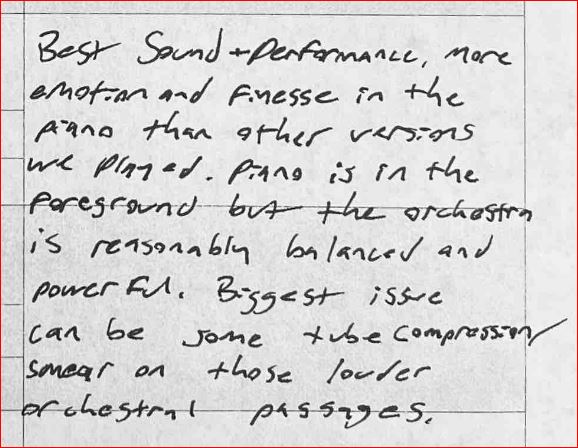
Smear, a blurring of the sharpness of the notes, refers to a loss of transient information which is most often associated with tube gear. However, smear occurs with every kind of gear, especially high-powered amps, the kind typically required to power the inefficient speakers audiophiles seem to favor these days. We caution against the use of both.

When we got rid of our tube equipment and high-powered amps, a lot of smear in the playback of our records disappeared with them.

Once that happened, the smear that is commonly heard on modern Heavy Vinyl repressings became much more noticeable and, as a consequence, even more annoying.

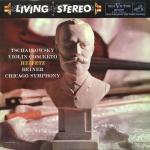
For Concerto No. 1, This Is the Way the Piano Should Sound

Hot Stamper Living Stereo Classical and Orchestral Titles Available Now

We love the huge, solid and powerful sound of the piano on this recording. This piano has weight and heft. As a result, it sounds like a real piano.

For some reason, a great many Rubinstein recordings are not capable of reproducing those all-important qualities in the sound of the piano.

Those are, as I hope everyone understands by now, the ones we don’t sell. If the piano in a piano concerto recording doesn’t sound solid and powerful, what is the point of playing such a record?

Or, to be more accurate, what is the point of an audiophile playing such a record? (Those of you who would like to avoid bad sounding vintage classical and orchestra records have come to the right place. We’ve compiled a very long list of them precisely for that purpose, and we’ve been adding to it regularly.)

No doubt Kenneth Wilkinson made sure the recording captured the weight of the piano he was listening to as it played all those years ago in the wonderful acoustics of Kingsway Hall.

The strings have lovely Living Stereo (Decca-engineered) texture as well.

As befits a Wilkinson recording from 1961, there is no shortage of clarity to balance out the Tubey Magical warmth and richness.

When you add in the tremendous hall space, weight and energy, this becomes a Demo Disc orchestral recording by any standard.


Notes from a 2024 Shootout

Our notes above point out that:

(more…)

Verdi, et al. / Ballet Music From The Opera

Hot Stamper Pressings of Living Stereo Recordings Available Now

UPDATE 2026

This review was written many, many years ago, so many years ago that I don’t think I knew that the Victrola reissue had consistently better sound than any Shaded Dog we had ever played.

But one thing I did know was that the sound had obvious and rather serious shortcomings, shortcomings that the fans of vintage vinyl never seemed to notice. The conventional wisdom according to which so many record collectors and record reviewers operate, including the vast majority of those who identify as audiophiles, may have blinded them to the reality of its defects.

It’s also rare and sells on the collector market for a lot of money. Those facts often blind record lovers too.

Someone with the original in his collection might pull it off the shelf where it has been sitting for years and show such a rare and valuable and therefore impressive record to you. I suspect that such a collector would be much less likely to play it for you.

Having to sit down and actually play the records we sell means that biases and prejudices of these kinds can have no effect on our judgments. The records get played against other pressings and we simply call them as we hear them.

Contrary to the conventional wisdom, the original is not that good of a record.

And the best news is that the reissue is a true Demo Disc of the highest order.


Our Old Review

This copy of LSC 2400 has vintage RCA Golden Age sound, for better and for worse. Even though the album was recorded by Decca, it’s got a healthy dose of Living Stereo Tubey Magic.

There will never be a reissue of this record that even remotely captures the richness of the sound found here.  

And the hall is HUGE — so spacious and three-dimensional it’s almost shocking, especially if you’ve been playing the kind of dry, multi-miked modern recordings that the 70s ushered in for London and RCA.

(more…)

Compression Works Its Magic on The Christmas Eve Suite

Hot Stamper Pressings of the Music of Rimsky-Korsakov Available Now

Some notes about the compression effects we heard on side two of a Blueback pressing of The Christmas Eve Suite album back in 2012. We wrote:

Side two is even more transparent and high-rez than side one. The texture on the strings and the breathy quality of the woodwinds make this a very special pressing indeed.

The horns are somewhat smeary and do get a bit congested when loud.

There is more compression on this side two than there was on the best copy we played, and that means low level detail is superb, but louder parts, such as when the more powerful brass instruments come in, can present problems.

Note how good The Flight of the Bumble Bee sounds here.

Compression is helping bring out all the ambience and detail in the recording, and there’s no downside because the orchestra is playing softly, unlike the piece that precedes it.

A classic case of compression having sonic tradeoffs.

(more…)

Bruch & Mozart Violin Concertos / Heifetz in 2010

Years ago we wrote:

This is a very old review, probably from the early 2010s, so take it for what it’s worth. I suspect we could find a much better sounding copy of the album today than we could back then, before we had the cleaning systems and playback equipment we do now.

All that turned out to be true.

In 2024 we did another shootout for the album, our first in more than ten years! I am happy to say the sound was a knockout on the best copies, some of the finest violin concerto sound we have ever heard.

Live and learn is our motto, and progress in audio is a feature, not a bug, of record collecting at the most advanced levels. (“Advanced” is a code word for having little to no interest in any remastered pressing marketed to the audiophile community. If you want to avoid the worst of them, we are happy to help you do that.)

Our comments from 2010:

(more…)

Violin Recordings and the Problem of Smear

Hot Stamper Pressings of Living Stereo Titles Available Now

This Shaded Dog pressing of LSC 2129 had practically no smear on either the violin or the orchestra.

Try to find a violin concerto record with no smear.

We often say that Shaded Dogs, being vintage All Tube recordings, tend to have tube smear.

But what about the 70s transistor mastered Red Label pressings – where does their smear come from?

Let’s face it: records from every era more often than not have some amount of smear.

And we can never really know what accounts for it.

The key thing is to be able to recognize it for what it is.

(We find modern records, especially those pressed at RTI, to be quite smeary as a rule. They also tend to be congested, blurry, thick, veiled, and ambience-challenged. For some reason most audiophiles — and the reviewers who write for them — rarely seem to notice these shortcomings.)

Of course, if your system itself has smear it becomes that much harder to hear the smear on your records.  Practically every tube system I have ever heard had more smear than I could tolerate – it comes with the territory. And high-powered transistor amps are notoriously smeary, opaque and ambience-challenged. Our low-powered, all-transistor rig has no trouble showing us the amount of smear on records, including those that have virtually none.

Keep in mind that one thing live music never has is smear of any kind. Live music is smear-free. It can be harmonically distorted, hard, edgy, thin, fat, dark, and all the rest, but one thing it can never be is smeary.

That is a shortcoming unique to the reproduction of music, and one which causes many of the pressings we sell to have their sonic grades lowered.

(more…)

The Trout Quintet – Original Versus Reissue

More of the music of Franz Schubert

This unusual 2-pack combines two very different pressings from very different eras to create a complete performance of The “Trout” Quintet with SUPERB Super Hot Stamper (or better) on both sides. One pressing, the one shown, is from the early ’60s; the other is from 1982. How could an imported budget late reissue beat a superb Golden Age pressing on any side you ask? Well, the answer to that question is provided by the records we will send you. 

Side one of this London Whiteback pressing is dark and opaque, with a serious lack of both top end and clarity. Side two however is GORGEOUS: so big, rich, clear and lively, it earned a sonic grade of A++ to A+++! In our shootouts the person reviewing the records (in this case me) never knows which pressing is being critiqued. Imagine my surprise when the late London handily beat the early one.

Actually it’s easy to imagine my surprise, because there was simply no surprise to imagine. In our shootouts here at Better Records, later pressings beat early pressings regularly. We let the records speak for themselves, and that’s what they told us, at least on side one of The “Trout.” The reason the late pressing even made it into our shootout was that in a preliminary round it showed us that it had very good sound on side one. Side two didn’t hold up, but any record with good sound on any side is going to go in the shootout, regardless of the “incorrectness” of its label or country of origin.

On the earlier pressing (CS 6090) the sound is rich and sweet; some might say it’s too rich, but for this music it works. The piano and the strings have that Golden Age Tubey Magical sound we love. It’s been years since I’ve had the opportunity to play this record; most copies are just too beat up to bother with, so I was glad to find this one in such minty condition. (more…)