harsh-sound

Paganini on Heavy Vinyl – Where Is the Outrage?

Hot Stamper Pressings of the Music of Paganini Available Now

Years ago we managed to get hold of the Heavy Vinyl pressing put out by Fenn Music in Germany, about which a well known record dealer on the web (you may recognize the style) had this to say:

“Stunning Reissue Of EMI ASD 440 Recorded In Stereo In 1961. This Recording Featuring The Royal Philharmonic Conducted By Alberto Erede Provides Convincing Proof, If Any Were Needed, That Menuhin Was One Of The Great Violinists Of The 20th Century.”

The “convincing proof” provided by this record is that those responsible for it are Rank Incompetents of the Worst Kind (see what I did there?).

Screechy, bright, shrill, thin and harsh, it’s hard to imagine worse sound than this piece of Heavy Vinyl trash delivers.

Had I paid good money to buy this pressing from 2004 in the hopes of hearing the supremely talented Yehudi Menuhin of 1961 tear it up on Paganini’s legendary first two concertos, I can tell you one thing: I would be pissed.

Where is the outrage in the audiophile community over this kind of trash?

I have yet to see it. I suspect I will grow quite a bit older and quite a bit grayer before anyone from the audiophile commentariat notices just how bad this record sounds. I hope I’m proven wrong.

Screechy, bright, shrill, thin and harsh, it’s hard to imagine worse sound from this piece of Heavy Vinyl garbage.

In other words, no trace of the original’s (or the early reissue’s) analog sound. At most I may own one or two classical CDs that sound this bad, and I own quite a few. When audiophiles of an analog bent tell you they don’t like the sound of CDs, this is why they don’t like them: they sound like this junky Heavy Vinyl record.

(more…)

Obscured By Cloudy Japanese Vinyl

Hot Stamper Pressings of the Music of Pink Floyd Available Now

When I was just getting up to speed in audio and exploring the world of music available on vinyl in the 70s, many of the stereo stores I frequented carried Japanese pressings. They were widely believed to have superior sound relative to their domestic counterparts — in this case, the mass-produced pressings I would see at the Tower Records right across from the Sports Arena in my hometown of San Diego. I went there at least once a week, probably more like two or three times.

Tower was far and away the best place to go record shopping in those days. The store was huge and they had dramatically more stock than Licorice Pizza or The Wherehouse.

They also had a separate section for Half-Speed mastered pressings from a number of labels, which of course was the first place in the store I would visit, digging through the bins to see what new remastered titles may have been produced for audiophiles searching for the ultimate in sound quality.

Of course, I identified as just such a person. In terms of sound quality, and with the extremely limited knowledge I had acquired at the time, I believed I set a high standard for the sound of the records I bought. I was willing — eager even, you could even say excited — to pay whatever premium price I had to for a record that was sure to deliver superior sound quality. To me, in the late 70s, that meant two things: direct to disc recordings, and Half-Speed mastered pressings.

(There was a another category of records that did not fall into the above two, best exemplified by American Grammaphone and the Fresh Aire series, but the less said about those schlocky releases the better, other than to point out that some of their titles are TAS list carryovers from HP’s time running the Super Disc list, specifically Fresh Aire 2 and 3, both best avoided.)

And, like any other open-minded individual, when it came to Japanese vinyl I was willing to give a few a spin.

However, the more of them I bought, the more clear it became to me that even the best of them sounded mediocre (veiled, smeary and dubby from second generation tapes) and more often than not they were just plain awful. (Second generation tape issues being the main problem, of course, with the additional insult of poor tonality, the result of being mastered using wacky equalization, typically with added brightness where none was needed.)

Pink Floyd

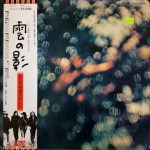
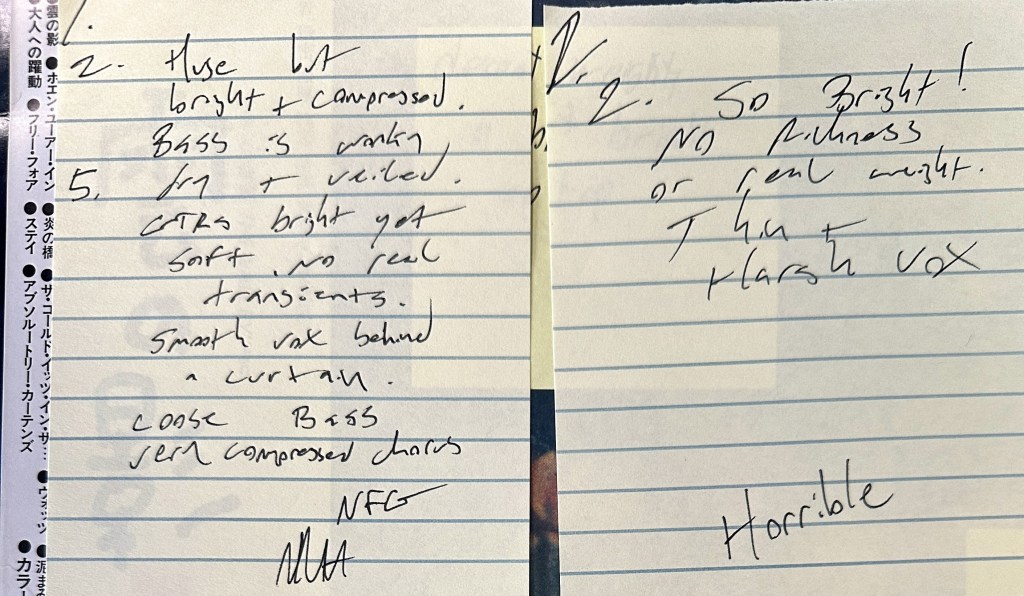
The notes for the Pink Floyd album you see below, Obscured by Clouds, were written sometime in March of 2025 as part of the shootout we conducted for the album.

If we assume it would be an audiophile who would be attracted to this pressing, perhaps for its quieter playing surfaces, perhaps operating under the assumption that the Japanese engineers mastering the record would be more likely to do a better job as well, then what we have here is a textbook case of an audiophile bullshit pressing.

One that sounds nothing like the album is supposed to, based on having played a number of exceptionally good sounding copies, all British and all on the Green Harvest label, mastered from good tapes, sometimes by the legendary Harry T. Moss. We feel we are more than qualified to make these judgments. If we can’t make them, nobody can.
Discogs allows us to glean some information regarding the desirability of this Japanese reissue with the record buying public currently in the market for Pink Floyd vinyl who register on their site.

(more…)

Skip the Classic Records Pressing of Ballet Music From The Opera

Hot Stamper Living Stereo Orchestral Titles Available Now

Classic Records ruined this album, as anyone who has played some of their classical reissues would have expected.

Their version is dramatically more aggressive, shrill and harsh than the Shaded Dogs we’ve played, with almost none of the sweetness, richness and ambience that the best RCA pressings have in such abundance.

In fact their pressing is just plain awful, like most of the classical recordings they remastered, and should be avoided at any price. 

Apparently, most audiophiles (including audiophile record reviewers) have never heard a top quality classical recording. If they had, Classic Records would have gone out of business immediately after producing their first three Living Stereo titles, all of which were dreadful and labeled as such by us way back in 1994. I’m not sure why the rest of the audiophile community was so easily fooled, but I can say that we weren’t, at least when it came to their classical releases. 

We admit to having made plenty of mistaken judgments about their jazz and rock, and we have the we was wrong entries to prove it.

The last review we wrote for the remastered Scheherazade, which fittingly ended up in our Hall of Shame, with an equally fitting sonic grade of F.

TAS Super Disc list to this day? Of course it is!

With every improvement we’ve made to our system over the years, their records have managed to sound progressively worse. (This is pretty much true for all Heavy Vinyl pressings, another good reason for our decision to stop buying them in 2007.) That ought to tell you something.

Better audio stops hiding and starts revealing the shortcomings of bad records.

(more…)

These Are the Stampers to Avoid on A Hard Day’s Night

Hot Stamper Pressings of the Music of The Beatles Available Now

In our experience, the stereo pressings with -2/-2 stampers are terrible sounding.

We do not have any on hand, but we doubt that -1/-1 — the original, the first, the one approved by George Martin himself! — is any better.

With -2 stampers this is a hall of shame pressing, as well as another early Beatles LP reviewed and found seriously wanting.

You may know that the pressings with -2 stampers are the ones that come in the original BC-13 Beatles Box from 1978.

Some of the titles in that set can sound very good, but this is not one of them. To recognize a mid-70s pressing, note that the back of the jacket will have a laminate strip on the side. At the bottom of this post you can find a picture of it.

Avoid that cover and the record inside it if you want a good sounding pressing of A Hard Day’s Night.

That Old Canard

The early pressings are consistently grittier, edgier and more crude than the later pressings we’ve played. So much for that old canard that “the original is better.” When it comes to A Hard Day’s Night it just ain’t so, and it doesn’t take a state-of-the-art system or a pair of golden ears to hear it.

The audiophile community seems not to have caught on to the faults of the early Beatles pressings, but we here at Better Records are doing our best to correct these and other misconceptions, one Hot Stamper pressing at a time.

It may be a lot of work, but we don’t mind — we love The Beatles! We want to find the best sounding copies of ALL their records, and there is simply no other way to do it than to play them, preferably by the dozens.

(more…)

On King Crimson’s Red Album, How Good Are the Polydor Pressings?

Hot Stamper Pressings of the Music of King Crimson Available Now

Harsh and congested.

Not remotely competitive with the British originals.

Clean copies on the UK Island label may be hard to find, but they are the only game in town if you are serious about sound.

Want to find your own killer copy?

Consider taking the following moderately helpful advice.

As of 2024, shootouts for this album should be carried out:

How else can you expect to hear the record sound its best?

Based on our experience, Red sounds better:

That’s about it. They are neither easy nor cheap to find, but they are definitely the best sounding.

There’s more collecting help where that came from. Click on the top link below to learn about the pressings that win shootouts.

(more…)

It’s Official – The Audiophile World Has Lost Its Mind

Hot Stamper Pressings of the Music of Black Sabbath Available Now
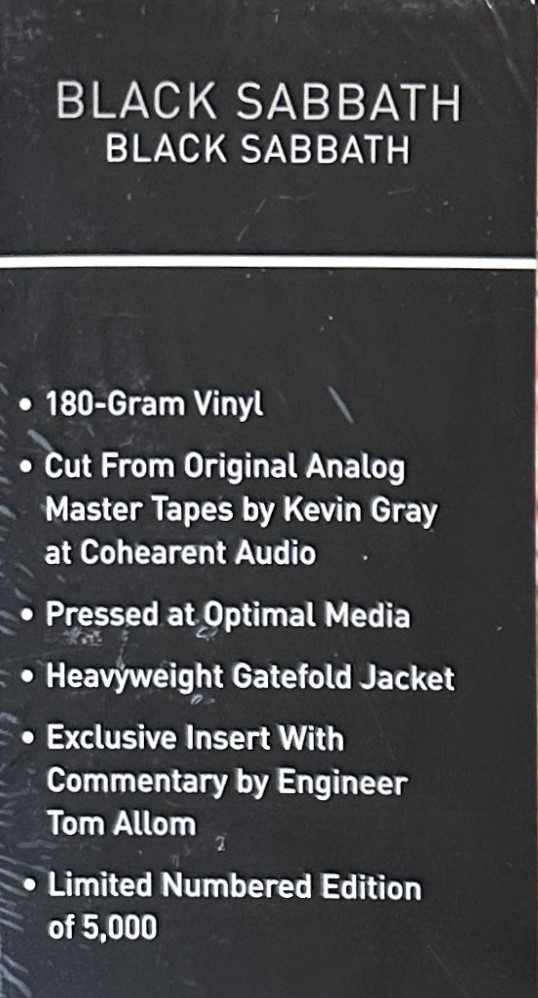
A little more than a year ago, back in June of 2023, we reviewed The Cars first album Rhino released on Heavy Vinyl. Here is our review.

We didn’t see the point in pulling our punches — when a record sounds as bad as that Cars album, somebody should stand up and say so, so we did.

We said it was possibly the worst version of the album ever made, its only competition being the Nautilus pressing from 1980, one of those bottom-of-the-barrel I-hope-we-all-learned-our-lesson Half-Speeds from back in the salad days of the remastered audiophile record craze.

(Yes, I admit I bought plenty of that crap back then, and I can’t even say for sure that I could tell how awful the remastered Nautilus pressing sounded. I believed what I was told — that the original pressings needed the ministrations of some guys with a lathe who thought they knew more than the engineers at Sterling when it came to cutting good sounding records. I must have been completely clueless to believe any of it, and now that I look back on those days, it’s obvious I was.)
But enough about me. Let’s talk about the hack who cut this godawful record. If you will allow me to quote myself from my Cars review:

Kevin Gray has struck again. He’s a modern one-man demolition crew, taking exceptionally well recorded analog albums and turning them into the vinyl equivalent of CDs, and bad CDs at that.

What we heard on side one of the new Black Sabbath remaster can be seen from our notes as reproduced below.

  • Nasal, upper midrange boost
  • No real space
  • Hard and smeary
  • Sizzly rain intro
  • Vocals are very present in a harsh and unpleasant way

(more…)

Speakers Corner Peer Gynt Reviewed, with Handy VTA Advice

Hot Stamper Pressings of the music of Edvard Grieg Available Now

Sonic Grade: C+

The Fjeldstad has long been one of our favorite performances of Peer Gynt here at Better Records. 

This record is handy for VTA set-up as well, a subject discussed below in our listing from 2010.

The sound is excellent for a modern reissue*, but in the loudest sections the orchestra can get to be a bit much, taking on a somewhat harsh quality. (The quieter passages are superb: sweet and spacious.)

So I adjusted the VTA a bit to see what would happen, and was surprised to find that even the slightest change in VTA caused the strings to lose practically all their rosiny texture and become unbearably smeared.

This is precisely why it’s a good heavy vinyl pressing for setting up your turntable.

If you can get the strings to play with reasonably good texture on this record you probably have your VTA set correctly.

VTA

Correct VTA adjustment for classical records (as well as all other kinds of records) is critical to their proper reproduction. If you do not have an arm that allows you to easily adjust its VTA, then you will just have to do it the hard way (which normally means loosening a set screw and moving the arm up and down until you get lucky with the right height).

Yes, it may be time consuming, it may in fact be a major pain in the ass, but there is no question in my mind that you will hear a dramatic improvement in the sound or your records once you have taken the time to correctly set the VTA, by ear, for each and every record you play.

We heard the improvement on this very record, and do on all the classical LPs (and all other kinds of records) we play.

The Big Caveat

As for the asterisk (*) above, it concerns the caveat “…for a modern reissue…” What exactly do we mean by that? Allow us to reprint what we wrote about another Heavy Vinyl classical pressing, one that we actually used to like.

(more…)

So at 45 RPM – One Side Bad, Another Awful, What’s a Mother to Do?

Hot Stamper Pressings of the Music of Peter Gabriel Available Now

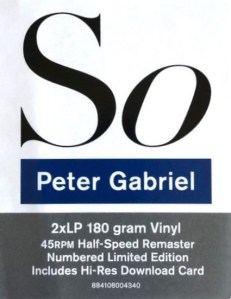
In 2016 a version of So came out using this currently popular vinyl format:

2 180g discs / 45 RPM / Deluxe, Numbered, Limited Edition /Half Speed mastered

As of this writing, there are 15 copies on Discogs, the cheapest of them starting at $139.77.

Sounds like it must be pretty good for that kind of money!

This So release was mastered by a fellow named Matt Colton, who has been doing this kind of work for a very long time, judging by the fact that he has 3,775 technical credits under his name on Discogs.

That did not stop this particular 2 LP set from being one of the worst sounding albums we have played in quite a while.

Let’s take a closer look at the specifics. We played sides one and four of the two-disc, four-sided album. That was more than enough to evaluate the sound quality.

(more…)

Why Is It So Hard for Mobile Fidelity to Get the Midrange Right?

Hot Stamper Pressings of the Music of Joni Mitchell Available Now

We recently auditioned the Mobile Fidelity One-Step pressing of Blue and made the notes regarding the sound you see below.

We focussed on the quality of their pressing’s vocal reproduction, for the simple reason that a Joni Mitchell album that gets the vocals wrong is a Joni Mitchell album that no music lover and certainly no audiophile  would ever want to play.

The fact that some audiophiles do want to play this record speaks poorly of their ability to reproduce it properly. Accurate playback will reveal the problems with Joni’s voice described in detail below. The post-it for side one is on the left, for side two on the right.

We try to be very specific about the shortcomings of these records, which is why we reproduce our notes whenever they are available.

Side One

  • Tonally not far off, a bit too stringy and flat. Not awful. Congested vocals at peaks, harsh. 1+

Side Two

  • Vocal peaks like “traveling, traveling, traveling…” or “California” get squashed and harsh, lacking the real dynamics, presence and space of the vocals. No grade. (Awful in other words.)

(more…)

Witches’ Brew on Classic Records and How Crazy Wrong I Was, Part One

Hot Stamper Living Stereo Orchestral Titles Available Now

Well below the reproduction of the front page of our old catalog you will find the review I wrote in 2007 for the Classic Records’ Heavy Vinyl pressing of Witches’ Brew.

Clearly I did not care for it in the least. In fact, I thought it was one of the worst reissues I’d ever heard, so aggressive, boosted and unnatural it defied understanding that anyone could ever play such a record and not notice how wrong it sounded.

Now when I think about the Classic Records reissue of Witches’ Brew and its awful sound, it’s obviously a modern remastering I could not possibly have liked.

However, in preparing to move to Georgia in 2022, I found myself digging through some old catalogs from the early Nineties. Something I read in one of them chilled me to the bone.

There it was in black and white: my rave review for the Classic Records pressing of Witches’ Brew.

It’s actually on the front page of the catalog, along with at least one other record that I would be mortified to sell today: the OJC pressing of Saxophone Colossus.

(As soon as I find my review in the old catalog for Saxophone Colossus, I will post it. I can hardly believe I wrote it, but I did. I wrote all my catalogs back then. My lack of competence and the guilt associated with my lack of expertise at the time is undeniable. It obviously would be foolish and wrong of me to try to deny any of it, so I don’t.)

Below you will find a commentary from 2007 detailing the shortcomings of the Classic.

I sure had a lot of nice things to say about it in 1994.

I thought my stereo was awesome back then, but it was not nearly as awesome as I thought it was. It was better than any system I had heard in a stereo salon, audio show or friend’s house, but that has to be seen as a pretty low bar, and it may even be lower now than it was back then.

I’ve written a bit about the limitations of my 90s system here.

The Dunning-Kruger effect is real, and I clearly suffered from it.

In 1994 I had been a fairly dedicated audiophile for more than twenty years, and a strongly opiniated audiophile record dealer, one who took pride in curating his vinyl offerings right from the start of the business in 1987.

I thought I knew what I was talking about. Looking back it’s clear I had a lot to learn.

(more…)