good-tubes

Miles Davis In Person and the Sound of Tubes in 1961

Hot Stamper Pressings of the Music of Miles Davis Available Now
UPDATE 2025

We have two new lists for those who would like to know which Columbia label pressings win shootouts — one for 6-Eye winners and one for 360 Label winners.

The pressing we review below was one of the 6-Eye winners. Most of what we have to say about it revolves around the idea that in 1961 the tube mastering was key to the sound of the best copies.


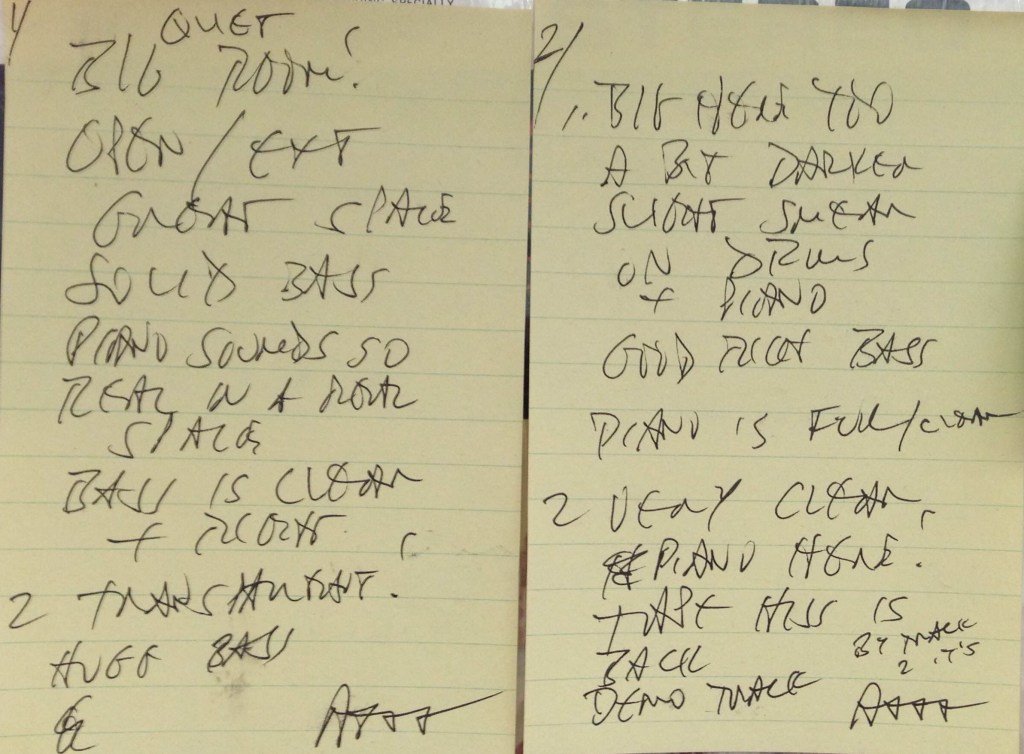
Below you will find some of the notes I made while playing a killer copy we auditioned a while back.

Normally our notes for the sound of the records we are shooting out against each other fall into two categories: what the record is doing right and what the record is doing wrong.

You’ll see that in the case of this pressing there was nothing wrong with the sound to write about.

I could have found fault somewhere, but when a specific pressing is so clearly superior to its competition, what’s the point?

  • The right sound — big, rich, tubey and real.
  • Transparent.
  • Rich, smooth, balanced.
  • Horn gets huge and loud the right way.
  • Piano is full.
  • Solid bass.
  • No need to pick nits.

The bottom line: both sides are killing it.

Reissues

There are some very good sounding reissues from the 70s that will eventually make it to the site. Again and again my notes made it clear that on those reissue pressings, the sound could have used some tubes in the chain.

On this record, more than any other, the tubes potentially make all the difference.

Now keep in mind that we are only talking about 1961 tubes, not the stuff that engineers are using today to make “tube-mastered” records. Those modern records barely hint at the Tubey Magical sound of a record like this, if our experience with hundreds of them is any guide.

(more…)

Breathy, Sweet and Lush – What’s Not to Like?

Hot Stamper Pressings of the Music of Tchaikovsky Available Now

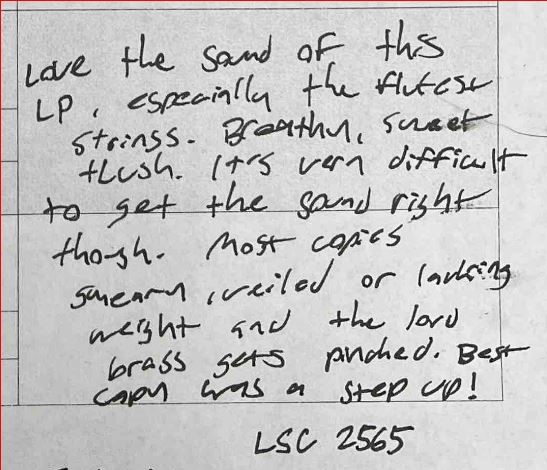
Our notes for LSC 2565 read:

Love the sound of this LP, especially the flutes and strings. Breathy, sweet and lush.

It’s very difficult to get the sound right, though. Most copies are smeary, veiled or lacking weight and the loud brass gets pinched. Best copy was a big step up!

We described the Top Copy from our 2023 shootout this way:

Wonderful Living Stereo sound throughout this original Shaded Dog pressing.

Our White Hot Shootout Winner was simply amazing sounding — some of the best orchestral sound we have heard lately, especially audible in exceptionally breathy flutes and sweet strings.

It was a quite a step up in sound quality over even the closest contender, which just goes to show how hard it is to come across these very special pressings no matter how many Shaded Dogs you play.

Our favorite performance of the Tchaikovsky — when you hear it played by the BSO, guided by the baton of the supremely talented Charles Munch, you know you are hearing the work performed with the greatest skill and interpreted as authentically as is humanly possible.

Spacious, rich and smooth – only vintage analog seems capable of reproducing all three of these qualities without sacrificing resolution, staging, imaging or presence.

Another amazing recording from the 60s, brought to you by your vinyl-loving friends at Better Records.

  • The three-dimensional space and Tubey Magic are jaw-dropping on this copy.
  • An amazing Living Stereo all analog recording from 1962 – nothing else sounds like it.
  • When you’ve played as many Living Stereo titles as we have (250+ and counting), you’re bound to run into this kind of Demo Disc sound from time to time – it’s what makes record collecting fun.
  • It’s the kind of record we live for here at Better Records.

(more…)

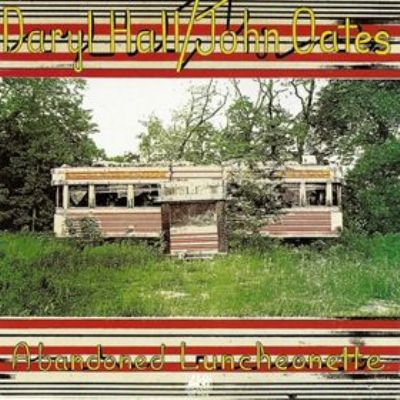
Abandoned Luncheonette – Remembering the Glorious Sound of Tubes

Hot Stamper Pressings of the Music of Hall and Oates Available Now

This record has the sound of TUBES. I’m sure it was recorded with transistors, judging by the fact that it was made after most recording studios had abandoned that “antiquated” technology, but there may be a reason why they were able to achieve such success with the new transistor equipment when, in the decades to come, they would produce nothing but one failure after another.

In other words, I have a theory.

They remember what things sounded like when they had tubes. Modern engineers appear to have forgotten that sound. They seem to have no reference for Tubey Magic. If they use tubes in their mastering chains, they sure don’t sound the way vintage tube-mastered records tend to sound.

Transistor Audio Equipment with Plenty of Tubey Magic

A similar syndrome was then operating with the home audio equipment manufacturers as well. Early transistor gear by the likes of Marantz, McIntosh and Sherwood, just to name three I happen to be familiar with, still retained much of the smooth, rich, natural, sweet, grain-free sound of the better tube equipment of the day.

I once owned a wonderful Sherwood receiver that you would swear had tubes in it. In fact it was simply an unusually well-designed transistor unit. Anyone listening to it would never know that it was solid state. It has none of the “sound” we associate with solid state, thank goodness.

Very low power, 15 watts a channel. No wonder it sounded so good.

Stick with the 4 Digit Originals (SD 7269)

If you’re looking for a big production pop record that jumps out of your speakers, is full of TUBEY MAGIC, and has consistently good music, look no further. Until I picked up one of these nice originals, I had no idea how good this record could sound. For an early ’70s multi-track pop recording, this is about as good as it gets (AGAIG as we like to say). It’s rich, sweet, open, natural, smooth most of the time — in short, it’s got all the stuff we audiophiles LOVE.   

(more…)

1962 Tubes and The Sound That’s Been Lost for Fifty Years

Hot Stamper Pressings of Pop and Jazz Vocal Albums Available Now

UPDATE 2025

This review was written many years ago, circa 2010 I would guess, right about the time we first started doing shootouts for the album. (Here is what we have to say about I Left My Heart in San Francisco these days, suspiciously similar to what we had to say in 2010. As the song says, ‘”The fundamental things apply…”)


Everything that’s good about All Tube vocal recordings from the 50s and 60s is precisely what’s good about the sound of this record.

The huge studio the music was recorded in is captured faithfully on this pressing. The height, width and depth of the staging are extraordinary, a true Demo Disc in that regard.

We are not big soundstage guys here at Better Records, but we can’t deny the appeal of the space to be found on a record that sounds as good as this one does.

Transparency and Tubey Magic are key to the sound of the orchestra and you will find both in abundance on these two sides.

(Other records that are good for testing those two qualities can be found here and here.)

Albums such as this live and die by the quality of their vocal reproduction. On this record Mr. Tony Bennett himself will appear to be standing right in your listening room, along with the 38 other musicians from the session. (Actually, come to think of it, they’re probably sitting.)

On the best pressings, the space of your stereo room will seem to expand in all directions to accommodate them — an illusion of course, but nevertheless a remarkably convincing one.

(more…)

Compression Works Its Magic on The Christmas Eve Suite

Hot Stamper Pressings of the Music of Rimsky-Korsakov Available Now

Some notes about the compression effects we heard on side two of a Blueback pressing of The Christmas Eve Suite album back in 2012. We wrote:

Side two is even more transparent and high-rez than side one. The texture on the strings and the breathy quality of the woodwinds make this a very special pressing indeed.

The horns are somewhat smeary and do get a bit congested when loud.

There is more compression on this side two than there was on the best copy we played, and that means low level detail is superb, but louder parts, such as when the more powerful brass instruments come in, can present problems.

Note how good The Flight of the Bumble Bee sounds here.

Compression is helping bring out all the ambience and detail in the recording, and there’s no downside because the orchestra is playing softly, unlike the piece that precedes it.

A classic case of compression having sonic tradeoffs.

(more…)

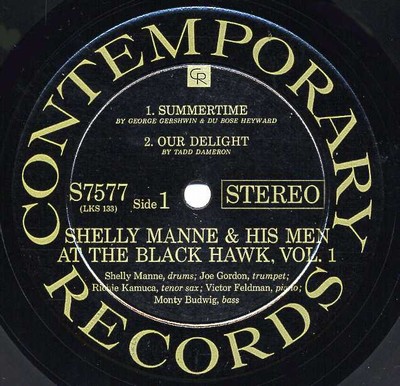
You Simply Cannot Record a Piano Better than Roy DuNann

The piano sounds uncannily lifelike right from the start, a beautiful instrument in a natural space, tonally correct from top to bottom. I can’t think of any record off the top of my head that gets a better piano sound than this one.

Listen to the tambourine on the third track on side one. Shelly Manne messes about with lots of percussion instruments on this album and all of them are recorded to perfection.

Not to leave Red Mitchell out, check out the bass; it’s deep and note-like throughout the album.

Better Than a Dream, the second track on side two, has one of the best sounding jazz pianos I have ever heard. My notes say “you cannot record a piano any better” and I stand behind that statement one hundred percent.

There is not a modern reissue on the face of the earth that can hold a candle to the sound of this record.

For any of you out there who doubt my words please take this record home and play it against the best piano jazz recordings you own. If it doesn’t beat them all we are happy to pay the domestic shipping back.

Even our amazing sounding 45 RPM pressing of The Three does not present the listener with a piano that sounds as real as the one on this record.


(more…)

Observations on RCA’s Chamber Recordings

beethseren_LSC2550

Hot Stamper Pressings of Living Stereo Titles Available Now

What do the best copies of this album sound like?

The sound is RICH and TRANSPARENT, and unlike a lot of RCA’s chamber recordings, not dry.

The tonality is also Right On The Money.

The performers are present and the transients of their instruments are not in the least bit smeared.

A case of good tube mastering?

On the best pressings, absolutely.

(More on the subject of tubes in audio here.)

Classical Shootouts

RCA is justly famous for its chamber recordings, which tend to be somewhat rare for some reason. Let’s be honest: we did not conduct this shootout with a dozen copies of the album. (It would take us at least twenty-five years to find that many clean pressings.)

What we had were quite a few other Heifetz RCA chamber recordings, as well as some favorites by the Quartetto Italiano and I Musici that we are very fond of and know well.

After thirty two years in business selling vintage vinyl, by now we’ve played scores if not hundreds of good violin recordings. We have no problem recognizing good violin sound (as well as correct violin tone, not exactly the same thing) when we hear it. In the past our top Hot Stamper classical pressings would go directly to our best customers, customers who want classical recordings that actually sound good. not just the kind of Golden Age Recordings that are supposed to. Now that we are able to do classical shootouts on a regular basis, we hope to have enough superb sounding classical recordings for all of our audiophile customers.

I’ve commented often over the years of the benefits to be gained from listening to classical music regularly. Once a week is a good rule of thumb I would say. I love rock and roll, jazz and all the rest of it, but there is something about classical music that restores a certain balance in your musical life that can’t be accomplished by other means. It grounds your listening experience to something perhaps less immediately gratifying but deeper and more enriching over time. Once habituated, the effect on one’s mood is not hard to recognize.

Orchestral Music Is Hard to Record, Master and Press, Apparently

(more…)

The Trout Quintet – Original Versus Reissue

More of the music of Franz Schubert

This unusual 2-pack combines two very different pressings from very different eras to create a complete performance of The “Trout” Quintet with SUPERB Super Hot Stamper (or better) on both sides. One pressing, the one shown, is from the early ’60s; the other is from 1982. How could an imported budget late reissue beat a superb Golden Age pressing on any side you ask? Well, the answer to that question is provided by the records we will send you. 

Side one of this London Whiteback pressing is dark and opaque, with a serious lack of both top end and clarity. Side two however is GORGEOUS: so big, rich, clear and lively, it earned a sonic grade of A++ to A+++! In our shootouts the person reviewing the records (in this case me) never knows which pressing is being critiqued. Imagine my surprise when the late London handily beat the early one.

Actually it’s easy to imagine my surprise, because there was simply no surprise to imagine. In our shootouts here at Better Records, later pressings beat early pressings regularly. We let the records speak for themselves, and that’s what they told us, at least on side one of The “Trout.” The reason the late pressing even made it into our shootout was that in a preliminary round it showed us that it had very good sound on side one. Side two didn’t hold up, but any record with good sound on any side is going to go in the shootout, regardless of the “incorrectness” of its label or country of origin.

On the earlier pressing (CS 6090) the sound is rich and sweet; some might say it’s too rich, but for this music it works. The piano and the strings have that Golden Age Tubey Magical sound we love. It’s been years since I’ve had the opportunity to play this record; most copies are just too beat up to bother with, so I was glad to find this one in such minty condition. (more…)

The Glorious Sound of Tubes (60s Tubes, That Is)

On this record, more than most, the tubes potentially make all the difference. 

Keep in mind that we are referring specifically to 1963 tubes, not the stuff that engineers are using today to make “tube-mastered” records.

Today’s modern records barely hint at the Tubey Magical sound of a record like this, if our experience with hundreds of them is any guide. We, unlike so many of the audiophile reviewers of today, have a very hard time taking any of the new pressings seriously. We think our position is pretty clear, and we have yet to hear more than a stray record or two that would make us want to change our minds.

If you’ve ever heard a pressing that sounds as good as this one, you know there hasn’t been a record manufactured in the last forty years that has this kind of sound. Right, wrong or otherwise, this sound is simply not part of the modern world we live in. If you want to be transported back to Philharmonic Hall in New York circa 1963, you will need a record like this to do it.

(more…)

Listening in Depth to What We Did On Our Holidays

More of the Music of Richard Thompson

This RARE Island Sunray British Import LP has Hot Stamper sound, full of the Tubey Magic you expect from a British Folk album in 1969 (and the unavoidable sonic shortcomings you should expect if you know much about this band and their records).

It’s without a doubt the nicest copy we have ever seen, the acquisition of which was purely a matter of luck, as early pressings are virtually impossible to find in anything but beat-to-death condition. 

The “haunting, ethereal” vocals of the lovely Sandy Denny (or Alexandra Elene McLean Denny as she’s listed on the sleeve) are sublime on this British early copy.

Some of you may recognize her voice from a ditty called ‘Battle of Evermore,’ found on a grayish ’70s rock album that no one even bothered to name. Wonder what ever became of that group? No doubt by now their story is lost to the sands of time. I have to say I thought the music was pretty good though.

The sound varies greatly from track to track. We played the first three songs on each side and guessed that the rest would fall in line with the average of the three we heard.

Side One

The third track gets the balance of tubes and clarity about right.

The second track has a Fleetwood Mac bluesy sound with grungy guitars and surprisingly sweet and breathy vocals.

The first track has too many tubes and sounds “dubby.”

Side Two

Again, the first track is rich but a bit too tubey.

Track two gets it right — still Tubey Magical but clear and clean, some of the best sound we heard.

Track three is the same way, rich and sweet and maybe a bit fat but that’s the way these British Folk Albums are supposed to sound, if our experience with dozens of them can serve as a guide.

(more…)