tubes-in-audio

Thoughts on tubes in audio.

You Simply Cannot Record a Piano Better than Roy DuNann

The piano sounds uncannily lifelike right from the start, a beautiful instrument in a natural space, tonally correct from top to bottom. I can’t think of any record off the top of my head that gets a better piano sound than this one.

Listen to the tambourine on the third track on side one. Shelly Manne messes about with lots of percussion instruments on this album and all of them are recorded to perfection.

Not to leave Red Mitchell out, check out the bass; it’s deep and note-like throughout the album.

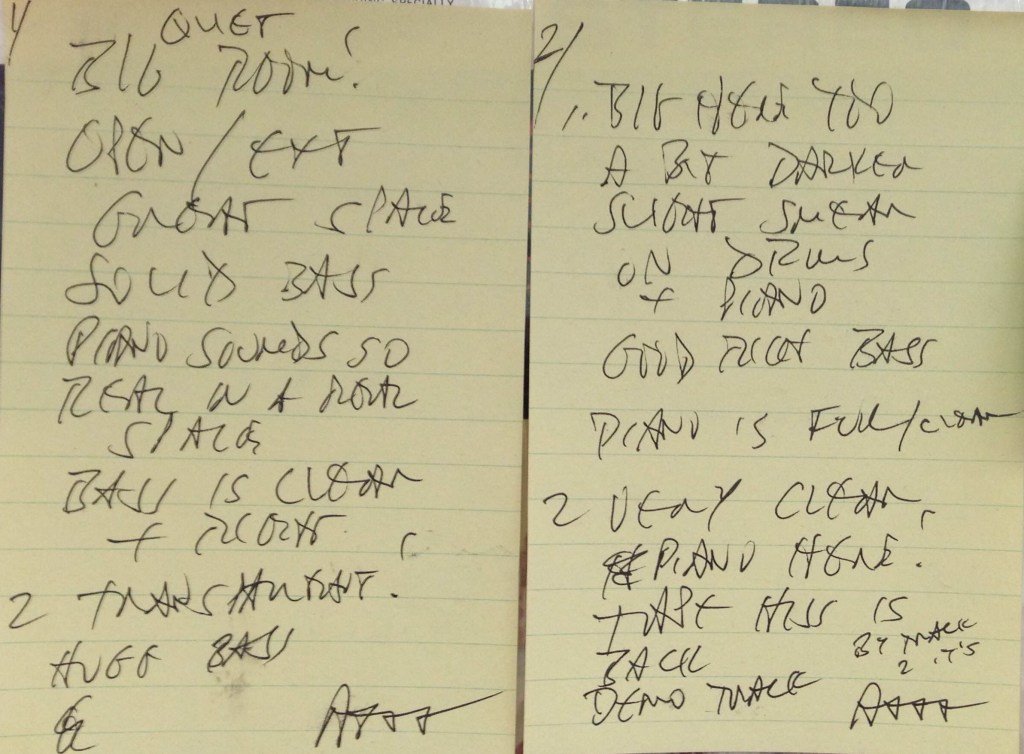
Better Than a Dream, the second track on side two, has one of the best sounding jazz pianos I have ever heard. My notes say “you cannot record a piano any better” and I stand behind that statement one hundred percent.

There is not a modern reissue on the face of the earth that can hold a candle to the sound of this record.

For any of you out there who doubt my words please take this record home and play it against the best piano jazz recordings you own. If it doesn’t beat them all we are happy to pay the domestic shipping back.

Even our amazing sounding 45 RPM pressing of The Three does not present the listener with a piano that sounds as real as the one on this record.


(more…)

Jimmy Page’s Houses of the Holy Needed Tubes and Didn’t Get Them

Hot Stamper Pressings of the Music of Led Zeppelin Available Now

We did not care for the newly remastered version of Houses of the Holy. It badly lacks the kind of mastering that Robert Ludwig brought to the sound, and by that we mean lots of lovely tubes in the mastering chain.

What tube equipment he used and how he used it is something we have been researching for years now, but rather than go down that rabbit hole for the moment, let’s just say the Tubey Magic that is all over the original cuttings of the album is hard to find on the new one, and that means it’s missing a quality that makes Houses of the Holy one of the most luscious audiophile listening experiences one can have, even for those of us who long ago gave up on tube equipment.

The notes for side one, track one (The Song Remains the Same) and track three (Over the Hills and Far Away), read:

  • Blary, but not as awful as I expected
  • Dry, top end is bright, big though

The notes for side two, tracks one (Dancing Days) and three (No Quarter), read:

  • A bit thick, tonally OK
  • Less space around the low end

Tubes are what the doctor ordered, precisely the medicine that was needed to cure many of this pressing’s problems, but tubes are not what Jimmy Page and his engineer, John Davis, brought to the project, and more’s the pity. Any good domestic original will show you exactly what is wrong with the sound of this version in under two minutes.

(more…)

Side One of Ritual Fire Dance Had Tubey Colorations Missing from Side Two

Hot Stamper Pressings of Vintage Columbia Albums Available Now

An undiscovered gem from 1967 on the 360 Columbia label.

Side two of this record blew our minds with its White Hot Stamper sound.

Musically and sonically this record is nothing short of wonderful.

Who knew? You could play fifty vintage piano recordings and not find one as good as this.

Tchaikovsky, Liszt, Beethoven, Debussy, Mozart — these shorter pieces and excerpts were composed by those with the greatest gift for melody, men who’ve produced works that have stood the test of time, enchanting audiences over the centuries with works of such beauty and charm.

Here at Better Records we have never been fans of Columbia classical LPs. Years ago we noted that:

Columbia classical recordings have a tendency to be shrill, upper-midrangy, glary and hard sounding. The upper mids are often nasally and pinched; the strings and brass will screech and blare at you in the worst way. If Columbia’s goal was to drive the audiophile classical music lover screaming from the room (or, more realistically, induce a strong desire to call it a day record-playing wise), most of the time one would have to grant they’ve succeeded brilliantly. Occasionally they fail. When they do we call those pressings Hot Stampers.

To be clear, the fault more often than not has to be in the mastering, not the recording. We’ve raved about so many great copies of titles in the past, only to find that the next three or four LPs we pick up of the very same titles sound just godawful. There are some amazing Bernstein recordings out there, but the the amount of work it takes to find the one that sounds good is overwhelming — how can such great recordings be regularly mastered so poorly?

Side One

A++, with a huge, rich, sweet, natural sounding piano. The more you listen, the more apparent it becomes that, as natural as it may seem at first blush, there are still some old school tubey colorations that make the sound not quite as lifelike and real as one might wish.

And the confirmation of that finding comes as soon as you flip the record over.

(more…)

Our Playback System – And Why You Shouldn’t Care

Advice to Help You Make More Audio Progress

Below you will find a list of most of the equipment we have been using over the last twenty years or so to carry out our Hot Stamper pressing evaluations, or “shootouts” as we like to call them.

Naturally the reality of the 80/20 Rule comes into play here — 80% (probably more like 90 or 95%, truth be told) of the sound is what you do with your audio system, 20% (or 10 or 5%) of the sound is the result of the components you own.

We like to say it’s not about the audio you have, it’s about the audio you do: how you set up your system, what you’ve done to treat your room, how good your electricity is and all the rest of it.

  • Our VPI Aries (original, not the latest model) with 
  • Super Platter (no longer made) and
  • TTWeights Carbon Fiber Platter (a big upgrade, no longer made).
  • VPI Synchronous Drive System (as of 2016 now sitting on a Townshend Seismic Sink).
  • Triplanar tonearm.
  • Dynavector 17dx.
  • Aurios (no longer made), which sit on a
  • Townshend Seismic Sink (another big upgrade).
  • EAR 324P and the hundreds of hours we’ve spent setting up and tweaking this beast is at the heart of everything we do around here.
  • We love our modified Legacy Focus speakers.
  • Even more now that they have much improved high frequency extension courtesy of Townshend Super Tweeters.
  • Mix in extensive room treatments, aided inestimably by three pairs of Hallographs (as we like to say, there is practically no Hi-Fi without them), more than thirty years of experience and endless hours of experimentation and you have a system that can separate the winners from the losers like nobody’s business.
  • Exactly like nobody’s business, because nobody does it in this business but us. Having heard hundreds of systems over the years, it’s an open question as to whether anyone else could do what we do even if they tried.

(more…)

Back In Black – None Rocks Harder

More of the Music of AC/DC

This review was written shortly after we discovered what an amazing recording Back in Black was after finally getting around to doing our first big shootout for the album, right around 2008 or thereabouts.

Robert Ludwig must have had a phenomenally good transistor cutting system in 1980, aided in no small part by superbly musical tube compressors, perhaps the same ones he used on Led Zeppelin II, and we’re very glad that he did.

All that massive tube compression on the low end is at least partly responsible for Back in Black being one of the best sounding rock records ever made, especially if you have the kind of big speaker system that plays at loud levels like we do.

(more…)

Arrogant and Elitist Skeptics – They’re the Worst!

Our Thoughts on Tubes in Audio

Below you will find a link to a reasonably fair and balanced look at the battle between transistors and tubes from Brian Dunning’s skeptoid website, worthwhile reading for those of us who favor a skeptical approach to life (and especially this hobby).

Thirty plus years ago, when I started my little record business, I knew that most records marketed to audiophiles offered junk sound (half-speed masters, Japanese pressings) or junk music (direct to discs by artists nobody ever heard of).

As our playback has improved, fewer and fewer of these “specialty” pressings have survived the test of time, a subject we write about endlessly on our site and here on this blog.

For the longest time our motto has been “Records for Audiophiles, Not Audiophile Records,” and we see no reason to change it.  If anything, the modern manufacturers of Heavy Vinyl pressings are making records that get worse sounding by the day. Many of the most egregious offenders can be found here.

More commentaries about Heavy Vinyl can be found here. We are not fans of the stuff, not because it’s our competition, but because it just doesn’t sound very good.

Here is the article.

I confess I sped through it quickly, barely skimming it, because I have heard plenty on the subject of  tubes versus transistors, most of it, in my opinion, misguided if I’m being honest.

This is my fifth decade in audio and I know where I stand on the subject. I offer it to those who might be interested in a less conventional view.

(more…)

Rose Darling’s Piano Favors Fast Electronics and Tight Bass

Hot Stamper Pressings of the Music of Steely Dan Available Now

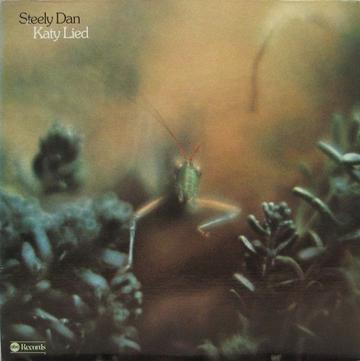
As a huge Steely Dan fan starting with the second album, Countdown to Ecstasy, I rushed down to the local Tower Records to buy Katy Lied as soon I heard it had come out.

Of course I fell in love it with immediately. It has long been a personal favorite, the ultimate expression of the art of Steely Dan on record. I’ve played it many hundreds of times over the last 40+ 50+ years and still listen to it regularly. I cannot imagine ever tiring of it.

Testing with Rose Darling

The piano is tough to get right on this track. If the piano doesn’t sound the way it should, this track will be a mess.

It’s big and bold in the mix and should sound really solid and weighty. Thin or washed out and you are in trouble.

This track punishes equipment that is slow, or has blubbery bass response. Vintage tube equipment is not what the doctor ordered.

If your woofers are too small, or you do not have enough low end definition and weight to reproduce such a large and powerful piano, the part the piano plays in the arrangement will suffer and so will the song. (More on the kind of speakers you need to play this album and hundreds of others here.)

Just wrote this today, please to enjoy:

Throw Back the Little Ones

I’ve been listening to Waka/Jawaka quite a bit lately. On this song, Steely Dan incorporates an homage to Zappa’s unique woodwind and horn arrangements starting at about 1:48. Go to youtube and check it out when you have a minute.

Jimmie Haskell gets the credit for the arrangement but I’m pretty sure I know who inspired him.


Further Reading

Where Can I Find Your Hot Stamper Beatles Pressings in Mono?

Hot Stamper Pressings of Rubber Soul Available Now

One of our good customers had a question about our Hot Stampers recently:

I notice you don’t mention whether the Beatles recordings are stereo or mono. The Rubber Soul that just arrived is stereo. I’m guessing that the one I reordered is also stereo.

Do you guys stock the mono versions? Do you say on the site when something is mono. Let me know, as I like mono versions too.

I was close with Geoff Emerick and he always stressed to me that they spent tons of time on the mono mixes and not much on the stereos (up through Revolver). So let me know if/when you have mono for Rubber Soul and Revolver and perhaps I can snatch them up.

Brian

Brian,

All our records are stereo unless we specifically mention otherwise, as are our Beatles records.

We never sell Beatles records in mono, ever.

Here is a little something I wrote about it: Revolver in disgraceful mono

They spent time on the mono mixes because getting the levels right for all the elements in a recording is ten times harder than deciding whether an instrument or voice should be placed in the left, middle or right of the soundstage.

And they didn’t even do the stereo mixes right some of the time, IMHO.

But in my book, wall to wall beats all stacked up in the middle any day of the week.

(more…)

Listening in Depth to Little Queen

Hot Stamper Pressings of the Music of Heart Available Now

This is a recording that I credit with taking me to the next level of sound. When I first heard a killer Hot Stamper pressing played back through the EAR 324P phono stage at a friend’s house, I immediately called the distributor and ordered one. That was a Saturday. It arrived on the following Tuesday.

Compared to the 834P tube unit I had been using, the solid state 324P simply took the recording to a level I had no idea could possibly exist. Yet there it was.

That was 2007. Looking back now, it’s clear to me that 2007 was by far the most momentous year in the history of Better Records.

Once I had reached that higher level of playback, I set about using the album for tweaking and testing, and learned a lot doing it. Along with a substantial number of other records I have come across in my forty plus years as a hobbyist and audiophile record dealer, Little Queen is one that has done a great deal to help me become a more critical listener. [1]

Side One

Barracuda

One of the little tricks I used toward the end of my marathon Little Queen tweaking session from many years ago (which lasted more than six hours one Saturday evening, leaving me euphoric but exhausted) was to listen to the ending of Barracuda. Some of the big guitar chords at the end of the song are louder than others, and the more the differences in level among them can be heard, the better the stereo and the room must be at exposing these micro-dynamic changes.

You can’t make the guitarist play some of the notes at the end louder than others, you can only reveal the fact that he indeed must have. This is what we mean by Hi-Fidelity.

(more…)

Seventies EMI Classical LPs and Vintage Tube Playback

More of the Music of Sergei Prokofiev

What to listen for on this album?

That’s easy: The all-too-common 70s EMI harshness and shrillness.

We could never understand why audiophiles revered EMI the way they did back in the 70s. Harry Pearson loved many of their recordings, but I sure didn’t. 

The longer I stay in his hobby, the more clear it is to me that many of the records on the TAS list are better suited to the old school audio systems of the 60s and 70s rather than the modern systems we have today.

These kinds of records used to sound good on those older systems, and I should know, I had an old school stereo even into the 90s. Some of the records that sounded good to me back in the day don’t sound too good to me anymore.

For a more complete list of those kinds of records, not just the ones on the TAS List, click here. Note that some I liked, and some I did not back in the day.

I chalk it up — as I do most of the mistaken judgments audiophiles make about the sound of the records they play, my own judgments included — to five basic problem areas that create havoc when attempting to reproduce recorded music in the home:

  1. Equipment shortcomings,
  2. Untweaked setups,
  3. Bad electricity,
  4. Badly treated or untreated rooms, and
  5. Improper record cleaning

(more…)