9-2022

The Tapestry Shootout Video Is Here!

Geoff Edgers’ Washington Post article “The Search for the Perfect Sound,” in which he talks to lots of audiophiles and music lovers about his personal journey into the world of audiophile equipment and records, is now active on their website.

NEWSFLASH! This is currently the most popular story/video on the WAPO website! Number One with a bullet, baby. [Alas, no longer.]

Don’t miss the video below of yours truly doing a shootout for Tapestry.

It’s actually not a real shootout. For Tapestry we would typically play 8-10 early pressings and grade them for sound. This was more of a test, to see if I could spot the Hot Stamper among the pretenders, more What’s My Line than a shootout.

Part of the attraction of course is that I’m the guy they love to hate. Just check out the comments.

And please add some of your own. You are the only people on the planet qualified to talk about Hot Stampers because you are the only ones who have heard them on your own stereos with your own two ears.

Why should anyone care what somebody else has to say about something that that person has never experienced? The reason we stopped posting on the Hoffman website back in 2002 was simply the fact that I was tired of arguing with people that have strong opinions about the results of experiments they have never run.

Hot Stamper Shootouts are simply our way of doing blinded experiments on various pressings of records. We eschew theories and conjecture. We prefer observations and data. We write about these issues a lot here on the blog for those who would like to learn more about records. If you already know it all, this is probably not a blog you will find of much value.

I will be posting some comments soon, mostly about all the stuff that got left on the cutting room floor. We spent most of the time with some orange label Vertigo pressings of Dire Straits’ first album, finding a White Hot Stamper LP out of the batch we played, then comparing our records to the execrable Mobile Fidelity 45 RPM 2 disc pressings, pressings so bad they defy understanding. But that is another story for another day! (The MoFi was mastered by Krieg Wunderlich, so if you see his name in the credits of a record you may be interested in, don’t waste your money. He is hopelessly incompetent and can be counted on to produce some of the worst sounding audiophile records ever made.)

I had eye surgery on my right earlier on the day of the interview, so hopefully that accounts for some of my squinty appearance.

I have also been invited to participate in a Reddit Q&A sometime next week, discussing the issues raised in the article or video anyone would like to ask about, so stay tuned for that, and I hope you will participate as well.

Our customers have plenty of their own Hot Stamper stories to tell, and I hope to hear from some of you on that Reddit panel.

You are the only audiophiles with real, first-hand knowledge of what a Hot Stamper sounds like. Perhaps you will wish to share with other audiophiles what they don’t know they are missing.

And if you have any questions of any other kind, I hope you will give me a chance to answer them.

Just email tom@better-records.com
(more…)

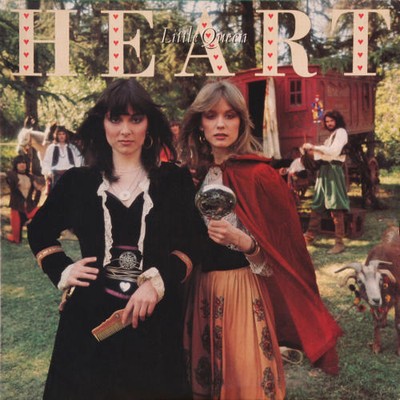
Listening in Depth to Little Queen

Hot Stamper Pressings of the Music of Heart Available Now

This is a recording that I credit with taking me to the next level of sound. When I first heard a killer Hot Stamper pressing played back through the EAR 324P phono stage at a friend’s house, I immediately called the distributor and ordered one. That was a Saturday. It arrived on the following Tuesday.

Compared to the 834P tube unit I had been using, the solid state 324P simply took the recording to a level I had no idea could possibly exist. Yet there it was.

That was 2007. Looking back now, it’s clear to me that 2007 was by far the most momentous year in the history of Better Records.

Once I had reached that higher level of playback, I set about using the album for tweaking and testing, and learned a lot doing it. Along with a substantial number of other records I have come across in my forty plus years as a hobbyist and audiophile record dealer, Little Queen is one that has done a great deal to help me become a more critical listener. [1]

Side One

Barracuda

One of the little tricks I used toward the end of my marathon Little Queen tweaking session from many years ago (which lasted more than six hours one Saturday evening, leaving me euphoric but exhausted) was to listen to the ending of Barracuda. Some of the big guitar chords at the end of the song are louder than others, and the more the differences in level among them can be heard, the better the stereo and the room must be at exposing these micro-dynamic changes.

You can’t make the guitarist play some of the notes at the end louder than others, you can only reveal the fact that he indeed must have. This is what we mean by Hi-Fidelity.

(more…)

John’s Really Digging a Pony. Are You?

Hot Stamper Pressings of the Music of The Beatles Available Now

The best copies of Let It Be are Demo Discs for energy, and here are some others that we’ve discovered are good for testing that quality on vinyl.

What blew our minds about the Shootout Winning side one we played recently was how outrageously big, open and transparent it was on the song Dig a Pony. As the song started up the studio space seemed to expand in every direction, creating more height, width and depth than we’d ever experienced with this song before. 

But there is no studio space; the song was recorded on Apple’s rooftop. The “space” has to be some combination of “air” from the live event and artificial reverb added live or later during mixing. Whatever it is, the copies with more resolution and transparency show you a lot more of “it” than run-of-the-mill pressings do (including the new Heavy Vinyl, which is so airless and compressed we gave it a grade of F and banished it to our Shame Hall).  (more…)

Salvation Is a Tough Test on Honky Chateau

Hot Stamper Pressings of the Music of Elton John Available Now

We award the Four Plus A++++ grade so rarely that we don’t have a graphic for it in our system to use in the grading scale. So the side two here shows up on the chart as A+++, but when you hear this copy you will know why we gave it a fourth plus.


UPDATE

We no longer give out grades of Four Pluses as a matter of policy, but that doesn’t mean we don’t come across records that deserve them from time to time.


When I hear a record with a side this phenomenally good, with the stereo tuned-up and tweaked within an inch of its life to reproduce the album at the highest level I can manage, I will sometimes sit my wife down and play her a track or two. I did it for a Four Plus Deja Vu earlier this year [2016] as a matter of fact, playing Country Girl: Whiskey Boot Hill on side two, with that crazy HUGE organ blasting out of the right speaker — what a thrill!

For this record I played her Salvation, with one huge chorus following another, like powerful waves crashing on the shore, until Elton takes a deep breath and belts out the final, biggest chorus, hitting his peak an octave higher and taking the song to an emotional level neither one of us had ever experienced with it before.

We followed it up with the lovely Mona Lisas and Mad Hatters, and that was about as much Elton John live in my listening room at practically concert hall levels we could take in one sitting.

Hearing Elton with such energy, standing right in front of us, with instruments and singers encircling him from wall to wall and floor to ceiling, was so powerful and immersive it left us both with tears in our eyes.

That’s what gets you a Fourth Plus around these parts.

(more…)

Who Can’t Hear Differences in Sound from Side to Side on Most Records?

rimskscheh_2446Hot Stamper Pressings of the Music of Rimsky-Korsakov Available Now

Both the Chesky [1] and Classic reissue pressings of LSC 2446 are just plain terrible. Embarrassingly, the latter is found on the TAS List.

There is a newly [2013, time flies!] remastered 33 RPM pressing of the album garnering rave reviews in the audiophile press. We didn’t like it either. It fails the violin test that we wrote about here.

Please note that in many of the reviews for the new pressing, the original vinyl used for comparison is a Shaded Dog pressing. In our experience almost no Shaded Dog pressings are competitive with the later White Dog pressings, and many of them are just plain awful, as we have noted previously on the site.


UPDATE 2024: Now that we know which stampers have the potential to sound the best in our shootouts, the Shaded Dog originals have lately been winning top honors, although the White Dog pressings can still sound quite good, just not as good.


rimskscheh_chesky

The “original is better” premise of most reviewers renders the work they do practically worthless, at least to those of us who take the time to play a wide variety of pressings and judge them on the merits of their sound, not the color of their labels.

[A fairly embarrassing example of live and learn.]

Missing the Obvious

The RCA White Dog with the best side two in our shootout had a very unmusical side one. Since reviewers virtually never discuss the sonic differences between the two (or more) sides of the albums they audition, how critically can they be listening? Under the circumstances how can we take anything they have to say about the sound of the record seriously?

The sound is obviously different from side to side on most of the records we play, often dramatically so (as in the case of Scheherazade), yet audiophile reviewers practically never seem to notice these obvious, common, unmistakable differences in sound, the kind that we discuss in every listing on the site. If they can’t hear the clear differences in sound from side to side, doesn’t that call into question their abilities at the most basic level?

(more…)

Have You Ever Noticed that Sometimes the Highs Come Back on Some Pressings?

More of the music of Sergei Rachmaninoff (1873-1943)

This side one is interesting., I would say that it starts out Super Hot (A++) and within a few minutes becomes White Hot (A+++). The piano is a bit veiled at the start, but within a relatively short period of time that subtle loss of transparency disappears and the piano is RIGHT THERE.

This is not unusual in our experience.

The first track on many records can sound dull, and by the second track the highs come back and the tonality is right from top to bottom. Who knows why?

We speculate that the vinyl did not have time to fully heat up the edge of the record, but that’s speculation, something that has almost no value in our (yours and mine) quest for better sounding records. 1A, 1B, first off the stamper, who gives a flying you-know-what. You have to play the record to know how it sounds.

The rest is BS, proffered by those who are simply too lazy to do the work of actually cleaning and playing multiple copies of an album to know what they are talking about.

Side Two

A++, with all the texture and transparency we heard on side one. The strings are PERFECTION — truly Demo Disc quality.

The piano however does not quite have the weight it does on side one, so we knocked a plus off, putting this one at A++.

Only the last quarter inch has the slightest amount of groove damage on the loudest piano peaks. We’ve never heard one that played cleaner all the way through, I can tell you that. [This was written about a decade ago. Now we have, many of them in fact. They are out there, but if you buy a copy, make sure you can return it for Inner Groove Distortion because most of them have a problem in that area.]

What an amazing recording! What an amazing piece of music!

Balancing Richness and Tubey Magic with Transparency, Clarity and Speed

More of the Music of Bread

Manna has the clear signature of Elektra from the late 60s and early 70s. It’s unmistakably ANALOG, but that double-edged sword cuts both ways. Richness and Tubey Magic (the kind you had in your old 70s stereo equipment) often comes at the expense of transparency, clarity, speed and transient information (the things your 70s equipment probably struggled with).

We heard a lot of copies that were opaque, smeary and dull up top, so the trick for us (and for those of you doing your own shootouts) is to find a copy with the resolving power and transparency that will cut through the thickness.

Look for breath on the vocals (reverb too!) and extended vocal and guitar harmonics; if those two qualities are strongly evident you can’t be too far off.

More presence, bigger bass (the bass is HUGE on the best copies!), more size, energy and space: these will help take you to the highest (Super Hot and White Hot) levels.

Speaking of bass, notice how prominent, big and clear the bass guitar is on many of these songs. This is not a sound we hear nearly enough of on popular recordings. During the shootout we were lovin’ it.

The Legacy Focus in our reference system has three twelve-inch woofers per channel. They do a lovely job with this kind of big-bottom-end recording, the kind of recording for which Botnick and The Doors (and Love too, let’s not forget them) are justly famous.

Where is that sound today? We miss it.

(more…)

The Nightfly on MoFi – More of the Same Old Same Old

Hot Stamper Pressings of the Music of Donald Fagen Available Now

More MoFi phony EQ on the top right around 10k and sloppy bass.

You should be able to do a whole lot better and you sure won’t have to work very hard to do it.

Robert Ludwig is the man who knows how to cut this album, not Stan Ricker.

The properly pressed, properly cleaned Robert Ludwig-mastered copies are right in a way that the typical Half-Speed mastered or Heavy Vinyl pressing rarely is. The more critically one listens, the more obvious this distinction becomes.

The real thing just can’t be beat, and you can be pretty sure that the real thing is an old record.

If you are buying these audiophile pressings, take the advice of some of our customers and stop throwing your money away on Heavy Vinyl and Half-Speed mastered LPs.

(more…)