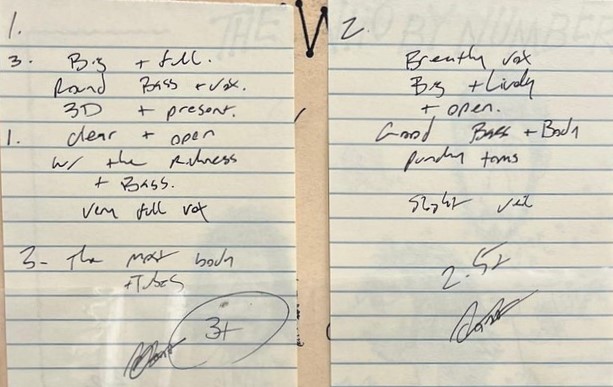
punchy-drums-test

Listening in Depth to JT

Hot Stamper Pressings of the Music of James Taylor Available Now

There are five or six James Taylor records that are Desert Island Discs for me. His albums really do set a standard that few other singer/songwriters’ albums can meet.

Start with the first album, which we can’t find for you because only the British ones sound good and they are just to hard to find in clean condition [not true, we did the shootout in 2022], Sweet Baby James and JT.

The next group to pursue would contain Mud Slide Slim, One Man Dog and Dad Loves His Work, and then maybe Flag.

As audiophiles we all know that sound and music are inseparable. After dropping the needle on a dozen or so copies, all originals by the way, you KNOW when the music is working its magic and when it’s not. As with any pop album there are always some songs that sound better than others, but when you find yourself marvelling at how well-written and well-produced a song is, you know that the sound is doing what it needs to do. It’s communicating the Musical Values of the material.

The most important of all these musical values is energy, and boy do the best copies have plenty of it.

Side One

Your Smiling Face

Our favorite test track for side one. The best copies have punchy bass and drums that are hard to beat!

(more…)

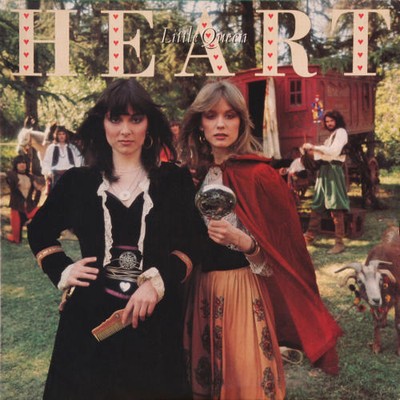
Listening in Depth to Little Queen

Hot Stamper Pressings of the Music of Heart Available Now

This is a recording that I credit with taking me to the next level of sound. When I first heard a killer Hot Stamper pressing played back through the EAR 324P phono stage at a friend’s house, I immediately called the distributor and ordered one. That was a Saturday. It arrived on the following Tuesday.

Compared to the 834P tube unit I had been using, the solid state 324P simply took the recording to a level I had no idea could possibly exist. Yet there it was.

That was 2007. Looking back now, it’s clear to me that 2007 was by far the most momentous year in the history of Better Records.

Once I had reached that higher level of playback, I set about using the album for tweaking and testing, and learned a lot doing it. Along with a substantial number of other records I have come across in my forty plus years as a hobbyist and audiophile record dealer, Little Queen is one that has done a great deal to help me become a more critical listener. [1]

Side One

Barracuda

One of the little tricks I used toward the end of my marathon Little Queen tweaking session from many years ago (which lasted more than six hours one Saturday evening, leaving me euphoric but exhausted) was to listen to the ending of Barracuda. Some of the big guitar chords at the end of the song are louder than others, and the more the differences in level among them can be heard, the better the stereo and the room must be at exposing these micro-dynamic changes.

You can’t make the guitarist play some of the notes at the end louder than others, you can only reveal the fact that he indeed must have. This is what we mean by Hi-Fidelity.

(more…)

Punch The Clock – Drums, Bass and Horns Are Key to the Best Imports

Hot Stamper Pressings of Elvis’s Albums Available Now

The bottom end is as punchy, well-defined and powerful as they come. There’s plenty of low-end on this record; regrettably most copies suffer from either a lack of bass or a lack of bass definition. I can’t tell you how much you’re missing when the bass isn’t right on this album. (Or if you have the typical bass-shy audiophile speaker, yuck.) When the bass is lacking or ill-defined, the music seems labored; the moment-to-moment rhythmic changes in the songs blur together, and the band just doesn’t swing the way it’s supposed to.

The bass, along with the horn sound, are the two key elements to getting a good copy of this record.

The horns are often compressed, making them lose their bite and smearing them together.

On some copies you can pick out the trombones and on some copies you can’t; you just hear horns because the individual instruments are smashed into a congested mess. This is Elvis’ Motown Album; the horns are what bring the music to life. They’re what make this album fun.

On this copy, you get the full-on bottom end WHOMP you paid for, with no loss in control. You can clearly follow Bruce Thomas’s bass lines throughout the songs, a real treat for any music lover. (He and Elvis don’t get along, hence the end of the Attractions as his backing band. I guess we should be thankful for the nine albums on which they were together; many of them are Desert Island Discs for me.)

Not only that, but the drums have real body and resonance, a far cry from the wimpy cardboard drums so many rock records have. Listen to the drum sound on Charm School. Man, those are some BIG FAT PUNCHY DRUMS. Very reminiscent of Bowie’s Let’s Dance. The drum sound on that album is some of the best we’ve ever heard, bar none.

Right out of the gate, Let Them All Talk is lively and full of energy. Elvis’ vocals have all the presence and clarity you could hope for. Since the drums are such a driving force for the Attractions, you have got to have room and spaciousness around them. This copy showcases the percussion with weight down low and harmonics on the cymbals.

The female background singers are clear, another tough test.

It should be noted that this is not an easy record to reproduce well. Everything needs to be working at its best to bring this recording to life, especially in the range of 200 cycles and under, an area where most audiophile systems are at their weakest. If you’ve got power to spare down there, this one will really rock.